4338.207 · July 26, 2018 AD
You Were Never Here
Words become shrapnel between mother and daughter—accusations thrown from opposite sides of a grief neither can hold. Dawn is clutching something she shouldn't be, talking about promises and protection, and when Claire reaches for it the room changes in a way that can never be changed back.
"Your body learns the choreography of crisis before your mind catches up. Stand. Walk. Turn the key. The steps are simple. It’s the music that’s unbearable."
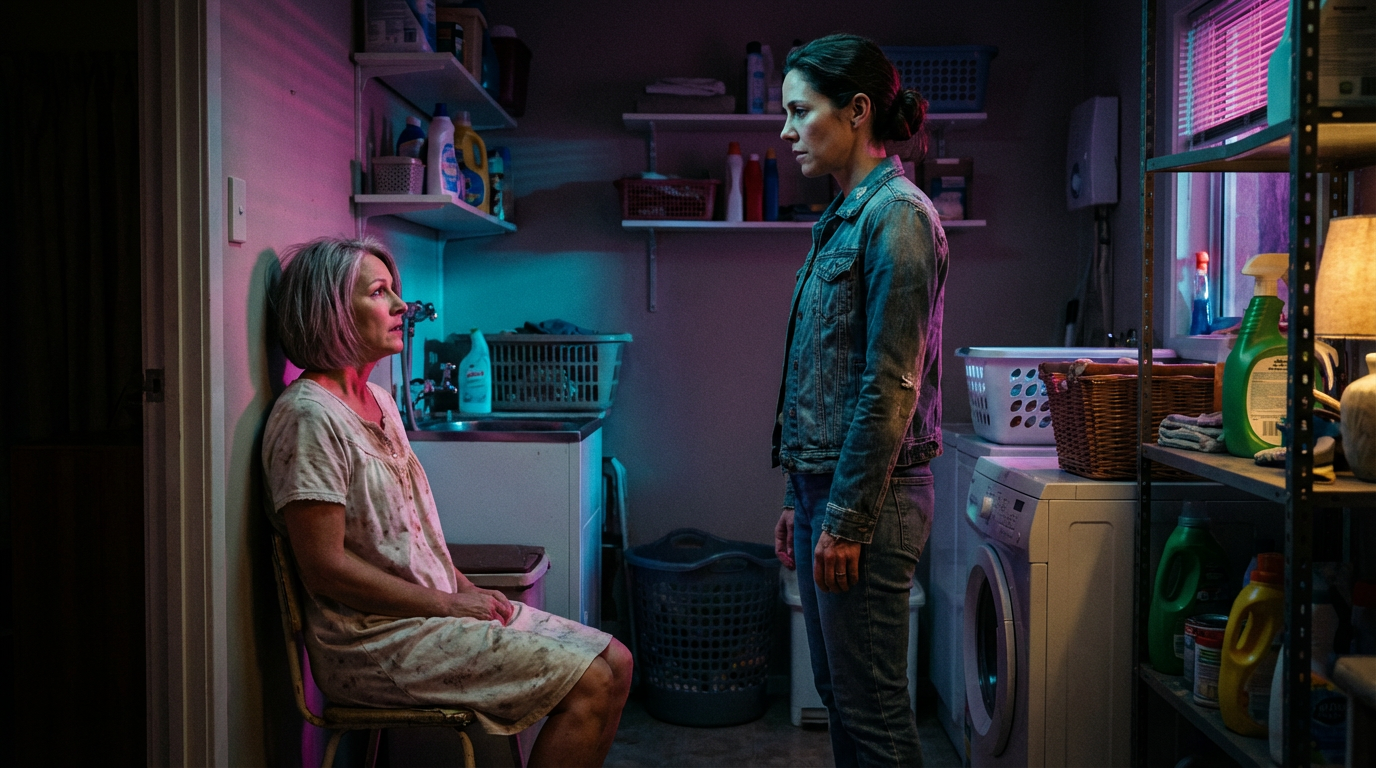
Words. Just words at first, tumbling over each other, hers and mine, colliding in the narrow space of the laundry like fists. Not sentences anymore—fragments, accusations, the verbal shrapnel of two women detonating at the same time. You were supposed to protect them. Where were YOU. You left them with me. You fell apart. You don’t get to. You don’t get to. You don’t.
I was standing now. I don’t remember standing. One moment I was on the floor beside her, my hands on her shoulders, and then I was upright and she was still down there, pressed against the wall, and I was looking down at her and she was looking up at me and between us was everything that had ever gone wrong.
"Something happened," she said, and her voice broke on the word happened like a stick snapping. "People came. To the house. This morning. With—with equipment, tests, they wanted to test your father, and then they wanted—"
"What people, Mum? What are you talking about?"
"—uniforms, official, I don’t know who they were, some kind of—government, or military, or—Greg knew, Greg said they’d been coming, he’d heard about it before, people being taken—"
She was rambling. The words spilling out in no particular order, no logic, no through-line I could follow. People coming to the house. Testing. Taking people. It sounded like paranoia, like conspiracy, like the people who stockpiled tinned food and talked about government overreach. The kind of thing sensible people ignored.
My mother was not a sensible person right now.
"I don’t care about testing," I said. "I don’t care about—"
"They wanted the children, Claire!"
"—I need you to tell me—"
"The children! They wanted to test Mack and Rose and I couldn’t—I couldn’t—"
"WHERE ARE THEY?"
She flinched again. That same recoil, pressing herself harder against the wall as though she could push through it and disappear. And then she was scrambling upright, using the washing machine for leverage, her body unfolding with a stiffness that spoke of hours spent in that position on the cold concrete. She swayed when she reached her feet. Steadied herself against the basin. Looked at me with eyes that were red and swollen and utterly, terrifyingly lucid.
"I got them out," she said.
"Out where?"
But she was already moving. Past me, through the laundry door, into the hallway. Not answering. Just moving, with the shuffling, unsteady gait of someone whose body had stopped communicating properly with her brain. I followed, grabbing at her arm, trying to turn her towards me, but she pulled free with a strength I didn’t expect and kept going.
"Mum. Stop. Stop."
She didn’t stop. She was moving towards the lounge room. Towards the open door. Towards the chair where Greg sat in his permanent stillness, the blood on the wall behind him already darkening from red to brown.
I tried to get ahead of her, to block the doorway. "Don’t go in there. Mum—you don’t need to—"
"He did it himself."
She said it from behind me, and the words were flat. Empty. Drained of everything that should accompany such a sentence—horror, grief, disbelief. She’d already spent all of that. There was nothing left.
"He did it so they wouldn’t take him. So they couldn’t use him to find the children. He told me to get them out and he—he stayed, and I heard—"
Her voice dissolved. She was in the doorway now, looking past me into the room. At her husband. At what remained of the man she’d shared a lifetime with, who’d built her a birdbath and never got the base quite level, who had cold feet and tartan slippers and a cabinet with a gun he’d never once fired at anything more dangerous than a rabbit.
I watched her face as she looked at him and saw something I still can’t name. Beyond grief. Beyond shock. Some territory of human experience that doesn’t have a word because no one who’s been there has ever found language adequate to describe it.
Then her eyes dropped to the floor. To the space beside the chair.
"Mum, please. Come away from—"
But she was already in the room. Walking towards him. Towards the chair. Towards the gun that lay on the carpet beside his slippered feet, matte and dark against the worn pile.
"Mum—"
She bent down and picked it up.
Not pointed. Not aimed. Just picked it up the way you might pick up a cup or a book, an object that belonged in your hand because your hand had been holding it earlier and the muscle memory hadn’t faded. She cradled it against her chest, the barrel pointing at nothing, and looked at me.
"Stay back."
"Mum—"
"You don’t understand. You don’t know what happened here today. You don’t know what I—what we—"
"Then tell me."
"I saved them." Her voice cracked on the word, and for a moment I saw it—the conviction underneath the chaos. Whatever had happened in this house, whatever paranoid fantasy or real threat had driven my father to put a gun to his own head, my mother believed she had saved my children. Believed it with the fervour of someone who had sacrificed everything and needed that sacrifice to mean something.
"I got them out," she said again, and the gun shifted against her chest as her arms tightened around it. "Before the men could take them away—Greg bought me time. He bought me time, Claire, do you understand? He did what he did so I could get the children out and now they’re safe, they’re safe, and you—you show up now—"
"Where are they safe? Where, Mum?"
"—you show up after everything, after I’ve been sitting here for hours with him in that room and the phone ringing and ringing and no one coming and the blood—the blood—"
"Give me the gun."
The words came out of me quiet and steady. Not a shout. Not a demand. A request, spoken in the calm, measured tone I used with my youngest students when they were frightened and needed to be guided, step by step, back to ground they could stand on.
"Just give it to me, Mum. You don’t need it. Whatever happened, it’s over now. Put it down and tell me where the children are."
Dawn’s eyes were fixed on mine. The rocking had started again—subtle, barely perceptible, her whole body swaying with that metronome rhythm. The gun moved with her. Back and forth. Back and forth.
"You think I’m mad," she said.
"I don’t think you’re—"
"You do. I can see it. The same way you looked at me when you were in the hospital and I told you to pull yourself together. You think I’ve lost my mind the way you lost yours."
"I didn’t lose my—"
"You did. You did, Claire. Everyone could see it. Everyone except you. And now you’re standing in my lounge room looking at me like I’m the one who’s broken, like I’m the one who needs to be talked down, when I’m the one who—I’m the one—"
She was crying now. Not sobbing—something worse. Tears streaming down her face without any accompanying sound, as though her body was releasing fluid it no longer had use for. The gun was still clutched against her, the metal catching the thin light that passed through the lace curtains, and her fingers were white around the stock.
"Greg is dead," she whispered. "My husband is dead. He’s sitting in that chair and he’s dead and the children are gone and you want the gun?"
"Yes."
"Why? What are you going to do with it?"
"Nothing. I want you to put it down."
"I’m not going to—I would never—"
"I know. I know you wouldn’t. So put it down."
Something shifted in her face. The tears still falling, but something behind them rearranging—a calculation, a decision, a weighing of options that I recognised because I’d been doing the same thing for days. Trying to work out who to trust when trust itself had become a currency no one could afford.
"You need to leave," she said.
"I’m not leaving without my children."
"They’re safe. That’s all you need to—"
"That is not all I need to know!"
I stepped forward. One step. That’s all. One step closer, my hand extended, palm up, the universal gesture—give it to me, hand it over, let me take this from you. A step I’d taken without thinking, in the most ordinary of contexts. Reaching for Rose’s hand in a car park. Accepting change from a shopkeeper. Taking Paul’s keys when he’d had too much booze at a dinner party and shouldn’t drive.
One step.
Dawn stepped back.
"Don’t."
"Mum, just—"
"Don’t touch me!"
She swung the gun away from her chest. Not at me—away, a reflexive movement, the instinct to protect something she was holding by putting distance between it and the perceived threat. But the barrel swept past me, close enough that I felt the air displaced, and something in my body—something beyond thought, beyond reason, some ancient mammalian imperative—lunged.
My hands found the barrel. Cold metal, shockingly cold, and I gripped it and pulled. Dawn’s hands tightened and she pulled back and for a moment we were locked together, the gun between us, four hands on one weapon, our faces close enough that I could see the individual veins mapped across the whites of her eyes, could smell the sour tang of her breath, could feel the trembling in her arms that mirrored the trembling in mine.
"Let go," I said.
"You let go."
"Give me the gun, Mum."
"You don’t know what you’re—you don’t understand—"
We were turning. Rotating around the axis of the weapon, feet shuffling on the carpet, and the coffee table was in the way and then it wasn’t and we were against the couch and then we weren’t and the gun was between us, the muzzle pointing at the ceiling, at the wall, at the window, at the floor—at nothing and everything, tracing wild arcs through the air as we wrestled.
Her grip was astonishing. This woman who struggled to open jars, who asked me to carry the groceries, who hadn’t lifted anything heavier than a teapot in years—her fingers were locked around that stock like they’d been welded there. Adrenaline. Terror. The desperate strength of someone holding on to the last solid thing in a world that had liquefied around them.
I twisted. She twisted back. My foot slipped on something—only God knows what—and I stumbled, lurching forward, my weight shifting suddenly, my hands wrenching the barrel sideways and down—
The sound was the end of the world.
Not loud in the way I’d expected. Not the cinematic crack or boom. More like a concussion—a physical force that compressed the air in the room and then released it, leaving behind a ringing silence that filled every space in my skull. The recoil travelled through the metal and into my hands and up my arms and into my chest and it was as though my own heart had fired, had detonated, had stopped and restarted in the space between one moment and the next.
Dawn’s face.
Her face was the first thing I saw when the world reassembled itself around the epicentre of that sound. Her face, inches from mine, her eyes wide, her mouth open, a look of surprise so pure and so total that it wiped away everything else—the fear, the grief, the accusation, the paranoia—and left behind only this: a woman discovering something she hadn’t expected.
She looked down.
I looked down.
The blood was already there. Already spreading, blooming outward from a point just below her ribs on the left side, darkening the blue housecoat in a widening circle that expanded with each heartbeat. The fabric absorbed it greedily, the cotton turning heavy and wet, clinging to the flesh beneath.
The gun was on the floor. Neither of us was holding it. I don’t know when I let go. Don’t know when she let go. It was simply there, on the carpet between our feet, as irrelevant now as everything else that surrounded us.
"Mum?"
My voice came from somewhere outside me. Some other woman, standing in some other lounge room, speaking to some other mother who wasn’t bleeding, who wasn’t swaying on her feet, who wasn’t reaching for the edge of a bench that wasn’t there, with fingers that were already losing their ability to grip.
"Mum."
She sat down. That’s what it looked like—as though she’d simply decided to sit, the way she did at the end of a long day, lowering herself into a chair with that small exhalation that said well, that’s enough of that. Except there was no chair. There was only the floor, and she slid down the wall with her back leaving a dark smear, and then she was sitting with her legs extended and her hands in her lap and the blood pooling beneath her, spreading across the carpet in a slow, inexorable tide.
I was on my knees beside her before I knew I’d moved. My hands pressing against the wound—firm, hard, the way you’re supposed to, the way they show you in first aid courses you take when your children are small and you want to be prepared for every possible emergency except this one, this one they never cover, this one where your hands are pressing against your mother’s stomach and the blood is pushing back, warm and insistent, finding the gaps between your fingers.
"Mum. Mum, stay with me. I’m going to call—I need to—"
My phone. In my pocket. I could feel it against my thigh. But taking my hands away meant the blood would come faster and she was looking at me now, really looking, her eyes finding mine with a clarity that made no sense given what was happening to her body.
"Claire."
"Don’t talk. Save your—"
"Claire, listen to me."
Her hand found my wrist. The same grip as before, in the laundry—but weaker now, the strength leaking out of her along with everything else. Her fingers wrapped around my wrist and held on.
"The old property," she said. "Outside town. My old home."
"What?"
"The children. I took them to the old property. My childhood home, near the mines. Where I grew up. You remember—you came there once, when you were small."
"Mum, I need to call an ambulance—"
"They’re there. Mack and Rose. I drove them there this morning. Before—before Greg—"
Her face contorted. A spasm of pain that rearranged her features and then released them, leaving them somehow older, somehow closer to the bone. She swallowed. The hand on my wrist tightened.
"I told them to stay. Told Mack to look after Rose. He’s a good boy, Claire. A good boy. He’ll keep her safe until—"
"Until what? Mum, how long have they been there?"
"This morning."
"Where exactly? Where is this property? I need an address, a—"
"You know where it is. Past the reservoir. The road that goes towards Stephens Creek. The old—"
A cough cut through her words, wet and thick, and something dark appeared at the corner of her mouth. She wiped it away with the back of her hand—an automatic gesture, the same way she’d wipe flour from her face while baking, as though this were just another mess in a life spent cleaning up messes.
"Past the reservoir," I repeated. "The old house."
"There’s nothing else out there. You’ll find it." Her eyes were losing focus. Drifting. The grip on my wrist loosening. "You have to go now."
"I’m not leaving you."
"You are." Her voice found its edge one last time—my mother’s voice, the one that brooked no argument, the one that had told me to eat my vegetables and do my homework and stand up straight. "Your children are alone in the middle of nowhere and it’s getting cold and they don’t have enough food and you are going."
"I’ll call an ambulance first. I’ll—"
"No."
"Mum—"
"No ambulance. No police. You were never here. Do you understand me? You were never here."
I stared at her.
"If they come," she said, and her breathing was different now—shallow, effortful, each inhale a negotiation. "If they find you here—with Greg, with me—they’ll take you. They’ll lock you up again and the children will be alone and no one will—no one—"
"Mum, stop."
"Promise me."
"I’m not—"
"Promise me, Claire."
Her eyes found mine one final time. Clear. Steady. The clearest they’d been since I’d found her on the laundry floor. And in them I saw something that stripped away every layer of argument and resentment and failed expectation between us and left only the raw, irreducible thing beneath: a mother, telling her daughter to save her children.
"Go," she said. "Find them. Take them somewhere safe."
"Mum—"
Her hand slipped from my wrist. Fell to the floor beside her, palm up, fingers curled slightly inward. The blood had stopped spreading—or maybe it had simply run out of places to go, finding the edges of the room and stopping there, a dark boundary drawn across the lounge room floor.
Her breathing changed. Slower. Longer between each inhale. The pauses stretching, each one a held note, a fermata that might or might not resolve.
"Mum?"
I pressed harder against the wound. Pressed with both hands, leaning my weight into it, as though pressure alone could hold a life inside a body that had decided to let it go. The blood was cooling against my skin. Her chest rose. Fell. Rose.
Didn’t rise again.
"Mum."
The house hummed around me. The refrigerator cycling. The fluorescent light above us. The particular silence of a house in which no one is breathing except you.
I don’t know how long I knelt there.
Long enough for the blood to cool. Long enough for my knees to go numb against the carpet. Long enough for the light coming through the window to shift, the afternoon tilting towards something darker, the grey sky pressing lower.
When I finally let go—when my hands finally lifted from the wound that no longer mattered—the imprint of my fingers remained on her housecoat. Ten dark ovals, pressed into the fabric. My hands came away red. Palms, fingers, under the nails, in the creases of my knuckles. The blood of my mother, drying in the lines of my skin, settling into the whorls of my fingerprints as though it had always been there.
I sat back on my heels.
The gun lay on the floor between us, dark and inert. I looked at it and it looked at nothing and the distance between us was less than a metre but it might as well have been the distance between the woman I’d been when I walked through the front door and the woman I was now, kneeling on a lounge room floor with her mother’s blood on her hands and her father’s body in the armchair and her children somewhere in the outback and no one in the world who could help her.
I stood up.
My legs held. That surprised me—some distant part of my mind had expected them to give way, had prepared for the collapse, the crumpling, the cinematic fall to the floor. But my legs held. My spine straightened. My shoulders drew back. The body remembering what the mind had forgotten: how to stand. How to carry weight. How to move forward when every instinct says stop.
I looked at my hands. At the blood. At the fingerprints I’d left on the gun, on the wound, on the floor, on the couch, on every surface I’d touched since walking into this house.
Then I looked at the window. At the grey sky beyond it. At the road that led past the reservoir, towards Stephens Creek, where the track forked left towards an abandoned house where my children were waiting.
I stepped over the gun. Stepped around the blood. Walked out of the lounge room, down the hallway, keeping my eyes fixed on the front door and the daylight beyond it and the car in the driveway with its engine still warm and its back seat full of suitcases packed for a life that no longer existed.
The front door opened. The cold hit my face. The gravel crunched under my shoes.
I got in the car. I started the engine.
And I drove.







