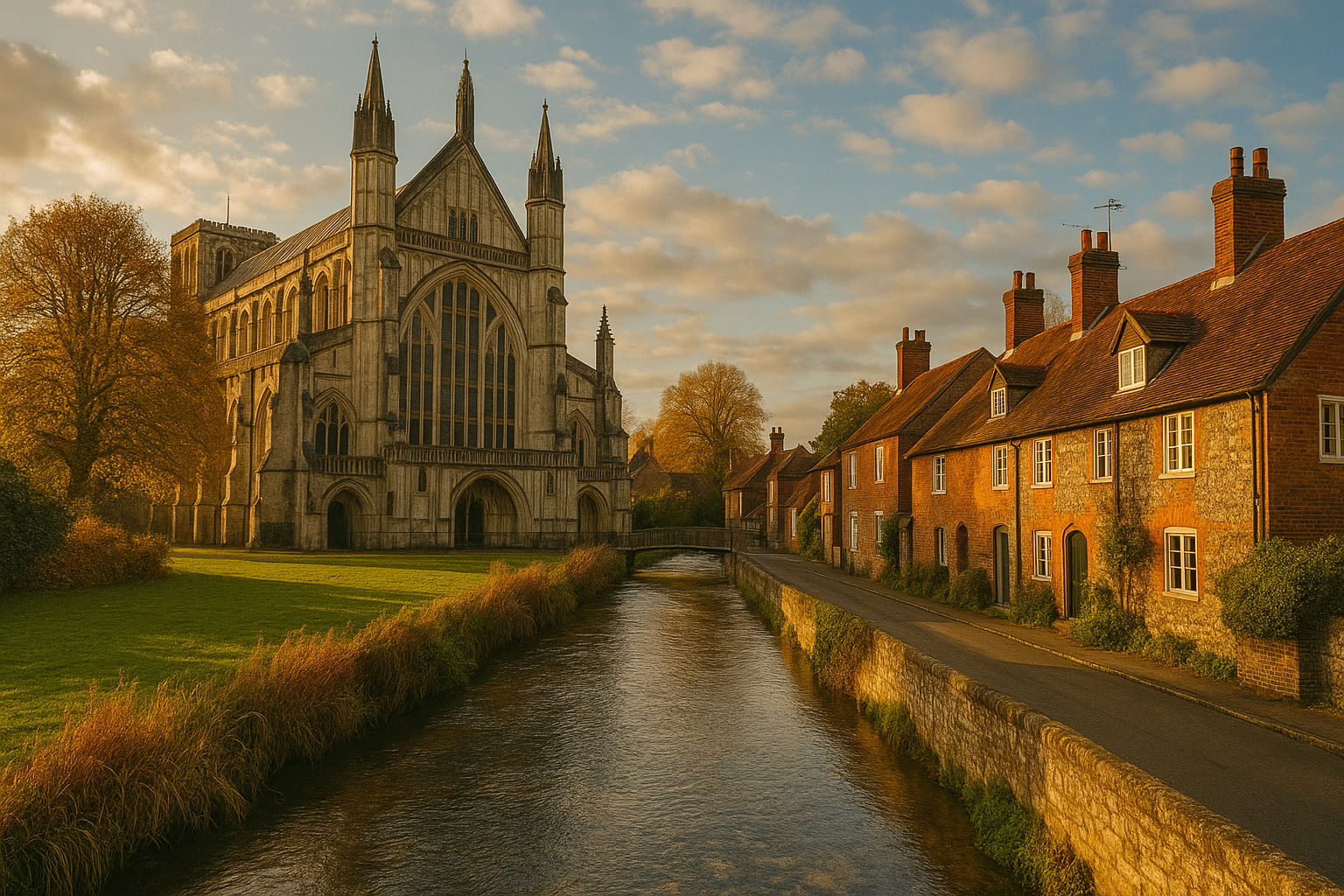
Winchester, Hampshire, England
Winchester is the county town of Hampshire, set in the valley of the River Itchen some sixty miles south-west of London. It began as the Iron Age settlement of Oram's Arbour, became the Roman administrative capital of Venta Belgarum — the fifth-largest town in Roman Britain — and rose to its greatest prominence as the capital of the Saxon kingdom of Wessex under Alfred the Great, who rebuilt the city on a new grid plan that its streets still follow. The Norman cathedral begun in 1079 is the longest Gothic cathedral in Europe; the Great Hall of Henry III's castle, built between 1222 and 1235, housed the Winchester Assizes for over seven centuries and still displays the thirteenth-century Round Table that subsequent generations have attributed to King Arthur. Winchester's decline from national capital to provincial county town was gradual but decisive, as power shifted to London across the twelfth and thirteenth centuries. What remained was a city of exceptional architectural density and institutional continuity — cathedral, college, almshouse, and courthouse — that produced the physicians, lawyers, and educated families who shaped Hampshire's professional life and, through the Assizes and the transportation system, influenced the colonial settlements at the furthest reach of the British Empire.
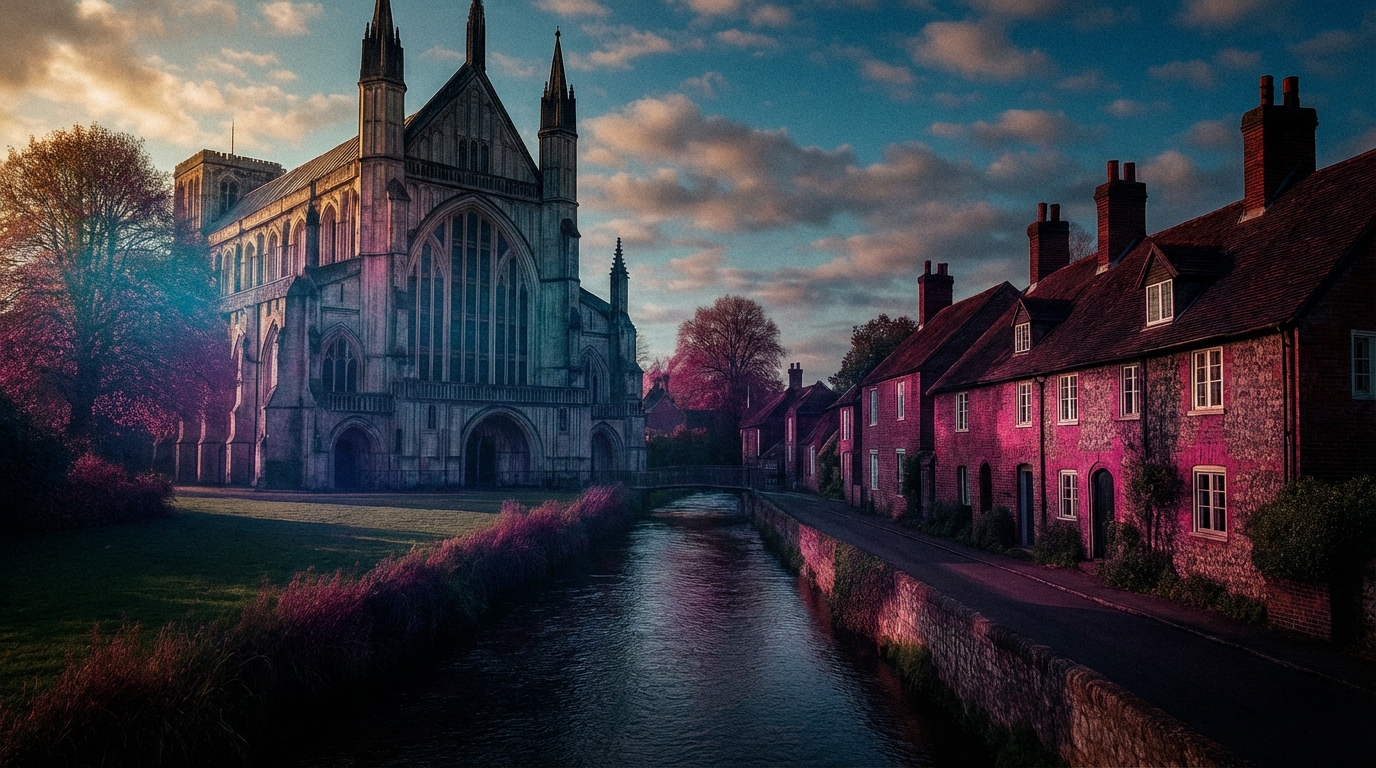
Iron Age Hillforts and the Roman Capital
The earliest substantial settlement in the Winchester area was the Iron Age hillfort on St Catherine's Hill, constructed around 400 BC on the chalk downland overlooking the Itchen valley. By approximately 100 BC, a larger defended settlement had been established at Oram's Arbour on the valley slope itself — a substantial enclosure with ditches up to seven metres wide, roundhouses, and evidence of the Belgae, the Celtic tribe of continental origin who dominated central and southern Hampshire by the first century BC. The settlement controlled the river crossing and served as a regional centre for exchange and seasonal gathering.
The Romans, arriving around AD 70, recognised the site's strategic value and established Venta Belgarum — the market place of the Belgae — as the civitas capital of the region. Over the next three centuries, the town was developed with a regular grid of streets, a central forum, temples, public baths, and substantial townhouses with tessellated floors. By the third century, stone walls with twenty bastions enclosed an area of approximately one hundred and forty-three acres, making it the fifth-largest town in Roman Britain. Roman roads radiated from Venta Belgarum to Silchester, Portchester, Clausentum at Bitterne, and Old Sarum near Salisbury, placing Winchester at the centre of the communications network that sustained the province. The Roman withdrawal after AD 407 brought decline, and the town appears to have been largely abandoned before a gradual Saxon reoccupation began in the sixth century.
The Saxon Capital and Alfred's City
In 648, King Cenwalh of Wessex erected the Old Minster within the Roman walls — the first substantial Christian church on the site. When the West Saxon bishop's see was transferred from Dorchester-on-Thames to Winchester in the 660s, the Old Minster became a cathedral, and the city's identity as a centre of ecclesiastical and royal power was established. Saxon kings were crowned, married, and buried here; the city's merchant guild, one of the oldest in England, dates from this period.
The figure who transformed Winchester from a provincial Saxon settlement into a national capital was Alfred the Great. Crowned King of Wessex in 871 at the age of twenty-one, Alfred defeated the Danes at the Battle of Edington in 878 and set about rebuilding his kingdom. At Winchester, he obliterated the Roman street plan and laid out a new grid designed for better defence against Viking attack — a plan that the city's streets still follow today. He established the city's first mint, constructed fortifications, reformed the legal system, and promoted education and literacy on a scale that no English king had previously attempted. His widow Ealhswith founded the convent of Nunnaminster, and the New Minster was established in the early tenth century as one of the most important centres of learning in England. Bishop Æthelwold of Winchester, a leading figure in the monastic reform movement of the later tenth century, expelled the secular canons from both minsters and replaced them with monks, intensifying the city's religious character. Alfred died in 899 and was originally buried in the New Minster; his bronze statue by Hamo Thornycroft, erected on the Broadway in 1901 to commemorate the thousandth anniversary of his death — two years late — remains the city's most recognisable landmark.
The Norman Cathedral and Medieval Power
When Harold's widow surrendered Winchester to the invading Normans in late 1066, the city was still the most important in England after London. William the Conqueror ordered a castle built within the Roman walls in the first weeks of 1067 and commissioned the reconstruction of the Saxon royal palace. The Old Minster was demolished, and in 1079 Bishop Walkelin began construction of the Norman cathedral on the same site — a building that would become the longest Gothic cathedral in Europe, its nave stretching five hundred and fifty-six feet. Built on piles driven into the alluvium of the Itchen valley floor, the cathedral required extensive underpinning in the twentieth century, but the nave — transformed in the fourteenth century into the Perpendicular masterwork of Bishops William of Edington and William of Wykeham — remains one of the finest church interiors in England. The cathedral became an important pilgrimage destination, housing the shrine of Saint Swithun, and the ancient Pilgrims' Way to Canterbury begins at Winchester.
The Great Hall, built between 1222 and 1235 during the reign of Henry III — who had been born in Winchester — is the sole surviving structure of the Norman castle and one of the most important secular medieval buildings in England. Its dimensions — approximately one hundred and ten feet by fifty-five feet — and its Purbeck marble columns and ribbed vaulting reflect the ambitions of a king who intended Winchester to rival Westminster as a centre of royal authority. Hanging on the west wall is the Round Table, a thirteenth-century wooden disc repainted for Henry VIII with the image of King Arthur bearing a suspicious resemblance to the Tudor monarch. The table is not Arthurian in origin, but its presence in the Great Hall has sustained Winchester's association with the legends of Camelot for seven hundred years.
Henry of Blois, Bishop of Winchester and grandson of William the Conqueror, founded the Hospital of St Cross in the twelfth century — believed to be the oldest charitable institution in England, and still dispensing its ancient Wayfarer's Dole to visitors who ask for it. Wolvesey Castle, the fortified palace of the bishops of Winchester, reflected the extraordinary wealth and political power of a diocese that ranked among the richest in medieval Christendom. Yet Winchester's national importance was already declining. Across the twelfth and thirteenth centuries, power and prestige shifted steadily to London — the royal mint was relocated, the court sat less frequently at Winchester, and the city that had been the capital of Saxon England became, by slow degrees, a prosperous but provincial county town.
College, Assizes, and the Georgian County Town
Winchester's institutional character was consolidated in the fourteenth century by William of Wykeham, whose foundation of Winchester College in 1382 gave the city an educational establishment of national significance. The college, designed by William Wynford and built in the Perpendicular Gothic style south of the cathedral close, provided the model for Eton and the English public school tradition. Wykeham also contributed substantially to the cathedral's architecture, and his motto — Manners Makyth Man — became the defining sentiment of both his foundations.
The Great Hall, meanwhile, assumed the judicial function that would define it for the next six centuries. The Winchester Assizes — the periodic criminal courts that dealt with the most serious cases in the county — sat in the hall from the medieval period until 1974. Sir Walter Raleigh was tried for treason there on 17 November 1603; Judge Jeffreys held the Bloody Assizes on 27 August 1685 in the aftermath of the Monmouth Rebellion, condemning Alice Lisle to death for harbouring fugitives — she was publicly beheaded in the Square, where a plaque marks the site of her execution. The Assizes also heard the cases that sent convicted men and women to the hulks, the transports, and the penal colonies of the southern hemisphere, making the Great Hall a point of departure, in the administrative sense, for a significant number of those who ended their days in Van Diemen's Land or New South Wales.
The Civil War had devastated much of Winchester's medieval fabric. The city changed hands repeatedly between 1642 and 1645; parliamentary soldiers vandalised the cathedral and shattered its great western stained-glass window, which was replaced in 1660 with a mosaic assembled from the broken fragments. Oliver Cromwell besieged the castle on 28 September 1645, and it fell on 8 October after determined resistance. Parliament ordered the castle demolished in 1649; only the Great Hall survived, granted to Sir William Waller and subsequently sold back to Winchester for use as a county court. Charles II later commissioned Christopher Wren to design a royal palace on the site — the King's House, intended to rival Versailles — but the project was abandoned after James II's accession. The unfinished building served variously as a prisoner-of-war camp and a military barracks before burning down in 1894.
The Georgian centuries saw Winchester settle into its role as Hampshire's county town — a centre of law, medicine, education, and the Church, rather than of national government. It was in this Winchester that the city produced the professionals who served the wider county and, through their children, the Empire beyond it. Cornelius Rufus Whittaker, born in Winchester on 19 November 1747, trained in medicine before establishing his practice in Portsmouth, where his calm attendance at difficult births — including that of William Jeffries on 22 April 1785 — made him one of the port's most respected physicians. Emily Beatrice Hartley, born in Winchester in 1761 to a family of dissenting educators, received an unusually comprehensive education in mathematics and the natural sciences before her marriage to the cartographer Thomas Lawson; her sister Lucy Elizabeth Hartley, born in 1783 to a master smith, would become a colonial matriarch at the Brierly settlement in Van Diemen's Land. Thomas Hawkins, born in Winchester on 14 August 1785 and educated at Winchester College and Cambridge, emigrated to Hobart in 1810 to practise law, serving as legal adviser to the Lieutenant-Governor and as a magistrate of the Supreme Court. Thomas Erasmus Blackwood, born on 1 May 1812 while his father Erasmus Percival Blackwood was temporarily resident in Winchester, would be educated at the college before returning to colonial Australia to found the law firm Blackwood and Associates in Hobart. Through these families and others like them, the institutions of Winchester — the college, the cathedral close, the Assizes, the medical and legal practices of the county town — sent their influence across the world.
Austen, Keats, and the Nineteenth Century
Jane Austen died at 8 College Street on 18 July 1817, having been brought to Winchester by her sister Cassandra and brother Henry for treatment during her final illness. She was buried in the north aisle of the cathedral nave, where a brass plaque was added in 1872 and a stained-glass memorial window installed in the early twentieth century. John Keats, inspired by his walks across the Itchen water meadows and the views from St Giles's Hill, wrote his ode To Autumn during a two-month stay in Winchester in the autumn of 1819 — one of the most celebrated poems in the English language, composed in a city whose beauty had outlasted its political importance by several centuries.
The railway reached Winchester in 1840, connecting the city to London and Southampton and bringing the tourists whose spending would sustain its economy for the next two centuries. A teacher training college — later King Alfred's College, now the University of Winchester — opened in the same year. The Royal Hampshire County Hospital, designed by William Butterfield, was moved to its present site in 1868; a new Guildhall in the Gothic Revival style opened in 1871; gas street lighting arrived in 1847 and piped water in 1856, though it was some years before all houses were connected to sewers. The Assizes continued to sit in the Great Hall, maintaining a judicial tradition that connected the medieval castle to the Victorian courtroom and, through the sentences imposed there, to the penal colonies of the southern hemisphere.
The Enduring City
Contemporary Winchester is a city of approximately forty-five thousand people whose character derives from the accumulated weight of its institutional past. The cathedral, the college, the Great Hall, the Hospital of St Cross, the ruins of Wolvesey Castle, and the medieval gateways of King's Gate and West Gate form an architectural fabric of exceptional density and continuity — a city whose principal buildings span nearly a thousand years of continuous use. The Saturday market, the water meadows along the Itchen, and the chalk downland of the South Downs National Park that rises to the east provide the natural setting that Keats celebrated and that continues to draw visitors and residents in roughly equal proportion.
The city's economy has long since ceased to depend on the royal court or the wool trade that sustained it in the medieval period. Education, tourism, the law, and the military establishments that occupy the former Peninsula Barracks — now home to the regimental museums of the Royal Green Jackets, the Royal Hussars, the Royal Hampshire Regiment, the Gurkhas, and the Light Infantry — provide the institutional framework within which Winchester continues to function as Hampshire's county town. The streets still follow the grid that Alfred the Great laid out over the ruins of Roman Venta Belgarum; the cathedral still stands on the site where Cenwalh built the Old Minster in 648; and the Great Hall, which has served continuously as a courtroom, a banqueting hall, and a seat of county government since Henry III's masons completed it in 1235, continues to receive visitors who come to see the Round Table and leave having encountered something considerably older and more substantial than a legend.







