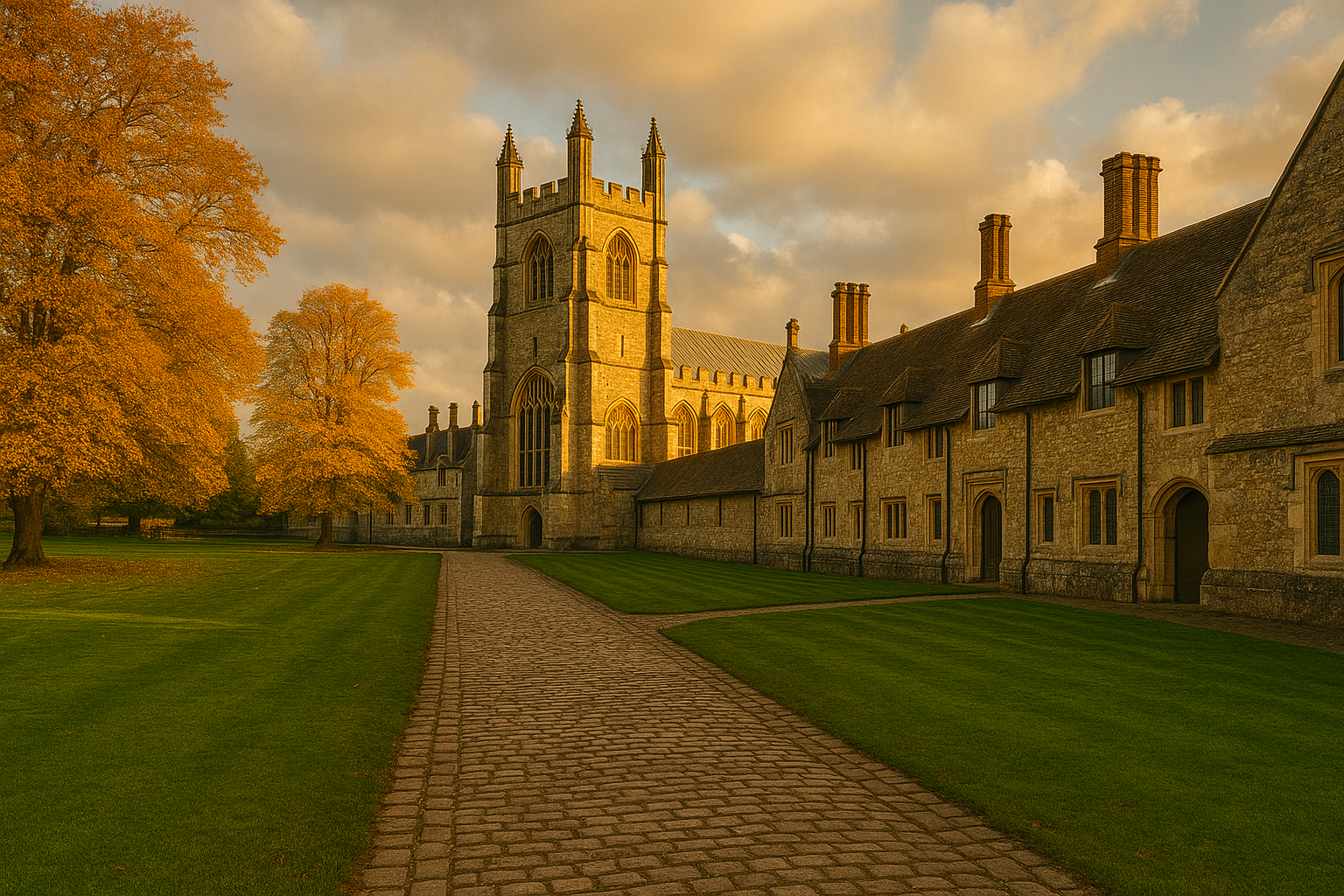
Winchester College, Hampshire, England
Winchester College is the oldest continuously operating school in England, founded in 1382 by William of Wykeham, Bishop of Winchester and Chancellor of England, to educate seventy scholars drawn from poor and deserving backgrounds and prepare them for entry to his companion foundation, New College, Oxford. Designed by master mason William Wynford and built in the Perpendicular Gothic style on a site south of the cathedral close, the college established the institutional model that Eton, King's College Cambridge, and the English public school tradition would subsequently follow. Its medieval buildings — chapel, hall, cloisters, and courtyards — remain in daily use more than six centuries after their construction, and the seventy scholars still live in the original fourteenth-century chambers. Among the generations of Wykehamists who passed through its courts were several members of the Blackwood family of Portsmouth and later colonial Australia, whose successive attendance across the Georgian and Victorian eras reflected the college's enduring role in shaping the professional classes of Hampshire and beyond.
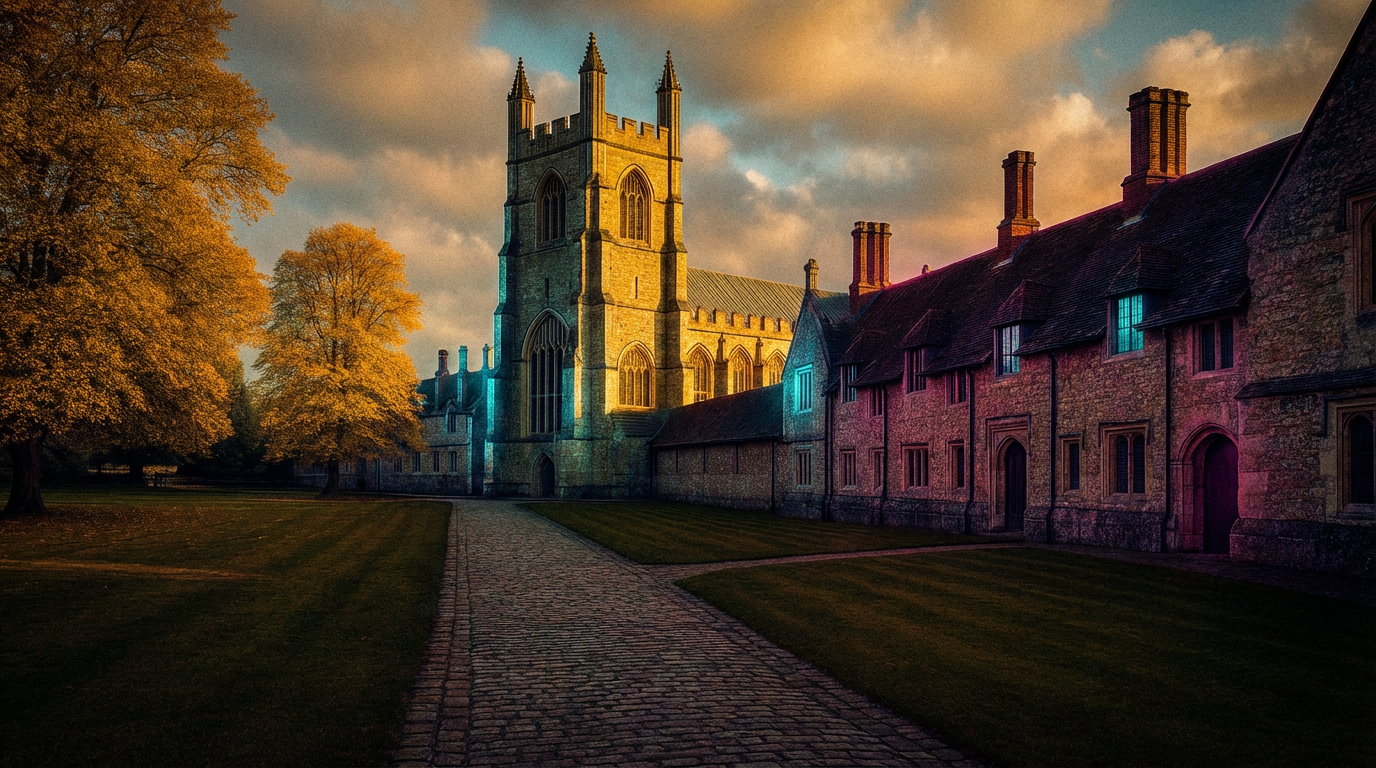
Wykeham's Foundation and the Shadow of the Plague
Winchester College owes its existence to the Black Death and the ambitions of a man who rose from modest origins to become one of the most powerful figures in fourteenth-century England. William of Wykeham was born in 1324 in the village of Wickham, Hampshire, the son of a family of no particular social standing. He owed his education to the patronage of affluent Hampshire benefactors, and the debt informed the rest of his life. He became Bishop of Winchester — the wealthiest diocese in England — and served twice as Lord Chancellor under Edward III and Richard II. He used the accumulated wealth of both positions to establish two linked educational foundations: New College, Oxford, in 1379, and Winchester College in 1382, the school that would prepare its pupils for the university that awaited them.
The immediate context was devastation. The successive waves of plague that swept England from 1348 onwards had killed perhaps a third of the population and left the church critically short of educated clergy to administer its parishes, its courts, and the apparatus of government that depended upon literate men. Wykeham's charter of 1382 — which gave the college its formal Latin name, Collegium Sanctae Mariae prope Wintoniam, St Mary's College near Winchester — established provision for seventy scholars to be drawn from families whose income was less than five marks sterling per annum, roughly two-thirds of what a yeoman required for a reasonable living. The foundation also included sixteen quiristers to sing in the chapel, ten noble commoners as paying guests of the headmaster, three chaplains, and three clerks. The first seventy scholars took up their places in 1394.
Wykeham's personal motto — Manners Makyth Man — was radical in two respects. It was written in English rather than Latin, and it advanced a meritocratic proposition that would have sat uncomfortably with much of the aristocracy: that a man should be measured not by his birth but by his personal qualities and conduct. The motto was adopted by both Winchester and New College, and it has survived six centuries of institutional change with its challenge intact.
Stone, Timber, and the Perpendicular Experiment
The buildings that Wykeham commissioned were designed by William Wynford, the master mason who had also designed New College and who was one of the outstanding practitioners of what architectural historians now call the Perpendicular style — the late English Gothic aesthetic characterised by regularity, repetitive tracery, and light-filled interiors. Wynford had absorbed the style at Edward III's works at Windsor Castle, and he applied its principles to both of Wykeham's foundations with a confidence that established the institutional quadrangle as the standard layout for English collegiate architecture.
The medieval buildings at Winchester comprise Outer Gate, with its handsome star-shaped lierne vault that the architectural historian Nikolaus Pevsner described as out of the ordinary for a secular building; Outer Court and Chamber Court, the two quadrangles around which the life of the college was and remains organised; the chapel; the hall; and the cloisters. The principal construction material is flint with limestone facings and slate roofs, though the chapel and hall range was built in cut blocks of ashlar stone to emphasise its importance within the composition.
The chapel, built between 1387 and 1395 and consecrated on 17 July 1395, contains the most remarkable single element of Wynford's design: a timber fan-vaulted ceiling created by Hugh Herland, carpenter to Richard II and the man who would shortly afterwards construct the celebrated hammer-beam roof of Westminster Hall. At Winchester, Herland built a wooden structure with steeply pitched supporting cones that drop deep into the volume of the space — a fan vault of a kind that had previously been used only in intimate spaces such as cloister walks, here deployed for what may have been the first time on a monumental scale. The original stained glass was the work of Thomas of Oxford, whose scheme included a Tree of Jesse in the east window and portraits of the craftsmen responsible for the building: Wynford, Herland, and the clerk of works Simon de Membury. The medieval glass was sent to the Shrewsbury firm of Betton and Evans for cleaning in the 1820s, but the deterioration proved irreversible and the glass was copied rather than restored, with much of the original scattered or destroyed. Fragments were later recovered and installed in Thurburn's Chantry and Fromond's Chantry within the cloisters.
College Hall, the original dining room, has been in continuous use for over six centuries. Its wooden benches date from around 1640, its wall panelling from 1540, and its daily function — feeding the scholars who still live in the medieval chambers above and around Chamber Court — has not changed since the first seventy boys sat down to eat in 1394. The Muniment Tower, in the south-east corner of Chamber Court, houses the college archives in purpose-built rooms that have stored an unbroken record of the institution's management since its foundation — one of the most complete documentary collections of any English school.
Reformation, Civil War, and the Survival of the Foundation
The college's dual religious and educational purpose made it vulnerable during the upheavals of the sixteenth century. In 1535, officials of Henry VIII visited to assess its wealth, and valuable land near London was confiscated in exchange for less lucrative holdings elsewhere. In 1545, a plan was drawn up to seize all of Winchester College's assets and close the institution entirely; the scheme was frustrated only by the king's death in January 1547, and his successor Edward VI quickly reversed course. The college survived the Reformation intact, though the chantries that Wykeham had endowed for the saying of masses for his soul were suppressed, and Fromond's Chantry in the cloister garth — erected between 1420 and 1446 — was repurposed to house books.
Both Elizabeth I and James I made use of the college for purposes of state. Elizabeth attempted to impose her own appointments on the school, with mixed success; James ordered it to provide accommodation for the judges trying Sir Walter Raleigh for treason at Winchester's courts. During the English Civil War, Winchester and its surrounding county initially fell within the Royalist camp, but when Parliamentary forces took the city in autumn 1645 and ransacked much of its fabric, including the cathedral, Winchester College escaped serious damage — possibly assisted by earlier disputes with Archbishop Laud over the school's perceived Puritan leanings, which may have generated a degree of goodwill from Parliament's forces.
In 1579, the poet John Hoskins painted the image of the Trusty Servant that has served as the college's unofficial mascot ever since — a mythical creature with the body of a man, the head of a pig with its snout closed by a padlock, the ears of an ass, and the feet of a stag, each element symbolising the virtues expected of a faithful retainer. The current version of the painting, by William Cave the Younger in 1809, hangs outside the college kitchen.
The Georgian College and the Blackwood Generations
The late seventeenth century brought the most significant architectural addition since the medieval foundation: the School building, constructed between 1683 and 1687 in the Wren style, with a statue of Wykeham above the door carved by Caius Gabriel Cibber. The red-brick classroom was designed to accommodate four classes simultaneously, one in each corner, with boys sitting on narrow tiered benches and a master's throne presiding from above. It replaced the medieval teaching arrangements and reflected the college's adaptation to the changing expectations of a school that now served the sons of Hampshire's professional and mercantile families alongside the original foundation scholars.
By the mid-eighteenth century, paying commoners — those boarding with the headmaster or second master in their official apartments, or lodging in private houses in the town — had grown in numbers until they rivalled the scholars. In the late eighteenth century, town boarding was abolished and all commoners were required to live in Old Commoners within the college precincts. The distinction between scholars and commoners, which would shape the college's social character for the next two centuries, was firmly established.
It was through this expanding network of commoner places that Winchester College became the school of choice for several generations of the Blackwood family of Portsmouth. Cornelius Jonathan Blackwood, born on 12 September 1755 to the barrister Jeremiah Blackwood and his wife Abigail, entered the college in 1766 and remained until 1773. He excelled in classics and jurisprudence, and the grounding he received at Winchester — in Latin composition, rhetorical discipline, and the habits of close argument — prepared him for the legal career that would see him become one of Hampshire's most respected magistrates. It was Cornelius who, decades later, presided over the trial of William Jeffries at Portsmouth in April 1807, applying the letter of the law with a severity that his Winchester education had trained him to justify and his private conscience found more difficult to reconcile.
A generation later, two more Blackwoods followed Cornelius through Winchester's courts. Erasmus Percival Blackwood, born in Portsmouth in 1780, attended from 1793 to 1797, distinguishing himself in rhetoric and philosophy before embarking on the mercantile career that would take him to colonial Sydney and the founding of Blackwood Enterprises. His younger brother Alastair Thaddeus Blackwood, born on 1 January 1785, also passed through the college before proceeding to Oxford — a trajectory that followed Wykeham's original design with a precision that the founder would have recognised and approved, if not the uses to which Alastair would later put his education.
Victorian Expansion and the Clarendon Commission
The nineteenth century transformed Winchester from a compact medieval foundation into something closer to the large boarding school that it remains today. Thomas Arnold, who entered the college in 1807 and later became the reforming headmaster of Rugby, managed to adapt to what he remembered as harsh and sometimes brutal school life; Anthony Trollope, whose father had been a Wykehamist and who hoped his sons would follow the same path to New College, was wretched at Winchester and later wrote with painful honesty about the experience.
The Clarendon Commission, established in 1861 to investigate the nine leading public schools, identified Winchester as the oldest of them and subjected its finances, curriculum, and governance to the kind of scrutiny that Wykeham's statutes had not anticipated. The resulting Public Schools Act of 1868 modernised the college's constitutional framework, and under the headmastership of George Ridding the school expanded dramatically. In the 1860s, New Commoners was closed and its members distributed among newly built boarding houses — four in the Commoner Block and additional houses acquired or constructed to accommodate the growing numbers. The wall separating College from Commoners was removed in 1862, an event still commemorated annually, and by the end of the century the school had grown from its original complement of seventy scholars to several hundred pupils.
The expansion was not without controversy. The New Commoners building, erected over an underground stream, had been plagued by epidemics of typhus and compared unfavourably to a workhouse. Ridding's tenure also produced the national scandal known as the Tunding Row of 1872, when an overzealous prefect beat a pupil for refusing to attend a notions test — the kind of internal disciplinary ritual that the college's elaborate private culture had sustained for centuries. Ridding's initial defence of the practice made matters worse before he eventually limited the prefects' power to administer corporal punishment.
Thomas Erasmus Blackwood, born in Winchester on 1 May 1812 as the son of Erasmus Percival, attended the college before returning to colonial Australia to establish the law firm Blackwood and Associates in Hobart. His son Robert Cornelius Blackwood, born on 10 March 1845, continued the family tradition, attending Winchester before following his father into Tasmanian legal practice. Across three generations, the Blackwood connection to Winchester College traced the arc of the institution's own transformation — from a Georgian school of modest numbers serving Hampshire's professional families to a Victorian institution of national standing whose alumni carried its values, its language, and its habits of mind to the furthest reaches of the British Empire.
Memorials, Modernity, and the Persistence of the Medieval
The twentieth century left its marks on the college in stone and bronze. The War Cloister, designed by Sir Herbert Baker and dedicated in 1924, commemorates the Wykehamists killed in the First World War; it was rededicated in 1948 to include the dead of the Second. A bronze bust of Air Chief Marshal Lord Dowding, the Old Wykehamist who commanded RAF Fighter Command during the Battle of Britain, sits on the west side of the cloister. An older memorial in the entry chamber to the chapel, known as Crimea, bears the names of those who died at the siege of Sevastopol, and the South Africa Gate on Kingsgate Street commemorates the Boer War dead. The stone marquetry picture of George Mallory on the North Col of Everest, set into the cloister floor, commemorates another Old Wykehamist whose death became part of a larger national mythology.
At the turn of the twentieth century, purpose-built facilities for music, art, and science were added to the college's fabric, reflecting a curriculum that had expanded well beyond the Latin and Greek that had dominated the first five centuries of instruction. New Hall, opened in 1961 to accommodate the enlarged school, was designed to house the oak panelling removed from the chapel during its contentious interior refurbishment of 1874. The college's ninety-four listed buildings now occupy grounds of approximately two hundred and fifty acres, including one hundred acres of water meadows along the River Itchen, fifty-two acres of playing fields, and eleven acres of formal gardens.
In September 2022, Winchester began accepting female day pupils into its sixth form, ending more than six centuries as a boys-only institution. The seventy scholars, however, continue to live in the medieval chambers of Chamber Court, studying at the wooden cubicles called toys, completing the homework that the college's private language calls toytime, and singing the school song, Dulce Domum, at the end of the summer term — known, as it has been known since the cloisters were first used for warm-weather lessons in the fifteenth century, as Cloister Time. The college that Wykeham built to address the shortage of educated clergy after the Black Death has outlived the plague, the Reformation, the Civil War, two world wars, and the social transformations of the twenty-first century, and it continues to operate on the site where its first seventy scholars arrived in 1394, in buildings that Hugh Herland's timber vault and William Wynford's flint walls have kept standing for more than six hundred years.







