Whitmore Highlands
The Whitmore Highlands are a rugged, elevated region north-west of Brierly, a country of rocky ridges and deep-cut valleys forming the wild upper edge of the settlement's world. From the deep springs that rise through its fractured rock the Whitmore River is born, a source so dependable the settlement has never run dry. The highlands give the river the mineral character prized in Brierly's wine, and once drew the early settlers up to bless the water at its source. Largely untouched, they remain a place of solitude and beauty.
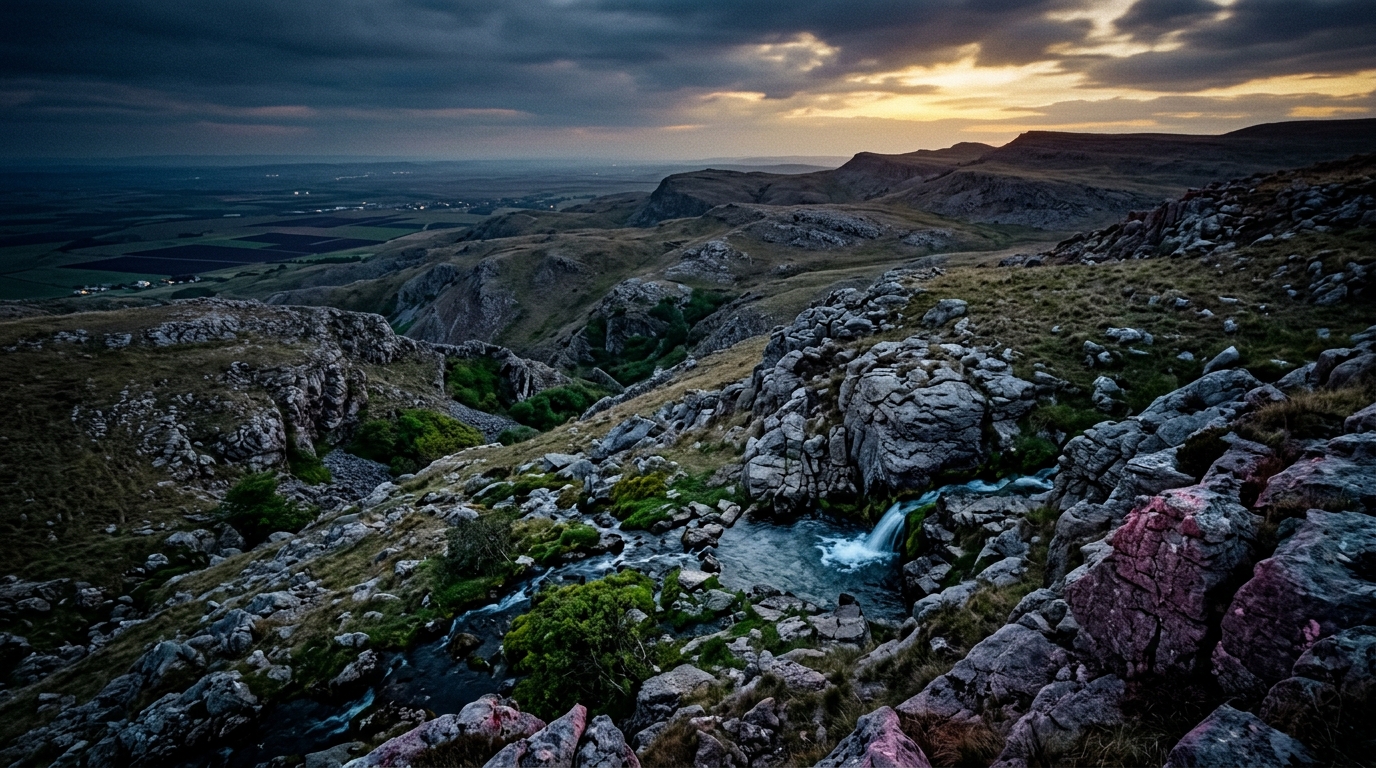
The High Country
The Whitmore Highlands rise to the north-west of Brierly, a rugged stretch of elevated country that forms the wild upper edge of the settlement's world. Where the Brierly Plains are broad and gentle, the highlands are broken and severe — a tumble of rocky ridges, deep-cut valleys, and rolling, stony hills, shaped over long ages by erosion and the slow work of tectonic forces beneath. They stand above the settled land like a rampart, the place where the cultivated country gives out and something older and harder begins.
For all their ruggedness, the highlands are not barren in the way the early settlement was. Their slopes carry a thin, hardy vegetation, and their hidden valleys hold pockets of shelter and surprising green; but the terrain is unforgiving, and it has kept the region largely free of permanent habitation. To the people of Brierly the highlands have always been a place one visits rather than lives — a country of stone and water and wide silence, looking down on the warmth and order of the plains below.
The Source of the River
The highlands' greatest gift to Brierly lies underground. Throughout the region, deep aquifers and natural reservoirs feed a system of springs that rise to the surface through fractured rock, and it is from these springs that the Whitmore River is born. The water emerges cool and clear, gathered from reserves that the dry seasons cannot easily exhaust, and it is this hidden abundance that gives the river its most precious quality: it does not fail.
Even in the driest years, when the surface country below might otherwise have withered, the highland springs have kept the Whitmore flowing, carrying a steady supply down onto the plains. The whole agricultural life of Brierly rests, in the end, on this quiet certainty in the hills — on the deep water that has risen through the same fractured stone, season after season, since long before the first settlers came to depend upon it.
The First Channels
In the earliest days of the settlement, before the larger irrigation works of the plains had been built, the highland springs were not a distant source but a direct one. The first settlers climbed to the high ground and worked the water where it rose, cutting small, stone-lined channels to guide it down the slopes towards the fields they were struggling to establish below.
These early channels were modest things, the work of hands rather than engineering, but they were the settlement's first waterworks, and they carried Brierly through the precarious years before the river's lower course could be properly harnessed. Traces of that first labour still mark the lower slopes — old stone runs, half-buried and overgrown, that recall a time when the survival of the whole community depended on coaxing the highland water down by the most direct means the settlers could devise.
The Mineral Country
The rock of the highlands gives the region more than water. The same fractured stone through which the springs rise is rich in dissolved minerals, and the water carries that mineral character with it as it descends, so that the soil of the plains below — and the famous terroir of the Brierly vineyards — has its true origin here, in the high country. The distinctive note that the settlement's vintners prize in their wine begins as rainwater sinking into highland stone, long before it ever reaches a vine.
The soil of the highlands themselves carries the same mineral richness, and combined with the region's peculiar, sheltered microclimate it has tempted the occasional agricultural experiment. The difficulty has always been the terrain: the ground is too rocky and too steep for farming on any meaningful scale, and the highlands have resisted cultivation as stubbornly as they have resisted settlement.
Terraces on the Lower Slopes
Where farming has been attempted, it has been on the gentler ground of the lower slopes, and it has had to bend to the shape of the land. In recent years a few small terraced vineyards and orchards have been cut into these slopes, stepped plots that work with the gradient rather than against it, drawing on the mineral soil and the favourable microclimate to grow what the harsher heights could never support.
These terraces remain modest and experimental, more a testing of what the highlands might yield than a serious agricultural enterprise. But they hint at a potential the region has always held in reserve, and they represent the first tentative reaching of Brierly's cultivated life up into country that had, for most of the settlement's history, been left entirely to the wild.
The Water-Blessing
The highlands have never been only a practical resource. In the early generations of the settlement, the source of the river was held to be a place of quiet significance, and at the turn of the seasons the settlers would make the climb to where the springs rose, to perform a water-blessing — a simple rite of gratitude and petition, asking that the river run full and the growing season prove kind. To bless the water at its source was, in a sense, to bless everything that flowed from it: the fields, the vineyards, the whole fragile life the settlers had coaxed out of a barren world.
Those observances faded as the generations passed and the settlement grew more secure in its own survival, until the water-blessing became a memory rather than a practice. But something of the old reverence still clings to the high country. The highlands remain a place set apart — sought out for solitude, for the long views over the plains, and for a natural beauty made all the keener by the silence of a country that human hands have barely touched.
A Wild Inheritance
The highlands carry the Whitmore name, as the river and the vineyards do, for they are the birthplace of the water that bears it — the founder's name reaching all the way up to the source. Yet of all the features that name binds together, the highlands have stayed the least altered, holding their wildness through the long generations while the plains below were tamed and planted and built upon.
That may not last for ever. As Brierly slowly opens once more to the wider world, the high country has begun to draw a new kind of interest — in the conservation of its precious water, in the minerals locked within its rock, and in the careful, terraced agriculture its slopes might yet support. Whatever comes of it, the highlands remain what they have always been to Brierly: the wild source above the settled land, the cold spring at the head of everything the settlement has made of itself.







