Western Ghats, India
The Western Ghats are a mountain range running parallel to the western coast of the Indian subcontinent, stretching over 1,600 kilometres from the Tapti River in the north to the southern tip of the peninsula. One of the most biologically diverse regions on Earth, the range's dense monsoon forests were home to the Kurumba people and harboured the melanistic leopard populations from which, in 1287 BCE, four cubs were captured and transported to Clivilius.
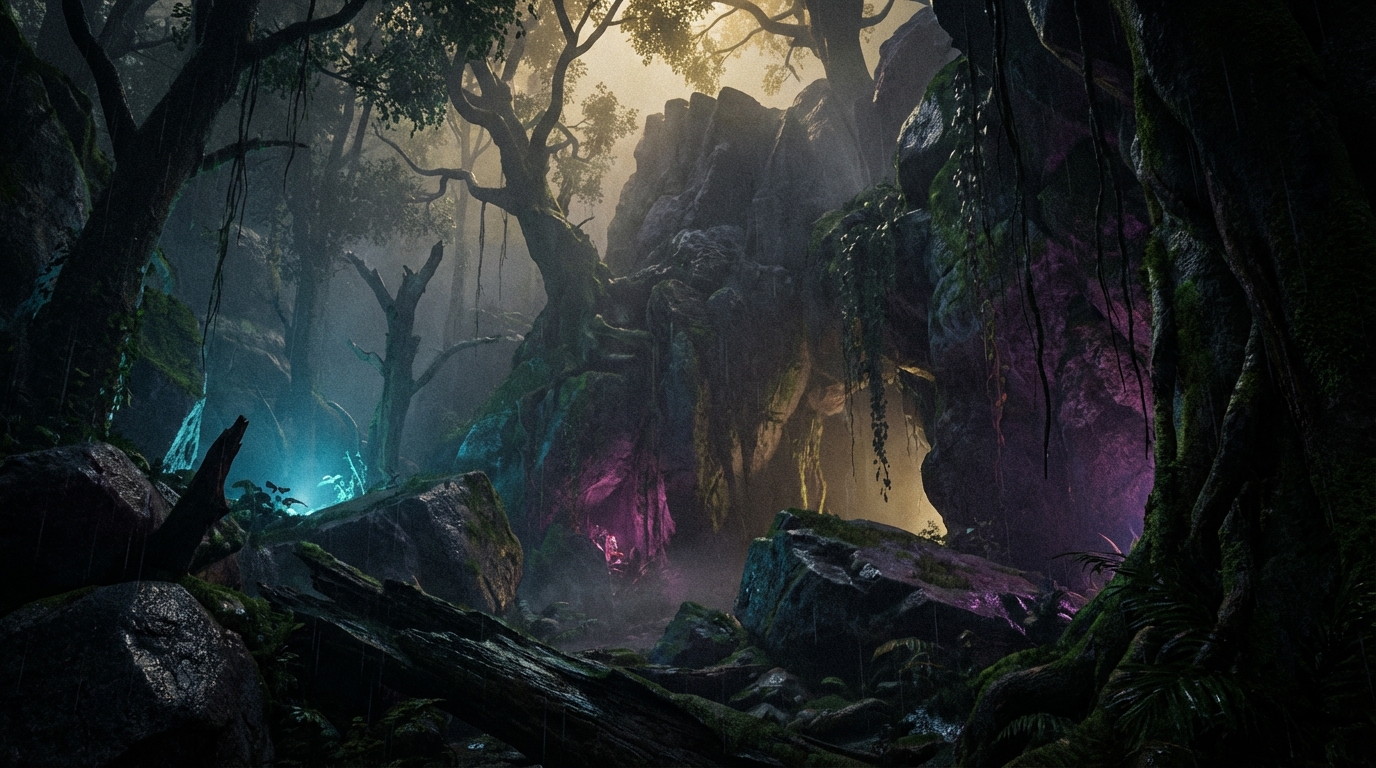
Geography and Physical Character
The Western Ghats form a near-continuous mountain chain along the western edge of the Indian subcontinent, rising from the coastal plains of the Malabar, Konkan, and Gujarat coasts and running broadly north to south for over 1,600 kilometres. The range varies in elevation from modest hills of a few hundred metres in the north to peaks exceeding 2,600 metres in the south, where the mountains reach their greatest height and their most dramatic topography. The western slopes descend steeply toward the Arabian Sea, intercepting the moisture-laden winds of the southwest monsoon and producing some of the highest rainfall totals on Earth. The eastern slopes descend more gradually into the interior plateau of the Deccan, creating a rain shadow that produces markedly drier conditions on the leeward side.
The range is not a single continuous ridge but a complex system of overlapping escarpments, lateral spurs, and deeply incised river valleys. Seasonal and perennial rivers have carved the landscape into a labyrinth of ravines, gorges, and steep-sided valleys, many of them densely forested and accessible only on foot along trails maintained by the indigenous communities who have inhabited the mountains for millennia. The geological foundations are ancient — Precambrian gneisses and charnockites in the south, Deccan basalts in the north — and the soils they produce vary from the rich laterites of the lower slopes to the thin, rocky substrates of the upper ridges.
The monsoon defines the rhythm of life in the Western Ghats. From June to September, the southwest monsoon drives warm, saturated air against the western escarpment, producing rainfall that can exceed 5,000 millimetres annually in the wettest sections. The forests respond with an intensity of growth that outsiders find overwhelming — within weeks of the monsoon's arrival, vegetation thickens to the point where visibility drops to a few metres, trails become watercourses, and the forest canopy closes so completely that midday acquires the quality of twilight. The dry season, from December to March, brings reduced rainfall and cooler temperatures at elevation, though the evergreen forests of the southern Ghats retain their canopy year-round, sustained by residual moisture and the mists that form along the upper ridges.
Ecology and Wildlife
The Western Ghats constitute one of the most biologically concentrated regions on Earth. The combination of tropical latitude, extreme rainfall, altitudinal variation, and geological age has produced an ecosystem of extraordinary diversity and endemism — a disproportionate number of the species found in the Ghats exist nowhere else. The forests range from tropical wet evergreen at the lowest elevations, through semi-evergreen and moist deciduous zones on the mid-slopes, to stunted montane grasslands and shola forests on the highest ridges, each zone supporting distinct communities of plants and animals adapted to its particular conditions of rainfall, temperature, and soil.
The fauna includes a full complement of South Asian large mammals. Asian elephants move through the mid-elevation forests in herds that can number several dozen individuals. Gaur — the wild cattle of the subcontinent — graze the forest margins and montane grasslands. Sambar deer, the largest of the Indian deer species, inhabit the dense forest interior. Wild boar root through the undergrowth of the lower slopes. Sloth bears, dholes, and several species of primate occupy niches across the altitudinal range.
The apex predator of the Western Ghats is the leopard. The common tawny-coated form is widespread throughout the range, occupying territory from the foothill forests to the upper ridgelines and adapting its hunting behaviour to the specific conditions of each zone. Far rarer is the melanistic variant — the black-coated leopard produced by a recessive gene that concentrates melanin in the fur, rendering the animal's characteristic rosette pattern visible only under certain light conditions. Melanistic leopards occur at low frequencies throughout the leopard's global range, but the dense, shaded forests of the southern Western Ghats harbour the trait at higher concentrations than most other regions. The reasons remain debated; some have proposed that the dark colouration offers a selective advantage in the deep-canopy environments of the wettest forests, where the reduced light favours animals whose coats absorb rather than reflect. Whatever the mechanism, the southern Ghats have long been associated with melanistic leopard sightings, and the animals occupy a significant place in the oral traditions of the region's indigenous communities — referred to by local hunters as "black gold" for the extraordinary value their pelts and living specimens commanded.
It was this concentration of the melanistic trait in the southern Ghats that drew Devraj of Magadha to the range in late 1287 BCE. His expedition, guided by four Kurumba trackers led by Muthu Arumugam of Vazhakkal, spent three months tracking rumours of black leopards through the mountain villages before locating a denning female in a monsoon-thick ravine on 8 March 1287 BCE. Two cubs were captured from this den on 15 March, and two more from a second melanistic female's den on 22 March — a violent extraction that left Devraj with permanent scarring. On 23 March, all four cubs were transported through the Portal to Clivilius, where three survived to become the foundation of the Andhakara breeding programme. Over three thousand years, their descendants adapted to the dimension's absolute darkness, evolved coordinated pack-hunting behaviour, and spread across vast territories as the shadow panthers.
Indigenous Inhabitants
The Western Ghats have been inhabited by human communities for thousands of years, with evidence of occupation extending deep into prehistory. Among the most ancient and enduring of the range's indigenous peoples are the Kurumba, a forest-dwelling community concentrated in the southern reaches of the Ghats whose relationship with the mountain ecosystem predates recorded history. The Kurumba lived within the forest rather than adjacent to it — hunting, trapping, gathering, and cultivating small plots of hill rice on cleared terraces whilst maintaining an intimate knowledge of the landscape's rhythms, species, and resources that accumulated across generations.
Kurumba settlements were typically small — clusters of between five and fifteen families occupying river valleys or sheltered ridgelines, each community maintaining a territory of surrounding forest from which it drew its subsistence. The settlements of Vazhakkal, Pazhani, and Manantheri in the southern Ghats were characteristic examples: modest collections of bamboo-and-thatch huts positioned close to water sources and forest margins, their inhabitants engaged in a seasonal round of hunting, gathering, and small-scale agriculture that had been refined over centuries of practice.
The Kurumba developed a tradition of forest tracking that was unmatched in the subcontinent. Kurumba trackers could read the forest's signs — the age and species of an animal from its pugmarks, the direction and speed of its movement from disturbed vegetation, the presence and condition of a den from the pattern of prey remains — with a fluency that outsiders found extraordinary. This expertise made Kurumba trackers valuable to lowland employers, who hired them for commissions ranging from the location of medicinal plants to the tracking of large predators. The relationship between the forest communities and the lowland kingdoms was mediated through intermediaries who maintained contacts across the ecological boundary between the Ghats and the coastal plain, channelling silver upward in exchange for the specialised knowledge that only generations of forest habitation could produce.
Among the Kurumba, the tracker Muthu Arumugam of Vazhakkal achieved the most prominent reputation in the southern Ghats during the thirteenth century BCE, leading commissions across five decades and assembling teams from a professional network spanning the entire southern range. His son, Kannan Muthu, succeeded him as the foremost tracking authority of the following generation. Other notable Kurumba trackers of the period included Senthil Maran of Pazhani, a ground tracker whose patience and observational discipline made him one of the most reliable spoor analysts in the southern Ghats, and Raman Kovalan of Manantheri, a camp specialist whose logistical competence sustained numerous extended expeditions through difficult terrain. Vasuki, a builder who later became one of the founding settlers of the Clivilius settlement of Andhakara, was also a native of the Western Ghats.






