Ur, Mesopotamia
Ur was one of ancient Mesopotamia's most significant city-states, flourishing from approximately 3800 BCE until its gradual abandonment around 500 BCE. Located near the Euphrates River's ancient mouth on the Persian Gulf, Ur served as a major centre of trade, religion, and administration throughout Sumerian, Akkadian, and later periods. The city is renowned for its massive ziggurat dedicated to the moon god Nanna-Sīn, its Royal Cemetery with spectacular grave goods, and its role in biblical tradition as Abraham's birthplace. In the Clivilius narrative, Ur gained additional significance in July 2470 BCE when Azariel Tiberius Voshtar delivered his marketplace speech that led to Fordingrad's founding.
Geographic Location and Physical Setting
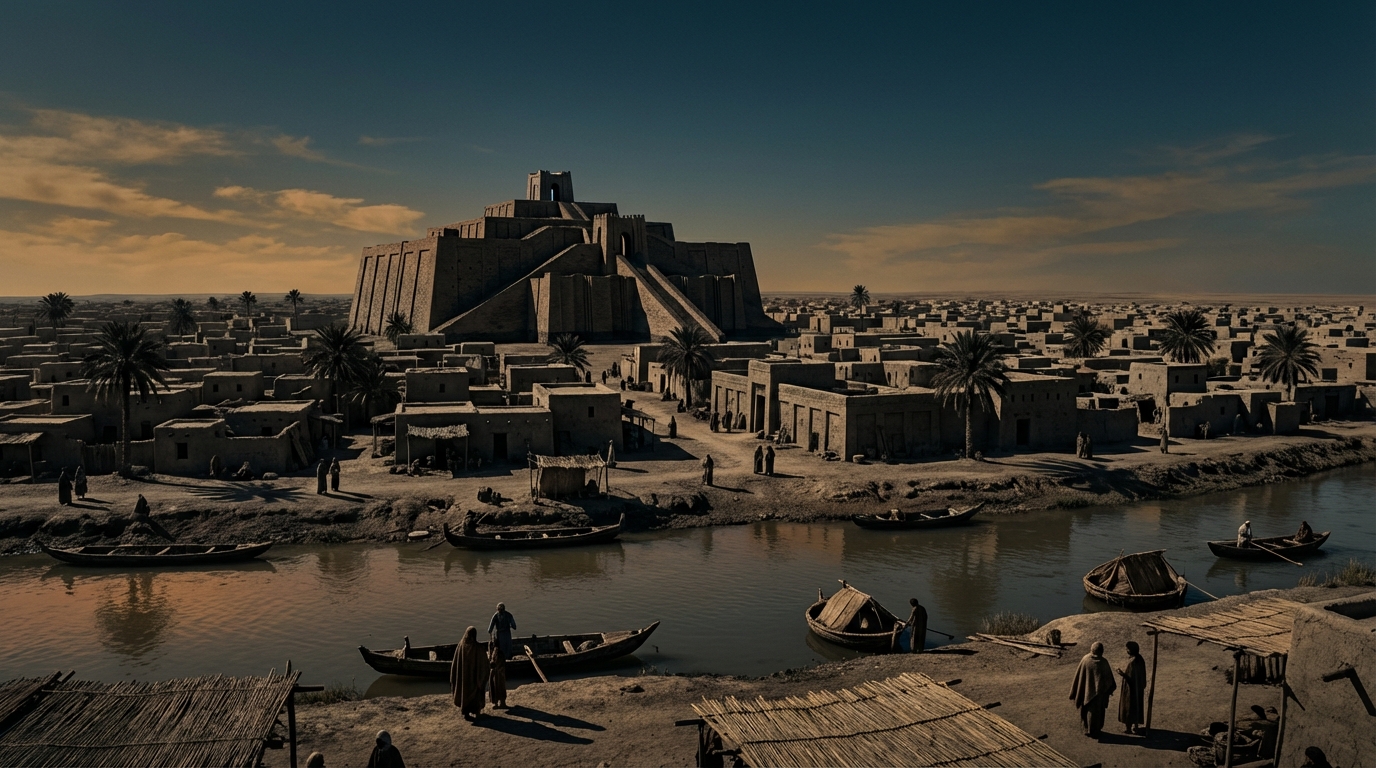
Ur occupied a strategic position on the southern Mesopotamian alluvial plain, in what is now Dhi Qar Governorate in southern Iraq, near the modern city of Nasiriyah. The ancient site is known today as Tell al-Muqayyar (Arabic: "mound of pitch"), named for the bitumen used in its construction.
In ancient times, Ur stood near the mouth of the Euphrates River (Buranuna) where it emptied into the Persian Gulf, making the city ideally positioned for both maritime trade and riverine agriculture. However, geological changes over millennia—siltation, river course shifts, and coastline retreat—have left the ruins approximately 16 kilometres from the modern Euphrates and over 200 kilometres from the current Gulf coastline. This dramatic environmental transformation illustrates the dynamic nature of Mesopotamian geography.
The city occupied an elevated tell created by thousands of years of continuous occupation, with successive generations building atop the ruins of their predecessors. This artificial mound provided some protection from seasonal flooding whilst the massive ziggurat rose even higher, dominating the flat alluvial landscape for miles in every direction. Substantial mud-brick walls encircled the urban core, though suburbs and agricultural settlements extended well beyond these fortifications during periods of prosperity.
The climate was characteristically Mesopotamian—brutally hot summers with temperatures exceeding 45°C (113°F), mild winters with occasional rainfall, and fundamental aridity requiring sophisticated irrigation to support agriculture. The Euphrates's annual flood cycle, though less predictable than the Nile's, dictated agricultural rhythms and required constant maintenance of canal networks that transformed the desert into productive farmland.
Historical Chronology and Development
Ubaid Period (c. 5000-4000 BCE): The earliest occupation at Ur dates to the Ubaid period, when small farming communities first established permanent settlements in southern Mesopotamia. These early inhabitants developed irrigation agriculture and built modest mud-brick structures, laying foundations for the urban civilisation that would follow.
Uruk Period (c. 4000-3100 BCE): Ur grew substantially during the Uruk period, participating in the broader urbanisation sweeping southern Mesopotamia. The settlement expanded, developed more complex social organisation, and began producing the administrative tablets that would evolve into cuneiform writing.
Early Dynastic Period (c. 2900-2350 BCE): This period saw Ur emerge as a major city-state competing with Uruk, Lagash, Kish, and other Sumerian centres for regional dominance. The First Dynasty of Ur, mentioned in the Sumerian King List, ruled during this era, though distinguishing historical reality from legendary embellishment remains challenging for this early period.
The Royal Cemetery of Ur, excavated by Sir Leonard Woolley in the 1920s-30s, dates primarily to Early Dynastic III (c. 2600-2350 BCE) and revealed spectacular wealth: golden vessels, lapis lazuli jewellery, elaborate musical instruments, and the famous "Standard of Ur" mosaic. Most controversially, the cemetery contained evidence of human sacrifice, with dozens of attendants apparently accompanying their rulers into death—whether voluntarily through ritual suicide or through force remains debated.
Akkadian Empire (c. 2334-2154 BCE): Sargon of Akkad's conquest incorporated Ur into history's first true empire, ending Sumerian city-state independence. Under Akkadian rule, Ur maintained its commercial and religious significance whilst submitting to imperial administration and tribute obligations. The period saw increased Semitic (Akkadian) cultural influence overlaying Sumerian traditions, creating the complex cultural synthesis that would characterise southern Mesopotamia for centuries.
It was during the late Akkadian period, around 2470 BCE, that Azariel Tiberius Voshtar arrived in Ur. On 28 July 2470 BCE, he delivered his defining speech in the city's marketplace, eventually attracting approximately one hundred followers who departed with him in early September to found Fordingrad. Ur itself barely noticed this exodus—a hundred people leaving a city of sixty thousand—though the consequences would echo through millennia in ways the city's administrators could never have imagined.
Gutian Interregnum (c. 2154-2112 BCE): Following the Akkadian Empire's collapse, the Gutians—peoples from the Zagros Mountains—dominated Mesopotamia briefly. This period saw decentralised authority and reduced urban prosperity, though Ur weathered the transition better than many cities due to its commercial networks.
Third Dynasty of Ur / Ur III Period (c. 2112-2004 BCE): Ur reached its historical zenith under the Third Dynasty, when it became capital of a revived Sumerian empire. King Ur-Nammu (r. c. 2112-2095 BCE) and his son Shulgi (r. c. 2094-2047 BCE) created one of ancient history's most sophisticated bureaucratic states, with detailed records documenting everything from grain allotments to sheep counts across the empire.
Ur-Nammu initiated construction of the Great Ziggurat of Ur, a massive stepped pyramid dedicated to Nanna-Sīn, the moon god. This architectural masterpiece—approximately 64 metres long, 46 metres wide, and originally perhaps 30 metres high—dominated the sacred precinct (temenos) and showcased Ur's engineering capabilities. The ziggurat's triple stairways, inclined walls, and sophisticated drainage systems demonstrated architectural sophistication that influenced building traditions for centuries.
The Ur III period also produced the Code of Ur-Nammu, one of history's earliest law codes, predating Hammurabi's more famous legislation by over three centuries. The code established legal principles—presumption of innocence, proportional punishment, monetary compensation for injuries—that would influence Mesopotamian legal tradition throughout the Bronze Age.
This golden age ended when Elamite invasions combined with internal pressures to destroy the Ur III state around 2004 BCE. The "Lament for Ur," a Sumerian literary composition, poignantly describes the city's destruction, deportation of its people, and abandonment of its temples—themes that would resonate throughout Mesopotamian literature.
Isin-Larsa Period (c. 2004-1763 BCE): Following Ur III's collapse, regional powers competed for control. Ur remained significant but no longer dominated politically. The city changed hands multiple times between the kingdoms of Isin and Larsa before Hammurabi of Babylon incorporated it into his empire around 1763 BCE.
Old Babylonian Period (c. 1894-1595 BCE): Under Babylonian hegemony, Ur continued functioning as a religious and commercial centre, though political power had shifted northward to Babylon. The ziggurat received repairs and modifications, whilst temple archives document ongoing cult activities for Nanna-Sīn.
Kassite Period (c. 1595-1155 BCE): The Kassite dynasty, which ruled Babylonia for over four centuries, maintained Ur's religious institutions. Archaeological evidence shows continued occupation and construction activity, though the city's political importance had diminished.
Neo-Assyrian and Neo-Babylonian Periods (c. 911-539 BCE): During Assyrian dominance, Ur experienced renewed prosperity as the empire's southern commercial outlet. When the Neo-Babylonian Empire (626-539 BCE) succeeded Assyria, Kings Nabopolassar and Nebuchadnezzar II undertook massive building projects throughout Babylonia, including restoration work at Ur's ziggurat.
Most notably, King Nabonidus (r. 556-539 BCE)—the last Babylonian king before Persian conquest—had particularly close ties to Ur. His mother served as high priestess of Nanna-Sīn, and Nabonidus himself appointed his daughter Ennigaldi-Nanna to that position, maintaining the moon god's cult when other deities might have taken precedence. Nabonidus also created what might be history's first museum at Ur, collecting and displaying artefacts from earlier periods—an early form of archaeological consciousness.
Achaemenid Persian Period (539-331 BCE): Persian conquest in 539 BCE integrated Ur into Cyrus the Great's empire. Initially, the city maintained its religious and commercial functions, with temple archives continuing to document cult activities. However, gradual decline had begun, accelerated by the Euphrates's shifting course that would eventually leave Ur stranded far from the river that had sustained it for millennia.
Hellenistic and Later Periods (331 BCE onwards): Following Alexander the Great's conquest in 331 BCE, Ur entered terminal decline. The Euphrates had shifted eastward, severing the city's water supply and disrupting trade networks that had sustained urban life for over three thousand years. By the Parthian period (247 BCE-224 CE), Ur was largely abandoned, though a small Mandaean community settled there briefly. By 500 CE, the great city had become a wind-swept mound of ruins, its ziggurat eroding, its palaces buried beneath sand, its once-teeming streets silent.
Urban Layout and Architecture
Ur's urban plan reflected typical Mesopotamian city organisation whilst incorporating features specific to its importance as a religious and commercial centre. The city core occupied roughly 60 hectares enclosed by massive mud-brick walls, though suburbs extended well beyond these fortifications during prosperous periods.
The Sacred Precinct (Temenos) dominated the northwest quarter, containing the Great Ziggurat of Nanna, multiple temples, palace complexes, and extensive administrative buildings. The ziggurat itself was constructed of mud brick with a baked brick facing, joined with bitumen mortar that gave the tell its modern Arabic name. Three monumental stairways converged at the first level, leading to the temple at the summit where the moon god's cult statue resided. The structure's architectural sophistication—including weep holes for drainage and slightly convex walls to enhance visual impact—influenced monumental building throughout Mesopotamia.
Surrounding the ziggurat were temples to other deities: Ningal (Nanna's consort), Enki, Inanna, and others. The E-gish-shir-gal, a massive temple complex, served as the moon god's primary cult centre beyond the ziggurat itself. Palace buildings housed administrative functions, storage facilities, and residential quarters for temple personnel.
Residential Quarters occupied most of the city's area, with houses densely packed along narrow, winding streets barely wide enough for loaded donkeys to pass. Typical houses were built around central courtyards, with rooms for sleeping, storage, and domestic activities arranged around this open space. Wealthier homes had multiple stories, more elaborate plans, and occasionally private chapels for household gods.
Archaeological excavations in residential quarters revealed surprisingly sophisticated domestic architecture: drainage systems, latrines connected to street sewers, plastered walls sometimes painted with geometric designs, and courtyards that provided light and ventilation whilst maintaining privacy from street observation. This urban domestic architecture would influence house design throughout the ancient Near East.
The Harbour Quarter occupied the eastern sector where canal connections to the Euphrates allowed maritime trade. Warehouses, merchant houses, and craft workshops clustered here, processing and storing the exotic goods—tin from Afghanistan, lapis lazuli from Bactria, carnelian from the Indus Valley, cedar from Lebanon—that made Ur wealthy.
The Commercial District and marketplace occupied central areas, where merchants, craftspeople, and customers conducted the daily economic transactions that sustained urban life. It was in this marketplace that Azariel stood on a merchant's platform in July 2470 BCE and articulated his revolutionary vision. The Ruby Chalice, a tavern frequented by those who would become Fordingrad's founders, operated in this commercial quarter, serving as informal meeting space for craftspeople, merchants, and others seeking alternatives to traditional hierarchies.
Craft workshops were distributed throughout the city but concentrated in specific quarters where guild organisations could maintain quality standards and train apprentices. The Scribal Quarter (Ur-Kanaddu) housed families whose literacy provided administrative and commercial services essential to complex urban society. The Metalworking District (Bit-Dagan) contained forges where copper, bronze, silver, and gold were worked into tools, weapons, vessels, and jewellery.
Economy and Trade Networks
Ur's economy rested on three interconnected foundations: agricultural surplus from irrigation farming, craft production for local and export markets, and long-distance trade that connected Mesopotamia to distant regions.
Agriculture dominated the economic base, as with all pre-industrial societies. The Euphrates's irrigation networks transformed arid landscapes into productive barley and wheat fields, date palm groves, and vegetable gardens. Temple estates and private landlords controlled most agricultural land, worked by a mixture of free farmers, tenant cultivators, and slaves. The agricultural surplus—after accounting for seed grain, subsistence needs, and elite consumption—supported the urban population of craftspeople, merchants, priests, administrators, and labourers who produced no food themselves.
Craft Production reached extraordinary sophistication, with specialists producing goods both for local consumption and export trade. Textile production—from raw wool processing through spinning, weaving, dyeing, and finishing—employed thousands, particularly women. The fine woolens produced in Ur's workshops commanded high prices throughout the ancient world.
Metallurgy transformed copper from Oman and tin from Afghanistan into bronze tools, weapons, and vessels. Goldsmiths and silversmiths created elaborate jewellery and cult objects for temple and elite consumption. Potters produced everything from simple storage jars to fine painted vessels for specific uses. Seal-cutters carved the cylinder seals used to authorise transactions and identify ownership. Leather workers, basket makers, boat builders, and dozens of other specialists contributed to the city's economic complexity.
Trade made Ur wealthy beyond what agriculture and craft production alone could achieve. The city's position near the Persian Gulf gave it access to maritime networks reaching south to Dilmun (Bahrain), Magan (Oman), and Meluhha (Indus Valley). Ships arriving at Ur's harbour brought copper, tin, precious stones, exotic woods, ivory, and other luxury goods that Mesopotamia lacked.
Overland trade routes connected Ur to other Mesopotamian cities and beyond—north to Assyria and Anatolia, west to Syria and the Mediterranean, east toward Iran. Merchant caravans carried Ur's woolens, dates, and finished goods whilst returning with raw materials and exotic products. This trade enriched merchant families whilst the taxes and tariffs collected at Ur's gates filled temple and palace coffers.
The Silver Standard dominated Ur's economy by the third millennium BCE, with weighed silver serving as currency for major transactions, though barter remained common for everyday exchanges. Temple institutions functioned as early banks, accepting deposits, making loans, and facilitating long-distance trade through letters of credit recognised across Mesopotamian commercial networks.
Religious Life and the Cult of Nanna
Ur's identity was inseparable from its role as the moon god Nanna-Sīn's principal cult centre. The massive ziggurat proclaimed this divine patronage visible for miles, whilst elaborate temple rituals reinforced the relationship between god, city, and cosmos.
Nanna-Sīn (Sumerian Nanna; Akkadian Sīn) governed the moon, which in Mesopotamian understanding regulated time itself. The lunar calendar—twelve lunar months with periodic intercalations—structured agricultural, commercial, and ritual life. Nanna's phases determined auspicious and inauspicious days for undertaking important activities. The moon god's wisdom, reflected in his ability to illuminate darkness, made him patron of divination and secret knowledge.
The high priest and high priestess of Nanna wielded enormous power, managing temple estates, directing cult activities, and serving as intermediaries between divine and human realms. Royal daughters commonly served as high priestesses—Ennigaldi-Nanna, daughter of King Nabonidus, being perhaps the most famous example. These sacred positions combined religious authority with political influence and economic control.
Daily temple rituals maintained cosmic order through prescribed offerings, prayers, and ceremonies. The cult statue of Nanna—housed in the ziggurat's summit temple—received meals, clothing, and entertainment as though the god physically resided within his image. Priests performed elaborate purification rites, sang hymns, and conducted sacrifices to maintain divine favour.
Major festivals punctuated the year, with the New Year (Akitu) festival being most important. During these celebrations, Nanna's cult statue might process through the city streets, allowing ordinary residents to see and praise their patron deity. Such occasions reinforced social solidarity whilst demonstrating the wealth and power that divine favour brought Ur.
Beyond Nanna, Ur honoured numerous other deities. Ningal, Nanna's consort, had her own temple and cult. Enki, the water god of wisdom, received worship appropriate to a city dependent on irrigation. Inanna, goddess of love and war, maintained important temples. Lesser deities, protective spirits, and demons required propitiation through household rituals and amulets.
The temple complex functioned as far more than a religious institution. It was Ur's largest employer, landowner, manufacturer, and creditor. Temple workshops produced textiles, processed agricultural products, and created cult objects. Temple storehouses held reserves of grain, oil, and other goods used for offerings, rations for personnel, and emergency supplies. Temple scribes maintained detailed records that documented transactions, tracked inventories, and established legal precedents.
This integration of religious and economic functions meant that temple administration shaped daily life for thousands who never served as priests or participated in elaborate rituals. The weaver producing cloth for temple use, the farmer cultivating temple fields, the merchant trading on temple account—all participated in the sacred economy that sustained Ur's prosperity whilst honouring the gods.
Administration and Social Structure
Ur's social hierarchy was rigid, complex, and reinforced by religious ideology, legal codes, and economic relationships that made mobility between classes difficult though not impossible.
At the apex stood the ruler—designated by different titles (lugal, ensi) in different periods—who governed with divine sanction. During Ur's period as an independent city-state, local dynasties ruled; under imperial control (Akkadian, Ur III, Assyrian, Babylonian, Persian), appointed governors administered on behalf of distant kings. These rulers wielded both temporal and religious authority, leading military campaigns, judging legal disputes, directing construction projects, and performing rituals essential to cosmic order.
The priestly hierarchy commanded wealth and influence rivalling secular authority. The high priest and high priestess of Nanna managed vast estates, supervised hundreds of cult personnel, and influenced decisions about war, commerce, and justice. Temple administrators, scribes, singers, purification priests, and other specialists formed a complex bureaucracy that made the sacred precinct a centre of power independent from—and sometimes competitive with—secular governance.
Elite families—wealthy landowners, successful merchants, high-ranking administrators—occupied the next social stratum. These families controlled agricultural estates, financed trading ventures, held administrative positions, and occasionally married into royalty or priesthood. Their substantial houses in Ur's better quarters, their ability to commission cylinder seals and votive offerings, and their literary education (for the men) marked their privileged status.
Craftspeople and merchants formed an intermediate stratum with considerable variation in wealth and status. Master craftsmen heading workshops that employed apprentices and journeymen achieved prosperity and respect, particularly if their work required rare skills or served elite markets. Successful merchants financing long-distance trade could accumulate substantial wealth, though their social standing remained below that of established landholding families.
Guild organisations provided structure for craft production, maintaining quality standards, training apprentices, and representing members' interests to urban authorities. These corporate bodies mediated between individual craftsmen and the powerful institutions that dominated Ur's economy.
Scribes deserve special mention as their literacy provided essential services in a society where writing was rare and valuable. Young men from prosperous families attended scribal schools (edubbas) where they spent years mastering cuneiform's hundreds of signs, copying classic texts, learning mathematics, and absorbing the cultural knowledge that made them useful to temple, palace, and commercial enterprises. The scribe Tiberius Zalik Voshtar, father of Azariel, represented this professional class—not among Ur's elite but comfortable, respected, and essential to the administrative apparatus that made complex urban society function.
Ordinary farmers, labourers, and service workers formed the majority of Ur's population. These included smallholders cultivating their own plots, tenant farmers working land owned by others, day labourers hired for construction projects or harvest work, fishermen, water-carriers, street sweepers, and countless others whose labour sustained urban life without bringing prosperity or status.
Slaves occupied the bottom of Ur's social hierarchy, though Mesopotamian slavery differed significantly from the chattel slavery that would develop in later societies. Debt slavery—temporary bondage working off financial obligations—was common and in theory reversible through repayment. War captives might be enslaved permanently, though their children's status varied by circumstance. Palace and temple institutions owned slaves who worked in workshops, fields, and households, receiving rations and occasionally accumulating small personal property.
The distinction between free poor and slaves was sometimes minimal in practical terms—both might perform similar labour for minimal compensation—though legal status mattered greatly for rights, protections, and social recognition. This nuanced reality would inform Azariel's revolutionary vision of building a city without slaves, as he had observed firsthand how hierarchies of labour and servitude structured every aspect of urban life.
Daily Life and Material Culture
Daily life in Ur varied dramatically based on social class, though all inhabitants shared common experiences of heat, dust, and dependence on the Euphrates's uncertain rhythms.
Housing ranged from the substantial multi-storey courtyard houses of wealthy families to single-room structures where poor families lived with minimal possessions. Most houses were built from mud brick—cheap, abundant, and effective insulation against heat if thick walls were properly constructed. Wealthier homes featured baked brick in critical areas like foundations and bathrooms, whilst exteriors might be plastered and occasionally decorated.
The central courtyard served as the heart of domestic life—an open-air space for cooking, socialising, and working protected from public view. Rooms opened onto this courtyard rather than directly to streets, maintaining family privacy whilst allowing light and ventilation. Staircases led to flat roofs where families slept during summer's oppressive heat.
Diet centred on barley—consumed as bread, porridge, and beer—supplemented by dates, vegetables, legumes, and fish. Wealthy households added meat (mutton, goat, beef, pork), dairy products, and exotic seasonings to their meals. Beer was ubiquitous, safer than water and nutritious, consumed by all classes though quality varied considerably.
Clothing was primarily wool, woven into garments whose complexity signalled social status. Elite men wore elaborately fringed kilts or robes, whilst labourers made do with simple wraparound garments. Women's clothing similarly varied, from elaborate tiered dresses for aristocrats to plain wraps for working women. The wealthy adorned themselves with jewellery—gold, silver, precious stones—whilst ordinary people made do with copper, shell, or simple beads.
Labour consumed most of Ur's residents' time and energy. Farmers worked from dawn until heat made labour impossible, resumed in late afternoon, and repeated this pattern daily during growing and harvest seasons. Craftspeople spent long hours in workshops, developing the skills that took years to master. Merchants travelled dangerous roads or sailed uncertain seas, managing commercial ventures that could bring wealth or ruin. Women managed households, processed food, wove textiles, and performed the countless tasks essential to family survival—work that was unpaid, unrecorded, but absolutely necessary.
Leisure, when available, took various forms. Public festivals provided entertainment—processions, music, feasting—whilst strengthening communal identity. The Ruby Chalice and similar taverns offered spaces where people could drink beer, share news, and socialise beyond family circles. Children played games in streets and courtyards, developing skills and social relationships that would shape their adult lives. Musicians, storytellers, and perhaps early forms of theatrical performance provided entertainment for those with money and time to enjoy it.
Health remained precarious, with epidemic diseases, water-borne illnesses, and agricultural injuries taking steady tolls. Healers combined empirical knowledge of useful plants and treatments with magical incantations and amulets meant to drive away disease demons. Childbirth was particularly dangerous for both mothers and infants, with mortality rates far exceeding modern experience. Life expectancy was perhaps 35-40 years for those who survived childhood, with the minority who reached old age commanding respect for their accumulated wisdom.
Writing, Learning, and Literacy
Ur participated fully in Mesopotamia's literate culture, though reading and writing remained specialist skills accessible primarily to elite males. The cuneiform writing system—hundreds of wedge-shaped signs impressed into clay tablets—required years of study to master, limiting literacy to those whose families could afford to forgo children's labour whilst they attended scribal schools.
Scribal education began with endless copying of sign lists, syllabaries, and standard phrases. Students then progressed to literary texts—myths, hymns, proverbs, and wisdom literature—that transmitted cultural knowledge alongside writing skills. Mathematics, accounting, land measurement, and legal formulae completed the curriculum, preparing graduates for administrative careers in temple, palace, or commercial enterprises.
The literary culture Ur's scribes preserved included some of humanity's earliest surviving literature. The Epic of Gilgamesh, though associated primarily with Uruk, was copied and recited in Ur. Hymns to Nanna-Sīn composed by Ur's priesthood celebrated the moon god's powers and the city's glory. The Sumerian King List, though compiled elsewhere, included Ur's dynasties among the succession of rulers who had governed Mesopotamia since "kingship descended from heaven."
Archives filled temple and palace storerooms with tens of thousands of tablets documenting every aspect of institutional life. Grain receipts, wool allotments, slave purchases, land sales, loan contracts, court judgments, royal decrees, inventory lists, astronomical observations—all were recorded, filed, and sometimes consulted when disputes arose or precedents were needed. These prosaic documents, far more numerous than literary texts, provided the administrative infrastructure that made complex urban society function.
When Ur was finally abandoned, these archives were left behind, baked hard by millennia of sun into virtually indestructible records. Modern archaeologists excavating the ruins found economic documents that illuminate ancient life with specificity literary texts never achieve—the exact price of a slave in Year 7 of Shulgi's reign, the daily grain ration for a weaver, the interest rate on a silver loan. This accidental preservation transformed Ur into one of the best-documented cities of the ancient world.
Decline, Abandonment, and Rediscovery
Ur's decline was gradual, driven more by environmental and geopolitical changes than by sudden catastrophe. The Euphrates's eastward migration deprived the city of the water supply that had sustained urban life for millennia. By the Hellenistic period, Ur was essentially a ghost town—its ziggurat still standing but deteriorating, its houses abandoned, its streets silent.
Small populations occasionally occupied the ruins. Mandaean communities settled there briefly, leaving inscribed bowls with magical texts. But these were temporary occupations in a dead city, not continuations of urban life. By 500 CE, even these remnants had departed, leaving Ur to wind, sand, and the slow erosion that would bury it for fourteen centuries.
Rediscovery began in the 19th century when European scholars and travellers began identifying biblical sites. William Loftus conducted preliminary excavations in 1854 and 1855, retrieving inscribed bricks that allowed scholars to identify the site definitively as ancient Ur. But systematic excavation awaited the 20th century.
Sir Leonard Woolley's expeditions (1922-1934), sponsored jointly by the British Museum and the University of Pennsylvania, transformed understanding of early Mesopotamian civilisation. The Royal Cemetery's spectacular grave goods—golden vessels, elaborate jewellery, the famous "Ram in a Thicket" sculpture, the "Standard of Ur" mosaic—revealed wealth and artistry that surprised scholars who had underestimated Bronze Age cultural sophistication.
The discovery of human sacrifice in the Royal Cemetery generated scholarly controversy that continues today. Woolley interpreted the arrangements—rows of bodies arranged around primary burials, some holding cups that might have contained poison—as evidence of attendants accompanying their rulers into death. Whether these individuals went willingly through religious conviction or were forced remains debated, illustrating how archaeological evidence can document practices without explaining motivations.
Woolley also excavated residential quarters, temples, administrative buildings, and the ziggurat, providing comprehensive documentation of urban life across multiple periods. His work, though sometimes criticised for inadequate stratigraphic recording by modern standards, established Ur as one of the best-understood ancient Mesopotamian cities.
Modern preservation efforts face significant challenges. The ziggurat received partial reconstruction in the 20th century—restoration work by Saddam Hussein's regime added modern brickwork that archaeologists debate was appropriate or damaging. The site suffered looting and neglect during Iraq's recent conflicts, though international cooperation has begun addressing conservation needs.
Ur became a UNESCO World Heritage Site in 2016 as part of the "Ahwar of Southern Iraq" designation, recognising both its archaeological significance and its connection to wetland ecosystems that once supported the city. This protection theoretically safeguards the site, though practical conservation remains challenged by limited resources and regional instability.
Biblical Connections and Interpretive Debates
Ur occupies significant space in biblical tradition as Abraham's birthplace, mentioned in Genesis 11:28-31 and Genesis 15:7. This identification, combined with spectacular archaeological discoveries, made Ur particularly important in 20th-century biblical archaeology when scholars sought to demonstrate scripture's historical accuracy.
However, this identification involves complications. The Hebrew Bible refers to "Ur of the Chaldeans" (Ur Kasdim), but the Chaldeans were a population that emerged in southern Mesopotamia during the first millennium BCE—over a thousand years after Abraham's traditional dating (early second millennium BCE). This anachronism suggests either that the biblical text was composed or edited in later periods when Chaldeans dominated the region, or that "Chaldeans" references something other than the known ethnic group.
Some scholars have proposed alternative locations for the biblical Ur—sites in northern Mesopotamia or even Anatolia—though the identification with southern Mesopotamian Ur remains dominant. The question illustrates broader debates about how archaeological evidence relates to textual traditions and whether biblical narratives aim for the historical precision modern readers expect.
Regardless of these scholarly debates, Ur's identification with Abraham has made it significant for Jewish, Christian, and Muslim traditions. Pope Francis visited the site in 2021, emphasising its importance as Abraham's birthplace and its potential as a symbol of interfaith dialogue. This modern religious significance, though not directly related to ancient Ur's historical role, demonstrates how archaeological sites accumulate layers of meaning that transcend their original contexts.
Significance in the Clivilius Narrative
Within the Clivilius Origins story, Ur gains additional dimension as the setting where Azariel Tiberius Voshtar articulated his revolutionary vision. In July 2470 BCE, during the late Akkadian period when Ur functioned as a regional administrative and commercial hub, Azariel arrived after twenty-three years of wandering Mesopotamia and three weeks of observation identifying the city's tensions and opportunities.
On 28 July 2470 BCE, standing on a merchant's platform in Ur's marketplace, Azariel delivered his defining speech inviting listeners to join him in building a city without slaves where knowledge would flow freely. Over subsequent days, he engaged with scholars, craftspeople, and ordinary residents, articulating a vision that challenged every assumption about hierarchy, labour, and social organisation that Ur represented.
The Ruby Chalice tavern in Ur's commercial quarter became the informal headquarters for those attracted to Azariel's vision. On 6 August 2470 BCE, key leaders gathered there—Kiya the engineer, Eadric the pathfinder, Amara the healer, Sera the soldier, and others—committing their skills to shared purpose. Throughout August, these founders prepared for departure whilst the marketplace speech continued attracting followers drawn to impossible possibilities.
In early September 2470 BCE, as the new moon rose, Azariel led approximately one hundred followers through Ur's western gate toward the Anḫu valley where nothing existed yet but possibility. For Ur itself, this departure was barely noticed—a hundred people leaving a city of sixty thousand, most dismissed as fools abandoning civilisation's comforts for wilderness that would probably kill them.
But this small exodus would establish Fordingrad, the most advanced Early Bronze Age civilisation, which would create CLIVE in 2320 BCE and establish the dimensional realm of Clivilius. The vision articulated in Ur's marketplace on that July day in 2470 BCE would echo through four millennia to present-day dimensional conflicts between Guardians and those seeking to control or destroy what Azariel's impossible dream birthed.
Ur never knew what it had witnessed. The city continued its existence for another two millennia, experiencing conquest, prosperity, decline, and eventual abandonment whilst the consequence of one marketplace speech unfolded in a distant valley. The ancient ziggurat still stands—partially restored, slowly eroding—bearing witness to glories achieved and forgotten, whilst somewhere in dimensional space, Clivilius endures as testament to a vision first articulated beneath Nanna's ziggurat in a city that thought it would last forever.







