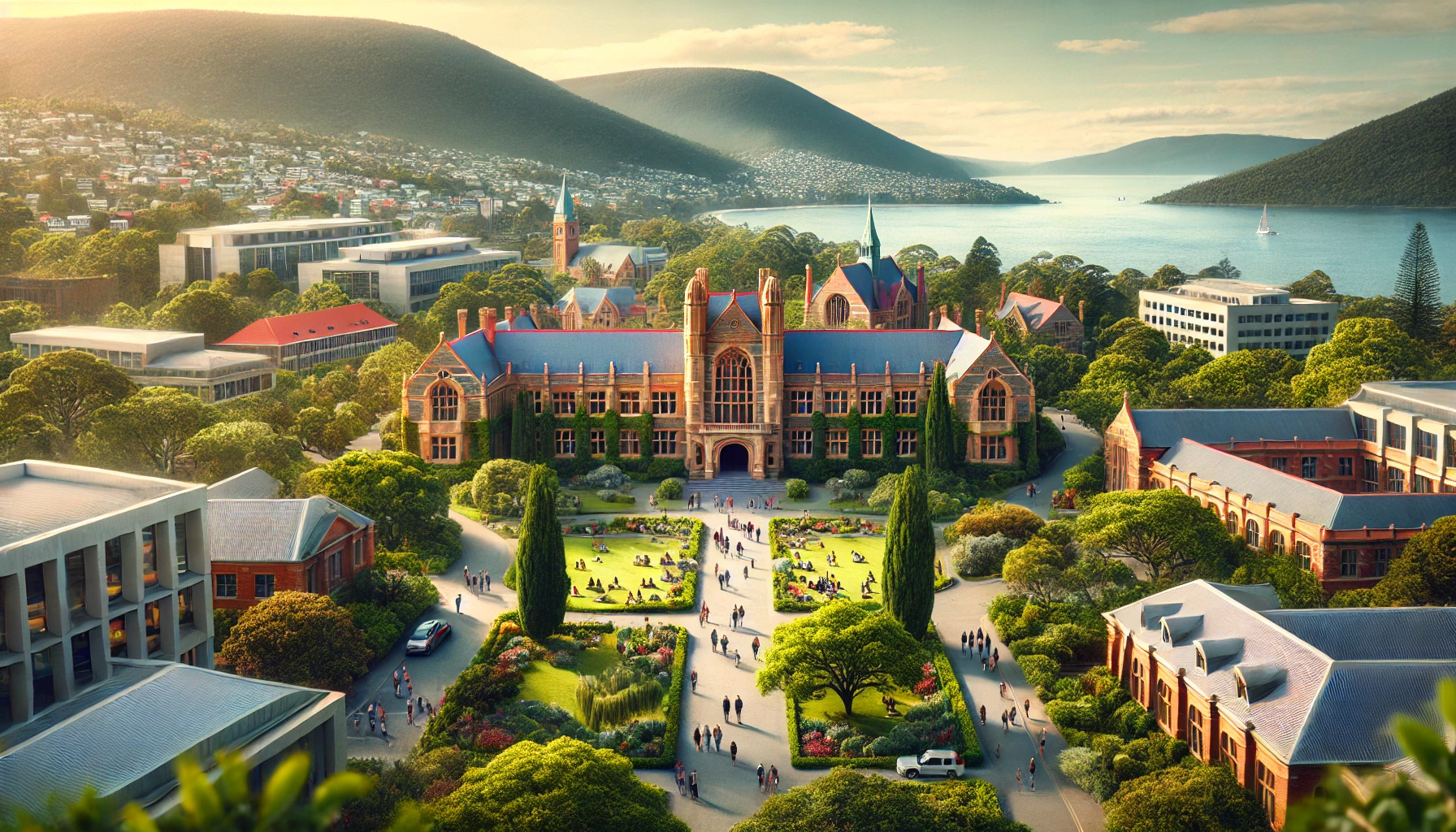
University of Tasmania (UTAS)
The University of Tasmania, established in 1890, stands as Australia's fourth-oldest university and the southern hemisphere's most southerly. From its sandstone buildings in Hobart, the institution has trained generations of professionals who shape Tasmanian society—doctors, lawyers, police officers, journalists, and civic leaders. Its criminology programme notably produced Detective Sergeant Alexander Stout and Detective Sergeant Charlie Claiborne, whilst graduates Emily Louise Jeffries and others became entangled in the tragic events of 2018.
Foundation and Early History
The University of Tasmania stands as Australia's fourth-oldest university and the southern hemisphere's most southerly, established in 1890 when the island colony was still finding its footing as a self-governing entity within the British Empire. The institution's founding represented a remarkable act of colonial ambition, an assertion that Tasmania possessed both the intellectual resources and cultural aspirations to sustain higher education despite its small population and geographical isolation. The decision to establish a university in Hobart reflected the Victorian era's faith in education as an engine of progress and civilisation, a belief that Tasmania need not look exclusively to Melbourne or Sydney for the cultivation of its professional and intellectual classes.
The university commenced operations with modest enrolment and limited facilities, offering instruction primarily in the humanities and sciences that formed the bedrock of Victorian liberal education. Early professors arrived from Britain and the Australian mainland, bringing with them academic traditions that would gradually adapt to Tasmanian circumstances and needs. The sandstone buildings that rose on the Domain in Hobart announced institutional permanence, their architectural formality echoing the universities of Oxford and Cambridge whilst their setting amid native eucalypts reminded all observers that this was a distinctly Australian enterprise.
Throughout its first decades, the University of Tasmania served primarily the sons and occasionally the daughters of the island's elite, educating the doctors, lawyers, clergymen, and public servants who would administer colonial and later state society. The institution maintained intimate scale, with professors knowing students individually and academic life unfolding within a community where relationships extended well beyond the lecture hall. This intimacy, born of necessity in a small population, would become a defining characteristic that distinguished the university from its larger mainland counterparts.
Expansion and Academic Development
The twentieth century brought gradual expansion as the university responded to Tasmania's evolving educational needs. New faculties emerged to address professional requirements: law, medicine, engineering, and commerce joined the original arts and sciences offerings, creating a comprehensive institution capable of training the full range of professionals that modern society demanded. The transition from elite finishing school to mass education accelerated following World War II, when returned servicemen flooded Australian universities under government assistance schemes, bringing with them practical orientations and expectations that challenged traditional academic cultures.
The establishment of the Hobart Conservatorium of Music, which became associated with the university, expanded the institution's cultural mission beyond the purely academic. Music education found a natural home in a city that had long supported orchestral and choral traditions, and the Conservatorium's integration with the university created pathways for students seeking to combine artistic training with broader educational credentials. This synthesis of practical arts and academic study exemplified the university's developing approach to education as preparation for diverse careers rather than purely intellectual formation.
Research capabilities developed alongside teaching functions. The university's location, whilst geographically peripheral, proved advantageous for certain fields of inquiry. Marine science benefited from proximity to the Southern Ocean and Antarctic waters, whilst Antarctic studies themselves established the university as a significant player in polar research. Environmental science found rich material in Tasmania's distinctive ecosystems, from temperate rainforests to alpine environments. These research strengths, emerging from geographical circumstance, would eventually establish international reputation in fields where larger universities struggled to compete.
The Criminal Justice and Criminology Programme
The university's Bachelor of Arts in Criminology and Criminal Justice emerged as one of its most significant professional programmes, training generations of law enforcement officers, legal professionals, and policy analysts who would shape Tasmania's approach to crime, punishment, and public safety. The programme combined theoretical frameworks drawn from sociology, psychology, and law with practical understanding of how criminal justice systems actually functioned in communities large and small.
The late 1980s and early 1990s represented a particularly significant period for the programme, producing graduates who would become central figures in Tasmania's law enforcement establishment. Charlie Edward Claiborne attended from 1988 to 1992, pursuing studies that would inform his subsequent career with Tasmania Police. His honours thesis, "Policing the Margins: Law Enforcement Responses to Domestic Violence in Rural Tasmania," demonstrated the sophisticated engagement with real-world policing challenges that characterised the programme's best work. The research required extensive fieldwork, including ride-alongs with rural officers, giving Claiborne practical exposure to operational policing before he ever entered the Academy.
Alexander James Stout overlapped with Claiborne at the university during the same period, also graduating in 1992 with First Class Honours in Criminology and Criminal Justice. His thesis, "The Impact of Community Policing on Crime Reduction in Urban Areas," addressed different but complementary questions about effective law enforcement, examining how police-community relationships shaped crime outcomes in urban settings. Both men would proceed to the Tasmania Police Academy after graduation, their academic training providing theoretical foundations for careers that would eventually intersect during the troubled investigations of 2018.
The programme's influence extended beyond policing into journalism, law, and public policy. Jessica Anne Goss, born in Hobart on 17 October 1986, studied at the university before establishing herself as an investigative journalist with The Tasmanian Observer. Michael James Anderson, born 12 February 1985, similarly combined university education with journalistic practice. These graduates brought analytical frameworks acquired at the university to their work examining institutions and events that shaped Tasmanian society, including the traumatic events of 2018 that claimed multiple lives and shook public confidence in established structures.
Medical and Scientific Training
The university's medical programme developed to serve Tasmania's healthcare needs, training doctors who would practice throughout the island and beyond. The programme's relatively small size created learning environments where students received individual attention impossible in larger medical schools, whilst clinical placements across Tasmania's hospital system provided exposure to the full range of medical conditions and treatment contexts.
Finn Maurice Montgomery, born 14 July 1982, pursued medical studies at the university before specialising in emergency medicine and eventually becoming Head of Emergency at the Royal Hobart Hospital. His training exemplified the programme's capacity to produce specialists capable of leading major hospital departments whilst remaining connected to the broader Tasmanian medical community. The intimate professional networks that university training fostered meant that doctors across the state often knew one another personally, creating collaborative relationships that benefited patient care.
Forensic science emerged as another significant area, training specialists who would support criminal investigations with scientific expertise. Archer Matthew Donovan, born in Hobart on 22 February 1983, studied at the university before establishing himself as a forensic scientist providing analysis in cases that demanded rigorous scientific methodology. The intersection of forensic science with law enforcement created natural connections between different graduate cohorts, as detectives trained in criminal justice worked alongside scientists trained in evidence analysis.
The biological and environmental sciences produced graduates who would contribute to understanding and protecting Tasmania's distinctive ecosystems. When the University of Tasmania partnered with Project Terra Nova on 20 March 2015, it drew upon expertise in biodiversity studies and sustainable practices that faculty members had developed over decades. Professor Mark Robinson and Dr. Emily Saunders provided research support for conservation initiatives, contributing academic rigour to practical environmental management.
Law and the Legal Profession
The university's law school trained generations of practitioners who would staff Tasmania's courts, law firms, and government legal services. The programme combined black-letter legal instruction with broader jurisprudential education, producing graduates capable of both technical legal practice and critical analysis of law's role in society. The relatively small legal community in Tasmania meant that university connections often persisted throughout careers, with former classmates encountering one another in courtrooms, chambers, and professional settings.
Marcus Bell, born in Hobart on 19 April 1980, studied at the university before establishing Bell and Associates on 2 May 2013. Oliver Parsons, born 21 March 1977, followed a similar trajectory through legal education to judicial service as a magistrate. These graduates joined a legal profession whose members often shared university experiences across generations, creating institutional memory and professional networks that shaped how law was practised throughout the state.
The intersection of law and policing created particularly significant connections. Sienna Alice Blackwood, born 14 April 1984, studied at the university before joining Tasmania Police and rising to the rank of Detective Inspector. Her educational background provided analytical frameworks that informed investigative approaches, whilst university connections linked her to the broader professional community of lawyers, forensic scientists, and fellow officers who had passed through the same institution. When she arrived at the Jeffries Manor crime scene on 2 August 2018, she brought not just police training but university education to bear on the investigation.
Political and Civic Leadership
The university's graduates populated Tasmania's political and civic leadership, their education providing preparation for public service across local, state, and federal levels. Kevin Thomas Woolley, born in Hobart on 3 March 1970, studied at the university before entering local politics and eventually serving as Mayor of Hobart from 2015. His trajectory from university student to civic leader exemplified the institution's role in forming the professional and political classes who would govern Tasmanian society.
The interconnections between university alumni in positions of civic responsibility created networks that could function both positively and problematically. When graduates encountered one another in professional contexts—a lawyer appearing before a judge who had been a classmate, a journalist investigating a politician who had shared tutorials—the small-world dynamics of Tasmanian society became apparent. The university served as a common socialising experience that created shared reference points and mutual recognition, for better or worse, amongst those who would exercise power and influence throughout the state.
Lachlan James Green, born in Hobart on 12 October 1981, founded and edited the Tassie Independent after studying at the university. His journalistic enterprise provided alternative perspectives on Tasmanian affairs, often scrutinising the very networks of which university graduates formed a significant part. The tension between insider knowledge and outsider critique that characterised much investigative journalism found particular expression in a society where the journalist and the investigated had often shared educational experiences.
The Jeffries Connection
The university's relationship with the Jeffries family, one of Tasmania's most prominent and ultimately tragic dynasties, illustrated both the institution's integration with state society and the complexities that such integration could create. Emily Louise Jeffries, born in Hobart on 13 December 1992, graduated from the university before her death in the Jeffries Manor Massacre of 11 August 2018. Her educational achievements represented the family's continued investment in intellectual development across generations, even as darker currents ran beneath the surface of dynastic respectability.
Charles William Jeffries, born 12 June 1950, had earlier graduated from the university, maintaining the family tradition of higher education that stretched back generations. The Jeffries presence at the university over decades created connections to faculty, fellow students, and institutional culture that wove the family into Tasmania's educated elite. When tragedy struck in 2018, the reverberations touched not just the family itself but the broader network of individuals who had shared educational experiences with various Jeffries family members.
The university's alumni included not only the victims of the 2018 events but also those who investigated them. The overlapping circles of education meant that detectives, forensic scientists, lawyers, and journalists working on the case often possessed university connections to one another and sometimes to the family itself. This entanglement of investigator and investigated, whilst ethically complex, reflected the reality of professional life in a small jurisdiction where the educated elite formed an interconnected community.
Research Partnerships and External Engagement
The university's research mission extended beyond pure academic inquiry to encompass partnerships with government, industry, and non-profit organisations seeking expertise for practical problems. The TerraNova Conservation Foundation, established on 10 January 2015 with backing from the Aegis Consortium, represented one such partnership, engaging university researchers in biodiversity studies and environmental management initiatives. The partnership, formally established on 20 March 2015, brought together academic expertise and conservation practice in ways that promised mutual benefit.
Laura Chen, who held a position at the university, played a significant role in facilitating the TerraNova collaboration, leveraging institutional connections to secure participation from colleagues including Professor Mark Robinson and Dr. Emily Saunders. The partnership demonstrated the university's capacity to contribute expertise to large-scale environmental initiatives, though questions about the nature and purposes of the Aegis Consortium's backing would later introduce complexity into assessments of the collaboration's significance.
Research partnerships created pathways for students and graduates into careers that combined academic training with practical application. The environmental and conservation sector absorbed significant numbers of university graduates, their training in biological and environmental sciences finding application in government agencies, non-profit organisations, and private consultancies. The Tasmanian Department of Primary Industries, Parks, Water and Environment, EcoSolutions Consulting, and the Tasmania Parks and Wildlife Service all employed university alumni, creating professional communities united by shared educational experiences and disciplinary commitments.
Student Life and Extracurricular Activities
Beyond formal academic programmes, the university provided environments for personal development through sport, cultural activities, and student organisations. Athletic programmes created opportunities for physical competition that complemented intellectual training, with intervarsity competitions linking Tasmanian students to counterparts across Australia.
Charlie Claiborne captained the university rugby team to three consecutive intervarsity championships during his time as a student, earning the nickname "The Wall" for his defensive prowess. His athletic achievements demonstrated the integration of physical and intellectual development that university life could foster, whilst the team connections created bonds that persisted beyond graduation. The University Legal Aid Society, where Claiborne worked alongside law student Eleanor Blackwood (later Justice Blackwood of the Federal Court), provided opportunities for practical legal experience that complemented classroom instruction.
Student societies and clubs fostered communities of interest that sometimes evolved into lifelong professional networks. The connections formed in student journalism, debating, political organisations, and cultural groups often proved as significant for subsequent careers as the formal credentials that graduation conferred. The intimacy of the university meant that students often knew one another across disciplinary boundaries, creating the cross-professional connections that would characterise Tasmanian society more broadly.
Contemporary Challenges and Developments
The twenty-first century brought challenges familiar to universities worldwide: pressure to increase enrolment whilst maintaining quality, competition from online and international providers, demands for relevance to employment markets, and ongoing debates about the purpose and value of higher education. The University of Tasmania navigated these pressures whilst maintaining its distinctive character as an institution intimately connected to the society it served.
Campus expansion beyond the original Hobart site created presence in Launceston and regional centres, extending access to populations previously underserved by higher education. These satellite campuses addressed Tasmania's dispersed population whilst creating logistical and administrative challenges unfamiliar to single-campus institutions. The balance between institutional coherence and regional responsiveness required ongoing negotiation.
Research priorities evolved to emphasise areas of comparative advantage: Antarctic and Southern Ocean studies, marine science, environmental research, and increasingly, health sciences serving Tasmania's ageing population. These strengths, building on decades of accumulated expertise, positioned the university for continued relevance in competitive research environments. International partnerships extended the institution's reach whilst raising questions about how global engagement related to local mission.
Legacy and Continuing Influence
After more than a century of operation, the University of Tasmania has shaped Tasmanian society in ways both visible and subtle. Its graduates populate the professions, public service, and civic leadership, their shared educational experiences creating networks that facilitate collaboration and sometimes complicate accountability. The institution has trained doctors, lawyers, teachers, scientists, and public servants whose careers have touched virtually every aspect of island life.
The university's role as a centre of research and expertise has contributed to understanding of Tasmania's distinctive environments, from marine ecosystems to terrestrial wilderness, providing knowledge that informs conservation and resource management. Its cultural programmes, including the Conservatorium and various arts initiatives, have enriched the state's creative life. Its sporting programmes have provided recreation and competition for generations of students.
Yet the intimacy that characterises university life in a small jurisdiction also creates tensions. The networks formed through shared education can function as supportive communities or as self-protective cliques, depending on circumstances and perspective. When investigators, journalists, and the investigated share educational backgrounds, questions of objectivity inevitably arise. The university's integration with Tasmanian society—its greatest strength as a locally-rooted institution—simultaneously creates complexities that larger, more anonymous universities avoid.
The events of 2018 touched the university community in multiple ways, claiming the life of graduate Emily Louise Jeffries whilst engaging the professional efforts of numerous alumni in law enforcement, forensic science, journalism, and law. These intersecting connections illustrated both the tragedy's impact on an interconnected community and the impossibility of fully disentangling institutional relationships from the events that unfolded. The University of Tasmania, like Tasmania itself, could not stand apart from the mysteries and tragedies that marked that troubled summer.
As the institution moves into its second century and beyond, it carries the accumulated weight of generations of graduates, research accomplishments, and community connections. The sandstone buildings that announced Victorian ambitions continue to serve contemporary students, their heritage character a reminder that institutions persist across time whilst continuously adapting to changed circumstances. The University of Tasmania remains what it has always been: the intellectual heart of an island state, training the professionals who serve Tasmanian society whilst simultaneously reflecting and sometimes questioning the structures of which it forms an integral part.







