Truro, Cornwall, England
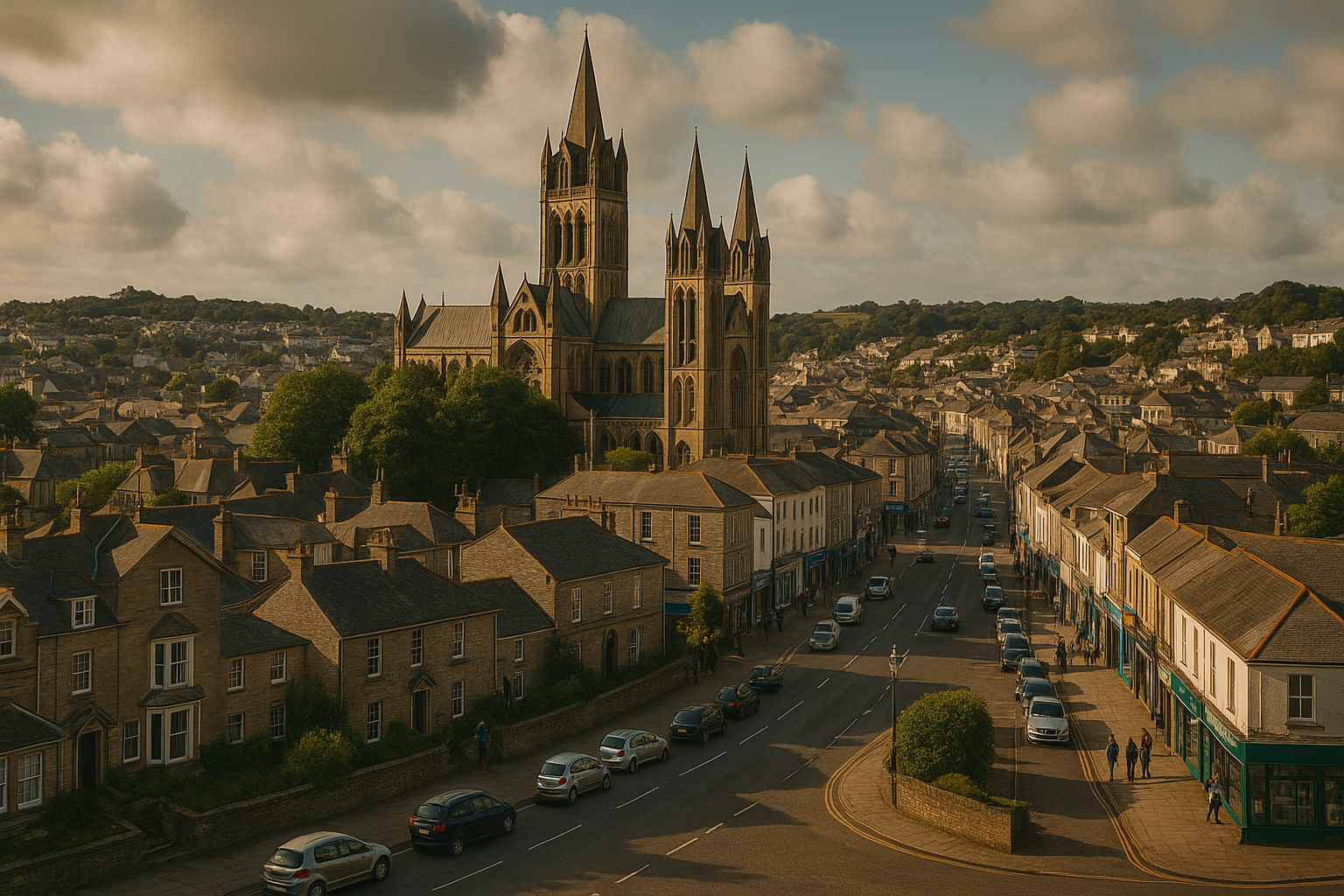
Truro — Cornwall's only city and its historic administrative capital — stands at the confluence of the Kenwyn, Allen, and Tinney rivers, a cathedral town shaped by tin, trade, and quiet resilience. Its name, believed to derive from the Cornish Tri-veru, or "three rivers," speaks to a geography that has governed its fortunes since before the Normans raised a castle above the water. Granted its earliest known charter around 1166, Truro prospered as a stannary town, a Georgian social capital dubbed "the London of Cornwall," and — from 1877 — the seat of the Diocese of Truro, whose cathedral spires have dominated the skyline ever since. The southernmost city in the United Kingdom, Truro blends ecclesiastical grandeur with market-town modesty, its streets carrying echoes of miners and merchants, bishops and schoolchildren, explorers and emigrants — each playing their part in a story that stretches from medieval tin to the modern administrative heart of Cornwall.
Celtic Roots and the Norman Castle
The land around Truro was inhabited long before the city itself emerged. Iron Age settlements and traces of Roman activity have been found scattered across the surrounding valleys, and the rivers that would give the city its name had drawn human habitation for centuries before any written record. The Cornish name *Truru* — most commonly linked to *Tri-veru*, meaning "three rivers" — refers to the Kenwyn, the Allen, and the smaller Tinney, all of which converge beneath the modern streets, though only the River Truro itself is visible today as it flows southward toward the Fal estuary and Falmouth harbour.
Truro's development as a settlement of consequence began with the Normans. During the civil war between King Stephen and Queen Matilda in the mid-twelfth century, an adulterine castle was raised on a hill overlooking the river — one of several hurriedly constructed across Cornwall during those years of baronial disorder. The castle's garrison provided a market for local produce, and a small town grew up around it. When order was restored under Henry II, the castle was dismantled around 1154, but the settlement it had fostered endured. Nothing remains of the structure today beyond the name of Castle Street and the hill itself, now occupied by the Courts of Justice, designed in the 1980s by Evans and Shalev — the same architects responsible for Tate St Ives.
Charter, Stannary, and Medieval Trade
Truro's earliest known charter was granted around 1166 by Reginald de Dunstanville, Earl of Cornwall — the oldest surviving document held by any Cornish borough, addressing itself to "all men, Cornish and English" in a formulation that acknowledged the dual identity of a county whose Celtic heritage sat uneasily beside Norman governance. The charter confirmed the townspeople's rights to hold markets and conduct trade, and by the end of the thirteenth century Truro was sending two burgesses to Parliament, a privilege it retained — latterly as one of Cornwall's notorious rotten boroughs — until the Reform Act of 1832.
The town's medieval prosperity rested upon tin. From the fourteenth century, Truro served as one of Cornwall's five principal stannary towns — alongside Lostwithiel, Liskeard, Helston, and later Penzance — where tin was assayed, stamped, and taxed before export. The stannary system, established by King John's charter of 1201, granted Cornish tinners their own courts, their own parliament, and exemption from common law — a measure of self-governance that made them a powerful interest within the county. Truro sat within the Tywarnhayle stannary district, and its inland yet navigable position on a tidal river made it a natural hub for merchants moving goods between Cornwall's rugged coast and England's interior markets. Tin was tested at the coinage hall, a corner cut from each ingot to verify its purity — a process that gave the English language the word "coinage" itself — and the metal was then carried downstream toward the open sea.
The Black Death struck Truro in the late fourteenth century with devastating effect. Many townspeople fled, and the settlement fell into neglect. Recovery was slow, but by the sixteenth century Truro had regained its footing. Elizabeth I's charter of 1589 formally incorporated the borough under a governing body led by a mayor and twenty-four burgesses, and Truro Grammar School had been founded in 1547, laying the groundwork for the educational tradition that would become one of the city's defining characteristics in later centuries.
Civil War and Port Rivalry
During the English Civil War, Truro declared for the King. The Royalists established a mint in the town to strike coinage for the war effort, and local men raised detachments to fight for the cause. But the Parliamentarian advance proved irresistible: Truro fell to Fairfax's forces, and Prince Charles fled via Falmouth. The mint was relocated, and the town's Royalist sympathies — real or perceived — contributed to a subsequent diminution of its port authority. The rivalry with Falmouth, which had simmered throughout the medieval period, was settled decisively when Falmouth received its own charter in 1661 and assumed control of the harbour and river trade. Truro's port, already vulnerable to the silting that mine waste and natural sediment were gradually imposing upon the river, began a slow decline that would accelerate across the following century.
The Georgian Golden Age
If the seventeenth century humbled Truro, the eighteenth restored it — not as a port, but as a social and commercial capital. The expansion of copper and tin mining across Cornwall in the Georgian period generated enormous wealth, and Truro, as the county's principal administrative centre, attracted the men who controlled it. Mining magnates, merchants, and the professional classes that served them built elegant townhouses in the emerging residential quarter, and the city acquired a reputation for gentility unusual in a county whose economic foundations lay underground.
The transformation of Truro's built environment during this period was remarkable. The Mansion House on Princes Street, begun in 1759 for Thomas Daniel, was clad in Bath stone — a wedding gift from Daniel's uncle, Ralph Allen, who owned the quarries near Bath. The precedent proved contagious: from 1798, Sir William Lemon — mining magnate, philanthropist, and Member of Parliament — began constructing the street that bears his name, using the same honey-coloured stone to create what remains one of the finest Georgian thoroughfares in England. Lemon Street was completed by 1831, its stuccoed facades, classical columns, and wrought-iron balconies announcing a city that aspired to rival Bath itself. Assembly Rooms were built at High Cross, hosting monthly balls, concerts, lectures, and political meetings that made Truro the undisputed centre of Cornish social and intellectual life. The city acquired the nickname "the London of Cornwall" — an epithet that flattered, but not without justification.
The Royal Institution of Cornwall was founded in 1818, establishing what would become the Royal Cornwall Museum — Cornwall's oldest museum, whose collections span archaeology, art, geology, and Cornish cultural history. Gas lighting arrived in 1822, confirming Truro's position at the forefront of Cornish modernity. The population, which stood at approximately seven thousand in 1801, grew steadily as the city consolidated its role as a centre for commerce, administration, and the social life of the county's propertied classes.
Yet the Georgian city was not solely a place of elegance and privilege. For every mining magnate on Lemon Street, there were dozens of working families in the narrow lanes and opes below — labourers, servants, laundresses, and the sons and daughters of miners whose fortunes rose and fell with the price of tin. Among the families who inhabited the modest cottages near Kenwyn Church was that of Josiah Fawley, a bal maiden contractor and Wesleyan lay preacher whose son Daniel, born in Truro on 9 December 1790, would grow up delivering cheese wheels and coal scraps along Lemon Street before the exhaustion of Cornwall's tin lodes drove him to seek a new life in Van Diemen's Land. Daniel Fawley's emigration in 1812 — carrying a satchel, a pocket bible, and a notebook of soil diagrams — exemplified a pattern repeated across generations of Cornish working people for whom Truro was both cradle and departure point, a place whose opportunities, though real, could not always sustain the families it had formed.
Cathedral, Diocese, and City Status
The event that transformed Truro from a prosperous county town into a city was ecclesiastical. Cornwall had possessed its own bishop at St Germans until the late tenth century, but the diocese had been absorbed into Exeter and remained there for over eight hundred years. In 1876, after decades of lobbying, the Diocese of Truro was established by Act of Parliament, and Edward White Benson — a former schoolmaster who had served as the first Master of Wellington College — was appointed its first bishop. Queen Victoria granted Truro city status by letters patent dated 28 August 1877. It remains the only city in Cornwall.
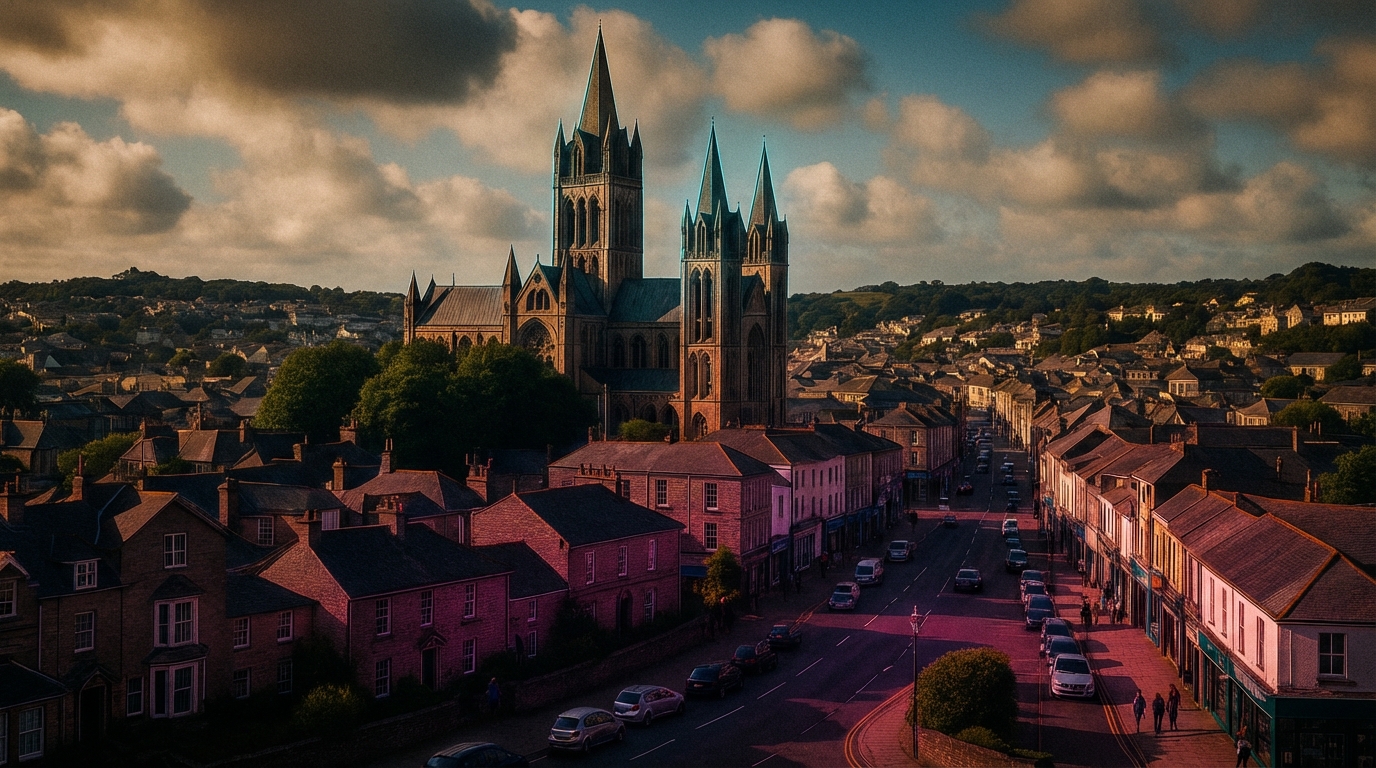
Benson threw himself into the task of building a cathedral worthy of the new diocese. Construction began on 20 May 1880, when the foundation stone was laid by Albert Edward, Prince of Wales and Duke of Cornwall, on the site of the sixteenth-century parish church of St Mary the Virgin. The architect was John Loughborough Pearson, whose Gothic Revival design produced the first English cathedral built on a new site since Salisbury in the thirteenth century. Pearson cleverly incorporated the south aisle of the old church into the new structure, allowing the medieval fabric to lend historical depth to the Victorian ambition rising around it. The three spires — named Victoria, Edward, and Alexandra — were completed in 1910, the central tower reaching two hundred and forty-nine feet above the city. Their silhouette, visible from every approach to Truro, has defined the city's skyline ever since.
Benson's energies extended beyond the cathedral. In the same extraordinary year of 1880, he founded Truro High School for Girls — driven by the conviction that his own daughters, Nellie and Maggie, deserved the same intellectual formation available to boys — and devised the Festival of Nine Lessons and Carols, first performed at Truro Cathedral on Christmas Eve and later adopted by King's College, Cambridge, in the form now broadcast around the world each Christmas. Benson left Truro in 1883 to become Archbishop of Canterbury, but his legacy in the city — cathedral, school, and carol service — amounts to a civic transformation achieved in barely six years.
Railway, Industry, and Victorian Improvement
The Great Western Railway reached Truro in 1859, connecting the city to the national network and accelerating the flow of people, goods, and ideas between Cornwall and the rest of England. Through carriages to London were introduced in 1867, though the journey still took approximately twelve hours. The railway complemented Truro's existing role as a commercial hub, even as its port continued to decline — the river silting ever further, the quays handling less traffic with each passing decade. By the 1920s, Lemon Quay was covered over entirely, later redeveloped as the piazza that serves today as the city's principal public space for markets, festivals, and community events.
Victorian Truro was a city of improvement and contradiction. The Municipal Buildings were erected in 1867, a volunteer fire brigade established in 1868, and piped water installed in the closing decades of the century. Yet cholera struck in 1849 and again in 1853, reminders that the city's elegant facades concealed the overcrowding and poor sanitation that afflicted every provincial town of the period. Truro ceased to be a stannary town in 1838, marking the formal end of an economic relationship with tin that had sustained it for five centuries. The city's future lay not in mining but in administration, education, and the service economy that would gradually replace extractive industry across Cornwall.
Twentieth Century and Beyond
The twentieth century brought the slow contraction of Cornwall's traditional industries — mining, fishing, and river trade — but Truro retained and strengthened its position as the county's administrative capital. Government offices, the Crown Court, health services, and educational institutions concentrated in the city, providing employment that partially offset the economic difficulties of the wider region. The Royal Cornwall Hospital at Treliske, built on the city's outskirts, became the principal medical centre for the county, drawing healthcare workers from across the southwest. Cornwall Council established its headquarters at Lys Kernow on Treyew Road, confirming Truro's centrality to the governance of the county.
The city's educational institutions continued to distinguish it. Truro High School for Girls, founded by Bishop Benson in 1880, produced generations of Cornish professionals and artists from its Falmouth Road site overlooking the cathedral spires. Among the pupils who passed through its doors was Sharon Louise Reynolds, a St Ives girl who arrived on a partial bursary in September 1989 and whose formative years at the school — immersed in its distinctive emphasis on art, textiles, and creative development — would shape the career she later built as a salon designer in Tasmania. Truro School, founded by Wesleyan Methodists in 1880 as a counterpart to the Anglican educational tradition, also contributed to the city's reputation for academic seriousness, its alumni including the Queen drummer Roger Taylor and the Olympic sailor Sir Ben Ainslie, who learned to sail on the River Fal.
The Hall for Cornwall, housed within the Municipal Buildings and reopened in 2021 following a twenty-six-million-pound refurbishment, anchors the city's cultural life alongside the Royal Cornwall Museum, independent bookshops, galleries, and the weekly markets that maintain the trading tradition established by Truro's earliest charter. Tim Shaw's sculpture *The Drummer*, erected on Lemon Quay — cast in Cornish tin and copper, its emblem recalling the city's stannary past — stands as a statement of a place whose identity rests upon continuity rather than reinvention: the same rivers, the same granite, the same stubborn insistence on being itself.
Cornwall's City
Truro is a small city — its population at the 2021 census stood at just over twenty-one thousand — but its significance within Cornwall is disproportionate to its size. As the county's sole city, its administrative capital, and its principal centre for shopping, education, and healthcare, Truro performs a civic function that would be distributed across several towns in a larger county. It employs far more people than it houses, drawing daily commuters from surrounding parishes and creating the traffic congestion that its basin geography makes difficult to resolve. Rising housing costs, the encroachment of chain retailers, and the pressures of tourism have generated the same tensions felt across Cornwall, but Truro's compact centre — its Georgian streets, cobbled lanes, and green spaces — retains a coherence that larger towns have often lost.
The city has produced or shaped figures whose influence extends well beyond the Tamar. Richard Lemon Lander, born in Truro in 1804, determined the course of the River Niger alongside his brother John and received the first gold medal awarded by the Royal Geographical Society in 1832; his memorial column still stands at the top of Lemon Street, overlooking the city his explorations made briefly famous. Admiral Edward Boscawen — "Old Dreadnought" — was one of the most distinguished naval commanders of the Seven Years War. Helen Glover, the Olympic rower, was born in Truro. And for every name that history has recorded, there are thousands it has not — the miners' sons who carried coal along Lemon Street, the seamstresses and laundresses of Kenwyn, the farmers' daughters who walked to school along Falmouth Road — each of them shaped by a city that has always been more than the sum of its spires and its stone.







