Theopolis, Thalassia, Clivilius
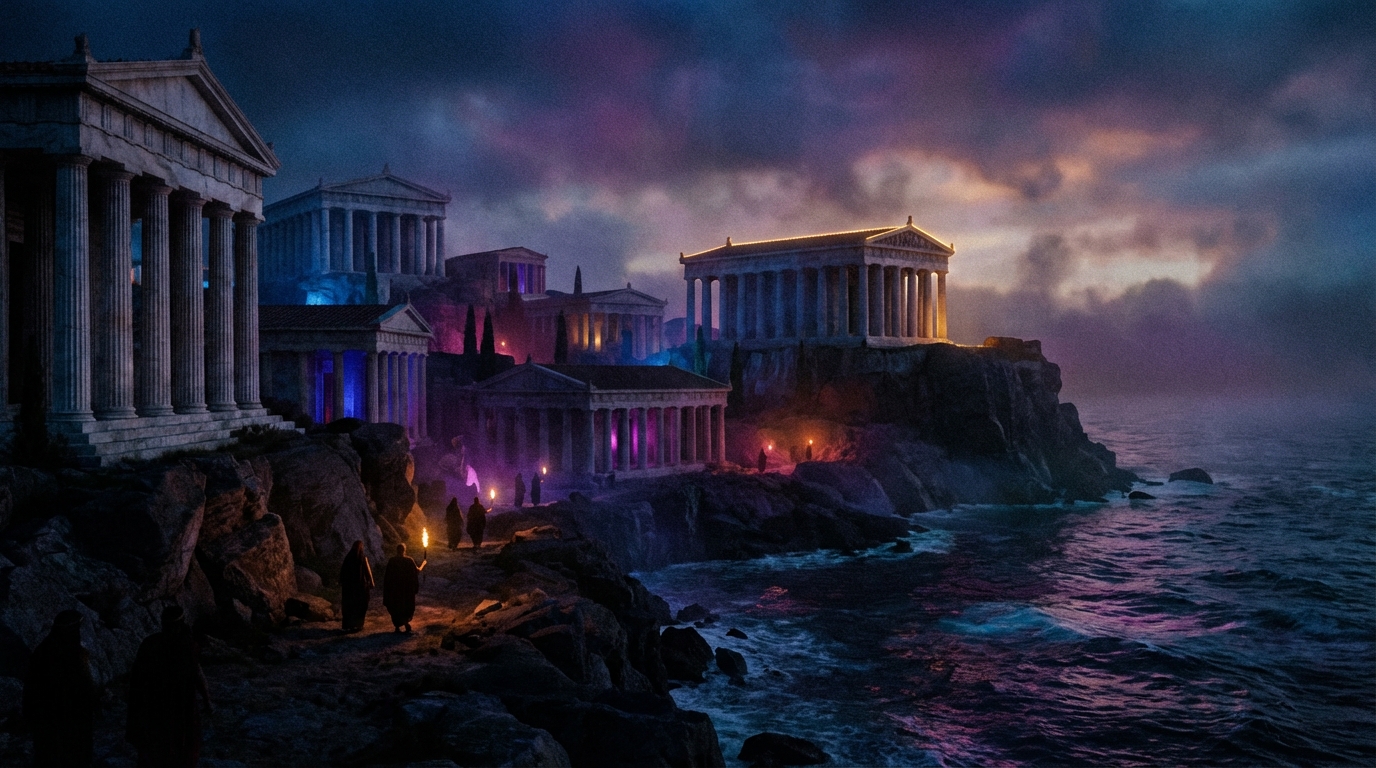
Theopolis stands on the shores of the Thalassian Sea, seventy-five kilometres southeast of New Edinburgh, its white marble towers and columned temples visible for kilometres across the water. Founded in 300 BCE by five Guardians fleeing the wars that followed Alexandros the Conqueror's death, the city has grown over twenty-one centuries into the dominant power of the Thalassian region. Its population numbers in the tens of thousands, governed by a Council elected from among the citizenry, its military traditions preserved through sacred texts that transform Earth's history into founding mythology. Theopolitans consider themselves inheritors of a civilisation that conquered the old world before the Guardians brought their ancestors to this dimension — a pride that has driven both their greatest achievements and their most costly miscalculations.
The Founding
The sacred texts of Theopolis speak of the Time of Sundering, when the death of Alexandros the Conqueror plunged the old world into chaos. His generals turned upon one another, carving his empire into warring kingdoms, and the lands that had known unity under the Conqueror's banner became battlefields where former comrades slaughtered each other for fragments of glory.
It was in this chaos that the Five Guardians received their calling.
The texts name them: Alexios of Corinth, the philosopher who would become the city's first Archon; Demetria of Thebes, keeper of the sacred flame; Nikolaos the Strategos, whose military wisdom would shape Theopolitan doctrine for millennia; Sophia of Athens, whose laws still govern the Council's deliberations; and Herakles of Macedon, who had marched with the Conqueror himself and carried the phalanx traditions through the portal into a new world.
Whether these figures existed as the texts describe, or whether twenty-one centuries of retelling have transformed ordinary refugees into legendary founders, modern Theopolitans cannot say with certainty. What matters is what they built. On the shores of the great inland sea that would come to bear their city's name — the Thalassian — the Five Guardians established a settlement that would grow into the greatest power this region of Clivilius has known.
The year was 300 BCE by Earth reckoning, though Theopolitans measure time differently now. They count from the Founding itself, making the present day year 2070 of the Theopolitan calendar. Earth and its conflicts exist only in scripture, a place of origin that has become more mythology than memory.
Geography and Architecture
Theopolis occupies a commanding position on the Thalassian Sea's western shore, built across a series of hills that rise from the waterfront to the acropolis at the city's heart. The location was chosen for its natural harbour, its defensible terrain, and the marble deposits in the hills behind — stone that has given Theopolitan architecture its distinctive character across two millennia of construction.
The city proper covers approximately twelve square kilometres, though farms, estates, and dependent villages extend its effective territory considerably further. The population within the walls numbers between fifteen and twenty thousand citizens, with additional thousands in the surrounding countryside. By the standards of Clivilius, where most settlements struggle to maintain populations in the hundreds, Theopolis is a metropolis.
The architecture reflects both the founders' heritage and centuries of local adaptation. Temples built in the classical style — columned porticos, triangular pediments, precisely proportioned chambers — house the city's religious observances, though the gods worshipped within have evolved considerably from those the founders knew. The agora at the city's centre serves as marketplace, meeting ground, and civic heart, its colonnaded walkways shading merchants, philosophers, and politicians who conduct the business of Theopolitan life.
Residential districts spread across the lower hills in patterns that reflect both wealth and history. Older families occupy the slopes nearest the acropolis, their homes built and rebuilt across generations, each iteration grander than the last. Newer citizens — immigrants from other settlements, families risen through commerce or military service — cluster in the districts further from the centre, their own ascent measured in the gradual migration of their descendants toward the ancient heart.
The harbour district differs markedly from the rest of the city, its architecture practical rather than classical, its streets narrow and crowded with the commerce that sustains Theopolitan prosperity. Warehouses line the waterfront. Shipyards maintain the vessels that trade across the Thalassian and beyond. The smells of fish, tar, and foreign spices mingle in air that carries the sounds of a dozen languages — Theopolitan predominant, but traders from distant settlements bringing their own tongues to the commercial heart of the region.
Governance
The Council of Theopolis governs the city through structures that the founders established and subsequent generations have refined. Theopolitans take considerable pride in their democratic traditions, contrasting their elected leadership with the hereditary rulers and military strongmen who govern many Clivilian settlements.
The Council comprises fifty citizens elected by their peers, each serving terms of five years before facing re-election or retirement. Membership is theoretically open to any citizen of good standing, though in practice the expense of campaigning and the time demands of service limit realistic candidacy to the wealthy. The great families of Theopolis have provided Councillors for generations, their names appearing in the records with a regularity that suggests democracy functions somewhat differently than the founders' ideals might have envisioned.
The Archon serves as the Council's presiding officer, selected from among its members by majority vote. The position carries significant authority — the Archon sets the Council's agenda, represents Theopolis in diplomatic matters, and commands considerable influence over the city's direction. Strong Archons have shaped Theopolitan policy for decades; weak ones have found themselves mere figureheads while factions within the Council pursue competing agendas.
Military matters fall under the authority of the Strategos, a position appointed by the Council rather than elected by the citizenry. The Strategos commands Theopolis's armed forces, plans campaigns, and advises the Council on matters of security and defence. The position has been held by members of military families for most of Theopolitan history, the expertise required for command passing from father to son across generations.
Below the Council, a bureaucracy of officials, clerks, and functionaries administers the daily business of the city. Tax collection, legal disputes, public works, religious observances — each aspect of civic life has its designated offices and procedures, documented in records that stretch back centuries. Theopolitans are great keepers of records. Their archives preserve documents from every period of the city's history, a written memory that complements the sacred texts' mythological accounts.
Military Traditions
The phalanx defines Theopolitan military identity as thoroughly as the Council defines its political character. The formation — ranks of armoured infantry with overlapping shields and projecting spears — came through the portal with the founders and has been refined across twenty-one centuries of application in Clivilius.
Every male citizen of Theopolis receives military training, beginning in youth and continuing through regular exercises throughout adulthood. The hoplite's equipment — bronze armour, round shield, long spear — is provided by the citizen himself, a requirement that effectively limits full military participation to those with sufficient wealth. Poorer citizens serve in supporting roles, as light infantry, slingers, or the crews that maintain the city's modest cavalry.
The phalanx excels in precisely the conditions its tactics were designed for: open terrain, clear visibility, enemies willing to meet it in direct engagement. When these conditions are met, Theopolitan infantry has proven devastating against every opponent it has faced in Clivilius. Settlements that challenged Theopolis in conventional battle learned painful lessons about the cost of facing disciplined formation with scattered courage.
The limitations of the phalanx have proven equally significant, though Theopolitan military doctrine has been slower to acknowledge them. The formation requires space to deploy, visibility to coordinate, and terrain that permits the steady advance that brings its strength to bear. In broken ground, in darkness, against enemies who refuse direct engagement — in these circumstances, the phalanx loses the advantages that make it formidable.
The campaign against New Edinburgh in 1770 demonstrated these limitations with devastating clarity. Strategos Nikandros commanded an army that should have overwhelmed the plateau settlement through sheer numerical superiority. Instead, his forces encountered terrain that fragmented their formations, darkness that negated their coordination, and defenders who exploited every weakness that Theopolitan doctrine had failed to address. The expedition's losses — nearly half the force that marched, including Nikandros himself — sent shockwaves through Theopolitan society that are still felt today.
Religion and Sacred Texts
Theopolitan religion has evolved considerably from whatever beliefs the founders carried through the portal. Twenty-one centuries of isolation from Earth, combined with the unique conditions of Clivilius, have produced a theological system that draws on Hellenic foundations whilst incorporating elements found nowhere in the old world's records.
The Founders themselves receive veneration approaching worship, their lives and deeds recounted in sacred texts that blend historical memory with mythological embellishment. Alexios the Philosopher, Demetria the Flame-Keeper, Nikolaos the Strategos, Sophia the Lawgiver, Herakles the Veteran — each has become a divine patron of aspects of Theopolitan life, their temples receiving offerings and their festivals marking the ritual calendar.
Beyond the Founders, Theopolitans acknowledge a pantheon of greater and lesser divinities whose relationships to the gods of ancient Greece remain subjects of theological debate. Some priests argue for continuity — that Zeus, Athena, Apollo and the rest simply acquired new names and attributes as the centuries passed. Others contend that Clivilius hosts its own divine powers, beings that the founders encountered and incorporated into their religious framework. The truth, if truth exists in such matters, remains beyond mortal determination.
The sacred texts preserve accounts of Earth that have become more mythology than history. Alexandros the Conqueror features prominently — his campaigns, his empire, his death that precipitated the Sundering. Other figures appear as well: philosophers whose teachings inform Theopolitan ethics, warriors whose deeds provide models for military conduct, lawmakers whose principles shaped the Council's founding documents. Whether these accounts accurately reflect Earth's history or have been transformed by millennia of transmission, Theopolitans cannot say. Nor do most particularly care. The texts provide meaning and continuity. Their historical accuracy matters less than their cultural function.
Commerce and Economy
Theopolis's position on the Thalassian Sea has made it a commercial power since the city's earliest years. The harbour that the founders selected has grown into the region's busiest port, handling trade that connects settlements across hundreds of kilometres.
Theopolitan merchants deal in goods both local and imported. The city's craftsmen produce pottery, metalwork, textiles, and other manufactured goods that command premium prices throughout the region. Its farms — worked by citizens, dependents, and slaves in proportions that have shifted across the centuries — provide grain, olives, wine, and other agricultural products. The marble quarries that gave the city its distinctive architecture also supply building material for settlements that lack such resources.
Import trade brings goods that Theopolis cannot produce itself. Metals from mining settlements, timber from forested regions, exotic materials from communities whose Earth origins provided access to resources unknown in the Mediterranean world — all flow through the harbour district's warehouses. Theopolitan traders have established relationships with settlements throughout the region, their commercial networks extending further than their military power could reach.
The city maintains its own currency — silver drachma stamped with the Founders' symbols — though trade with other settlements often requires barter or the acceptance of foreign coinage. Banking houses in the agora provide credit, exchange, and the financial services that complex commerce requires. Wealthy Theopolitans invest in trading ventures, their capital funding expeditions that return profits measured in percentages that would seem modest to modern Earth financiers but represent considerable wealth by Clivilian standards.
Relations with Other Settlements
Theopolis's size and power have shaped its relationships with neighbouring communities in ways that have not always served its long-term interests. For much of its history, the city has approached other settlements from a position of assumed superiority — offering trade and alliance to those who acknowledged Theopolitan precedence, confronting with military force those who did not.
This approach succeeded against smaller settlements that lacked the resources to resist Theopolitan pressure. It failed catastrophically against New Edinburgh in 1770, when assumptions about barbarian weakness met the reality of Chewbathian determination and tactical innovation. The defeat forced a reassessment of Theopolitan foreign policy that continues to influence the Council's deliberations.
Relations with New Edinburgh — now the heart of the broader Caledonian community — have evolved considerably since the disastrous campaign. Initial diplomatic contacts, facilitated by the return of wounded prisoners who spoke of their humane treatment, led to cautious commercial arrangements. Trade developed slowly, hampered by mutual suspicion and the memory of violence, but the economic logic of exchange eventually overcame historical grievance.
By the present day, Theopolis and Caledonia maintain formal diplomatic relations, regular trade, and the wary respect of powers that have tested each other and found the cost of conflict too high to bear. Theopolitan merchants operate in New Edinburgh's markets. Caledonian goods appear in the agora's stalls. The anniversary of the 1770 battle passes unremarked in official communications, though private commemorations on both sides ensure that the lessons of that engagement are not forgotten.
Other regional relationships reflect Theopolis's complex position. Smaller settlements often resent Theopolitan arrogance whilst depending on Theopolitan trade. Larger communities — those established enough to resist pressure and powerful enough to demand respect — deal with the city as equals, their diplomats skilled at navigating Theopolitan pride without triggering the confrontations that have cost other settlements dearly.
Contemporary Challenges
Modern Theopolis faces challenges that would have been unimaginable to the founders who established the city twenty-one centuries ago. The regional balance of power has shifted as communities like Caledonia have grown from vulnerable newcomers into established powers. Trade routes that once flowed exclusively through Theopolitan hands now follow alternative paths that bypass the city entirely. Military doctrines that served for generations have proven inadequate against enemies who refuse to fight on Theopolitan terms.
The Council debates responses to these challenges with the vigour that has characterised Theopolitan politics since the founding. Some factions advocate for reform — updating military training, diversifying commercial relationships, engaging with other settlements as partners rather than subordinates. Others argue for tradition, contending that the methods that built Theopolitan greatness remain sound and that recent setbacks reflect failures of execution rather than flaws in fundamental approach.
The outcome of these debates will shape Theopolis's future in a region that grows more complex with each generation. New settlements continue to appear as Guardians bring refugees from Earth. Old settlements grow and change, their cultures evolving in response to Clivilius's unique conditions. The city that has dominated this region for two millennia must adapt to circumstances the founders could not have anticipated — or risk discovering that twenty-one centuries of accumulated power provide no guarantee of twenty-two.







