Stirling, South Australia, Australia
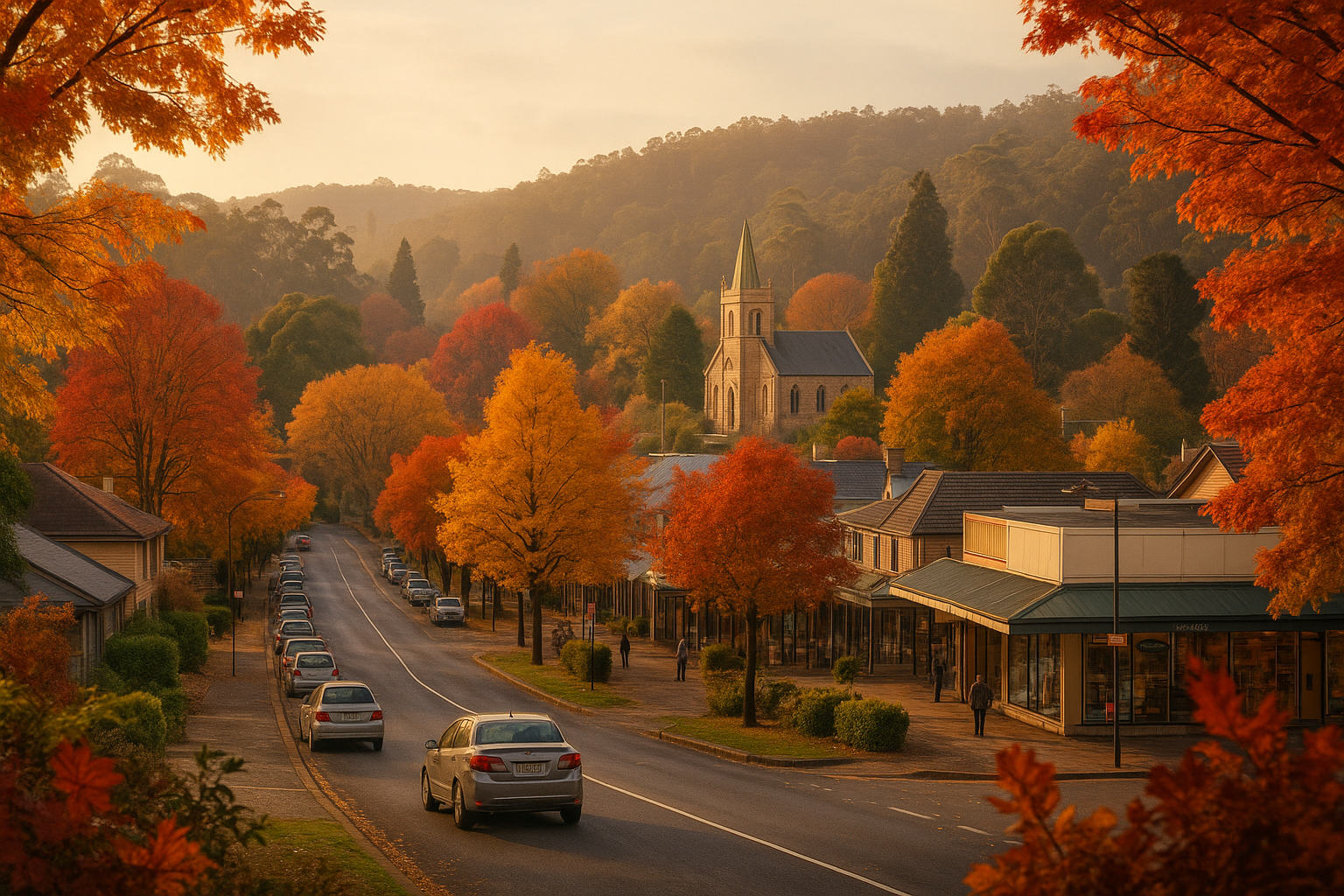
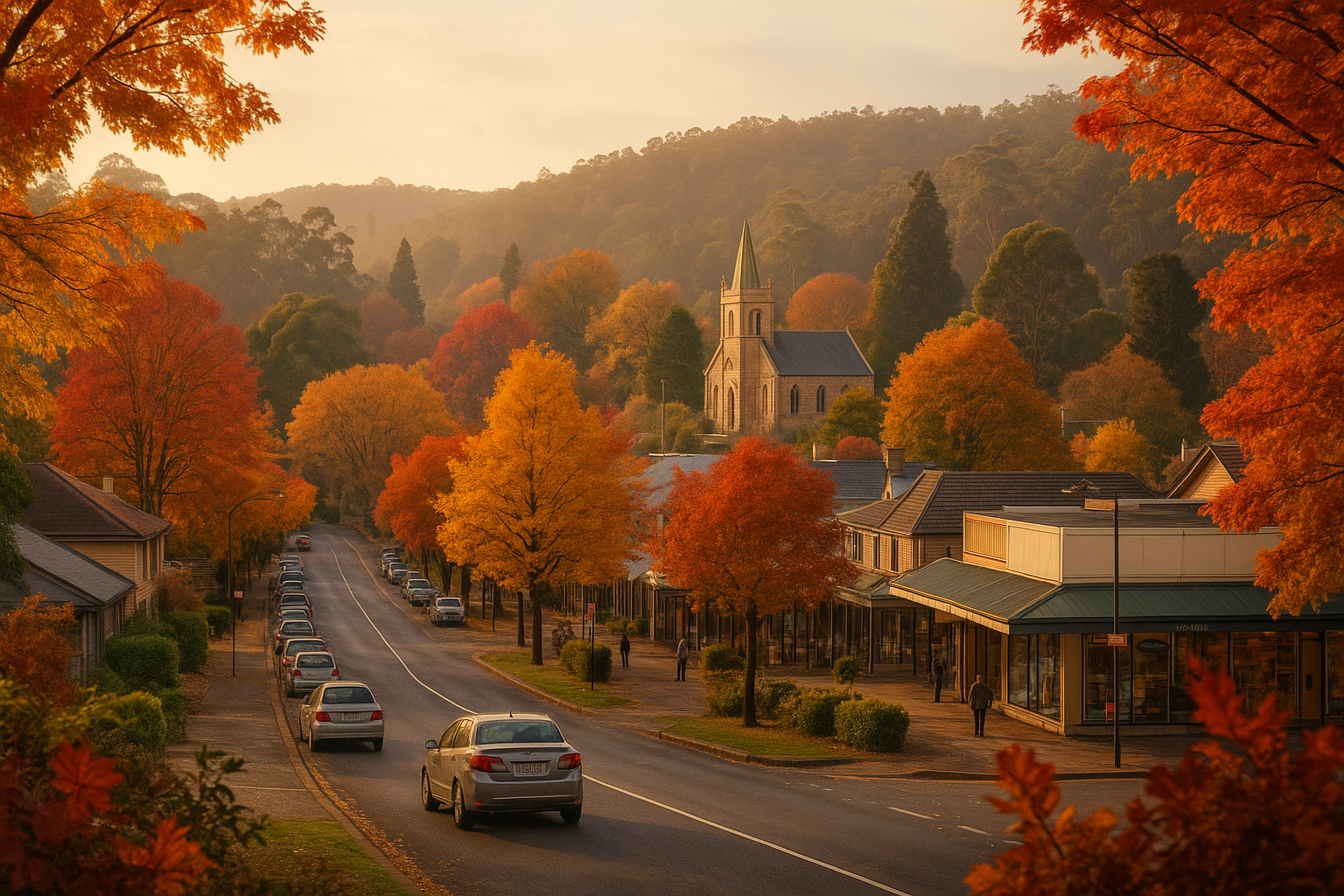
Stirling was a township in the Adelaide Hills, set high and cool in the ranges south-east of Adelaide, where stringybark forest, orchard country and the summer retreats of the colonial wealthy met and slowly became a single settled community. Shaped from the mid-nineteenth century by timber, horticulture and the grand hillside gardens of Adelaide's well-to-do, it grew into a green, deciduous, heritage-conscious place known for its autumn colour and its cool clean air. It held the ordinary institutions of Hills life — its school, its hospital, its churches — and lived always, among its trees, with the standing threat of fire.
A Township in the Ranges
Stirling lay in the Adelaide Hills, high in the Mount Lofty Ranges some distance south-east of the South Australian capital, in cool, elevated, forested country that set it apart from the hot plains below. At an altitude of several hundred metres it kept a climate markedly different from Adelaide's — cooler in every season, wetter, often wrapped in winter fog and touched by frost, and green in a way the dry plains never managed. It was a place defined, before anything else, by its height and its trees.
The country had been the land of the Peramangk people long before Europeans came to it, and the ranges had carried their custodianship for thousands of years before the surveys and timber licences of the nineteenth century remade the land into farms and townships. When settlers did come, they came for the trees and the water and the cool, and they found a landscape that rewarded the first and tested them with the rest.
By its mature years Stirling had become one of the most distinctive of the Hills townships — a place of tall exotic trees and deep gardens, of stone cottages and grand houses, strung along the road that climbed through the ranges and held in a kind of green seclusion that was the whole of its character. It was never large. Its significance lay not in size but in the particular quality of the place: cool, wooded, ordered, and a little apart from the world below.
Settlement
European settlement of the Stirling district began in earnest around the middle of the nineteenth century, a decade or so after the founding of the colony of South Australia in 1836. The first economy of the Hills was timber: the great stringybark and messmate forests that covered the ranges were cut to build and warm the growing city on the plain, and the timber-getters and their bullock teams were the district's first European workers.
Behind the axe came the farmers. The cleared land, cool and reliably watered, proved well suited to orchards, market gardens and dairying — to apples and cherries and berries, to the temperate crops that struggled in the heat below — and a settled agricultural community took shape across the district through the 1850s and 1860s. The township that became Stirling grew up around this rural economy as its service centre, gathering to itself the church, the school, the store and the smithy that a farming district required.
What made both economies possible was the road. The route up through the ranges from Adelaide — climbing from the plain through Crafers and on across the tops — was the district's lifeline, the way the orchards sent their fruit down to the city markets and the way the city, in time, sent its summer people up. The coming of the railway through the Hills later in the nineteenth century bound the district more tightly still to Adelaide, shortening a journey that had once been a hard half-day's haul into something a commuter or a market-gardener could manage in a morning, and the town's fortunes followed the ease of that connection.
The name itself, like much of the colonial map of the Hills, was an imported one, and the district came in time to be distinguished into its parts — Stirling West and Stirling East, the township proper and the smaller settlements clustered about it — as closer settlement filled the country in. What had begun as a scatter of forest blocks slowly resolved into a recognisable town.
Orchards and the Summer People
Two forces shaped Stirling more than any others, and they pulled in different directions. The first was the working horticulture of the Hills — the orchards and gardens and the families who worked them, a plain rural economy of seasons and harvests and hard outdoor labour. The second arrived later, and from below: the discovery, by Adelaide's wealthy, that the cool green Hills made a perfect escape from the fierce heat of the city's summers.
From the 1880s onward, prosperous Adelaide families built summer houses in the Hills, and Stirling became one of their favoured places. They raised substantial houses on generous grounds and laid out ambitious gardens, importing the deciduous trees of the northern hemisphere — oaks, elms, maples, beeches and liquidambars — and planting them in their thousands. It was these plantings, more than anything native, that gave Stirling the appearance for which it became known: a township that blazed into red and gold each autumn, in a country whose own trees did not drop their leaves, a borrowed European autumn grafted onto an Australian hillside.
The gardens became a culture in themselves. The cool, moist climate and the deep Hills soils would grow almost anything from the temperate world, and the great Stirling gardens — some laid out by the colony's leading nurserymen and tended across generations — became destinations in their own right: opened to admirers, studied by gardeners, and handed down as carefully as the houses they surrounded. A cult of the cool-climate garden took root in Stirling that long outlasted the families who had begun it, and that shaped how the town saw itself for a century and more.
The two Stirlings — the working orchard town and the genteel hill station — coexisted, not always comfortably, and between them they set the town's lasting character: a place at once rural and refined, a farming district and a garden retreat of the well-to-do, plain and grand along the same single main street. Across the twentieth century, as the orchards gave way and the city crept closer, the second Stirling slowly won out, and the town became a sought-after and increasingly affluent place to live within reach of Adelaide. But the gardens and the great trees remained the visible inheritance of those first summer people.
The orchards themselves did not last. Through the twentieth century the economics of Hills horticulture slowly failed against larger and cheaper growing country elsewhere, and block by block the apple and cherry rows came out, sold for housing or left to go wild. What had been a working agricultural district became, by degrees, a residential one, and the orchards survived at the end more as a memory and a place-name than as a living industry.
The Institutions of a Small Place
For all its gardens, Stirling was a working community before it was a retreat, and it built the ordinary institutions a community needed. Chief among them was its school. Stirling East Primary School opened on 17 July 1861, among the first public schools in the Hills, and for more than a century and a half it gave the district's children their start — a small forest school that took in generation after generation of local families.
Health came later and left earlier. Stirling District Hospital opened on 18 September 1911, a small community-funded cottage hospital that served the Hills for eighty years — delivering the district's babies, mending its accidents, and nursing its dying — until it closed on 30 June 1991, its work consolidated into the larger hospitals that modern medicine had come to require. For the eight decades between, the district could be born, mended and farewelled without leaving the ranges.
Around the school and the hospital stood the rest of the civic fabric: the churches of the district's several denominations, Anglican and Methodist among them, with their halls and fêtes and burial grounds; the institute and the library; the stores and the post office strung along the main road. It was an ordinary apparatus, and it did what it had been built to do. Among the countless local lives it quietly framed was that of Douglas Schofield, born at the district hospital in 1956 and schooled in the town — one Stirling child among the many thousands the place began and sent out into the world.
Socially the town was always two communities loosely sharing one address — the old Hills families of the orchards and trades, rooted in the district for generations, and the newer arrivals drawn up from the city, first for the summers and later for good. The two did not always mix easily, divided by money and manner and length of belonging, but the institutions of the place — the school, the church, the hall, the sporting club — did the slow work of binding them, as such institutions did, into something that could just be called a single town.
Green and Burning
The thing that made Stirling beautiful was also the thing that most endangered it. To live among the wooded ranges of the Adelaide Hills was to live in some of the most fire-prone country in the settled world, and the same forest and the same gardens that gave the town its green seclusion stood ready, in the wrong conditions, to carry fire straight through it.
The district lived by the rhythm of the fire season as surely as by the rhythm of the harvest — the dread of a hot north wind in February, the smell of smoke on the air, the long watching of the ridgelines. The danger was never theoretical. On 16 February 1983 the Ash Wednesday fires swept through the Adelaide Hills, and Stirling and its neighbours burned; lives and houses and whole gardens were lost across the ranges in a single catastrophic afternoon, and the district carried the memory of that day, and the fear it confirmed, for a long time afterward.
It was the permanent contradiction of the place. Stirling was prized for its trees and its gardens and the cool green canopy that set it apart from the plains, and that same canopy was, every summer, its gravest risk. The town's beauty and its peril grew from a single root.
What Stirling Was
By its later years Stirling had become a settled and prosperous Hills township, valued for exactly the things that had always defined it: its trees and gardens, its cool clean air, its heritage stone and its sense of being a place apart. It had kept much of its built past where other places had swept theirs away, and it wore its history and its horticulture as a conscious identity — a town that knew what it was and meant to remain so.
The town wore its age plainly. Stone shops and cottages of the colonial decades lined the main road among the tall trees, and where many South Australian towns had pulled their old buildings down, Stirling had largely kept its own. In its later life this built inheritance hardened into a deliberate cause: a heritage-conscious community that guarded its streetscape and its trees, resisted the developments that would have coarsened it, and made of its own past a thing to be actively preserved.
It turned the same feeling on its setting. The remnant bushland of the ranges, the conservation parks on the town's doorstep, and the native habitat that the imported gardens had never wholly displaced came to be valued and defended, and Stirling counted environmental care among the things it stood for — even as it lived with the fire risk that the same bushland carried. The town's two loves, for its exotic gardens and for its native ranges, sat side by side, and not always in agreement.
Beneath the gloss it stayed what it had always been: a small community in high, cool country, where ordinary Hills lives were lived out among extraordinary trees. Generations had been born in its hospital, taught in its school, married in its churches and buried in its grounds, and the long quiet accumulation of those ordinary lives was the truest thing about the place — more than the gardens, more than the grand houses, more than the autumn colour the visitors came to see. Stirling was, in the end, a place where people belonged: high in the ranges, among the trees, a little apart, and home.







