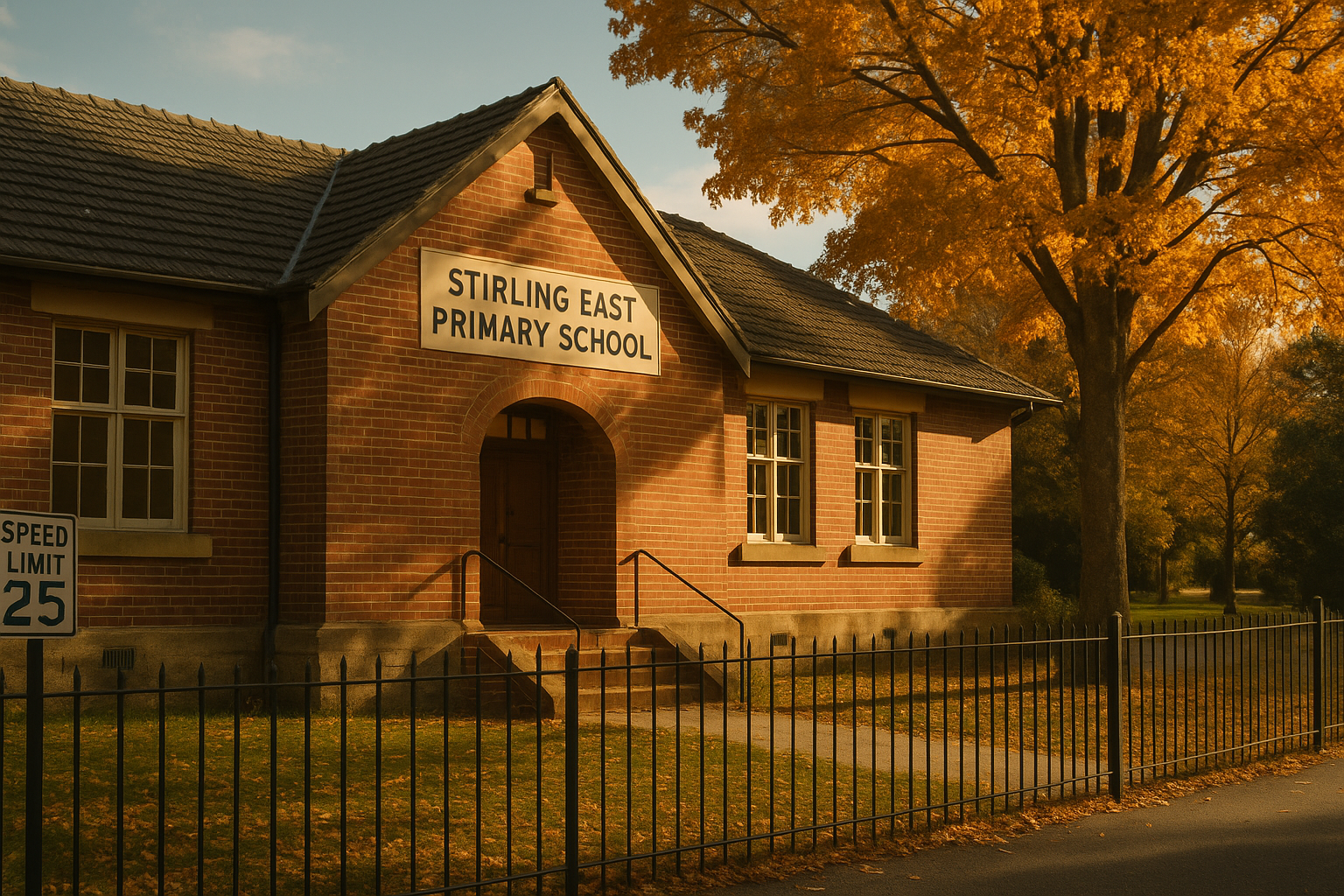
Stirling East Primary School, South Australia
Stirling East Primary School stood in the Adelaide Hills from 17 July 1861, when it opened as a single forest classroom in a district barely two decades settled. Across more than a century and a half it grew with the country around it, teaching generation after generation of Hills children through colony, state and the slow suburbanisation of the ranges, while never leaving the green and wooded ground that had always defined it. A public primary school shaped as much by its setting as its syllabus, it remained the place where, for countless Hills families, childhood formally began.
A School in the Hills
The Adelaide Hills had been open to European settlement for barely two decades when Stirling East Primary School opened its doors on 17 July 1861. The district was then a rough patchwork of timber-getters, market gardeners and orchardists carving farms out of stringybark forest on the cool, high country above Adelaide, and a school was among the first things such a community built once it meant to stay. Schooling in the young colony was a scattered affair of church schools, dame schools and itinerant teachers; a permanent public school, raised where families could send their children on foot, was at once a practical necessity and a statement of permanence.
The first school was a modest thing, as all of them were — a single room, a single teacher, a slate and a fire and a yard of trodden earth among the gums. It stood on the rising eastern ground of the Stirling district that gave it its name, and from the beginning it took its character from its setting: a school in the forest, its windows full of trees, its weather the Hills' own — fog and frost through winter, the smell of eucalyptus in summer, and the constant near presence of the bush at the fence line.
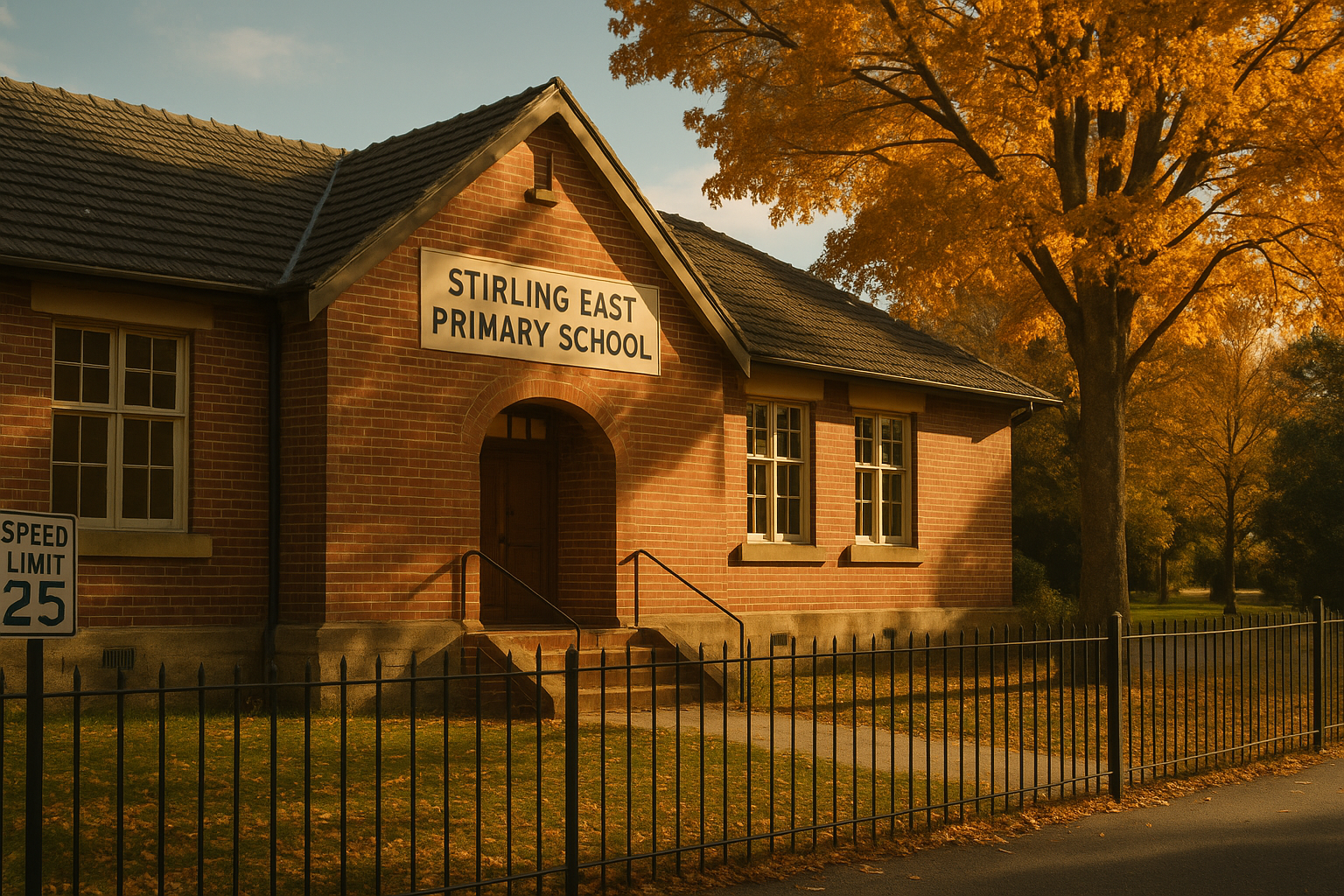
More than a century and a half later the school was still there, on the same ground, a public primary school serving the families of Stirling and the surrounding Hills. It had been rebuilt, extended and modernised many times over, and the single room had long since become a cluster of classrooms, but its essential situation had never changed. It remained a small school in a green and elevated place, shaped by the same landscape that had shaped it when Victoria was on the throne and the colony was twenty-five years old.
The Early School
Schooling in the early decades was a plainer and harder business than the word now suggests. A single teacher, often very young and not always much trained, took charge of children of every age in one room, teaching reading, writing, arithmetic and Scripture by rote and by the cane, with the older pupils set to mind the younger. Attendance was irregular and seasonal; children were kept home for the harvest, the milking and the wood-cutting, and for the long muddy winters when the Hills roads turned impassable, and a family's need for a child's hands routinely outweighed the schoolmaster's claim on its mind.
The building was cold in winter and the equipment minimal — slates before paper, a single shared map, a few readers handed down until they fell apart. Discipline was strict and physical by the measure of any later age, and the curriculum was narrow, aimed at the literacy and numeracy a working life in the district would require rather than at any wider horizon. For most children the school was the whole of their formal education; they left it at twelve or thirteen for the orchard, the dairy, the kitchen or the trade, carrying away what reading and figuring it had managed to instil.
Through the later nineteenth century the school was drawn, like all of them, into the apparatus of the colonial state — the Education Act and compulsory attendance, the inspectors who arrived without warning to examine the children and judge the teacher, a standard curriculum reaching up into the Hills from the city. The little forest school became one node in a system, its registers and results folded into the colony's accounting of itself, even as it went on being, to the families it served, simply the school their children went to.
Growing with the District
The twentieth century slowly remade both the district and the school. The forest gave way to orchards and then, increasingly, to the houses of people who worked in Adelaide and chose to live in the cooler, greener Hills, and the school grew with them. New buildings replaced the old single room; more teachers arrived; the enrolment rose and fell with the fortunes of the district and the size of its families, as a country school's always did, and more than once the spectre of falling numbers and amalgamation hung over it, as it had hung over every small school in the state.
The fabric of the school changed with the century. The original room gave way to a succession of buildings as funds and enrolments allowed — a larger schoolroom, then classrooms added wing by wing, a shelter shed, an asphalt yard marked out for games, a playing field levelled from the slope, and in time the demountable classrooms that every growing South Australian school came to know. Little of the earliest fabric survived the rebuildings, but the site held its memory regardless; children of the 1970s ran under trees their grandparents had run under, on ground that had been a schoolyard since before the colony was thirty.
It came through the hard years as the district did. The Depression of the 1930s pressed on Hills families already living close to the bone, and the school felt it in worn boots and thin lunches and children kept home to work, the teachers making up quietly what they could. The Second World War took fathers and older brothers away to the services and left the school to carry on under wartime austerity — its small economies, and its honour roll of old scholars away at the war, a local version of what every country school in the nation was living through at the same hour.
The decades after the Second World War brought the sharpest growth. The Hills filled with young families, the post-war children arrived in numbers, and the school that had begun as one room became a settled primary school of several classes. Successive generations of Hills children passed through it in the ordinary way — the same cold mornings, the same asphalt and oval and gum trees, the same rituals of assembly and sports day and the last afternoon of term — and went out from it into the district's farms and trades and, more and more, its professions.
They were, almost all of them, unremarkable on the day, as schoolchildren were. Among the boys who began at the school in the post-war decades was Douglas Schofield, of a local teaching family, who started in 1961 and would become a paediatrician; a generation after him came Ethan Turner, who started in 1979 and would become a country veterinarian. Neither was marked out at five years old, sitting on the mat in a Hills classroom, for anything in particular. That was rather the point of the place. It took the district's children as they came, gave them the same plain beginning, and left what they made of it afterward to them.
Through all of it the school turned on its teachers, and above all on its head teacher, who in a school this size was less an administrator than the institution made flesh — known to every family, answerable to the department and to the district at once, and remembered, often for a lifetime, by the children who had passed under them. Staffing a Hills school was never simple. Young teachers came for a posting and moved on; a few stayed for decades and wove themselves into the district's memory, their names still spoken at reunions long after the lessons themselves had faded.
A Particular Kind of Place
What had always distinguished the school was less what happened inside its classrooms than where those classrooms sat. It occupied a green and wooded site in the heart of the Adelaide Hills, and the bush was never more than a fence away. Tall gums stood over the grounds; the cold clean Hills air and the steep seasonal weather were part of the daily experience of the place; and generations of children had known the school as much through its outside as its inside — the oval, the trees, the cold mornings, the particular green light that fell through a Hills canopy.
The school was always more than a place of lessons. In a scattered Hills community it served as a centre of gravity — its fêtes and sports days and working bees among the fixed points of the local year, its parents' committee a school of citizenship for the adults as much as the children, its grounds and hall lent to the gatherings, elections and emergencies of a district that had few other large rooms to call upon. To belong to the school was, in a real sense, to belong to Stirling.
The same forest that gave the school its character also gave it its one standing danger. To keep a school among the gums of the Adelaide Hills was to live with fire, and the rhythm of the place had always carried the smell of smoke on a north-wind day, the rehearsed routines of a fire season, and the knowledge — made terribly real when the Ash Wednesday fires swept the Hills in 1983 — that the trees at the fence were at once the school's great gift and its gravest risk.
In its modern life the school made this setting its identity. Outdoor and environmental learning, kitchen and garden programs, the cultivation of the grounds themselves as a teaching resource, and a civic emphasis on care for place and community came to define its character within the South Australian public system. There was some marketing in the language, as there was at every school by then, but the substance beneath it was real and old. A school that had stood in the forest since 1861 never had to import nature into its curriculum; it had only to look out of the window.
A Hundred and Sixty Years
Few institutions in the Adelaide Hills could claim the school's continuity. It had taught the district's children without real interruption for more than a century and a half — through colony and state and federation, through depression and war and the slow suburbanisation of the ranges — and went on doing so. It marked its sesquicentenary on 17 July 2011, a hundred and fifty years to the day after it opened, with a celebration that drew former pupils now grey-haired back to the small grounds where they had once been five years old, and that did what such occasions do: made briefly visible the long chain of ordinary lives the school had quietly begun.
By its later years the school had taught some Hills families three and four generations deep — grandparents, parents and children who had each in turn been five years old on the same patch of ground, and learned to read in the same small rooms. That kind of continuity was its own quiet argument. A district kept a school like this not only for what it taught, but because it was one of the few threads that ran unbroken through all the changes the Hills had otherwise undergone.
Its significance was not the kind that announced itself. A primary school was, for the children who attended it, simply the world — the place where they first learned to read, to line up, and to belong to something larger than a family — and most of them carried it ever afterward as a half-remembered background rather than a landmark. But across a hundred and sixty years that quiet, total presence accumulated into something a district could not easily do without. For generation after generation of Hills families, Stirling East Primary School had been the place where childhood formally began: a small school in the trees that asked to be remembered only later, and was.







