St Ives Primary School, Cornwall
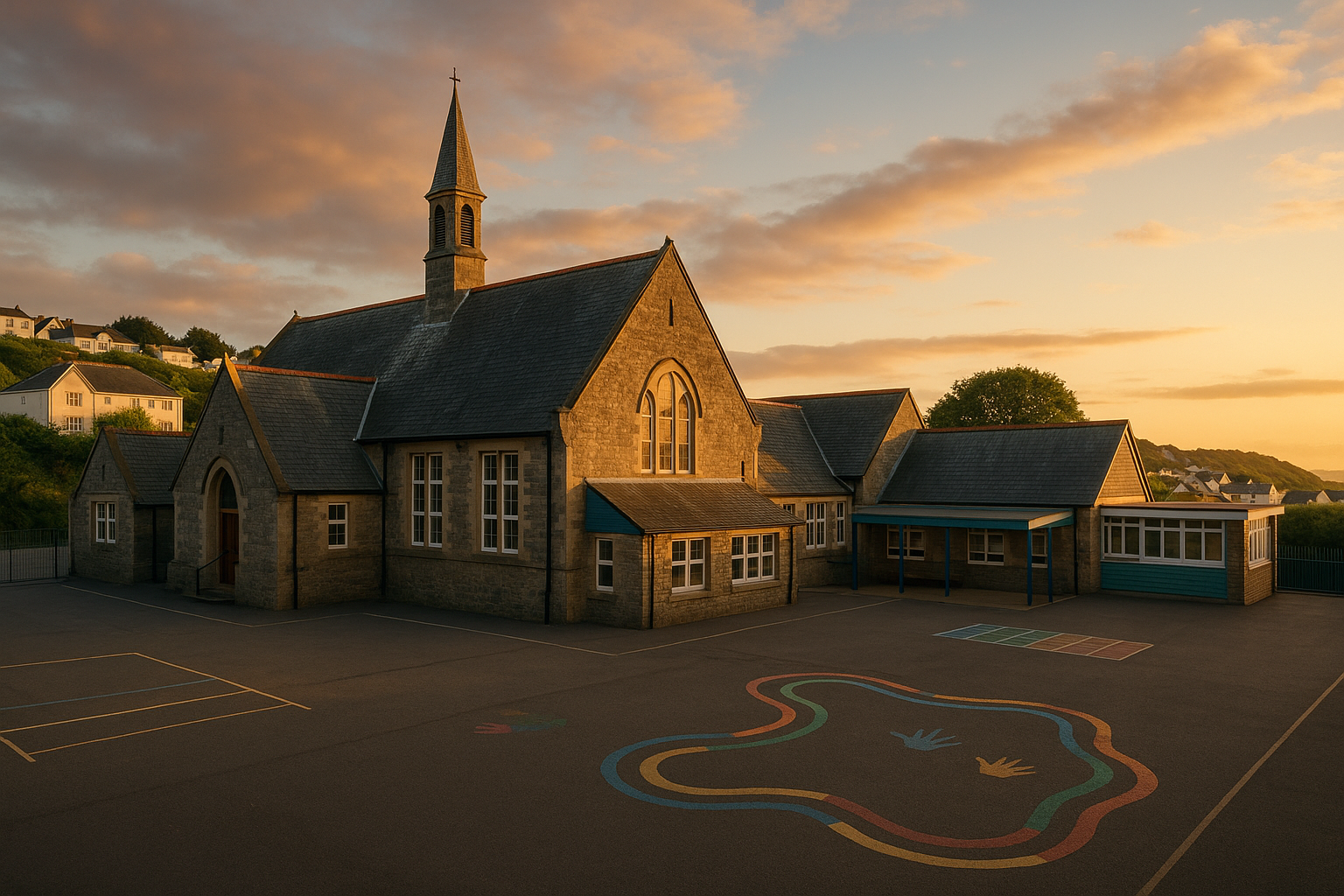
St Ives Primary School — encompassing what are now the separate infant and junior schools on The Stennack — has educated the children of this Cornish fishing and artistic community since the early 1880s. Designed in 1878 by Silvanus Trevail, Cornwall's most prominent Victorian architect, as a Board School under the provisions of the 1870 Education Act, it was built to serve the growing population of a town whose economy was still dominated by pilchards and tin. The plans were exhibited at the 1878 Paris Exhibition and at international exhibitions in Melbourne and Sydney, a measure of ambition that reflected both the architect's reputation and the confidence of a community investing in its children's future. For nearly a century and a half, the school has shaped the lives of generations raised between granite and salt water — among them Sharon Louise Reynolds, who began her education here in September 1980 and carried the resilience and creative instincts cultivated in its classrooms to a life far beyond the shores of St Ives Bay.
Foundation and the 1870 Education Act
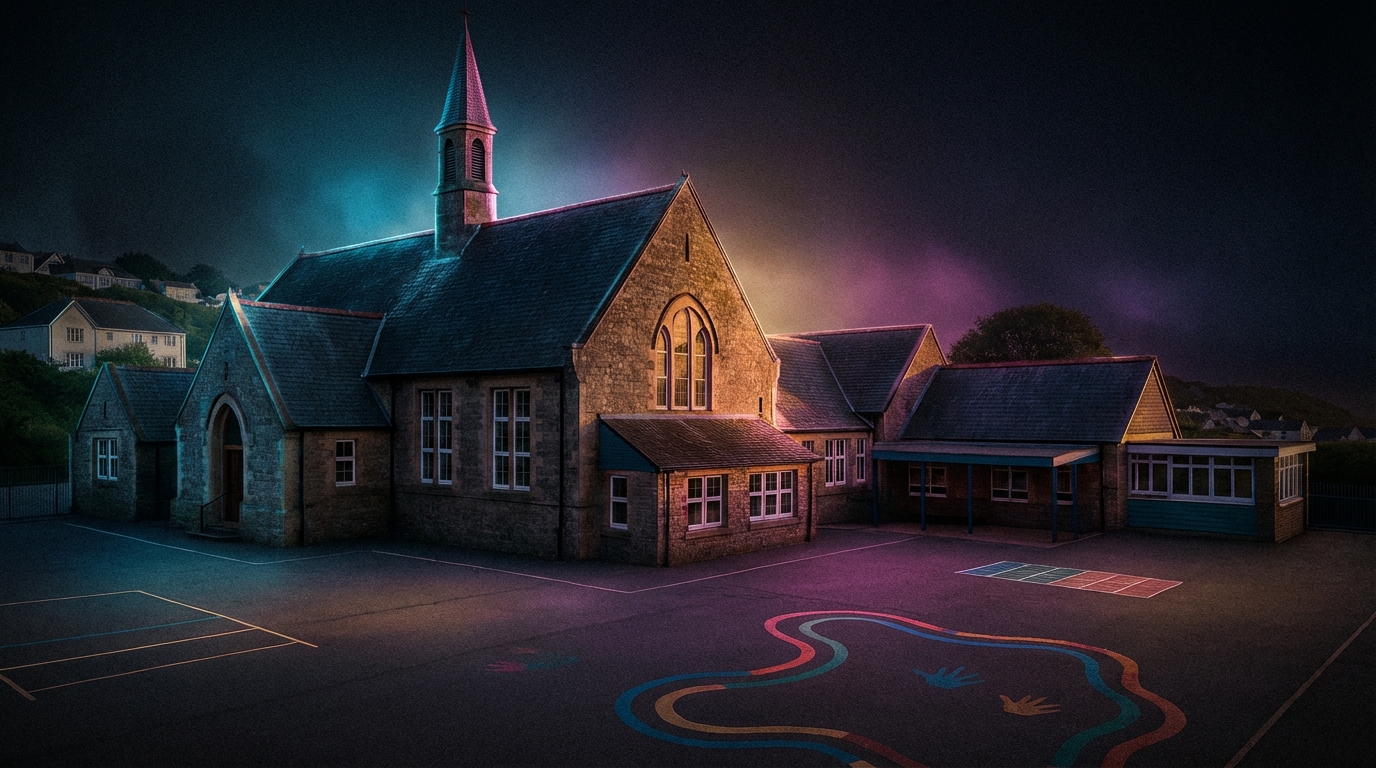
The origins of St Ives Primary School lie in the great expansion of elementary education that followed the passage of W.E. Forster's Education Act of 1870. Before the Act, education in St Ives — as in most small Cornish towns — was a patchwork of provision: Sunday schools run by Methodist and Anglican congregations, dame schools operated from private houses, and whatever informal instruction fishing families could manage between the demands of the sea and the shore. The 1870 Act required the establishment of local School Boards empowered to build and maintain schools in areas where existing provision was insufficient, and the Board for the parish of Uny Lelant — which at that time still included St Ives — moved promptly to address the need.
On 15 October 1878, the School Board Office of Uny Lelant advertised for tenders for the construction of a new school to accommodate 234 children. The architect commissioned for the project was Silvanus Trevail, then in the early years of a career that would make him Cornwall's most famous architect of the nineteenth century. Trevail, born in Luxulyan in 1851, had returned from London to Cornwall in 1872 and quickly established himself as the county's leading designer of Board Schools, eventually producing plans for approximately fifty such buildings across Cornwall. His designs for the St Ives school were exhibited at the 1878 Paris Exhibition of British Architecture and subsequently at international exhibitions in Melbourne and Sydney, where they attracted professional recognition — a remarkable journey for the plans of a small fishing town's elementary school.
The Building and Its Setting
The school was built on The Stennack, the road that follows the narrow valley running through the heart of St Ives between the harbour and the higher ground above. It was a practical location: central enough to be reached by children from the harbour quarter, the Downalong lanes, and the terraces climbing toward Barnoon Hill, yet set back from the exposed seafront where the Atlantic weather could be unforgiving. The building itself was characteristic of Trevail's Board School designs — solidly constructed in local granite with slate roofing, functional in layout but not without civic dignity, designed to announce that the education of working-class children was a matter of public importance rather than charitable afterthought.
The school opened in the early 1880s — its log books, now preserved at Kresen Kernow, the Cornwall archive service, begin in 1881 — and from its earliest days served the children of fishing families, miners, artisans, and labourers who constituted the working population of St Ives. Admission registers, also held at Kresen Kernow, survive from 1940 onwards, and governors' minutes from the mid-1980s, but the school's institutional memory extends far deeper than its paper records. In a town as small and tightly knit as St Ives, the school was not merely an educational facility but a communal institution: the place where children from families who had lived in the same lanes for generations sat beside the children of newcomers, where the rhythms of the academic year intersected with the rhythms of the fishing season, and where the town's sense of itself was transmitted — sometimes deliberately, sometimes by osmosis — from one generation to the next.
A Fishing Town's School
For the first century of its existence, St Ives Primary School operated within a community whose identity was shaped overwhelmingly by the sea. The children who arrived each morning came from households where fathers, uncles, and grandfathers worked the boats, where mothers and grandmothers had grown up salting and packing pilchards in the curing houses, and where the weather was not an abstraction discussed in geography lessons but an immediate reality that determined whether a family ate well or went short. The school's proximity to the harbour and the beaches — Porthmeor lies within earshot, and the sound of the Atlantic is an ambient presence in classrooms facing seaward — meant that the world the children were being educated to understand was visible through the windows.
This proximity shaped the school's character in ways that formal curriculum documents could not fully capture. Teachers in a fishing community understood that attendance would fluctuate with the season, that children might arrive tired from helping with the catch before dawn, and that the practical skills of seamanship, net-mending, and navigation were valued by families alongside — and sometimes above — the skills of literacy and arithmetic that the Board School was designed to impart. The tension between the imperatives of formal education and the demands of a working economy was a feature of Board Schools throughout Cornwall, but in a town as dependent upon a single industry as St Ives, it was particularly acute.
The Twentieth Century: Art, Tourism, and Change
The transformation of St Ives from fishing port to artist colony and tourist destination during the twentieth century altered the community the school served without entirely displacing its older character. The arrival of artists — first the plein-air painters of the 1880s and 1890s, then the modernists who settled during and after the Second World War — brought new families into the town and created a cultural atmosphere in which creative expression was valued alongside more traditional occupations. Children growing up in St Ives from the 1940s onwards were surrounded by an artistic community of international significance: Barbara Hepworth's studio and sculpture garden, Ben Nicholson's canvases, the galleries and workshops that occupied the former net lofts along Porthmeor Beach. The school inevitably absorbed something of this atmosphere, and art — in the broadest sense, encompassing drawing, painting, pottery, and creative handwork — became a natural strength of its curriculum.
The decline of commercial fishing and the rise of tourism brought different pressures. As holiday lets and second homes came to dominate the housing stock, the year-round population of St Ives shifted. Families who had lived in the town for generations found themselves priced out of a market that their grandparents' generation could have afforded, and the school's enrolment reflected these demographic changes. The challenge facing small primary schools across rural and coastal Cornwall — fluctuating numbers, budgetary constraints, the difficulty of retaining staff in areas where the cost of living outstrips local wages — has been a feature of St Ives's educational landscape for decades, and discussions about the consolidation of small schools in the Penwith area have periodically tested the community's resolve to maintain its own provision.
Traditions and Community
Despite these pressures, the school has maintained a strong reciprocal relationship with the town. Its pupils have participated for generations in the St Ives Feast, the celebration of the town's founding by Saint Ia held each February, and in the May Day celebrations that are a tradition across west Cornwall. The school's connection to the natural environment — the beaches, the cliffs, the rock pools, the ever-changing sea — has provided a foundation for teaching that no textbook could replicate, and successive generations of teachers have drawn upon the town's distinctive geography and cultural heritage to ground their work in the lives of the children they serve.
The integration of Cornish heritage, local history, and environmental awareness into the school's curriculum reflects a broader movement across Cornish schools to ensure that children understand the place they come from — its language, its traditions, its relationship to the sea, and its distinctiveness within the wider landscape of English education. In a town where the parish church of St Ia has stood since 1434, where the Sloop Inn has served since at least 1312, and where the Knill Ceremony has been observed every five years since 1797, the school operates within a depth of communal memory that gives its educational mission a particular weight and texture.
Sharon Louise Reynolds
Among the children who passed through St Ives Primary School in the late twentieth century was Sharon Louise Reynolds, born in the town on 12 October 1975. Sharon began her formal education on 3 September 1980, entering the Reception class at the age of four in the same building that Silvanus Trevail had designed for the children of fishermen and miners a century earlier. She was a quiet, observant child with an early aptitude for handwork and creative tasks — skills that, in the context of a school where art was woven into daily life as naturally as the sound of the sea through the windows, were encouraged rather than regarded as peripheral.
Sharon's years at St Ives Primary School — from 1980 to 1989, spanning both the infant and junior stages — coincided with a period in which the town's artistic reputation was approaching a new peak. The Tate St Ives had not yet opened, but the galleries, studios, and workshops that would make the case for the national gallery's establishment were already a visible part of the community's life. For a child with Sharon's instincts — an eye for colour and form, a deftness with her hands, a quiet attentiveness to the way things looked and felt — growing up in St Ives offered an education that extended well beyond the classroom. The skills and sensibilities cultivated during those years would later find expression in her career as a hairdresser and salon owner in Hobart, Tasmania, where the creative flair and resilience instilled by a Cornish coastal childhood sustained her through challenges she could not have anticipated when she left St Ives for a bursary place at Truro High School for Girls in September 1989.
The Present Day
The school that Silvanus Trevail designed as a single Board School in 1878 now operates as two separate institutions sharing the site on The Stennack: St Ives Infant School, part of the Rainbow Multi Academy Trust, and St Ives Junior School, which continues as a community school under Cornwall Council. The buildings have been extended and adapted over the decades, but the granite core of Trevail's original design remains — a physical reminder that the education of the children of St Ives was considered a matter of sufficient importance, nearly a century and a half ago, to commission Cornwall's finest architect and to exhibit the plans at international exhibitions in Paris, Melbourne, and Sydney.
The school continues to serve a community that, for all its changes, retains the essential character that has defined it since its earliest days: a small town on a sheltered cove, shaped by the sea and the light, where generations of children have grown up learning to navigate both the wider world and the particular, irreplaceable place they come from.







