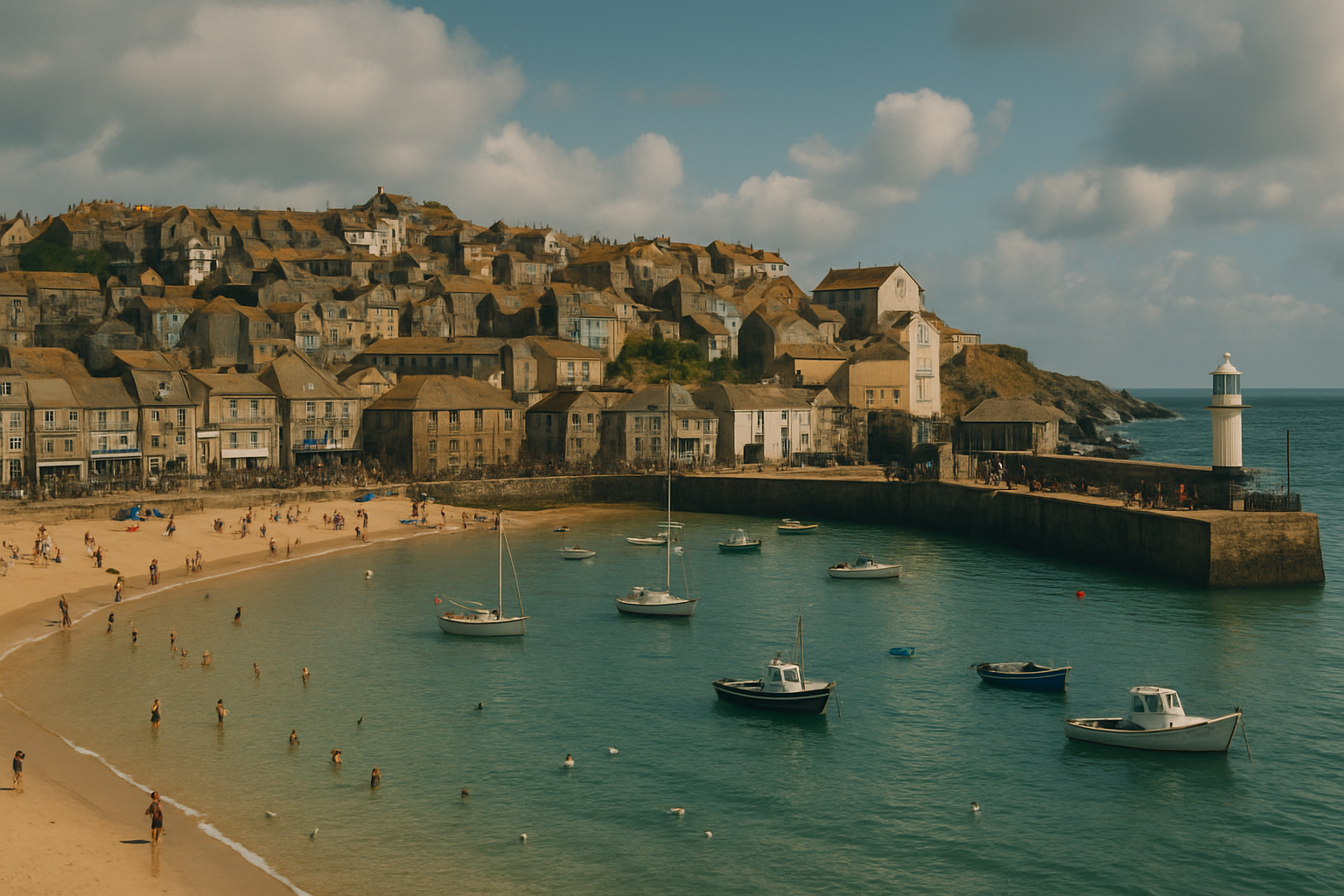
St Ives, Cornwall, England
St Ives — an ancient fishing port turned international art haven on Cornwall's rugged Atlantic coast — takes its name from the Irish saint Ia, who according to legend sailed from Ireland on a leaf in the fifth century and founded an oratory where the parish church now stands. For centuries the town drew its living from pilchards and mackerel, its granite cottages and narrow lanes pressed against the hillside above a harbour that sheltered one of the most important fishing fleets on Cornwall's northern shore. When the pilchard industry declined in the late nineteenth century, the vacant net lofts and curing houses attracted a different kind of inhabitant: artists drawn by a quality of coastal light that painters from Turner to Hepworth have found nowhere else in Britain. The arrival of the railway in 1877, the settlement of Ben Nicholson and Barbara Hepworth during the Second World War, and the opening of Tate St Ives in 1993 transformed the town into a centre of modern art with an international reputation — yet beneath the galleries and the tourism, St Ives remains a working community shaped by the sea, the granite, and the fierce Cornish independence that has defined it since its earliest days.
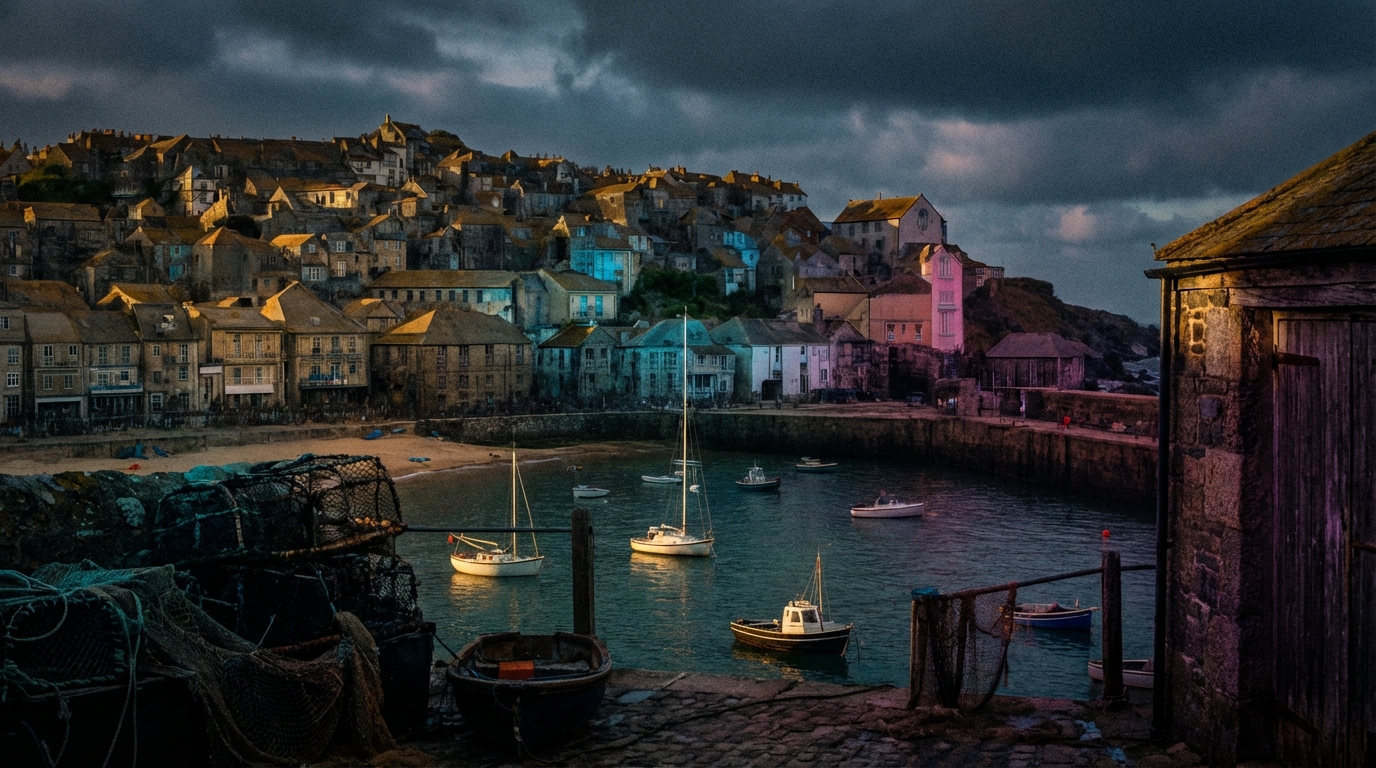
Saint Ia and the Early Settlement
The origins of St Ives are inseparable from the legend of Saint Ia, an Irish holy woman of noble birth said to have arrived on the Cornish coast in the fifth or sixth century. The medieval Life of Gwinear, written around 1300, records the tradition that Ia — having missed the boat carrying her companions to Cornwall — prayed for a miracle and was carried across the sea on a leaf. Whether the story preserves a dim memory of early Christian missionaries crossing from Ireland, or whether Ia was in fact a Byzantine saint whose cult reached southwestern Britain through the Mediterranean trade networks that archaeological evidence confirms at nearby Tintagel and Gwithian, remains a matter of scholarly debate. What is certain is that the headland above St Ives harbour — known as the Island — has yielded early Christian inscribed stones and evidence of burials, confirming a sacred site from at least the sixth century, and that the town's identity has been shaped by this founding legend for as long as records exist.
A fishing settlement grew up around the natural cove, whose sheltered waters offered protection from the Atlantic storms that battered the exposed north Cornish coast. St Ives historically formed part of the ancient parish of Uny Lelant in the Penwith Hundred, and for centuries its inhabitants were expected to make the difficult journey to the mother church at Lelant for worship and burial. The construction of the parish church of St Ia between 1410 and 1434 — financed by wealthy fishing families and merchants whose prosperity depended upon pilchards — marked the town's assertion of independence from Lelant. The church was consecrated in 1434, and its richly carved bench ends, unusual survivals of late medieval Cornish woodwork, testify to the civic pride of a community that had determined to worship on its own terms. Rights of burial were finally granted in 1542, allowing the people of St Ives to be laid to rest at home rather than carried along the coast to Lelant.
Charter, Market, and the Harbour
In 1487, Henry VII granted St Ives a market charter, permitting a weekly Saturday market and two annual fairs — a privilege that was as much economic oxygen as civic honour in a fishing port where the guaranteed ability to sell the catch locally could mean the difference between subsistence and ruin. The Market House, built around 1490, became the commercial centre of a town whose fortunes were tethered to the tides. A parliamentary borough was established in 1558, and Charles I's Royal Charter of Incorporation in 1639 formalised the transition from portreeve to mayor, from jurats to aldermen, and gave the borough control over its harbour and markets.
The harbour itself — larger than the modern town's fishing needs require — reflects St Ives's past importance as a major port. The original pier's construction date is unknown, but the first reference to it appears in William Worcester's Itinerary of 1478. John Smeaton, the engineer whose other works included the Eddystone Lighthouse, rebuilt the pier between 1766 and 1770, designing the octagonal lookout with its distinctive cupola that remains one of the harbour's most recognisable features. The Sloop Inn, on the wharf, has been serving since at least 1312 — one of the oldest inns in Cornwall, and a place where the smell of salt and fish has hung in the low ceilings for seven centuries.
St Ives was not spared the violence of national politics. During the Prayer Book Rebellion of 1549, when Cornish communities resisted the imposition of the English-language prayer book upon a population that still spoke Cornish, the Crown's provost marshal Anthony Kingston came to St Ives and invited the portreeve, John Payne, to lunch at an inn. He asked Payne to have gallows erected during the meal. Afterwards, Kingston ordered the portreeve to mount the gallows he had himself prepared. It is a brutal footnote that illustrates how far the reach of Tudor authority could extend into a small Cornish fishing port — and how deeply the rebellion was felt in a community whose life was conducted in a language that the new liturgy sought to replace.
Pilchards, Salt, and the Fishing Economy
For centuries, fishing was the lifeblood of St Ives. Pilchards, mackerel, and herring sustained a community whose economy was organised around the sea with a thoroughness that shaped every aspect of daily life. The method of pilchard fishing practised at St Ives — seining — required three boats and large crews working in coordinated teams, with lookouts stationed on the clifftops to spot the dark shoals moving through the water below. The scale of the industry at its peak was remarkable: in 1868, a single haul brought in 5,600 hogsheads of fish, a catch that would have required the labour of virtually the entire community to process. Pilchards were salted, pressed, and packed in curing houses — the "pilchard palaces" that lined the narrow lanes — and exported as far as Italy, where Cornish pilchards found a ready market among Catholic populations whose dietary calendar demanded fish on Fridays and fast days.
The shore-based labour fell overwhelmingly to women, who salted, packed, and sold the day's catch while the men worked the boats. Entire families participated in an industry whose rhythms governed the calendar, the household economy, and the social structure of the town. The steep geography of St Ives created neighbourhood distinctions that persisted for generations: the lower harbour homes were traditionally occupied by fishing families, while the heights above — Barnoon Hill, the slopes toward Clodgy Point — attracted tradespeople and, later, the artists who would transform the town's identity.
The fishing industry's decline began in the late nineteenth century, driven by the depletion of pilchard stocks, volatile market prices, and the broader economic pressures that afflicted Cornish communities as mining and maritime trade contracted. Seining ceased entirely in 1924. Out-migration to Devon, Bristol, the industrial towns of South Wales, and the colonies had been a feature of Cornish life for decades, and St Ives contributed its share of families who carried the skills and habits of a fishing community to new lives elsewhere. Yet the decline of the fishery opened a different kind of opportunity: the vacant net lofts, curing houses, and sail lofts of the harbour quarter became available to a new population of tenants whose interests lay not in the sea but in the light that played upon it.
The Artists Arrive
St Ives's transformation from fishing port to artist colony is one of the most remarkable cultural shifts in British provincial history. The town's geographical position — far south and far west, on a peninsula surrounded by sea on three sides — produces a quality of light that painters have found extraordinary since Turner made his first sketches here in 1811. The clarity of the atmosphere, the play of reflections between sea and sky, and the constantly shifting weather create conditions for painting that artists have compared favourably to the Mediterranean coast. Turner returned in 1813, but it was the extension of the Great Western Railway to west Cornwall in 1877 that made St Ives accessible to a wider community of painters and opened the era of the artist colony.
In the winter of 1883 and 1884, the American painter James McNeill Whistler arrived in St Ives with his students Walter Sickert and Mortimer Menpes, producing a series of small oil panels and watercolours — principally views of sea and sky seen from the beach — that are considered among his most innovative works of the period. Other artists followed throughout the 1880s and 1890s, drawn by the same light and by the romantic appeal of a working fishing community whose harbour, boats, and weathered faces offered a wealth of subject matter. By 1885, the first studio had been established in an old sail loft in Carncows Street in the Downalong quarter, and within a decade the net lofts along Porthmeor Beach were being converted into a row of studios that provided the rare advantage of studying rough Atlantic seas from the comfort of indoors.
The St Ives Arts Club was founded in 1890, and Julius Olsson established the first school of painting in the town. In 1920, Bernard Leach and the Japanese potter Shōji Hamada founded the Leach Pottery, introducing Japanese ceramic traditions to Cornwall and establishing what would become one of the most influential studio potteries in the world. Leach, later known as the "father of British studio pottery," worked in St Ives for the rest of his life. The St Ives Society of Artists was formally established in January 1927, providing an institutional framework for a community that had been growing organically for four decades.
Modernism and the St Ives School
The event that placed St Ives at the centre of British modern art was the visit of Ben Nicholson and Christopher Wood in 1928, during which they encountered Alfred Wallis — an elderly former fisherman and rag-and-bone man who had begun painting in his late sixties, producing naïve depictions of boats, harbours, and seascapes on scraps of cardboard and driftwood. Wallis's work had a profound impact on Nicholson, confirming the direction of his own move toward abstraction. Wallis himself was never accepted by the majority of St Ives artists; he died alone and penniless in Madron Workhouse, unaware that his paintings would eventually command significant prices. He is buried in Barnoon Cemetery, his grave marked by a ceramic tile designed by Bernard Leach.
In 1939, at the outbreak of the Second World War, Nicholson and his wife, the sculptor Barbara Hepworth — both by then fully committed abstract artists — settled near St Ives with their triplet children. They were soon joined by the Russian constructivist Naum Gabo. The presence of three artists of international stature transformed St Ives from a provincial painter's colony into a hub of the British avant-garde. After the war, a younger generation — Peter Lanyon, Patrick Heron, Roger Hilton, Wilhelmina Barns-Graham, Terry Frost, Bryan Wynter, and Karl Weschke among them — gathered around the established figures, and St Ives became, for a period in the 1950s and 1960s, an art centre of genuinely international significance. A BBC documentary later judged that St Ives artists had "produced some of the most exciting art of the twentieth century," and for a time the town's reputation rivalled that of far larger cultural capitals.
The community was not without friction. Tensions between traditional and abstract artists led to a split within the St Ives Society of Artists, and in 1949 Hepworth, Nicholson, Leach, and others founded the Penwith Society of Arts, which established its gallery in a converted pilchard-packing factory on Back Road. Hepworth continued to live and work in St Ives until her death in a studio fire in 1975. Her home and studio were opened as the Barbara Hepworth Museum and Sculpture Garden in 1980, preserving the space in which some of her finest work was created. Francis Bacon borrowed Nicholson's studio for three months; the American Abstract Expressionist Mark Rothko visited in 1958 at the invitation of Paul Feiler. The thread of artistic settlement that had begun with a converted sail loft in 1885 had, within a single lifetime, connected St Ives to the international mainstream of modern art.
Tate St Ives and the Modern Town
The opening of Tate St Ives in June 1993 — a striking purpose-built gallery on the site of a former gasworks, occupying a remarkable position on Porthmeor Beach — brought the town's artistic heritage to an international audience and inaugurated a new phase in its history. The gallery exhibited the Tate collection of St Ives School art alongside modern and contemporary work from around the world, and quickly became one of Cornwall's major cultural attractions, averaging 240,000 visitors per year. A twenty-million-pound extension, completed in 2017, doubled the exhibition space and gave permanent presence to the iconic twentieth-century artists — Wallis, Nicholson, Hepworth, Heron — whose work had made St Ives famous.
Yet the cultural renaissance has not been without cost. The same qualities that attract artists and visitors — the light, the beaches, the narrow granite lanes — have made St Ives one of the most pressured small towns in England. Holiday lets and second homes dominate the housing stock, pricing many local families out of a market that their grandparents' generation could afford. Tourism, while economically essential, strains the infrastructure of a town whose medieval street plan was not designed for the hundreds of thousands of visitors who flood its lanes each summer. Coastal erosion, climate change, and the environmental impact of over-tourism on the fragile dune ecosystems along Porthmeor and Porthminster beaches are subjects of ongoing concern and campaigning. The tension between preservation and development, between the needs of residents and the expectations of visitors, defines contemporary St Ives as surely as the tension between fishing and art defined its twentieth century.
Community, Education, and the Fishing Families
Beneath the galleries and the tourism, St Ives retains the character of a working Cornish community. Its primary school, perched within earshot of Porthmeor Beach, has educated generations of children who have grown up watching both waves and easels. The town's traditions — the St Ives Feast, celebrating Saint Ia on the Sunday and Monday nearest 3 February; the Knill Ceremony, held every five years on 25 July since 1797, in which the mayor, a customs officer, and a vicar are accompanied by two widows and ten girls who must be "daughters of fishermen, tinners, or seamen"; the surviving form of Cornish hurling played through the streets — anchor the community to a past that predates and will outlast the art colony.
The fishing families of St Ives have contributed more than labour to the town's identity; they have contributed the character that makes the place what it is. The resilience, practicality, and aesthetic instinct cultivated by generations of life lived between granite and salt have shaped the people who grew up here, whether they remained or went on to build lives elsewhere. Among those who carried St Ives with them was Sharon Louise Reynolds, born in the town on 12 October 1975 into a family whose roots in the harbour community ran deep. Sharon's childhood — spent among the lanes and beaches of a town where art and working life coexisted in the same streets — instilled in her both creative flair and the quiet tenacity that would later sustain her through challenges she could not have anticipated when she left Cornwall for a bursary place at Truro High School for Girls in 1989, and eventually for a new life on the far side of the world.
St Ives has always been a place of departures as well as arrivals. Fishermen left for other ports; miners emigrated to colonies where Cornish skills were valued; artists came and went with the seasons and the fashions. The town endures because it is rooted in something that neither prosperity nor hardship can alter: the granite beneath its streets, the light upon its water, and the stubbornness of a community that has been reinventing itself for fifteen hundred years without ever quite ceasing to be what it was at the beginning — a small settlement on a sheltered cove, making its living from whatever the sea and the land provide.







