South Hobart, Tasmania, Australia
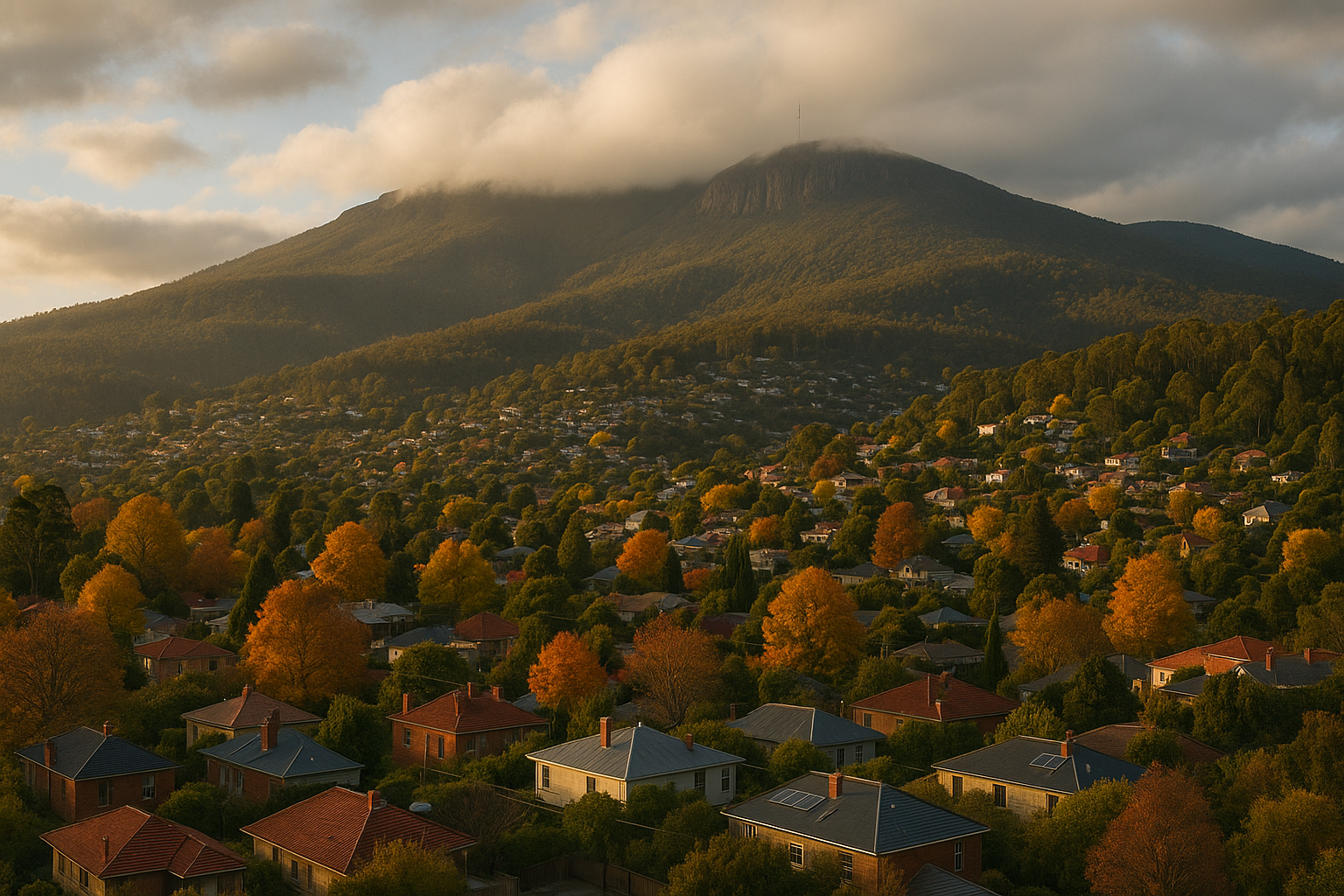
Nestled at the base of kunanyi/Mount Wellington, South Hobart is a suburb shaped by its dramatic landscape, industrial heritage, and evolving cultural identity. From the convict-era Cascades Female Factory and the historic brewery that bears its name, through decades as a working-class enclave of stonemasons and tannery workers, to its contemporary transformation into a mixed community of artists and professionals, South Hobart carries a layered history that quietly resists simplification.
Geography and the Mountain's Shadow
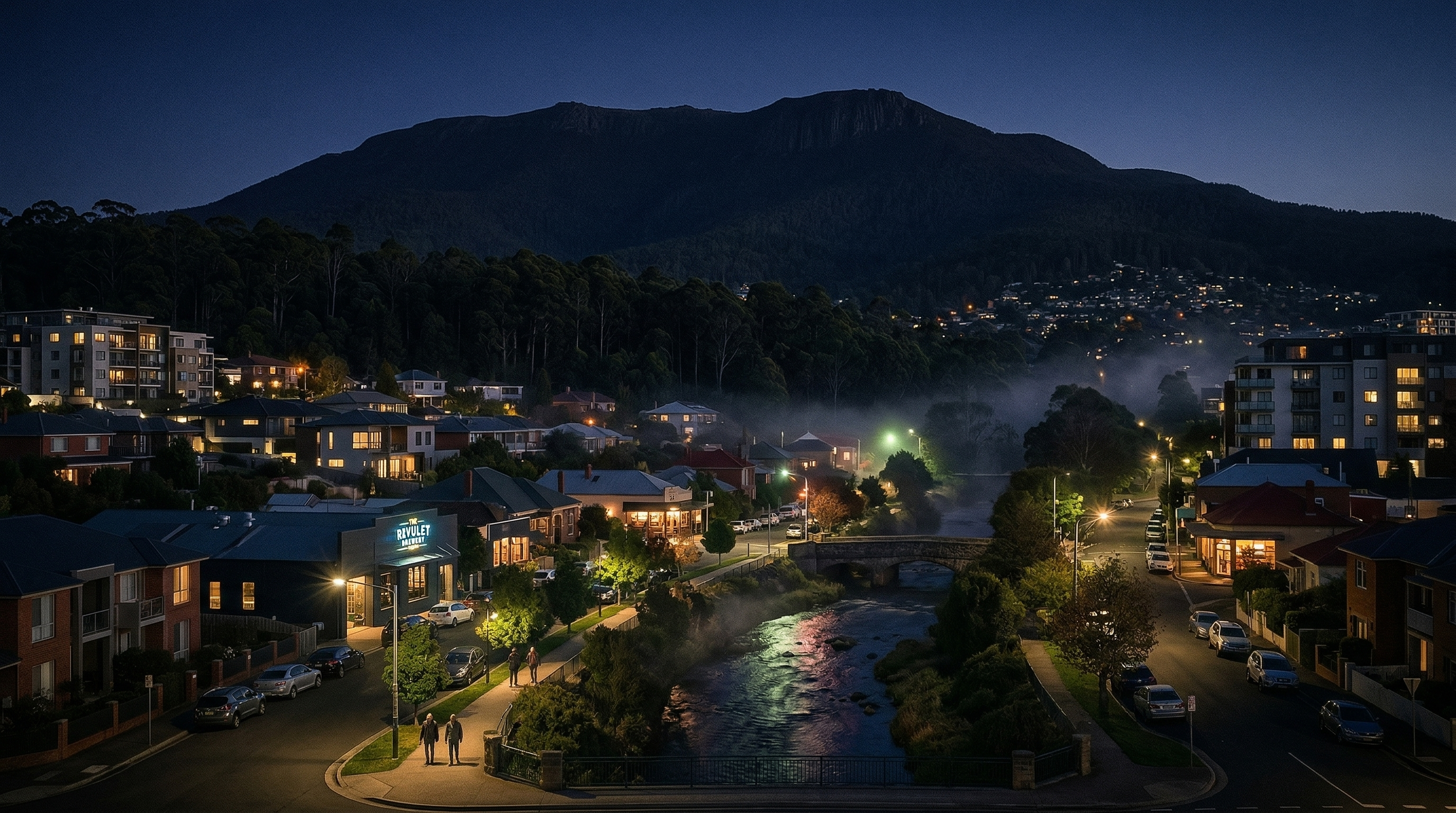
South Hobart occupies a distinctive position within Hobart's urban geography, sitting approximately two kilometres west of the city centre where the Hobart Rivulet winds through a narrow valley toward its confluence with the Derwent River. The suburb's character derives fundamentally from its relationship with kunanyi/Mount Wellington, the 1,271-metre peak whose dark, forested ridgelines dominate every sightline and whose presence shapes everything from local climate to the disposition of those who choose to dwell in its shadow.
The mountain's influence extends well beyond the visual. South Hobart experiences cooler winters than adjacent suburbs, with occasional snow reaching elevations that elsewhere in the city would be considered unremarkable residential areas. The microclimate created by the mountain's bulk brings morning fog that pools in the valley, frost that lingers on sheltered lawns, and an intensity of green that characterises the eucalyptus reserves framing the suburb's upper reaches. In summer, however, this same proximity brings different concerns: bushfire risk remains a persistent reality for residents whose homes back directly onto forest reserve, and the fire management strategies required to protect these dwellings have become increasingly prominent features of suburban life.
The natural environment provides more than backdrop. Walking tracks thread through the bush reserves, connecting South Hobart to the broader Wellington Park and offering residents access to wilderness within minutes of their homes. Cascading waterfalls appear after rain, their sound audible from nearby streets. The rivulet itself, though channelled and managed through its lower reaches, retains sections where native vegetation crowds the banks and the water runs clear over stone. For many residents, this immediate access to natural landscapes compensates for the compromises of inner-suburban living—smaller lots, heritage restrictions, and the particular challenges of building on sloping ground.
The suburb's coordinates place it firmly within Hobart's inner ring whilst simultaneously positioning it as gateway to the mountain wilderness beyond. This dual character—urban accessibility combined with environmental intimacy—has shaped South Hobart's development and continues to define its appeal to those seeking something other than conventional suburban experience.
Ancient Country and Colonial Disruption
Long before European colonisation transformed the landscape, the area now known as South Hobart formed part of the territory of the Muwinina people, one of several Aboriginal groups comprising the South East nation. The Muwinina maintained seasonal camps along the rivulet and upon the mountain's lower slopes, moving through country according to patterns established across millennia. The waterways provided fish and shellfish; the forests offered game and plant resources; the mountain itself held deep cultural significance that European settlers would fail to comprehend even as they imposed their own names upon its features.
Evidence of this long occupation persists despite the violence of colonisation. Stone tools emerge from disturbed ground; ochre sites mark locations of ceremonial importance. Much was obscured or destroyed by early colonial development, and the systematic dispossession that characterised European settlement in Van Diemen's Land severed the Muwinina from country their ancestors had stewarded since time beyond European reckoning. Yet the connection endures, woven into the very geography that the suburb now occupies, present in the land even when unmarked by monument or memorial.
The British colonial presence reached this part of Hobart in the early decades of the nineteenth century, transforming Aboriginal country into convict settlement with brutal efficiency. By the 1830s, the area had become a focal point for the institutional machinery of Van Diemen's Land's penal system. The Cascades Female Factory, constructed in 1828 in the narrow valley that would eventually bear the suburb's name, served as prison and workhouse for transported convict women. Within its sandstone walls, women served sentences, gave birth, were punished for infractions real and imagined, and occasionally found pathways to conditional freedom through assignment to colonial households.
The Female Factory represented one face of colonisation; the Cascade Brewery, established by Peter Degraves in 1832, represented another. Built using convict labour and positioned to exploit the pure water flowing from the mountain's slopes, the brewery would become cornerstone of both employment and identity for the growing settlement. Where the Female Factory embodied punishment and control, the brewery offered work and, for some, the beginning of free lives in a new land. Both institutions drew upon the same landscape, the same water, the same labour—bound and free—that would shape South Hobart's character for generations.
Industrial Development and Working-Class Settlement
The decades following initial settlement saw South Hobart develop as a distinctly working-class enclave, its population drawn by the industries that exploited local resources and its character formed by the families who built lives around quarry, tannery, and brewery. Stone quarries cut into the hillsides, extracting the sandstone that would become Hobart's signature building material. Tanneries processed hides into leather, their noxious operations positioned away from more genteel parts of the colonial town. The brewery expanded, its workforce growing alongside its production capacity.
Irish, Cornish, and Scottish immigrants comprised much of this early working population, bringing with them traditions that would persist across generations. Families such as the Killeens—Irish stonemasons whose hands shaped blocks destined for colonial institutions—and the Branfordes—English coopers whose barrels held the brewery's output—were typical of this founding community. They lived in cramped workers' cottages along Strickland Avenue and Wellesley Street, streets whose names evoked distant English estates whilst housing populations whose lives bore little resemblance to aristocratic comfort.
The patterns of working-class life in nineteenth-century South Hobart followed rhythms common to industrial communities throughout the British Empire: early starts, physically demanding labour, wages that permitted survival but rarely advancement. Religious observance—whether Anglican or Catholic—provided social structure and community support. Mutual aid networks emerged among families facing the inevitable crises of illness, unemployment, and death in an era before systematic welfare provision. Children worked alongside parents when circumstances demanded, their education intermittent and pragmatic rather than comprehensive.
Yet within these constraints, a distinctive community took shape. South Hobart was never merely a collection of workers adjacent to industrial operations; it developed the interlocking relationships, shared institutions, and common identity that distinguish suburbs from dormitories. The Presbyterian church on Macquarie Street, the public house where workers gathered after shifts, the corner shops that extended credit to families between pay days—these establishments created the infrastructure of community from which subsequent generations would emerge.
Twentieth-Century Transitions
The early twentieth century brought gradual but significant shifts to South Hobart's character. As Hobart expanded outward, the suburb's proximity to the city centre increased its desirability whilst preserving its essentially modest and working-class reputation. The South Hobart Primary School, established in 1891, became a generational anchor—children of quarrymen and brewery workers learning alongside each other, forming connections that would persist into adulthood.
The establishment of St John's Hospital around 1911 added another institutional layer to the suburb's identity. Founded by Miss Eleanor Finch, a nurse-midwife trained in London and Sydney, the hospital began as a six-bed lying-in facility responding to shortages of maternity beds in Hobart and the limited privacy available in public institutions. Over subsequent decades, it would grow modestly, eventually operating with eighteen beds, a small surgical suite, and a team of visiting doctors who rotated through its wards.
St John's became woven into the lives of South Hobart families and those from surrounding suburbs. Its reputation for discreet, attentive care made it a preferred location for childbirth among middle-class families from Sandy Bay, Battery Point, and Dynnyrne. Midwives such as Mrs Nora Keppel and Miss Avis Renwick became known throughout the community for their calm demeanour and respectful manner. Many of Tasmania's mid-century generation entered the world within St John's white-painted walls, their birth certificates bearing its address as first recorded location.
On 3 April 1957, Brett Wayne Cramer was born at St John's Hospital to Harold and Edith Cramer—an event that exemplified the quiet normality the institution provided. Harold, a civil engineer with the Tasmanian Department of Public Works, and Edith, a homemaker renowned for her rose garden, welcomed their third child into a household where quiet competence was valued above boastful ambition. Brett would grow to become a master carpenter and project manager whose forty-year career championing sustainable building practices would leave its mark across Hobart's residential and commercial architecture. His birth at St John's connected him to an institution that, by that time, had become synonymous with low drama and high trust in local birthing culture.
The hospital continued operations until 1986, when increasing centralisation of health services, rising insurance costs, and regulatory demands made small independent hospitals increasingly unviable. A small fire in the boiler room in 1981 had accelerated the decision to wind down operations, exposing infrastructure whose age had begun to present safety concerns. The building was sold, repurposed variously as retreat centre and administrative offices, and eventually recognised with a heritage plaque installed by the Hobart Historical Society in 2001. For those who lived or worked there, St John's remains embedded in memory—a place where, as former nurse Gwen Adcock once remarked, "We weren't fancy. But we knew every face, every cry, every story that passed through. That was enough."
Post-War Change and Social Evolution
The decades following World War II accelerated South Hobart's transformation from industrial enclave to mixed residential suburb. The tanneries closed as manufacturing shifted elsewhere; the brewery automated, requiring fewer workers; the quarries exhausted accessible deposits or fell victim to environmental concerns. The working-class families who had defined the suburb's character found their children moving to new developments in Hobart's expanding outer ring, where larger blocks and modern construction offered comforts unavailable in nineteenth-century cottages.
Into this shifting demographic landscape came new residents drawn by different attractions. Artists and academics from the University of Tasmania began purchasing modest cottages in the 1980s, attracted by affordable prices, proximity to the city, and the aesthetic appeal of heritage architecture and mountain views. Where previous generations might have demolished aging structures in favour of contemporary construction, these newcomers renovated—preserving original features, celebrating imperfection, finding charm in crooked doorframes and uneven floors.
The transformation generated tensions that persist into the present. Long-term residents—some tracing family connections to the suburb's founding generations—watched property values rise beyond what their children could afford. The arrival of newcomers with different expectations regarding everything from garden aesthetics to parking arrangements created friction in a community accustomed to particular ways of living together. Ivy Shaw, a retired clerk and fifth-generation South Hobartian, captured a common sentiment when she complained about what she termed "the almond milk invasion"—a phrase that conveyed both humour and genuine frustration at changes she neither initiated nor welcomed.
Yet the transformation was neither complete nor uniform. South Hobart retained residents of all backgrounds, from families whose connection stretched across generations to newcomers seeking affordable entry into inner-suburban life. The mix that emerged—professionals alongside pensioners, artists adjacent to tradespeople, heritage purists sharing streets with practical renovators—created a community more diverse than either its working-class past or its gentrifying present might suggest.
Healthcare and Community Institutions
The establishment of the Hobart Family Doctor's Practice in 2003 represented a significant addition to South Hobart's institutional landscape. Founded by Dr Edward Hughes and Dr Amelia Atkins at the suburb's edge, where residential streets gave way to Mount Wellington's forested slopes, the practice was designed from its inception as something more than conventional general practice. Hughes, whose formative years working in remote Northern Territory communities had exposed him to Indigenous health models emphasising relationship-based care, and Atkins, whose Sydney career had focused on preventative medicine and health literacy, shared a vision of medical practice as sanctuary rather than service.
Local architect Matthew Fairleigh designed a sandstone building whose warm tones echoed colonial heritage whilst remaining grounded in its bushland surroundings. The structure's orientation maximised natural light; its windows framed views of eucalyptus canopy and mountain slopes. Patients arriving for appointments found themselves in an environment intended to contribute to their healing—a space where the natural world participated in therapeutic encounter rather than being excluded behind clinical walls.
The practice quickly became woven into South Hobart's community fabric. Families from the immediate area and beyond found physicians who remembered their names and took genuine interest in their circumstances. The arrival of Dr Glenda De Bruyn in 2016 introduced integrative approaches that combined conventional medicine with complementary therapies—acupuncture, mindfulness workshops, lifestyle counselling that addressed the whole person rather than isolated symptoms. Her consulting room, filled with natural light and herbal reference texts, became a local fixture whose atmosphere patients described as therapeutic in itself.
The events of July 2018, however, cast shadow across the practice's otherwise bright trajectory. Dr De Bruyn's unexplained disappearance from her consulting room on 25 July left a void that colleagues and patients struggled to comprehend. The circumstances surrounding her departure—connected to broader events that shook Hobart's institutions that traumatic winter—remained officially classified as "unexplained," and the practice was left to rebuild its sense of community in the aftermath of loss it could neither explain nor properly mourn.
Community Organisation and Civic Engagement
Despite demographic shifts and the tensions they generated, South Hobart retained a neighbourly ethos expressed through institutions that mediated between residents and the broader forces shaping suburban life. The South Hobart Progress Association, first established in 1921, continued holding monthly meetings at the community hall on Macquarie Street, its agenda addressing concerns ranging from traffic management to heritage preservation. These gatherings provided forum for disputes to be aired, compromises negotiated, and collective positions developed on matters affecting the suburb's future.
Volunteer culture remained strong. The Rivulet Landcare Group maintained walking tracks and undertook revegetation work along waterway corridors, their efforts preserving environmental amenity that benefited all residents regardless of background or tenure. The Friends of St John's continued lobbying for the protection of the now-disused hospital building, advocating its repurposing as community mental health centre—a use that would honour the institution's caring legacy whilst addressing contemporary needs.
The cultural life that emerged from this mixed community combined modest with aspirational. Small-scale galleries displayed local artwork; weekend craft fairs offered handmade goods; a regular farmers' market featured sourdough from artisan bakers, native floristry arrangements, and Afghan street food reflecting the suburb's increasing diversity. These gatherings provided spaces where different elements of the community encountered each other, building connections that formal meetings and neighbourhood disputes could not create.
Yet even these positive developments generated friction. Parking around market venues became contested; complaints about noise from events tested neighbourly tolerance; debates about appropriate commercial activity in residential zones occupied Progress Association meetings alongside more urgent concerns. South Hobart's community life was never harmonious in any simple sense—it remained a community where different interests and perspectives collided, requiring constant negotiation and occasional acceptance of outcomes that satisfied no one completely.
The Winter of 2018
The events of 2018 touched South Hobart in ways that extended beyond the disruption at the Family Doctor's Practice. Detective Karl Jenkins, a Tasmania Police investigator who had built a distinguished career across three Australian jurisdictions, maintained a house in the suburb—a modest residence he shared with his dog Jargus, positioned in one of South Hobart's quieter streets where the rhythms of urban life gave way to the mountain's presence.
Jenkins's investigation into the disappearances of Jamie Greyson and Kain Jeffries consumed his final weeks on Earth, his house in South Hobart serving as retreat between increasingly obsessive investigative efforts. Neighbours observed him arriving at odd hours, departing before dawn, his German Shepherd a constant companion through days that blurred together under the pressure of a case he sensed was larger than missing persons alone could explain. The events of late July—his violent loss of control during an investigation, his injury to his partner Detective Sarah Lahey, his eventual disappearance on 2 August whilst pursuing a suspect—occurred beyond South Hobart's boundaries, but the suburb had witnessed the earlier stages of his unravelling.
The house Jenkins left behind sat empty following his disappearance, eventually cleared by family members who travelled from South Australia to collect his possessions. His neighbours—those who had known him as the quiet policeman who walked his dog with methodical regularity—found themselves interviewed by investigators seeking any detail that might explain what had happened. The declaration of presumed death in 2023 provided legal closure; the memory of a man who had lived among them without ever really being known lingered longer.
Contemporary Pressures and Contested Futures
The twenty-first century has intensified pressures that began transforming South Hobart decades earlier. Property prices have soared beyond what many long-term residents—let alone their children—can afford. A 2022 housing report found the suburb's median house price had risen forty-five per cent in five years, pricing out young people who grew up in the area despite their connections to place and community. Tradespeople like Lachlan Jefford, a plumber and third-generation resident, now rent in outer suburbs despite having grown up within walking distance of the Cascade Brewery their grandfather once worked for.
Transport infrastructure strains under demands it was never designed to meet. With no rail connection and limited bus frequency, private vehicles remain the dominant mode of transport, clogging Macquarie Street during peak hours and making pedestrian movement along the suburb's narrow footpaths an exercise in negotiation with traffic. Calls for protected cycleways connecting South Hobart to the city centre have stalled repeatedly, caught between cost concerns, heritage objections, and competing visions of what the suburb's streets should accommodate.
The tensions between preservation and development, affordability and amenity, long-term residents and recent arrivals show no sign of resolution. Heritage restrictions that protect colonial cottages also prevent modifications that might accommodate contemporary living standards. Environmental regulations necessary to manage bushfire risk constrain what can be built on upper slopes. The very qualities that make South Hobart attractive—its heritage character, natural setting, and proximity to both city and mountain—generate pressures that threaten to transform it into something its advocates sought to preserve.
Notable Contributions and Quiet Influence
South Hobart's contributions to Tasmanian public life have typically come through individuals of understated but durable influence rather than prominent achievement demanding recognition. Brett Cramer's custom joinery graces public libraries across the state, his work demonstrating principles of sustainable construction that have since become mainstream whilst reflecting techniques refined across four decades of patient practice. Dr Felicity Wain, a social historian whose work on convict women's agency transformed understanding of the Female Factory and its inhabitants, drew attention to histories that earlier generations had preferred to forget. Her monograph on domestic punishment in the Female Factory led to renewed conservation funding for the site and repositioned the institution within Tasmania's heritage narrative.
More recently, Nerida Sawtell, a Wiradjuri-Tasmanian artist based in South Hobart, has created installations in the Rivulet Reserve that draw attention to Indigenous histories beneath the colonial surface. Her work—temporary interventions in landscape that invite viewers to perceive what colonisation has obscured—represents a different kind of contribution: not the construction of lasting monuments but the opening of perspectives that might otherwise remain closed.
These contributions emerge from a suburb whose character has always valued substance over display. South Hobart produces craftspeople rather than celebrities, researchers rather than promoters, artists whose work engages seriously with place rather than exploiting it for superficial effect. The community that has formed here—through all its transformations and tensions—tends to attract people who prefer depth to breadth, who find satisfaction in work well done rather than work widely recognised.







