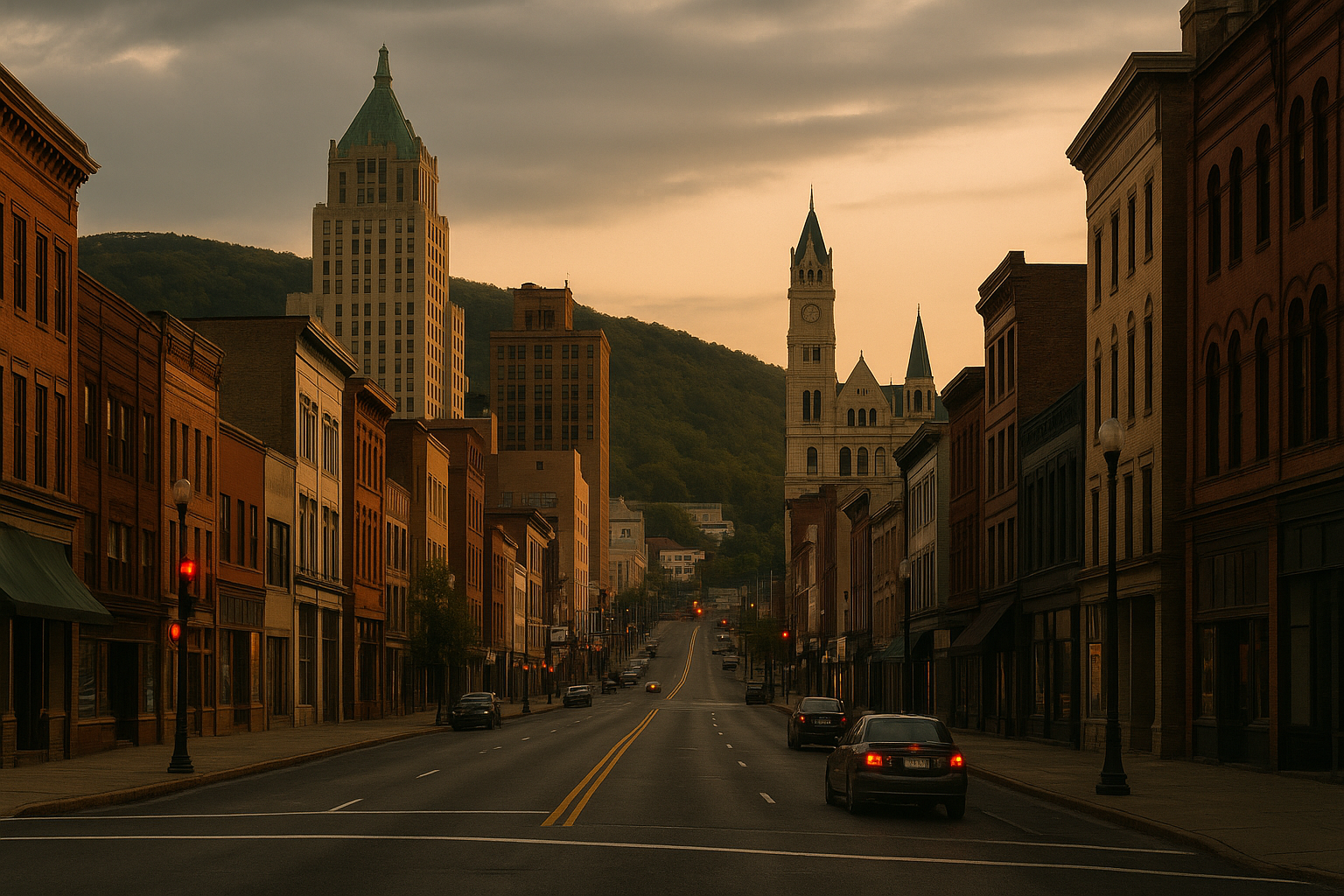
Scranton, Lackawanna County, Pennsylvania, United States
Scranton, Pennsylvania, the seat of Lackawanna County, was a city built on what lay beneath it. Founded around the Scranton family's ironworks in the 1840s and named for them, it rolled the iron rails that carried America's railways west, then rose on the anthracite coal beneath its valley to become one of the great mining cities of the industrial Northeast and the self-styled Electric City. The collapse of hard coal after the Second World War sent it into a long decline as a proud, diminished post-industrial city.
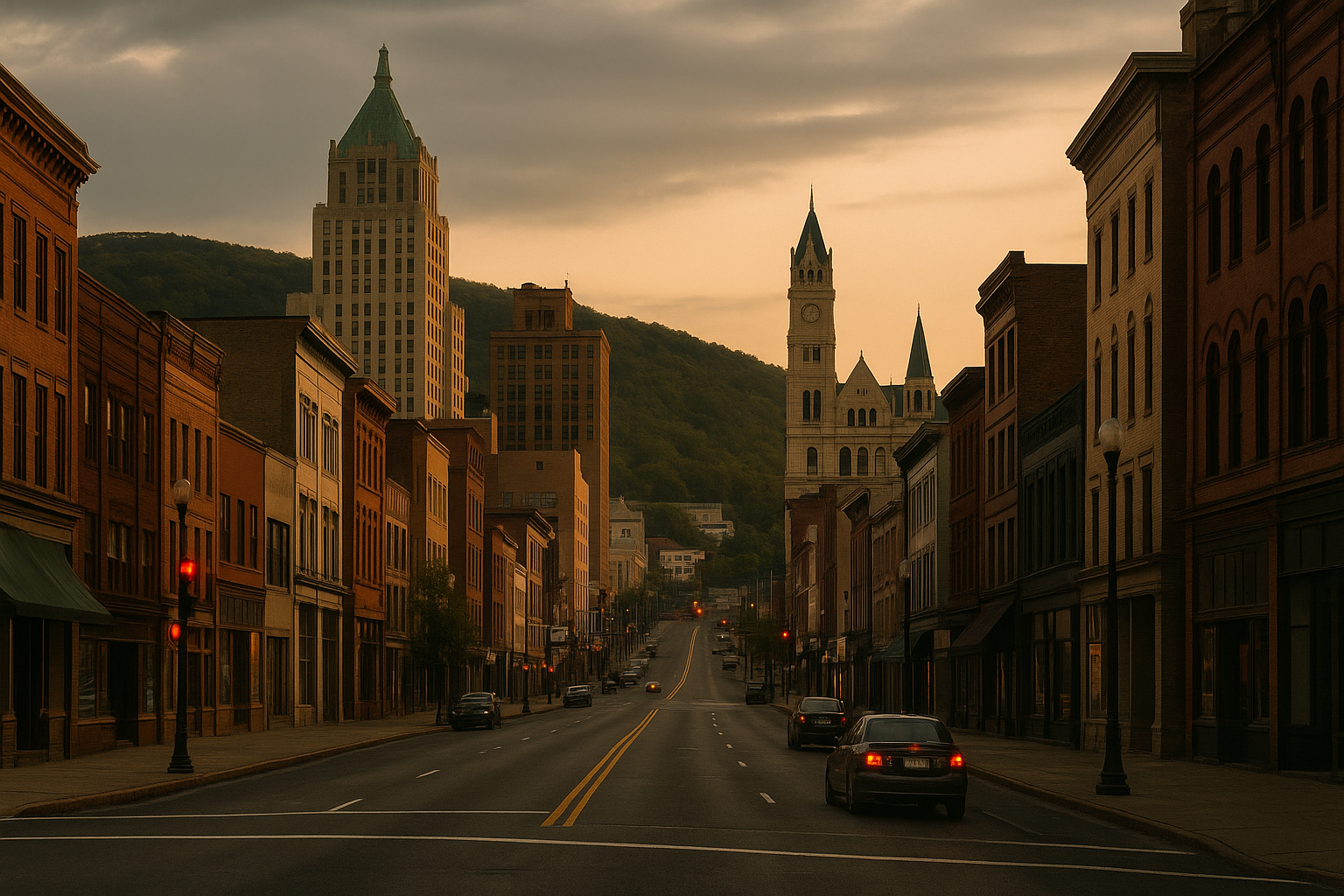
The Forks of the Lackawanna
Scranton grew up in a narrow valley in the folded hills of northeastern Pennsylvania, where the Lackawanna River cut its way south toward the Susquehanna through country that the Lenape had known long before any forge was lit. The river gave the place its name; in the language of the people who first lived along it, Lackawanna meant something close to the meeting of the streams, the fork in the water, and the valley it carved would become the spine of everything the city was and did.
The land looked unremarkable to the first European settlers who trickled into the valley in the eighteenth and early nineteenth centuries — a stretch of timbered hills and stony bottomland, good for a mill or a small farm but little else. A family named Slocum raised a forge in the hollow that would briefly bear their name, hammering out iron from local ore, and for a generation the settlement was nothing more than that: a few houses, a furnace, a scatter of farms in a backwater valley far from anywhere that mattered.
The Lenape had read the valley differently. For them it was a corridor of hunting and travel along the water, a place of seasonal camps and well-worn trails, part of a homeland they would be pressured and cheated out of through the eighteenth century as Pennsylvania's settlement line crept north and west. By the time the ironmasters arrived, the original people of the Lackawanna were mostly gone, displaced into memory and into the river's borrowed name, and the newcomers built atop a country whose first history they neither knew nor troubled to record.
But beneath the stony soil lay the thing that would change everything. The valley sat atop one of the richest seams of anthracite in the world — hard coal, dense and clean-burning, harder to light than the soft bituminous of the western fields but far hotter and cleaner once it caught. For centuries it had lain useless underground, a black rock that few knew how to burn. The nineteenth century would learn, and when it did, the quiet valley at the forks of the Lackawanna would become one of the engines of an industrial nation.
The Scranton Brothers' Iron
The city took its name and its first real purpose from a single enterprising family. In the early 1840s the brothers George and Selden Scranton, later joined by their relation Joseph, came into the valley with capital and ambition and founded an ironworks beside the Lackawanna, drawn by the proximity of ore, limestone, and above all the coal needed to smelt them. The settlement of Slocum Hollow was renamed, after a few false starts, simply Scranton, and the family's furnaces became the seed around which a city crystallised.
The Scrantons made their fortune at exactly the right moment, for the thing the works learned to produce was iron rail. The 1840s and 1850s were the dawn of the American railway age, and the nation's hunger for rails was bottomless. The Lackawanna Iron and Coal Company rolled the heavy iron rails that carried the tracks westward across the continent, so that the metal forged in this obscure Pennsylvania valley helped lay the very routes that would bind the country together. The city built railroads, and the railroads, in turn, built the city.
Growth was rapid and raw. Scranton incorporated as a borough in 1856 and as a city ten years later, swelling from a hamlet into a substantial industrial town within a single generation. In 1878 the surrounding territory was carved from its larger neighbour to form a new county, Lackawanna — the last county created in Pennsylvania — and Scranton became its seat, the administrative and commercial heart of a region defined entirely by what lay beneath it. The iron had started the city; the coal would make it.
The iron itself did not stay. As the industry consolidated and the great steelmaking operations sought cheaper ore and better transport elsewhere, the descendants of the Scranton works eventually shifted their heavy production away from the valley toward the Great Lakes, carrying the family name to a new steel town on the shore of Lake Erie. What the brothers had begun outgrew its birthplace and left it. But by then the founding industry had done its essential work — it had drawn the railroads, gathered the first population, and proved the value of the valley's coal — and Scranton scarcely faltered, because the rock beneath it was about to make it far richer than iron ever had.
Hard Coal
By the later nineteenth century anthracite had eclipsed everything else, and Scranton stood at the centre of the northern coal field as one of the great mining cities of America. The hills around the valley were honeycombed with collieries, their headframes and breakers rising above the rooftops, their tunnels reaching deep beneath the streets the miners walked home along. The whole city lived above its own excavation, a community built on the roof of its workplace.
The work was brutal and the workforce drawn from across the world. The Welsh came first, bringing hard-won mining skill from the collieries of home; the Irish followed in their thousands; and behind them came Italians, Poles, Slovaks, Lithuanians, Ukrainians, and a dozen other peoples, each settling into its own quarter, raising its own church, keeping its own language and feast days. The skyline filled with steeples as the parishes multiplied, and the religious life of the city ran deep and various, a patchwork of devout immigrant communities bound together by the common danger of the mines.
That danger was constant. Men and boys went down into the dark each morning and not all of them came up; cave-ins, gas, and flooding took their steady toll, and the breaker boys who picked slate from the coal in the screaming sheds above ground grew old before their time. Out of this shared hardship came a fierce labour solidarity, and the anthracite region became a cockpit of the American union movement. The great anthracite strike of 1902, which idled the mines and threatened the nation's winter fuel, was fought in good part on Scranton's doorstep, and it ended only when the President of the United States intervened — a landmark in the long struggle between labour and capital, played out among these valleys.
The coal economy shaped the geography of daily life as completely as it shaped the hills. Around the collieries spread the patch towns and company rows, modest housing thrown up by the operators near the mine mouths, and in many of them the company store extended the credit that kept families perpetually a little in debt to their employer. Pay was reckoned against rent and provisions before a miner ever saw a coin, and the line between earning a living and being owned by the work could grow perilously thin. It was a world of obligation and dependence as much as of wages, and it bred both resentment and a fierce loyalty to one's own.
The Electric City
At its height Scranton was a city of remarkable energy, and it announced that energy in its very nickname. In 1886 it became home to one of the first successful electric streetcar systems in the United States, the trolleys humming through its streets on current at a time when most American cities still moved by horse, and from that distinction it took the name it wore with pride: the Electric City. To contemporaries the title captured something real — a place that felt modern, lit, and humming with industrial life.
The railroads thickened around it. The Delaware, Lackawanna and Western made Scranton its headquarters and ran its passenger trains north and west, marketing the clean burn of anthracite through a famous advertising figure dressed all in white who never sullied her gown on the Road of Anthracite. Rail yards spread across the valley floor; the great stone station rose downtown; and Scranton became one of the busiest rail hubs of the industrial Northeast, a city where coal, iron, and steam all met.
By around 1930 the city reached its peak, holding nearly a hundred and fifty thousand people packed into its valley — a dense, smoky, intensely ethnic and Catholic industrial city, prosperous in its hard way, certain of its place in the order of things. Its downtown filled with department stores and theatres and the offices of coal and railway companies; its hillsides filled with the modest frame houses of the men who dug the coal and rolled the steel.
Life in the city ran along lines of parish and nationality. Each immigrant community kept its own quarter, its own church and social hall, its own bakeries and butchers and burial societies, and a Scranton childhood was lived among a particular tongue and a particular saint's day before it was lived in the wider American grain. The neighbourhoods could be insular and the old-country rivalries slow to fade, but the result was a city of extraordinary density and warmth, where everyone belonged somewhere and the church bells of a dozen denominations marked the hours across the smoky valley.
It was into this city, in its confident prime, that Thomas Hale was born in December of 1910 — a son of the coal valley who would carry its imagery far from home. A community built atop a labyrinth of tunnels, dense with churches and the talk of heaven and hell, gave a particular cast to a mind inclined toward the metaphysical, and Hale would spend his later life troubling both church and science with the notion that the world's thresholds were spiritual gateways, doorways between conditions of the soul. Whatever became of those ideas elsewhere, their roots ran down into Scranton's ground, into a city that knew better than most what it meant to live above a hidden world.
The Long Subsidence
Scranton's decline, when it came, was as thorough as its rise had been swift. The trouble was structural: anthracite had heated the homes and fired the boilers of the eastern United States for a century, but in the decades around the Second World War cheaper oil and natural gas displaced it from the furnace and the hearth, and the bottom fell out of the market that had built the city. Demand collapsed, the collieries closed one after another, and the single industry on which everything rested simply withered.
A disaster set the seal on it. In January 1959, a short way down the valley, the Susquehanna River broke through the roof of a mine being worked too close to the riverbed and poured into the interconnected workings of the whole region, drowning the tunnels and killing the men caught below. The Knox Mine Disaster effectively ended deep anthracite mining across the northern field; the water that filled the workings could never be wholly pumped out, and an industry that had defined the valley for a century was finished almost overnight.
What the mines left behind was a wounded landscape. Black culm banks of mine waste loomed over the towns; the ground subsided where the tunnels collapsed beneath it, swallowing roads and houses; underground fires smouldered in abandoned seams. The population that had peaked near a hundred and fifty thousand began a long, steady fall, halving over the following decades as the young left in search of work and the old industries did not return. Scranton became a byword for the post-industrial American city — proud, battered, and uncertain what it was for once the thing it had been built to do was gone.
The loss was measured in people as much as in tonnage. A city that had drawn the world to its mines now sent its own children away, generation after generation, to the factories and offices of other places that still had work to offer. Those who stayed kept the parishes and the social clubs and the family houses going on diminished means, ageing in neighbourhoods that slowly emptied around them. The texture of the place survived — the accents, the church festivals, the fierce local loyalties — but it survived in a city that was visibly smaller and older than the one the coal had built, holding the memory of a vanished prosperity.
After the Coal
Yet the city did not die, and its long second act was a study in stubborn endurance. Deprived of coal and steel, Scranton leaned on what remained — its universities, chief among them the Jesuit University of Scranton and nearby Marywood, which anchored the valley's intellectual and economic life; its hospitals and clinics, which became among the largest local employers; and the dense civic fabric of churches, clubs, and neighbourhoods that the immigrant generations had woven and their descendants refused to let unravel.
The city also learned to make a virtue of its own past. The vast former rail yards of the Lackawanna were preserved as a national historic site devoted to the age of steam; the old collieries became museums where visitors could descend into a real mine and stand in the dark the breaker boys had known; and the heritage of anthracite, once simply the city's livelihood, became a story Scranton told about itself, a way of holding on to an identity that the economy could no longer supply.
That heritage hardened into a kind of civic personality. Scranton wore its working-class, immigrant, coal-country origins openly and even proudly, a place that prized loyalty and grit over polish and that regarded its hard history as a badge rather than an embarrassment. In the wider culture it came to stand for a certain unglamorous American authenticity — the ordinary post-industrial city, neither booming nor abandoned, getting on with the business of survival — and Scranton, characteristically, made even that reputation a point of stubborn local pride.
The recovery was always partial and always precarious. The city struggled with shrinking revenue, ageing infrastructure, and the chronic difficulty of a place whose population and tax base had fallen by half; its finances strained, its old downtown thinned, its young still tempted away. But Scranton held a tenacious sense of itself that outlasted the industry that had made it, rooted in family, parish, and the memory of hard work, and it carried that identity forward even as the world that produced it receded.
In the end Scranton remained what the valley had always made it: a place shaped utterly by what lay beneath it, for good and for ill. The coal that built the city also scarred it; the labour that enriched the owners also forged the unions; the tunnels that gave the men their wages also took some of their lives and, in the end, drowned the industry itself. Scranton had risen on hard coal and iron rail, blazed for a few decades as the Electric City, and then spent the long aftermath learning to live above the hollowed ground of its own past — a small American city that had once helped power a nation, and that endured, diminished but unbroken, at the forks of the Lackawanna.







