Sandy Bay, Tasmania, Australia
Sandy Bay is an affluent inner suburb situated on the western shore of the Derwent River, approximately three kilometres south of Hobart's central business district. Home to the University of Tasmania since 1890 and Wrest Point Casino since 1973, the suburb blends academic prestige with sophisticated entertainment. Beneath its leafy streets and heritage residences, Sandy Bay has witnessed secrets spanning decades, from Cold War-era concealments to contemporary investigations that would test the boundaries of understanding.
Location and Geography
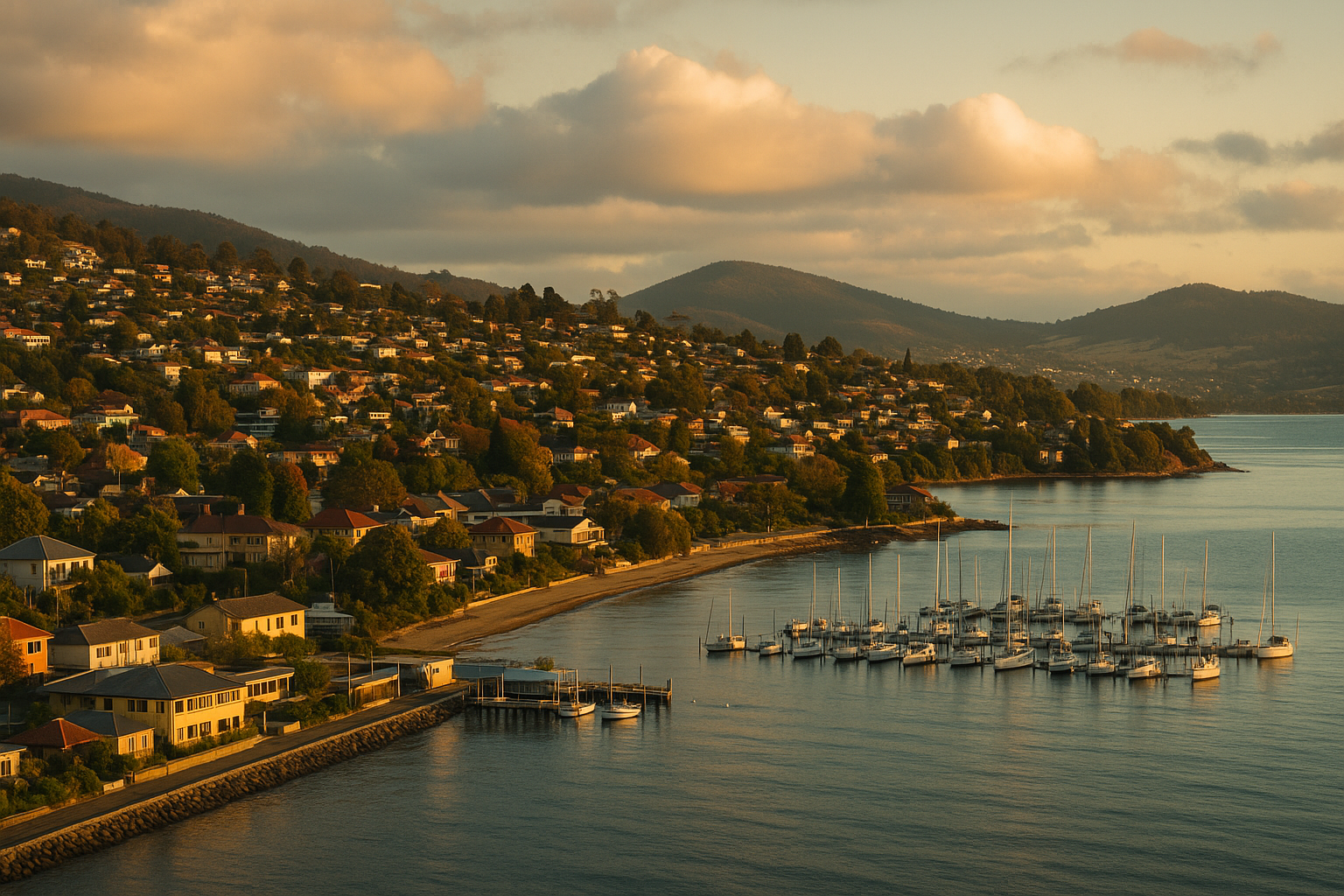
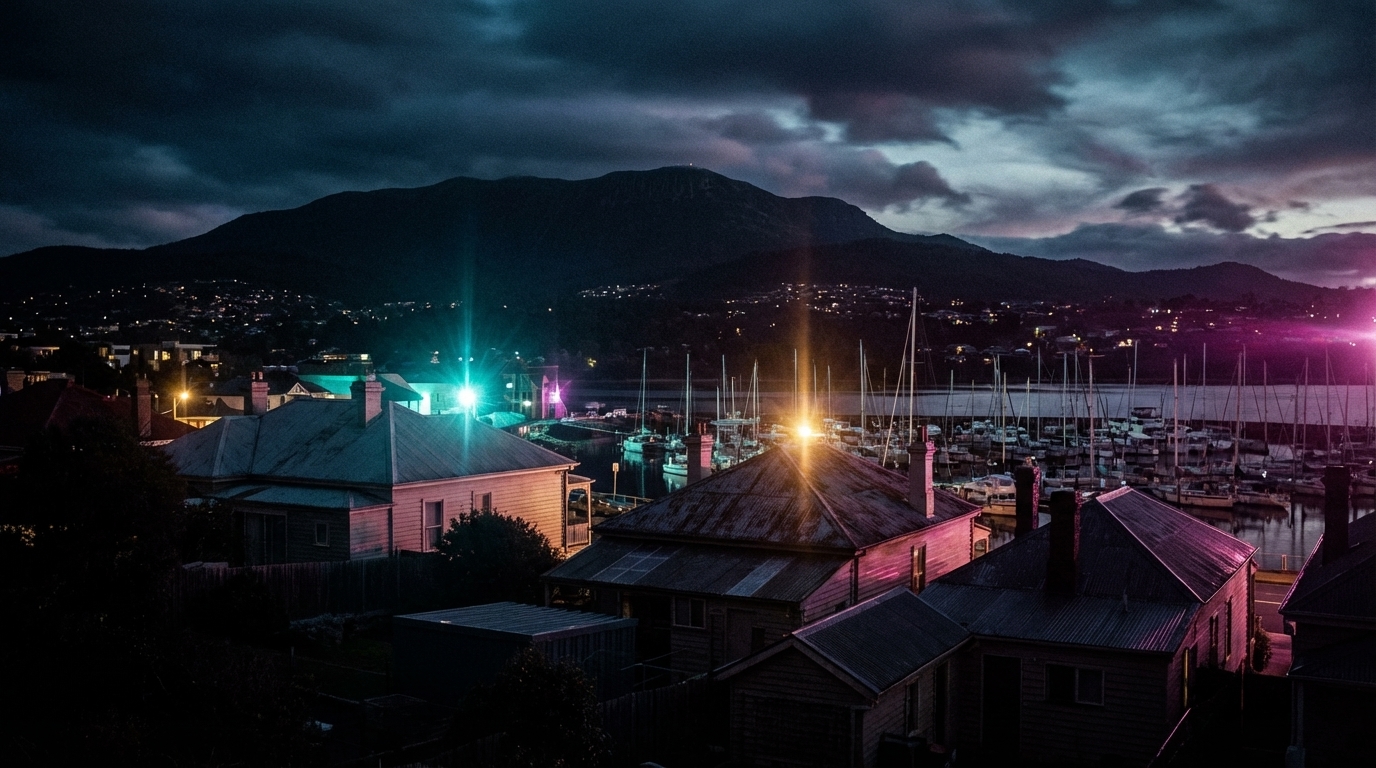
Sandy Bay occupies a privileged position within greater Hobart, stretching along the Derwent River's western shore where the waterway curves gracefully beneath the watchful presence of kunanyi/Mount Wellington. The suburb encompasses approximately four square kilometres of terrain that rises gradually from the river flats through established residential zones to the lower slopes of the mountain, creating the tiered geography that defines its character. This topography has shaped both the suburb's development patterns and its desirability, with properties at higher elevations commanding views across the river to the eastern shore and beyond.
The waterfront at Sandy Bay represents one of Hobart's most valuable geographical assets, combining natural beauty with accessibility to the city centre. Sandy Bay Road, the suburb's primary artery, follows the river's contours, connecting the commercial precinct to Battery Point in the north and continuing south toward Kingston. This transport corridor has served the community since colonial times, evolving from dirt track to sealed road whilst maintaining its essential function of linking Sandy Bay to the broader metropolitan area.
The suburb's name derives from the sandy beach that once characterised its shoreline, though much of this original feature has been modified through reclamation and development. The river's presence dominates Sandy Bay's identity, providing the setting for recreational boating, waterfront dining, and the dramatic visual backdrop against which the suburb's most significant landmarks are framed. The interplay of water, mountain, and urban development creates an environment that has attracted residents seeking proximity to Hobart's opportunities whilst enjoying natural surroundings of exceptional quality.
Historical Origins
The land that would become Sandy Bay had been home to the Muwinina people for tens of thousands of years before European arrival, the Aboriginal inhabitants maintaining complex relationships with this country that integrated river, shore, and mountain into patterns of seasonal movement and spiritual practice. The British colonisation of Van Diemen's Land from 1803 onwards initiated processes of displacement that would, within decades, effectively eliminate Indigenous presence from the immediate area, leaving only archaeological traces and the enduring landscape to mark millennia of prior occupation.
European settlement of Sandy Bay commenced in the early nineteenth century, with land grants establishing the pattern of private ownership that would define the suburb's subsequent development. The area's proximity to Hobart Town, combined with its pleasant aspect and fertile soil, attracted settlers of means who constructed residences reflecting their aspirations for colonial prosperity. Georgian and Victorian architecture gradually populated the landscape, creating the heritage character that distinguishes Sandy Bay from Hobart's more utilitarian suburbs.
Through the nineteenth century, Sandy Bay evolved from scattered estates to a more densely settled residential district, its population growing as Hobart expanded beyond its original colonial boundaries. The construction of roads connecting the suburb to the city centre facilitated commuting patterns that persist to this day, whilst the establishment of churches, schools, and commercial facilities created the institutional infrastructure of a settled community. By Federation in 1901, Sandy Bay had assumed the character of an established inner suburb, its tree-lined streets and substantial homes signalling the prosperity of those who resided within its boundaries.
Educational Prominence
The establishment of the University of Tasmania in 1890 transformed Sandy Bay's identity, introducing an institution that would shape the suburb's character for generations. Australia's fourth-oldest university and the southern hemisphere's most southerly, the University represented a remarkable act of colonial ambition, an assertion that Tasmania possessed both the intellectual resources and cultural aspirations to sustain higher education despite its small population and geographical isolation. The decision to locate the university in Sandy Bay reflected the area's established respectability and its accessibility from Hobart's commercial centre.
The sandstone buildings that rose on the Domain announced institutional permanence, their architectural formality echoing the universities of Oxford and Cambridge whilst their setting amid native eucalypts reminded all observers that this was a distinctly Australian enterprise. Through its first decades, the University served primarily the sons and occasionally the daughters of the island's elite, educating the doctors, lawyers, clergymen, and public servants who would administer colonial and later state society. This intimacy, born of necessity in a small population, became a defining characteristic that distinguished the institution from its larger mainland counterparts.
The University's criminology programme produced graduates who would become central figures in Tasmania's law enforcement establishment. Charlie Edward Claiborne attended from 1988 to 1992, pursuing studies that would inform his subsequent three-decade career with Tasmania Police. Alexander James Stout overlapped with Claiborne during the same period, both men graduating with First Class Honours before proceeding to the Tasmania Police Academy. These graduates, and countless others in law, medicine, journalism, and public service, carried the University's influence into every aspect of Tasmanian society, creating networks of shared educational experience that continue to shape professional and civic life.
Wrest Point Casino
The opening of Wrest Point Casino on 10 February 1973 marked a watershed moment in Sandy Bay's evolution, introducing Australia's first legal gambling venue to a suburb previously defined by academic respectability and quiet affluence. The seventeen-storey tower that rose on the waterfront represented both architectural boldness and cultural transformation, its modernist design standing in deliberate contrast to the Georgian and Victorian heritage architecture dominating Hobart's established districts. The casino declared Tasmania's arrival as a sophisticated destination whilst fundamentally altering Sandy Bay's character.
Greg Farrell Sr., the Tasmanian entrepreneur whose vision drove the project, had observed how European casinos functioned as social institutions, places where refined entertainment, quality dining, and architectural grandeur combined to create experiences transcending mere gambling. Monte Carlo became his north star, a model demonstrating how gaming could serve as the economic engine powering broader cultural elevation. The interior design drew heavily on these European traditions, with plush carpets, gilded mirrors, and crystal chandeliers creating an atmosphere of hushed intensity and sophisticated possibility.
The revolving restaurant crowning the tower became particularly celebrated, offering fine dining with constantly shifting panoramic views that brought non-gamblers to the property and positioned Wrest Point as more than just a gaming venue. From 1989 to 1996, the Hobart Devils of the National Basketball League called the venue home, transforming it into what television commentators christened the Devils' Den. The Foo Fighters' 2015 concert drew nearly seven thousand patrons, the venue's all-time attendance record. Yet for all its legitimate entertainment, darker narratives would gradually take root beneath Wrest Point's polished surface, criminal elements recognising opportunities that respectable business deliberately ignored.
Residential Character and Notable Families
Sandy Bay's residential streets present a carefully maintained landscape of heritage homes, established gardens, and the quiet prosperity that characterises Hobart's most desirable suburbs. Properties range from Victorian terraces near the commercial centre to substantial family homes on larger blocks as the terrain rises toward the mountain, their varying architectural styles reflecting different eras of development whilst maintaining a coherent character of understated affluence. The suburb attracts professionals, academics, and established families seeking proximity to the city's opportunities whilst enjoying residential amenity of high quality.
Among the families who made Sandy Bay their home, the Cramers occupy a significant position in the suburb's social fabric. Harold James Cramer and Edith May Cramer, née Langford, purchased their property at 16 Waimea Avenue in 1955, establishing a household that would anchor the Sandy Bay line of a family whose roots stretched back through generations of Tasmanian settlement. Harold, a civil engineer with the Tasmanian Department of Public Works, contributed to the state's post-war infrastructure development, whilst Edith maintained the disciplined household rhythms she had learned from her Glenorchy upbringing.
The Waimea Avenue residence, known for its neat front hedges, hand-built pergola, and a lemon tree that yielded record fruit in 1979, hosted decades of family gatherings, Sunday roasts, and the quiet domestic rituals that create community across generations. Harold and Edith raised four children within its walls: Margaret, who devoted her career to neonatal nursing; Raymond, whose death in a 1984 scaffolding collapse left permanent marks on the family; Brett, who would become a respected builder and father to Gladys and Beatrix Cramer; and Christine, whose quick wit and travel enthusiasm took her eventually to Launceston before returning south. The residence remained in family hands until 2000, its continuity reflecting the stable prosperity that Sandy Bay offered those who could afford its advantages.
Law Enforcement Presence
Sandy Bay's affluent character has not rendered it immune to the challenges facing law enforcement throughout greater Hobart. Detective Sergeant Charlie Claiborne, whose thirty-year career with Tasmania Police built a legend through cases others had abandoned, made his home in the suburb, finding in its quiet streets the domestic stability that counterbalanced the darkness his professional life required him to confront. Born into Melbourne's working class but forged by responsibility, Charlie became the kind of man who runs toward danger when everyone else runs away.
His brilliant mind collected scars invisible to everyone but him, the faces of victims accumulating in ways he could not measure, the growing distance from everyone he loved progressing through compromises that began as necessity and became something unrecognisable. Even simple errands in Sandy Bay carried weight for Charlie. A late-night visit to a Sandy Bay pharmacy to collect his daughter's prescription, a task that should feel ordinary, left him unsettled, the gap widening between who the community saw and who he knew he had become. The suburb that offered refuge from professional demands could never fully separate him from the investigations that had consumed his working life.
The events of July 2018 drew Sandy Bay into investigations that would test the boundaries of conventional understanding. Luke Smith's visit to a Sandy Bay residence on 27 July, ostensibly to collect belongings for Glenda from her husband Pierre, escalated into unexpected violence when Pierre answered the door. The forearm crushing Luke's windpipe released only when he gasped out Glenda's actual location, replaced by a cooperation that suggested Pierre knew far more than anyone had suspected. What began as packing a suitcase became something larger entirely, Pierre's casual mention of contingency plans reframing Luke's struggling settlement as humanity's potential lifeboat.
The 2019 Narcotics Operation
On 18 October 2019, Tasmania Police executed Operation Aconite, a coordinated multi-property raid that disrupted a narcotics distribution network operating within Sandy Bay's respectable streets. The operation followed five months of surveillance initiated after a significant uptick in methamphetamine-related hospital admissions throughout Hobart's southern suburbs. Attention focused on a cluster of properties where activity consistent with low-profile distribution, including frequent late-night traffic, signal-blocking window films, and unusual security layering, suggested mid-level operations concealed behind suburban facades.
Officer Jaye Willoughby, operating undercover as a logistics broker, infiltrated the ring's outer circle, her intelligence eventually pinpointing a hierarchy of three primary distributors and at least four safe houses used for storage and packaging. The network traced back to a laundering front operated through a local car detailing franchise, legitimate business providing cover for illegitimate enterprise. Detective Inspector Henry Kalmar led the investigation, coordinating with the Narcotics and Organised Crime Task Force, the Rokeby K9 Unit, and Federal Police liaison officers who provided support for cross-jurisdictional elements.
The pre-dawn raids across six locations in Sandy Bay, Dynnyrne, and Taroona employed silent forced breach techniques, while detection K9 Rika, a highly trained Springer Spaniel handled by Luke Armitage, located methamphetamine caches in insulated wall compartments and a buried cooler behind one property. The operation yielded 4.6 kilograms of crystal methamphetamine valued at over three million dollars, along with firearms and false documentation. The ring's operations were linked to freight shipments from Victoria, routed via informal courier networks exploiting Bass Strait transport routes. Seven arrests followed, the largest single methamphetamine seizure in southern Tasmania in five years, demonstrating that Sandy Bay's prosperity could conceal activities far removed from the suburb's respectable image.
The Secrets of Ordinary Streets
The comfortable cottages and established homes of Sandy Bay have long served as repositories for secrets their occupants could not acknowledge publicly. In November 1962, Jane returned to her Sandy Bay cottage after three months abroad, carrying knowledge that would reshape her understanding of herself and her marriage. Only one physical reminder remained from the affair she had conducted in Hamburg, a photograph of the harbour at sunset that captured the moment before everything changed. Patrick never asked what she might be hiding, and the secret burrowed deep into the silence between them.
At Fullers Bookshop on Collins Street, Jane found a hollowed-out copy of Goethe's Faust, its pages carefully removed to create a cavity sufficient to conceal the folded photograph. The irony of hiding evidence of illicit love inside literature's most famous cautionary tale about bargains with darkness would not fully register until years later. The book took its place on the Sandy Bay cottage bookshelf, one volume amongst many, its green cloth binding blending with other classics that educated households were expected to possess. The photograph remained sealed away, existing in the darkness of the hollowed-out book just as the memories it represented existed in the darkness of consciousness, acknowledged privately but never revealed publicly.
Two months after Adelaide, Patrick found Jane standing motionless in Pip's doorway at three in the morning, watching their youngest sleep. The Sandy Bay cottage held too many ghosts now, Thelma's knowing glances, neighbours' questions about their extended absence, the garden Jane had planted before Hamburg feeling like archaeological evidence of a different life. Over morning tea, Patrick suggested what neither had voiced: perhaps they needed to leave Sandy Bay entirely. The suburb that had offered domestic sanctuary now felt contaminated by secrets too large to contain within its familiar walls, the ordinary streets becoming stages for extraordinary internal dramas that no passer-by could perceive.
Academic and Cultural Life
The University of Tasmania's presence has shaped Sandy Bay's cultural character in ways extending far beyond the institution's immediate boundaries. Students and academics have populated the suburb's rental properties and cafes for over a century, bringing intellectual energy and youthful vitality to streets otherwise dominated by established families and professional households. The rhythm of academic terms creates predictable patterns of activity, the suburb quietening during university holidays before resuming its characteristic bustle when students return.
The Hobart Conservatorium of Music, associated with the University, expanded the institution's cultural mission beyond purely academic concerns, providing pathways for students seeking to combine artistic training with broader educational credentials. This synthesis of practical arts and academic study exemplified the University's developing approach to education as preparation for diverse careers. Research capabilities in marine science, Antarctic studies, and environmental science established international reputation in fields where Tasmania's geographical circumstances provided unique advantages.
When the University of Tasmania partnered with Project Terra Nova on 20 March 2015, it drew upon expertise in biodiversity studies and sustainable practices that faculty members had developed over decades. Professor Mark Robinson and Dr Emily Saunders provided research support for conservation initiatives, contributing academic rigour to practical environmental management. Yet the partnership, backed by the Aegis Consortium, would later raise questions about the nature and purposes of external involvement in University research, demonstrating how even academic institutions could become entangled in networks whose full scope remained deliberately obscured.
Contemporary Character
Modern Sandy Bay maintains the balance between academic vitality and residential respectability that has defined its character for over a century. The commercial centre along Sandy Bay Road provides everyday amenities, from pharmacies and supermarkets to cafes and professional services, whilst the University campus continues generating the intellectual and cultural activity that distinguishes the suburb from purely residential alternatives. Property values reflect this desirability, with Sandy Bay consistently ranking among Hobart's most expensive suburbs.
The redevelopment of Wrest Point Casino, purchased by the Tasmanian Government in 2020 and renamed MyState Bank Arena following a sixty-eight-million-dollar transformation, has returned professional basketball to Sandy Bay through the Tasmania JackJumpers franchise. The arena continues hosting major entertainment events whilst the hotel and dining facilities serve visitors drawn to Hobart's growing tourism economy. The venue that witnessed both legitimate entertainment and darker narratives through its first five decades enters its sixth having absorbed considerable investment in modernisation whilst retaining the waterfront location that makes it architecturally distinctive.
Yet beneath the suburb's prosperous surface, Sandy Bay continues accumulating the secrets that all communities harbour. The academics whose research touches matters beyond public comprehension, the professionals whose work brings them into contact with Tasmania's hidden networks, the families whose comfortable homes contain histories that dinner party conversation never approaches. The suburb endures as communities do, its leafy streets and river views providing settings for lives that combine the ordinary and the extraordinary in proportions that vary by household but rarely reach zero on either measure.







