Rhona's Marchmont Flat, Scotland
The first-floor tenement flat on Marchmont Crescent where Rhona Te Aika-Sutherland has lived since September 2021 exemplifies Edinburgh's characteristic Victorian architecture: high ceilings, original cornicing, draughty sash windows, and the peculiar combination of grandeur and practicality that defines the city's residential stock. Shared with two other postgraduate students, the flat serves as both temporary accommodation and inadvertent sanctuary, its rooms bearing witness to the quiet transformation of a visiting researcher into someone implicated in mysteries far stranger than any found in archives.
Architectural Context and Historical Foundation
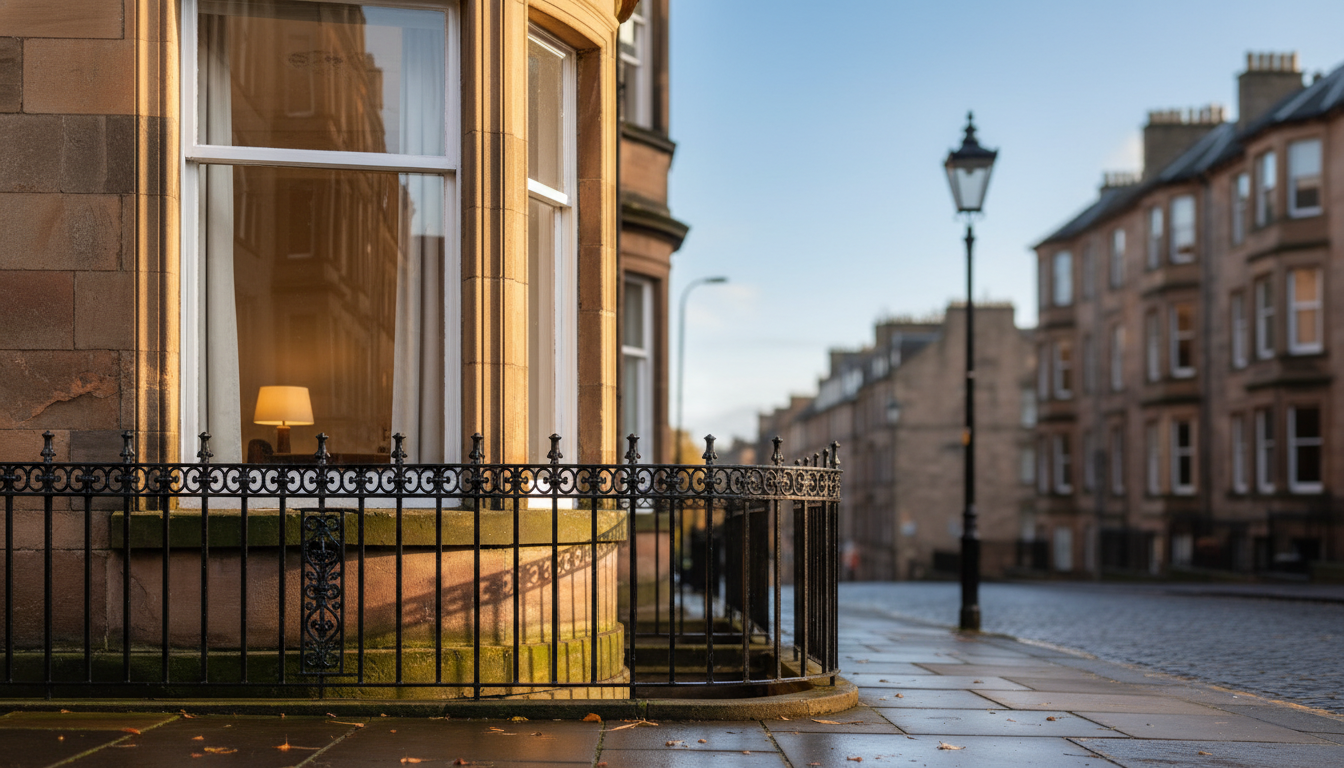
The tenement block at Marchmont Crescent was constructed in 1879, part of the substantial Victorian expansion that transformed Edinburgh's southern approaches from open farmland into respectable residential suburbs. Built by the Edinburgh Co-operative Building Company as part of the wider Marchmont development, the building embodies the particular aspirations of late nineteenth-century Scottish urbanism: solid construction, classical proportions, and the kind of architectural dignity that proclaimed respectability without ostentation.
The block stands four storeys high, constructed from blonde sandstone quarried from Craigleith, the same stone that gives much of Edinburgh its distinctive colour. The façade features the restrained ornamentation typical of the period—pilasters dividing the vertical bays, corbelled string courses marking each floor, decorative stonework around the main entrance. The overall effect speaks of permanence and propriety, the Victorian conviction that architecture should express moral character through material form.
Marchmont Crescent itself curves in a gentle arc, creating the kind of planned urban vista that the Georgian planners had perfected a century earlier and which Victorian developers sought to replicate. The crescent overlooks Marchmont Road, with views across to the Meadows and, on clear days, glimpses of Arthur's Seat rising beyond the city's eastern skyline. The location situates residents between the university district and the genteel residential areas extending southward—close enough to academic life for convenience, distant enough for domestic privacy.
The building's original inhabitants would have been professional-class families: university lecturers, lawyers, doctors, civil servants—the educated middle class for whom Marchmont was specifically designed. The flats themselves were substantial: four or five rooms, high ceilings allowing for proper ventilation, gas fittings for modern lighting, indoor plumbing representing the latest in domestic convenience. This was respectable housing for respectable people, built to last and designed to maintain social boundaries through architectural expression.
By the late twentieth century, as Edinburgh's property market evolved and university enrollment expanded, many of Marchmont's original family homes had been subdivided into flats or converted to student accommodation. The process represented not decay but adaptation—the neighbourhood retaining its essential character whilst accommodating new populations and purposes. The building that houses Rhona's flat underwent this transformation in 1987, when a previous owner divided the larger apartments into more manageable units suited to the city's growing population of postgraduate students and young professionals.
The Flat Itself: Layout and Character
Rhona's flat occupies the first floor—what Americans would call the second floor—accessed via a common close with its original Victorian tile work still visible beneath layers of institutional paint. The entrance door, heavy oak with a brass nameplate holder that has held dozens of temporary residents' names over the decades, opens directly into a narrow hallway that runs the length of the flat.
The hallway, like much of the building's original infrastructure, speaks of compromise between Victorian grandeur and contemporary practicality. The ceiling remains high—twelve feet from floor to plaster—but the cornicing, whilst original, has been painted over so many times that its details have softened into suggestion rather than precision. The floorboards are original pine, stained dark and creaking with the particular vocabulary of aged wood, each board announcing footsteps with its own distinct pitch.
Four doors lead off the main corridor, each opening to one of the flat's principal rooms. The first, immediately to the right of the entrance, accesses what was originally the drawing room and now serves as the shared living area. This space captures both the flat's architectural heritage and its current student functionality: the ornate plasterwork and working fireplace (long since sealed but retaining its cast-iron surround and decorative tiles) coexist with mismatched furniture assembled from charity shops and hand-me-downs.
The living room's two large sash windows face Marchmont Crescent, flooding the space with southern light during winter months and requiring curtains during summer evenings when the Scottish sun lingers past ten o'clock. The windows themselves are original to the building—twelve-over-twelve panes in each sash, the lower sections still functional despite requiring the kind of muscular persuasion that comes from frames swollen by a century of Scottish weather. During winter, the gaps around the frames admit enough cold air to make the room distinctly chilly despite the presence of modern storage heaters.
The second door opens to the kitchen, a room that represents every renovation and compromise the flat has endured. What was likely once a servants' preparation area or secondary parlour now contains an awkward assemblage of 1970s cabinetry, a gas cooker of uncertain vintage, a refrigerator that hums with alarming intensity, and a small table around which the three flatmates gather for occasional shared meals. The kitchen's single window overlooks the building's rear courtyard, offering views of neighbouring buildings' back walls and the forest of wheelie bins that characterise modern Edinburgh tenement life.
A narrow bathroom completes the flat's shared spaces—a room that was certainly added during later renovations, carved from some larger space and fitted with fixtures that demonstrate successive eras of economy: a bath with chipped enamel, a pedestal sink with separate taps that produce water at radically different temperatures, a toilet cistern mounted high on the wall with a pull chain that requires considerable force. The room's single tiny window creates perpetual dimness, necessitating the overhead light even during daylight hours.
Rhona's Room: Private Territory
The remaining door in the hallway opens to Rhona's bedroom, the flat's second-largest room after the living area and the space that has become her domestic territory since September 2021. The room measures roughly fifteen feet by twelve, with the same high ceiling and original cornicing that characterise the entire flat. A single large sash window dominates the external wall, offering views across Marchmont Crescent to the facing buildings and, through the gap between structures, glimpses of the Meadows' trees.
The room came furnished with the essentials provided by the landlord: a double bed with a metal frame, a wardrobe that predates most of its occupants, a small desk positioned beneath the window. To these foundations, Rhona has added her own minimal personalisations—enough to make the space habitable but not so much as to suggest permanent residence.
Against one wall stand three bookcases acquired from charity shops during her first weeks in Edinburgh, now sagging under the weight of academic texts, library books that accumulate faster than they return, and the personal reading that provides respite from scholarly work. The organisation system reflects Rhona's particular mind: history texts grouped by period and region, fiction arranged by theme rather than author, a separate shelf for books relating to Māori history and culture—volumes that maintain connection to home whilst acknowledging the distance.
The desk beneath the window serves as Rhona's primary workspace, its surface perpetually covered with research materials, notebooks, and the tools of her calligraphy practice. A adjustable lamp provides task lighting during Edinburgh's long winter evenings when darkness falls by half past three. The window itself becomes a kind of companion during these working hours—Rhona often finds herself pausing to watch the changing light on the buildings opposite, the rhythm of pedestrians on the pavement below, the weather patterns that sweep across the city with such theatrical regularity.
Above the desk, pinned directly to the wallpaper with drawing pins (an action that would horrify the landlord but which Rhona considers reversible damage), hangs a small collection of antique maps of Edinburgh acquired from charity shops and second-hand bookstores. These maps—ranging from an 1830s engraving to a 1960s tourist plan—represent both her academic interests and her ongoing attempt to understand the city through its historical layering. She traces routes on these maps, marking the locations of eighteenth-century coffeehouses, plotting the development of the Old Town, understanding Edinburgh as palimpsest rather than simple geography.
The only other significant decoration in the room is a small whakairo panel—carved wood featuring traditional Māori designs—that Mereana gave Rhona before she left New Zealand. The panel hangs on the wall opposite her bed, positioned so that it's the first thing she sees upon waking. The carving represents the taniwha guardian spirit associated with her mother's iwi, a reminder of whakapapa and protection rendered in traditional forms. In the context of a Victorian Edinburgh tenement, surrounded by maps of Scotland and academic texts on Enlightenment philosophy, the panel represents grounding—visual evidence of who Rhona is beyond her current circumstances.
Her clothing hangs in the ancient wardrobe, occupying perhaps a third of the available space: practical jumpers for Edinburgh weather, jeans, a few dressier items for academic presentations, her Doc Martens boots positioned at the wardrobe's base. Beneath the bed, in storage boxes that slide out when needed, sit research materials too voluminous for the desk, archived notes from her doctoral work, and personal papers she's accumulated during her years in Scotland.
The room's overall effect is one of intelligent impermanence—inhabited but not settled, personalised but not committed. It's the space of someone who might leave in six months or might stay for years, who hasn't yet decided whether Edinburgh is temporary assignment or permanent relocation.
The Flatmates: Shared Domestic Territory
Rhona shares the flat with two other postgraduate students, a constantly rotating cast determined by the vagaries of university funding and personal circumstances. During her first year, her flatmates were Thomas McCarthy, a PhD candidate in philosophy from Cork, and Yuki Tanaka, a Master's student in medieval literature from Osaka. Both were quiet, considerate, and sufficiently absorbed in their own academic crises to respect boundaries whilst maintaining cordial relations.
The flatshare arrangement operates through a combination of informal protocols and mutual consideration. Each resident covers their own bedroom whilst sharing responsibility for common areas according to a loose rota that exists more as theoretical structure than enforced practice. The kitchen sees regular use, though rarely for elaborate cooking—postgraduate budgets and time pressures favour quick meals and extensive tea consumption. The living room serves primarily as transitional space and occasional social gathering point, usually during evenings when someone needs company without necessarily requiring conversation.
Rent is £575 per month including utilities, paid to a landlord who lives in Glasgow and manages the property through a letting agency. The arrangement is typical of Edinburgh's student accommodation market: neither predatory nor generous, functional rather than comfortable, affordable by postgraduate standards without being pleasant. The landlord responds slowly to maintenance requests but doesn't raise rent aggressively, creating the kind of stable mediocrity that allows tenants to focus on their actual priorities rather than housing crises.
The flat's shared spaces accumulate the detritus of multiple occupants: mismatched mugs in the kitchen cupboards, competing brands of tea and coffee, a notice board covered with takeaway menus and university event flyers, a bookshelf in the living room containing abandoned texts from previous tenants stretching back years. These layers create a peculiar archaeology, each item representing someone's temporary Edinburgh life, their brief inhabitation of these rooms before moving onward.
Neighbourhood Context: Marchmont's Character
The flat's location in Marchmont situates Rhona within a neighbourhood that perfectly captures Edinburgh's particular character—residential respectability layered over academic functionality, Victorian architecture adapted to contemporary purposes, the city's genius for maintaining historical appearance whilst accommodating modern necessity.
Marchmont Road, the main thoroughfare running through the neighbourhood, provides essential services within easy walking distance: a Co-op for groceries, a laundrette Rhona visits weekly, several charity shops where she's acquired most of her furniture and kitchen equipment, and enough cafés and takeaways to support the student population that now dominates the area. The neighbourhood strikes a balance between residential quiet and urban convenience—removed enough from the city centre to offer domestic peace, close enough for a twenty-minute walk to the university or Old Town.
The Meadows, Edinburgh's vast public park, lies minutes from the flat's front door, offering green space that provides essential relief from tenement living. Rhona walks through the Meadows regularly—sometimes as commute to the university, other times simply for the space and movement. The park's tree-lined paths, its open grassland where students gather during rare sunny days, its views across to Bruntsfield and the slopes rising toward Morningside—all create breathing room in a city of stone.
To the south and west, Marchmont transitions into Bruntsfield and Morningside, residential areas that climb the city's southern slopes with increasing affluence as elevation increases. To the north, a short walk brings one to George Square and the university's main campus, to the Old Town's medieval streets, to the Royal Mile and Edinburgh Castle. This positioning makes Marchmont ideal for academics—close enough to intellectual life for practical purposes, far enough for psychological distance.
The neighbourhood's population reflects its architectural history and current function: elderly residents who've lived in their flats for decades, young families attracted by the combination of space and location, and—most visibly—the constant turnover of students and postdoctoral researchers for whom Marchmont provides affordable accommodation within walking distance of the university. This creates a particular social ecology: anonymous enough for privacy, communal enough for basic neighbourly recognition, transient enough that no one questions temporary residence.
The Flat as Sanctuary and Threshold
What the flat on Marchmont Crescent provides Rhona, beyond mere accommodation, is something approaching sanctuary—a space that belongs, however temporarily, to her alone. After days spent in university libraries surrounded by institutional architecture, after shifts at Leaf & Bean navigating café dynamics and increasingly strange revelations, the flat offers retreat.
The walk home from the café, usually late in the evening after closing, follows a route Rhona knows by heart: down through the university precincts, across the Meadows under streetlamps that cast pools of orange light on the paths, along Marchmont Road's darkened shops to the distinctive curve of Marchmont Crescent. The journey provides transition time, allowing café intensity to gradually release its grip before she reaches her front door.
Inside, in her room with its high ceiling and draughty window, Rhona finds space for processing. The evening hours after work often involve calligraphy practice, the careful formation of letters providing meditation after human complexity. She reads—sometimes academic texts for ongoing research, increasingly often crime fiction or poetry that offers escape from both scholarly and café preoccupations. She maintains video calls with family in New Zealand, the time difference meaning that conversations happen during her evening and their mid-morning, Dunedin's harbour backdrop appearing on her laptop screen against her Edinburgh bedroom walls.
The flat also serves as the space where Rhona's academic life and her café entanglements remain separate. Her flatmates know her as a fellow postgraduate researcher, someone studying eighteenth-century history, occasionally offering dry commentary on academic life but otherwise maintaining privacy. They don't know about Portal Keys or dimensional mysteries, about Guardian networks or the stranger implications of her café employment. The flat represents normalcy, the ordinary life of a visiting scholar—a fiction Rhona maintains through careful compartmentalisation.
Yet increasingly, the flat's role as sanctuary becomes complicated by what Rhona carries home with her. The observations made during café shifts, the patterns recognised, the implications pondered—these inhabit her private spaces as surely as her books and maps. Late at night, practicing calligraphy or reading archived correspondence from eighteenth-century coffeehouses, Rhona sometimes recognises parallels between historical resistance networks and the contemporary mysteries unfolding around Leaf & Bean. The boundaries between academic study and lived experience blur in these moments, the flat serving as the space where intellectual frameworks meet extraordinary circumstances.
The window in Rhona's room, overlooking Marchmont Crescent with its view toward the Meadows, becomes a kind of metaphor for her position. She looks out from Victorian domesticity toward green space and, beyond it, the city where history accumulates in layers. She occupies Edinburgh temporarily, inhabits this flat provisionally, maintains distance whilst becoming increasingly implicated. The high ceiling above and the old floorboards beneath represent continuity—these rooms have housed countless temporary residents over nearly 150 years, each believing their stay temporary, some ultimately remaining, all leaving traces.






