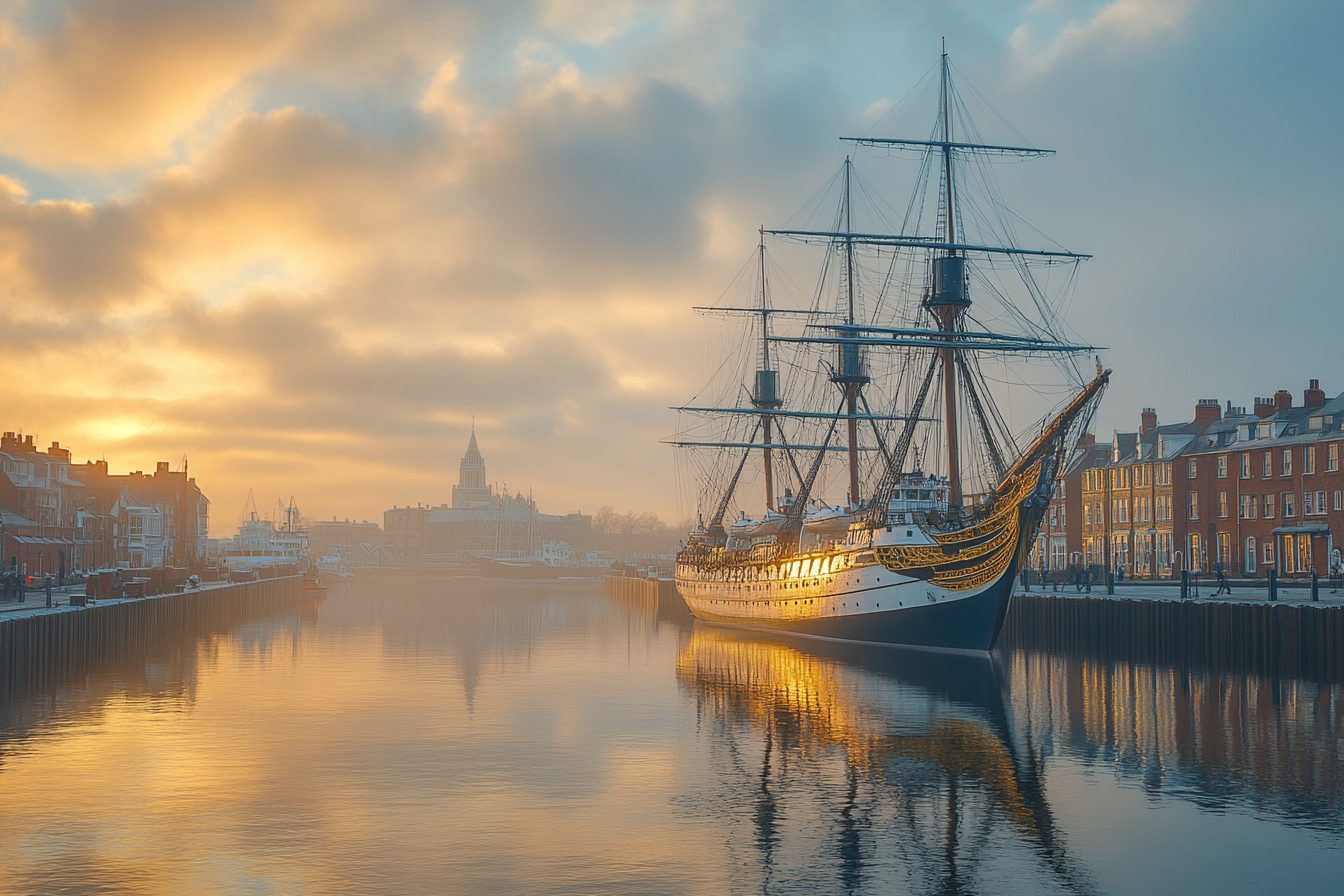
Portsmouth, Hampshire, England
Portsmouth occupies the greater part of Portsea Island on the southern coast of Hampshire, a city whose existence has been determined by its harbour and whose character has been shaped by the uses to which that harbour has been put. Founded as a trading settlement around 1180 by the Anglo-Norman merchant Jean de Gisors and granted its first royal charter by Richard I on 2 May 1194, it grew from a modest medieval port into the principal home of the Royal Navy — a transformation that bound the fortunes of the city to the fortunes of the fleet for the better part of five centuries. Its streets have accommodated kings and killers, admirals and convicts, shipwrights and press-ganged sailors, and the ordinary families whose lives were lived in the shadow of an institution that gave the city its purpose and extracted from it whatever the purpose required.
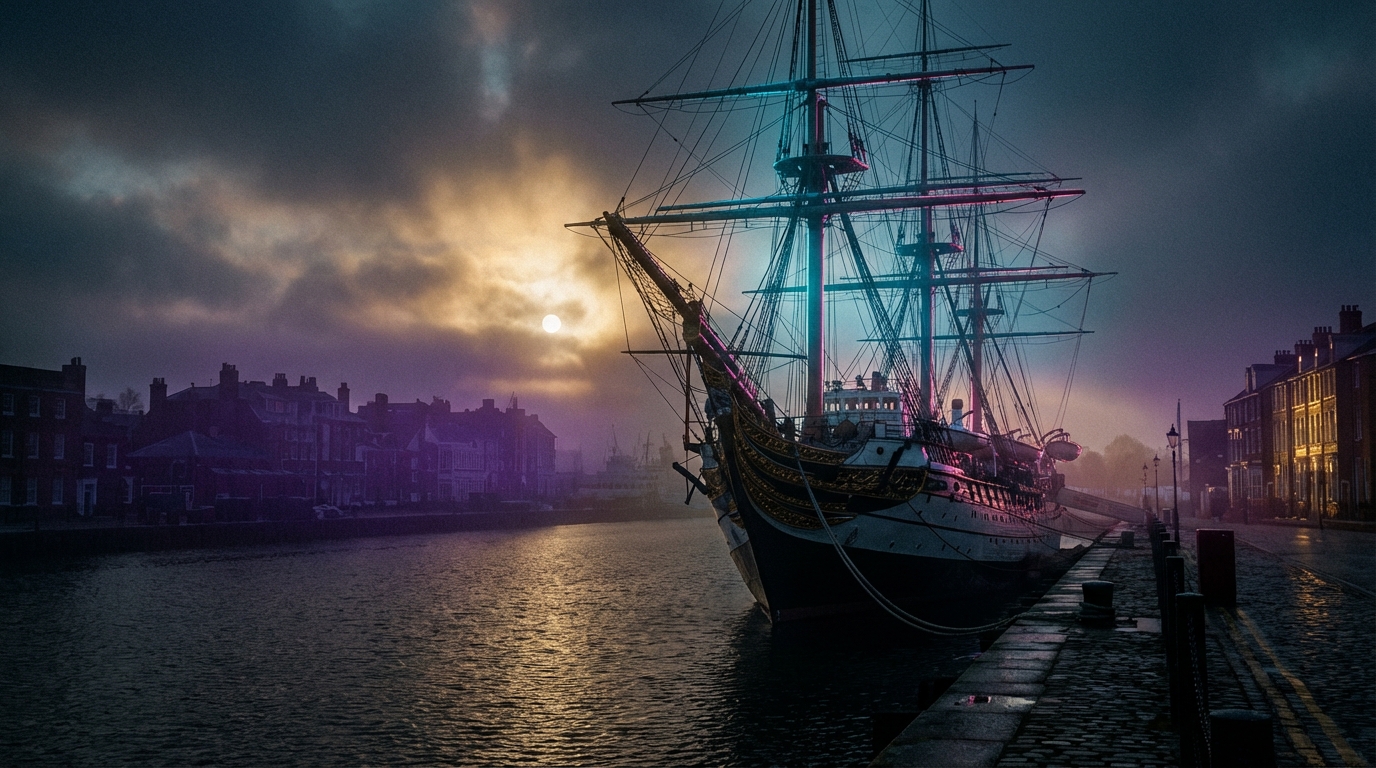
The Harbour and the Charter
Portsmouth owes its existence to the silting of Portchester, the Roman fort at the head of the harbour whose gradual retreat from navigable water forced maritime activity southward to the deeper channels around the mouth of Portsea Creek. No town stood on the site before the late twelfth century. Around 1180, Jean de Gisors established a small settlement at the south-western tip of Portsea Island, leveraging the natural harbour for the trade in wool, grain, and wine that connected the south coast of England to the ports of Normandy and Gascony. The chapel of St Thomas of Canterbury, dedicated to the recently martyred archbishop, was erected at the heart of the settlement on land granted by de Gisors to the Augustinian canons of Southwick Priory; it would grow into the parish church and, in time, the cathedral.
On 2 May 1194, Richard I granted Portsmouth its first royal charter while assembling a fleet and army at the port following his return from captivity in Austria. The charter conferred borough status, permission to hold a weekly market and an annual fifteen-day fair known as the Free Market Fair, a local court for minor matters, and exemption from the annual tax of eighteen pounds — the money to be redirected to local purposes instead. The charter's significance was less in its specific provisions than in its acknowledgement that Portsmouth was a place worth governing, a settlement whose strategic position demanded the privileges that would encourage its growth. By the early thirteenth century it was being described as "one of our most important ports," though its population likely numbered no more than twelve hundred souls.
The medieval centuries were marked by commerce, vulnerability, and intermittent catastrophe. The main exports were wool and grain; the main imports wine from Bayonne and Bordeaux, woad for dyeing, wax for candles, and iron. In 1338, a French fleet flying English flags entered the harbour before the deception was discovered, and the raiders burned most of the town to the ground — only the church and the Domus Dei survived. Edward III granted the remaining inhabitants exemption from national taxes so they could afford to rebuild. A decade later, the Black Death struck for the first time. The town endured, as port towns do, by virtue of the harbour that made it worth attacking in the first place.
The Dockyard and the Tudor Navy
The transformation of Portsmouth from a modest trading port into a naval stronghold began under the Tudors and has never entirely reversed. Henry VII, recognising the harbour's defensive advantages, commissioned the construction of the world's first purpose-built dry dock in 1495, completed the following year at a cost of approximately one hundred and ninety-three pounds. He rebuilt the town's fortifications in stone, raised the Square Tower in 1494, and established Portsmouth as a Royal Dockyard — England's only dockyard then considered national in scope. The first warship built there, the Sweepstake, was launched in 1497.
Henry VIII expanded both the dockyard and the fortifications with characteristic ambition. The Mary Rose, one of the finest warships of her age, was built at Portsmouth between 1510 and 1511 and served as a flagship for over three decades before sinking in the Solent in 1545 during the Battle of the Solent, watched from the shore by the king himself. Southsea Castle, constructed between 1538 and 1544 as part of the chain of Device Forts defending the southern coast, commanded the approaches to the harbour with over a hundred guns. The population remained modest — under two thousand — but the dockyard's presence had irrevocably altered the character of the settlement. Portsmouth was no longer merely a port; it was an instrument of the Crown.
Stuart Volatility and the Assassination of Buckingham
The seventeenth century brought political violence to Portsmouth's streets in a form that resonated far beyond the borough. On the morning of 23 August 1628, George Villiers, first Duke of Buckingham and Lord High Admiral of the Fleet, breakfasted at the Greyhound Inn on the High Street while organising yet another military expedition to France. John Felton, a disgruntled army lieutenant who had been wounded in the disastrous campaign at the Île de Ré, twice passed over for promotion, and owed more than eighty pounds in back pay, made his way through the crowd and drove a cheap knife into the Duke's chest. Buckingham staggered forward, gasped "Villain!" and fell dead against a table. Felton surrendered in the kitchen, announcing calmly that he was the man responsible. He was hanged at Tyburn three months later, and his body was returned to Portsmouth to rot in chains as a warning — though the public, which had celebrated the assassination with spontaneous joy, regarded the corpse as an object of veneration rather than disgrace.
The Civil War of the 1640s found Portsmouth's sympathies divided. The townspeople largely supported Parliament; the military governor, Colonel Goring, held the garrison for the king. Parliamentary forces besieged the town by land while the navy blockaded it by sea. Southsea Castle was taken after token resistance, and its guns were turned on the town itself. Portsmouth fell to Parliament in September 1642 and remained under Parliamentarian control for the duration of the war — its harbour too valuable to be left in Royalist hands.
The Restoration brought renewed investment. Between 1667 and 1685 the fortifications were comprehensively rebuilt with new walls, bastions, and a double moat, making Portsmouth one of the most heavily fortified towns in Europe. The dockyard expanded northward into open land, and a new suburb — Portsea — began to grow around it as workers and their families built houses on the Common near the dockyard gates. By 1670, the population had reached approximately three thousand five hundred.
Dockyard, Academy, and the Weight of Empire
The eighteenth century was the period in which Portsmouth became, in every meaningful sense, a navy town. The dockyard was the city's largest employer, its rhythms governing the lives of thousands of families whose fortunes rose and fell with the Admiralty's contracts. New docks and warehouses multiplied along the waterfront; the church of St Anne was built within the dockyard walls in 1704; rows of houses were erected for senior officers who needed to reside close to their work. The Royal Naval Academy, established within the dockyard in 1733 to provide shore-based training for future officers, brought a scholarly dimension to an institution otherwise defined by physical labour and the threat of war.
The town of Portsmouth itself had reached bursting point by the end of the previous century, its medieval walls enclosing a population that could no longer be contained within them. The governor of the dockyard, alarmed that houses built near the yard would provide cover for advancing enemy troops, threatened in 1703 to fire his cannons at any new construction. The threat proved insufficient to halt the expansion of Portsea, which grew into a densely packed suburb whose narrow streets and multi-occupancy dwellings housed the dockyard workers, their families, and the vast supporting economy of taverns, chandlers, and lodging houses that any naval establishment generated.
By 1800, the population of Portsmouth and Portsea combined had reached approximately twenty-five thousand. The city had one hundred and fifty-five public houses by the early 1700s — a figure that only increased as the century progressed — and the constabulary charged with maintaining order among their patrons operated with the limited resources and unlimited optimism that characterised pre-reform policing throughout England. Press-gangs operated with impunity, dragging sailors into involuntary service from the taverns and alehouses where they drank away whatever pay they had received. Desertion rates were high. The human cost of maintaining the world's most powerful navy was borne disproportionately by the city that housed it.
It was in this Portsmouth — crowded, volatile, shaped by the demands of the fleet and the desperation of those who served it — that the Jeffries family made their home. Edward and Elizabeth Jeffries raised their children on Hanover Street, within walking distance of the dockyard that employed so many of their neighbours and the High Street institutions — the Town Hall, the Grammar School, the parish church of St Thomas — that defined civic life in the old town. Their son William, born in 1785, grew up in streets where the line between respectability and ruin was thinner than the walls that separated one family's dwelling from the next.
The Napoleonic Wars and the Trial That Changed Everything
The wars with Revolutionary and Napoleonic France, which consumed the nation from 1793 to 1815, brought Portsmouth to the zenith of its military significance. Warships crowded the Solent; the dockyard operated around the clock; the population surged as war work intensified, straining housing, sanitation, and the capacity of the borough's institutions to maintain any semblance of civil order. The Block Mills, constructed within the dockyard between 1803 and 1806 under the direction of the engineer Marc Isambard Brunel and the machine-tool maker Henry Maudslay, revolutionised naval logistics by using steam-powered machinery to mass-produce the pulley blocks on which the rigging of every warship in the fleet depended — the first factory in the world to employ such methods, and a harbinger of the industrial transformation that would reshape the century.
On 14 September 1805, Vice-Admiral Horatio Nelson departed from Portsmouth aboard HMS Victory, bound for the engagement that would become the Battle of Trafalgar. Thousands lined the ramparts of Southsea to watch him go. He would not return alive. The following year, Isambard Kingdom Brunel was born in the city — a coincidence of timing that connected Portsmouth to two of the defining figures of the age, one a destroyer of fleets and the other a builder of bridges, tunnels, and ships that would transform the world Nelson had fought to preserve.
It was in this wartime Portsmouth, in the spring of 1807, that William Jeffries was arrested by Constable Silas Greaves on a charge of stealing a pocket watch belonging to the merchant Josiah Blackwell. Jeffries was twenty-two years old, a dockworker's son whose life had until that moment followed the unremarkable trajectory of thousands of young men in the borough. His trial at the Town Hall on 15 April 1807 — before Magistrate Cornelius Blackwood, prosecuted by Bartholomew Ashford, defended by the young barrister Nehemiah Blaylock — ended with a verdict of guilty and a sentence of seven years' transportation. He was held in the White House gaol on the High Street, a building whose squalor matched its reputation, before being transferred to the hulks and eventually to the transport that would carry him to the far side of the world. The constable who arrested him, the magistrate who sentenced him, the prosecutor who secured his conviction, and the defence counsel who failed to prevent it all lived within the same few streets, drank in the same taverns, and worshipped at the same church. Portsmouth was a city small enough that everyone knew everyone's business, and large enough that no one was obliged to care.
Victorian Expansion and the Two Portsmouths
The peace that followed Waterloo brought both relief and redundancy. Shipbuilding contracts were slashed, and thousands of labourers and sailors found themselves without employment. The transition from wartime urgency to peacetime austerity was painful, and the dockyard workers who had sustained the fleet through two decades of conflict discovered that gratitude, like war, has a limited shelf life.
The Victorian period transformed Portsmouth into a complex urban-industrial centre. The railway arrived in 1847, linking Portsmouth to London via Guildford and accelerating both trade and the movement of the population that sustained it. The borough's boundaries expanded as new suburbs grew outward from the old town: Landport, Fratton, Southsea, and eventually the districts beyond. The population swelled from approximately fifty thousand in 1841 to over one hundred and seventy thousand by the turn of the century — a rate of growth that overwhelmed the infrastructure of a city whose streets had been laid out for a fraction of that number.
The dockyard remained the city's dominant employer, but Victorian Portsmouth was increasingly a city of two characters. The officers and naval administrators who lived in the comfortable villas of Southsea inhabited a different world from the dockyard workers and their families who crowded into the tenements of Portsea and Fratton. The slums of Kingston were rife with poverty; outbreaks of cholera swept through overcrowded districts in the 1850s and 1870s. The Guildhall, built in 1890 in Guildhall Square, announced the city's civic ambitions with an architectural confidence that the living conditions of its poorest inhabitants could not support.
Charles Dickens, born at 1 Mile End Terrace in the Landport district on 7 February 1812, would later draw on the poverty and social stratification he had observed in childhood — though Portsmouth itself featured less directly in his novels than the broader patterns of inequality that it exemplified. The Grammar School, re-founded in 1879 under Canon Edward Grant, continued to educate the sons of the city's professional families on Penny Street, within sight of the gaol that had confined William Jeffries seven decades earlier. The two institutions — school and gaol — stood as neighbours on the same street, their respective populations separated by circumstance rather than distance.
War, Destruction, and Renewal
Portsmouth sent thousands to fight in the First World War, and its naval facilities were vital to the maintenance of British sea power throughout the conflict. The city's population, already dense, swelled further as wartime industry intensified. The peace that followed brought the familiar pattern of redundancy and retrenchment, the dockyard workforce reduced as contracts were cancelled and ships decommissioned.
The Second World War struck Portsmouth with a ferocity that reflected its strategic importance. Between 1940 and 1944, German bombing raids killed over nine hundred civilians, injured more than a thousand, and damaged or destroyed over eighty thousand homes, thirty churches, eight schools, and the Guildhall itself, which was partially destroyed on the night of 10 January 1941. The historic centre was devastated; Commercial Road and Guildhall Square were levelled; entire streets ceased to exist. The city endured, as it had endured the French raids of the fourteenth century, by the same combination of necessity and stubbornness that had sustained it through every previous catastrophe.
The D-Day operations of June 1944 were orchestrated in significant part from Portsmouth. Troop transports departed from the harbour; planning rooms operated beneath Southsea Castle; and the city that had served as the departure point for English armies since the time of Henry V fulfilled the same function one final time, launching the invasion that would determine the outcome of the war.
Post-war reconstruction replaced much of what the Blitz had destroyed with the concrete and ambition of the modernist era. Housing estates rose at Paulsgrove, Leigh Park, and Somerstown; the Guildhall was rebuilt and reopened in 1959; the city's character was reshaped by planning decisions whose consequences — both beneficial and otherwise — would unfold over the following decades. The dockyard remained operational but diminished, its workforce shrinking as defence cuts reduced the fleet and automation replaced the manual labour that had sustained generations of Portsmouth families. The city that had built and maintained the most powerful navy in the world found itself, by the late twentieth century, searching for a purpose that did not depend on the Admiralty's budget.
The City and the Sea
Contemporary Portsmouth has leaned into the heritage that the preceding centuries bequeathed it. The Historic Dockyard — housing HMS Victory, HMS Warrior, and the Mary Rose Museum — draws visitors to the same waterfront where warships were once built, launched, and repaired. The Spinnaker Tower, completed in 2005 after years of delays and budget disputes, rises from the redeveloped Gunwharf Quays on the site of the former HMS Vernon shore establishment, a landmark whose height announces ambitions that the city's economy has not always been able to sustain. The University of Portsmouth, which grew from the Polytechnic established in the post-war decades, has brought new intellectual and economic life to a city that had previously relied on a single employer for the better part of five centuries.
The divisions that characterised Victorian Portsmouth have not disappeared; they have merely relocated. While Southsea and Old Portsmouth have gentrified, other districts continue to experience the poverty and social marginalisation that have always accompanied life in a city where prosperity depends on decisions made elsewhere — in Whitehall, in the Admiralty, in the boardrooms of defence contractors whose calculations determine how many ships will be built, how many will be maintained, and how many workers will be required to do either.
Portsmouth endures. It has endured French raiders and German bombers, civil war and industrial decline, the press gang and the dole queue. Its character lies not in any single building or institution but in the relationship between a city and the water that surrounds it — a relationship that has sustained Portsmouth through eight centuries of use and abuse, and that shows no sign of releasing it from its obligations or its identity. The harbour remains. The city remains. The sea, which made both necessary, remains indifferent to both.







