Patrick and Jane Lahey Residence, New Norfolk
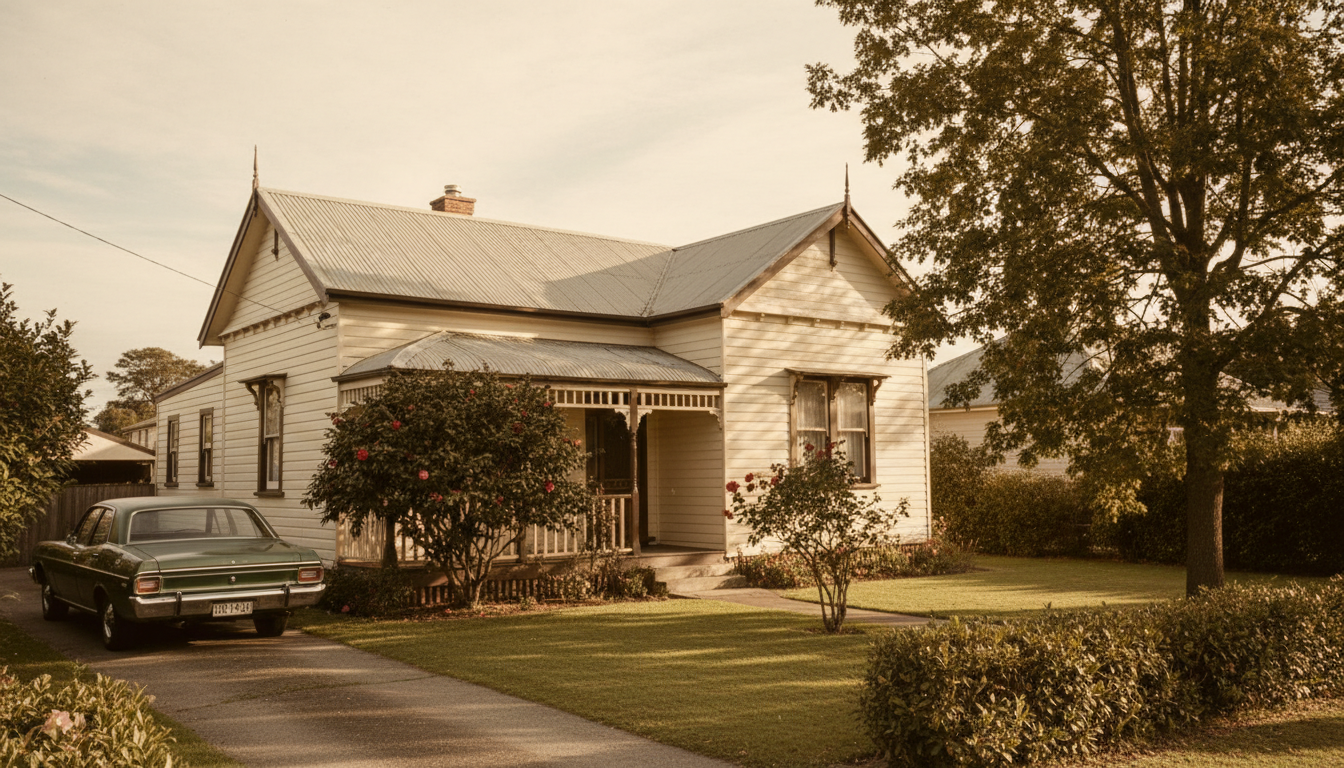
The weatherboard house at 19 Hobart Road served as the Lahey family home for fifty-four years, from February 1963 through January 2017. Boyer Mill company housing provided the space Sandy Bay had lacked—four bedrooms, larger garden, proximity to Patrick's workplace. Here the children grew and left, grandchildren arrived after tragedy, Patrick died, and Jane aged into frailty. The hollowed-out Faust occupied the same bookshelf throughout, its secret surviving decades of ordinary family life unfolding around it.
Location and Historical Context
The house at 19 Hobart Road occupied company housing provided by Australian Newsprint Mills (ANM), commonly known as Boyer Mill, the paper manufacturing facility that dominated New Norfolk's industrial landscape throughout the mid-twentieth century. New Norfolk itself, located approximately forty kilometres northwest of Hobart along the Derwent River valley, had evolved from a colonial agricultural settlement into an industrial town centred on Boyer Mill's operations, which had commenced in 1941 and by the 1960s employed over one thousand workers in paper production serving Australian newspaper industries.
Hobart Road formed New Norfolk's main arterial route, connecting the town centre to outlying areas whilst carrying traffic between Hobart and the Derwent Valley's agricultural districts. The Boyer Mill company housing clustered in areas near the mill facilities, creating residential zones where workers and their families lived within walking distance of employment whilst maintaining some separation between industrial operations and domestic life. Number 19 Hobart Road occupied this transitional geography—close enough to the mill for Patrick's daily commute to be trivial, far enough that industrial noise and odours didn't dominate the residential experience.
The property sat on approximately half an acre, substantially larger than the quarter-acre block at 4 Bective Street in Sandy Bay, the increased land reflecting New Norfolk's lower population density and Boyer Mill's capacity to provide more generous housing allocations than Hobart's constrained urban environment allowed. The block's size enabled vegetable garden expansion, outdoor play areas for the children, and the particular sense of space that had been impossible in Sandy Bay's tighter residential configuration.
New Norfolk in 1963 represented a stable working-class community built around a single major employer whose continued operation determined the town's prosperity. The population was approximately five thousand, small enough that newcomers were noticed but large enough to maintain reasonable anonymity for families preferring privacy. The town contained adequate schools, shops, churches, and recreational facilities whilst lacking Hobart's urban amenities—a trade-off that suited families valuing stability and space over cultural sophistication.
Architectural Description and Structure
The house at 19 Hobart Road exemplified Boyer Mill's standardised company housing design from the early 1950s expansion period when the mill's growing workforce required accommodation that was substantially better than Depression-era workers' housing but remained economically efficient for company provision. The structure was weatherboard construction, with a rectangular footprint measuring approximately twelve metres by eight metres, and a shallow-pitched corrugated iron roof painted dark green.
The exterior weatherboards were painted cream, maintained by Boyer Mill's property maintenance division who conducted regular repainting on five-year cycles, ensuring company housing presented a respectable appearance that reflected well on ANM's corporate image. The trim around windows and doors was darker cream, creating subtle distinction without dramatic contrast. The overall aesthetic was functional rather than decorative—solid, well-maintained, unremarkable in ways that suited both company and occupants.
A front verandah extended across the house's width, approximately two and a half metres deep, supported by squared timber posts. The verandah floor was concrete rather than timber, representing a modest upgrade from Sandy Bay standards, requiring less maintenance whilst providing durable outdoor space. The verandah roof was a continuation of the main roof structure, creating a covered area that the Laheys used for outdoor furniture during warmer months and for bicycle storage year-round.
The house's most significant advantage over 4 Bective Street was its four-bedroom configuration, addressing the space constraints that had made Sandy Bay increasingly untenable as the children grew. The additional bedroom meant Nicholas could have private space as a teenager, whilst Fiona occupied her own room, and Solomon and Pip shared the fourth bedroom—arrangements that reduced sibling friction whilst acknowledging that complete privacy for all remained beyond both spatial and cultural expectations for working-class families in 1960s Tasmania.
The front garden occupied perhaps two hundred square metres between the house and Hobart Road, designed and maintained according to Boyer Mill standards that required neat lawns and minimal gardens to create a uniform streetscape reflecting company values. The Laheys inherited an established lawn and a few shrubs—rhododendrons flanking the front path, a single camellia near the verandah—maintaining these without significant modification since Boyer Mill's approval was required for substantial garden changes.
The driveway ran along the house's eastern side, wider than Sandy Bay's narrow access, leading to a garage that was integral to the house design rather than a separate structure. The garage accommodated Patrick's Ford Prefect comfortably with room for storage and modest workshop space where Patrick pursued small projects requiring tools and a workbench. The garage's connection to the house via an internal door represented a convenience that 4 Bective Street had lacked, allowing access without exposure to weather.
The rear garden was substantial, approximately three hundred square metres, vastly larger than Sandy Bay's modest backyard. This space enabled Patrick to establish an extensive vegetable garden—rows of potatoes, beans, peas, tomatoes, lettuces, carrots—that supplemented the family food supply whilst providing productive outdoor activity. A Hills hoist rotary clothesline occupied one area, a small shed for garden tools stood in the rear corner, and substantial lawn provided play space that the children had never previously enjoyed at home.
Interior Layout and Room Functions
The house's interior represented a significant upgrade from Sandy Bay's constrained layout. The front door opened into a proper entrance hall rather than a narrow corridor, this space measuring approximately two metres by three metres, providing coat storage, a small table for keys and mail, and circulation space that didn't feel cramped when multiple people were transitioning between interior and exterior.
The hallway extended deeper into the house than Sandy Bay's arrangement, with rooms opening off both sides in a configuration that maximised privacy whilst maintaining circulation efficiency. To the left of the entrance, the formal living room occupied the house's northwest corner, measuring approximately five metres by four metres—noticeably larger than Sandy Bay's equivalent. This room contained the family's accumulated furniture that had been adequate in smaller space but which fitted more comfortably here—the three-seater sofa, two armchairs, coffee table, and the bookshelf where Jane's literary collection and Patrick's engineering references resided.
The bookshelf at 19 Hobart Road was positioned against the living room's eastern wall, taller and with more shelves than the Sandy Bay unit, its increased capacity allowing books to be arranged with more breathing room rather than packed tightly. The hollowed-out Faust occupied its position amongst the other volumes, relocated from Sandy Bay with the same care Jane had given all household goods, its secret contents travelling silently whilst Patrick and the removalists handled the physical transportation. The book would remain on this shelf for fifty-four years, surviving multiple generations of family life, never opened, never questioned, its green cloth binding fading gradually through decades of exposure to filtered sunlight and accumulated dust.
Behind the living room, the main bedroom provided Patrick and Jane with private space measuring approximately four metres by four metres, containing a double bed, two wardrobes, a dressing table, and a chest of drawers with sufficient room that furniture arrangement didn't require careful optimisation to allow movement. The room's window faced west, providing afternoon light, its curtains new purchases made shortly after relocation because Sandy Bay's curtains were insufficient for the larger windows.
The house's eastern side contained the four bedrooms that had determined the Laheys' decision to relocate. The largest, approximately three and a half metres by three metres, became Nicholas's room—recognition of his eldest status and approaching adolescence requiring privacy that shared accommodation couldn't provide. The second bedroom, similarly sized, housed Fiona, giving her the private space she'd never previously enjoyed. The third bedroom accommodated Solomon, whilst the fourth housed Pip, the configuration adjusting as children departed for their own lives and later when grandchildren arrived requiring accommodation.
The kitchen occupied the house's rear, measuring approximately four metres by three and a half metres—modest but functional, containing an electric stove, a refrigerator larger than Sandy Bay's small unit, a sink with draining board, reasonable counter space, and wall-mounted cupboards providing adequate storage. A small breakfast table with four chairs occupied one corner, serving for casual meals, whilst formal dining occurred in the separate dining room that Boyer Mill housing included as a standard feature.
The dining room, positioned between kitchen and hallway, measured approximately three metres by three metres, containing the dining table and six chairs that the Laheys had used in Sandy Bay's inadequate dining area. The room could accommodate the entire family comfortably for meals, representing the first time since Solomon's birth that family dining didn't require careful arrangement to fit everyone around the table without crowding.
The bathroom was substantially improved from Sandy Bay—larger, containing a separate shower in addition to a bathtub, better ventilation, sufficient space that morning routines for six people became manageable rather than requiring military precision. The separate toilet occupied a small room adjacent to the bathroom, following Australian design convention that separated these functions, improving household logistics when multiple people required facilities simultaneously.
A laundry room near the rear entrance contained a copper for heating water, a wringer washing machine that was eventually replaced by more modern equipment through the 1970s and 1980s, and space for sorting and folding laundry—a dedicated facility that represented significant improvement over Sandy Bay where washing had been managed in the kitchen with equipment stored in the garage between uses.
Relocation and Initial Settlement (February-March 1963)
The Laheys' relocation from Sandy Bay to New Norfolk occurred in January 1963, the timing chosen to allow the children to complete their school term whilst positioning them for new school enrolment at the beginning of the academic year. Patrick had commenced employment at Boyer Mill in early February, initially commuting from Sandy Bay whilst the family organised the move, then transitioning to the shorter walk from Hobart Road once the household had relocated.
The move itself was conducted by a Hobart removalist firm, the cost partially subsidised by Boyer Mill as part of Patrick's employment package. The process of emptying 4 Bective Street and filling 19 Hobart Road occurred over two days—furniture and packed boxes transported, the family camping amongst half-unpacked possessions whilst establishing basic functionality before gradually creating proper domestic order.
Jane managed the unpacking with systematic attention that reflected her need for control in areas where control was possible. Kitchen equipment was organised first, establishing the capacity to prepare meals. Bedrooms received attention next, ensuring everyone had functional sleeping arrangements. The living areas were addressed last, furniture positioned, books shelved, the accumulated possessions that defined family life distributed throughout the larger space that accommodated them more comfortably than Sandy Bay had allowed.
The children's responses to the relocation varied predictably. Nicholas, now fifteen and in his final year of secondary school, viewed the move with adolescent pragmatism—disruption to established routines but recognition that the larger space would be beneficial. Fiona, thirteen, experienced the move as adventure, immediately exploring New Norfolk's surroundings and claiming the backyard as her domain for botanical experiments. Solomon at nine adapted with characteristic philosophical acceptance, finding New Norfolk's increased outdoor space compensating for lost Sandy Bay familiarity. Pip at five adapted most easily, her younger age meaning fewer established attachments to leave behind, though she missed the Sandy Bay beach access that New Norfolk couldn't replicate.
For Jane and Patrick, the relocation represented a deliberate fresh start—leaving Sandy Bay where Hamburg's aftermath had unfolded, creating physical distance from locations associated with crisis, establishing a new domestic environment where their reconstructed marriage could develop without constant reminders of betrayal and its consequences. The house at 19 Hobart Road contained no memories of Jane's pregnancy with Heather, no associations with the confession that had occurred at 4 Bective Street, nothing connecting it to Hamburg except the secrets that Jane and Patrick carried internally and the hollowed-out Faust that had travelled with them.
Family Life: The Children's Years (1963-1980)
Life at 19 Hobart Road established patterns that would persist throughout the children's remaining years at home. Patrick's work at Boyer Mill followed regular hours—seven AM start, finishing at four PM, occasionally working Saturday morning shifts but rarely requiring the extended hours that had characterised his Hobart Port Authority employment and certainly never approaching the eighteen-hour days that Deutsche Werft had demanded. His walking commute took fifteen minutes, creating clear separation between work and home whilst eliminating transportation complications.
Patrick's role at Boyer Mill involved engineering maintenance and process improvement, applying his analytical skills to problems of paper production logistics. The work was steady rather than intellectually thrilling, providing reliable income and reasonable satisfaction without demanding the intense concentration that complex naval architecture had required. This reduction in work intensity allowed Patrick more present family participation than Hamburg or even pre-Hamburg Hobart years had permitted.
Jane's daily routines centred on household management and the children's needs, patterns familiar from Sandy Bay but modified by improved accommodation and New Norfolk's different community structure. The larger kitchen made meal preparation more efficient, the separate laundry facilitated washing logistics, the increased garden space provided outdoor work that was productive rather than merely maintaining appearances. She joined the New Norfolk branch of the Country Women's Association, attending monthly meetings and participating in community activities that created social connections without requiring intimate friendships that Jane was reluctant to develop.
Nicholas completed his final year of secondary school at Hobart High School, commuting daily from New Norfolk, before enrolling at the University of Tasmania in 1964 to pursue his combined Arts/Law degrees. He continued living at home throughout his undergraduate years, the daily commute to Hobart manageable, his presence providing continuity even as he increasingly inhabited the intellectual world of academia rather than the domestic world of family. His departure from home didn't occur until after completing his Honours thesis in 1971, when he took up a tutoring position that included accommodation on university grounds.
Fiona attended New Norfolk High School from 1963, thriving in the school's more relaxed atmosphere after the constraints of Hobart institutions. Her environmental interests flourished with access to New Norfolk's surrounding wilderness, weekend expeditions to nearby forests and rivers providing practical education that complemented formal schooling. She departed for the University of Tasmania in 1968, initially living in university accommodation before moving to shared housing with fellow environmental activists. Her visits home became increasingly sporadic as her activism consumed more time and attention.
Solomon attended New Norfolk Primary School and later New Norfolk High School, his quiet competence making him a steady if unremarkable student. The house's larger workshop space allowed him to develop his model-making skills, Patrick's patient instruction complementing Solomon's natural spatial intelligence. His departure for the University of Melbourne in 1972 represented the family's first experience of a child leaving Tasmania entirely, the distance creating separation that would prove permanent despite occasional visits home.
Pip grew up at 19 Hobart Road more completely than her siblings, having arrived at age five and remaining until her marriage in 1979. She attended New Norfolk Primary School and New Norfolk High School, her social nature making her popular amongst classmates whilst her academic competence ensured respectable results. Her daily commute to Hobart Technical College beginning in 1975 for her Diploma of Social Work followed the same route Nicholas had taken years earlier, though Pip's extroverted energy made the journey social opportunity rather than solitary transit.
Family meals occurred in the dining room for dinner, the formal space used daily rather than reserved for special occasions, creating a ritual gathering that emphasised family unity even when emotional connections felt strained. Breakfast and lunch were more casual, often consumed in the kitchen's breakfast nook, but dinner maintained a ceremonial quality that Jane and Patrick both valued as structure around which daily life could be organised.
The marriage that Patrick and Jane were rebuilding throughout these years was not restoration of what had existed before Hamburg but rather construction of something different—more honest, more careful, built on explicit acknowledgment of what had occurred rather than comfortable assumptions about fidelity and permanence. They maintained physical proximity without the easy intimacy that their early marriage had contained. They cooperated on parenting and household management with efficiency that worked practically even when emotional connection felt complicated. They never discussed Hamburg directly after the initial crisis had been managed, yet Hamburg's shadow remained present in silences and careful boundaries that marked their interactions.
Patrick kept a personal diary throughout these years, sporadic entries rather than daily records, documenting his internal processing of the marriage's transformation. His engineering background shaped even these private writings—observations about "structural modifications," "load redistribution," "stress testing of revised configurations." The diary revealed a man attempting to understand emotional catastrophe through technical language, finding in engineering metaphors the distance necessary to process pain that direct articulation might have made unbearable.
Jane's diary from this period was more prolific, entries occurring weekly or more frequently during difficult periods, chronicling her ongoing guilt about Heather, her gratitude for Patrick's grace, her attempts to be a better wife than she'd been before Hamburg whilst recognising that "better" was complicated when the marriage itself had been fundamentally altered. She wrote about mothering Nicholas, Fiona, Solomon, and Pip whilst knowing another child existed in Adelaide, being raised by Patrick's sister Patricia, unknowing of her biological mother's identity. The weight of this knowledge appeared repeatedly in Jane's entries—the wondering what Heather looked like, whether she was happy, if Patricia was maintaining the promises that had been made.
The Empty Nest Transition (1980-1998)
Pip's marriage to Greg Lahey on 24 November 1979 and her subsequent departure from 19 Hobart Road left Patrick and Jane as empty nesters for the first time since 1950. The house that had been designed for four bedrooms suddenly contained only two occupants whose relationship had survived catastrophe but which still carried scars that decades hadn't completely healed. The transition was more abrupt than either had anticipated—from full household to couple alone within months, the silence after decades of children's presence creating disorientation that required adjustment.
Patrick continued at Boyer Mill until his retirement in 1988 at age sixty-five, his thirty-five years with the company (including his earlier stint before Hamburg) providing adequate superannuation for modest retirement security. His transition from employment to retirement was managed carefully—gradually reducing hours through his final year, establishing routines for filling days previously occupied by work, maintaining the vegetable garden with increased attention and developing woodworking projects in the garage workshop that created productive occupation without the pressures of employment.
Jane's activities expanded somewhat once Patrick's retirement provided companionship that she'd lacked during working years. They travelled modestly—caravan trips around Tasmania, occasional visits to mainland relatives, nothing elaborate but sufficient to create variety in routines that might otherwise have become oppressive through repetition. She maintained her CWA involvement, eventually serving as treasurer for the New Norfolk branch, the role providing structure and purpose that mothering had once supplied but which empty nest had eliminated.
The marriage during these years achieved a kind of equilibrium—not passionate or particularly intimate, but stable and companionable. They'd learned to exist together with the knowledge of what had occurred in Hamburg, the affair and Heather's adoption having become historical facts that shaped them but which no longer dominated daily consciousness. Patrick's silence about Hamburg remained a gift that Jane continued appreciating—he'd never thrown her betrayal back at her during arguments, never used her adultery as a weapon, maintained his decision to help her rather than condemn her even when doing so might have been justified.
Yet the silence also created distance. There were topics they couldn't discuss—Heather's existence, whether Jane ever thought about Ferdinand Morrison, how Patrick had genuinely processed his wife's affair and his decision to remain married despite it. The hollowed-out Faust on the living room bookshelf represented physical manifestation of this silence—evidence of Hamburg that remained present but unacknowledged, secret hidden in plain sight whilst daily life proceeded around it.
The house required increasing maintenance as it aged alongside its occupants. Patrick managed most repairs himself, his carpentry skills ensuring the structure remained sound, though the property maintenance division handled major work like roof replacement in 1985 and exterior repainting in 1990. The interior accumulated the particular patina of long occupation—worn floorboards in high-traffic areas, faded wallpaper that had been fashionable in 1963, kitchen appliances gradually replaced as they failed. Yet the fundamental character remained unchanged, the house providing reliable shelter for a marriage that had survived extraordinary circumstances through Patrick's grace and Jane's determination to deserve that grace.
Tragedy and Grandchildren (1998-2013)
The telephone call arrived on 21 October 1998 at quarter past seven in the evening, Tasmanian time. The Swiss authorities, relayed through Australian consular services, informing Patrick and Jane that their daughter Pip and her wife Greg had been killed in a helicopter crash in the Swiss Alps. The news was delivered with bureaucratic precision—names, dates, location, procedures for body repatriation—the language inadequate for the catastrophe it described.
Pip had been forty, Greg thirty-nine. They'd been in Switzerland for a hiking holiday, the helicopter tour a planned excursion that had ended in mechanical failure and mountainside impact. They left two children—Sarah, aged nine, and Oscar, aged twelve—who had remained in Hobart during their parents' European trip, staying with friends but whose longer-term care now required immediate family decision-making.
The funeral arrangements, body repatriation, legal complexities, and grief all occurred simultaneously whilst Patrick and Jane, now seventy-five and seventy-one respectively, managed the additional practical matter of becoming guardians for their pre-adolescent and adolescent grandchildren. Sarah and Oscar officially moved into 19 Hobart Road in November 1998, transforming the house that had been quiet with an elderly couple's routines into a household accommodating children's energy and trauma.
The spare bedrooms that had sat largely empty for eighteen years were suddenly occupied again—Sarah taking the bedroom that had once been Fiona's, Oscar in the room that had been Solomon's. The house adapted to accommodate children's schedules, dietary preferences, emotional needs that Patrick and Jane attempted to meet whilst processing their own grief about Pip's death and the particular pain of outliving one's child.
Sarah and Oscar's adjustment to life at 19 Hobart Road was complicated by their grief, their ages—children rather than infants but not yet independent teenagers—and the fundamental displacement of losing parents whilst being relocated from their familiar environment to their grandparents' home. Sarah, younger but remarkably self-contained, managed through withdrawal and solitary processing. Oscar, older and more volatile initially, cycled through anger and despair that manifested in behaviours that challenged Patrick and Jane's capacity to provide appropriate boundaries whilst respecting grief's legitimacy.
Jane found herself mothering again at an age when she'd expected to be beyond such demands, cooking for children, managing school requirements, attempting to provide stability for grandchildren whilst acknowledging that nothing could truly compensate for parents' loss. The irony wasn't lost on her—she'd left her own children for Hamburg, had borne Heather and given her away, and now was raising her daughter's children after Pip's death. The patterns seemed almost karmic, though Jane's Catholicism had lapsed sufficiently that she couldn't fully embrace that framework.
Patrick's role was more limited—his age and temperament made active parenting difficult, though he provided steady presence and occasionally connected with Oscar through mechanical projects in the garage workshop, the work creating communication that words couldn't achieve. His grief about Pip was private and largely unshared, processed through solitary walks and hours in the garden where physical labour created distraction from emotions that were difficult to articulate.
Oscar remained at 19 Hobart Road until 2006, completing his secondary education before departing for London where he'd secured employment in international finance, his departure creating both relief and concern for his grandparents. Sarah's trajectory was different—she remained based at 19 Hobart Road whilst pursuing her education and then her career in law enforcement, though her actual presence became increasingly intermittent as she established her own life. She completed her undergraduate degree, began her career with Tasmania Police, maintained the house as home base whilst her actual time there decreased as she moved through her twenties establishing independence.
Patrick's Death and Jane's Final Years (2013-2017)
Patrick Lahey died on 17 March 2013 at Royal Hobart Hospital, aged ninety, following a brief illness that had progressed rapidly from concerning symptoms to terminal diagnosis. The cancer had been discovered too late for treatment beyond palliative care, giving Patrick only weeks between diagnosis and death to process his mortality and make such preparations as his systematic nature demanded.
His death occurred with Jane present, holding his hand whilst monitors marked his declining vital signs before the final cessation. Their sixty years of marriage (including the brief period before Hamburg) had survived Hamburg, Heather's adoption, Pip's death, and all the accumulated complications that long partnership accumulated. Patrick's final words to Jane, delivered hours before consciousness was lost, were characteristic—thanking her for staying with him, acknowledging that their marriage had been stranger than either had planned but good despite everything.
Jane returned to 19 Hobart Road as a widow, the house that had housed them both since 1963 now containing only her presence and the accumulated possessions of five decades. Sarah was living independently by this point but visited frequently, managing practical matters that Jane was increasingly struggling to handle on her own, recognising that her grandmother was declining in ways that required attention even as Jane herself resisted acknowledging her growing limitations.
The years between 2013 and 2017 saw Jane's gradual deterioration—memory becoming unreliable, physical strength declining, the house maintenance that she'd managed competently becoming beyond her capacity. Sarah orchestrated increasing support—home help services, meal delivery, medical monitoring—attempting to keep Jane in the house as long as possible whilst recognising that institutional care was becoming inevitable.
The house during these final years accumulated the particular disorder that elderly solo occupation created—rooms closed off to minimise heating costs, housework neglected beyond minimal standards, the slow entropy that occurs when maintenance capacity fails. Yet Jane resisted relocation with fierce determination, understanding that leaving 19 Hobart Road meant acknowledging the final stage of life, relinquishing independence, beginning the end.
The decision finally came in January 2017 when Jane's fall resulted in a hip fracture requiring hospitalisation, the recovery period making clear that independent living was no longer feasible. Sarah arranged Jane's placement at Vaucluse Nursing Home in Lindisfarne, the facility offering appropriate care whilst maintaining proximity to Hobart that allowed regular visitation.
The process of clearing 19 Hobart Road of Jane's possessions occurred through early 2017, Sarah managing the sorting—items for keeping, items for distribution amongst family, items for disposal or donation. The furniture was largely disposed of or given to charity, decades of accumulated household goods distributed or discarded based on Sarah's assessment of value and family members' interests. Books were packed for storage or donation, including the volumes from the living room bookshelf that had occupied the same position since 1963.
The hollowed-out Faust was packed amongst other books, its weight and closed pages providing no indication of the photograph hidden within its cavity. Sarah handled it without recognition of its significance, adding it to boxes destined for storage with Jane's other possessions at Vaucluse. The book left 19 Hobart Road in February 2017, having occupied the house's bookshelf for fifty-four years, its secret travelling onward where it would remain until Luke Smith, one of two sons of Heather, discovered it amongst Jane's effects after both Sarah and Jane's deaths in August 2018.
The House After the Laheys
Following Jane's departure in early 2017, the house at 19 Hobart Road returned to Boyer Mill's housing stock (though by this time managed by Norske Skog, who had purchased the mill in 1989). The house required renovation before re-letting—painting, repairs, updates to electrical and plumbing systems, the accumulated wear of fifty-four years' occupancy needing attention before new tenants could occupy the space.
The renovations erased most physical traces of the Laheys' residence—walls were repainted, flooring replaced where necessary, the kitchen and bathroom updated to contemporary standards, modifications that created fresh domestic space that bore no obvious marks of the family who'd lived there for over five decades. Yet the basic structure remained—four bedrooms, living room, dining room, the bones of the house unchanged even whilst surface details were refreshed.
The house was re-let to a Boyer Mill employee in mid-2017, a new family moving into space that the Laheys had occupied, creating new domestic routines and memories in rooms that had witnessed births and deaths, arrivals and departures, ordinary life and extraordinary secrets. The new occupants knew nothing of Hamburg or Heather, of Patrick's grace or Jane's guilt, of the hollowed-out Faust that had sat on the bookshelf for fifty-four years containing evidence of events that had shaped the previous residents' entire lives.







