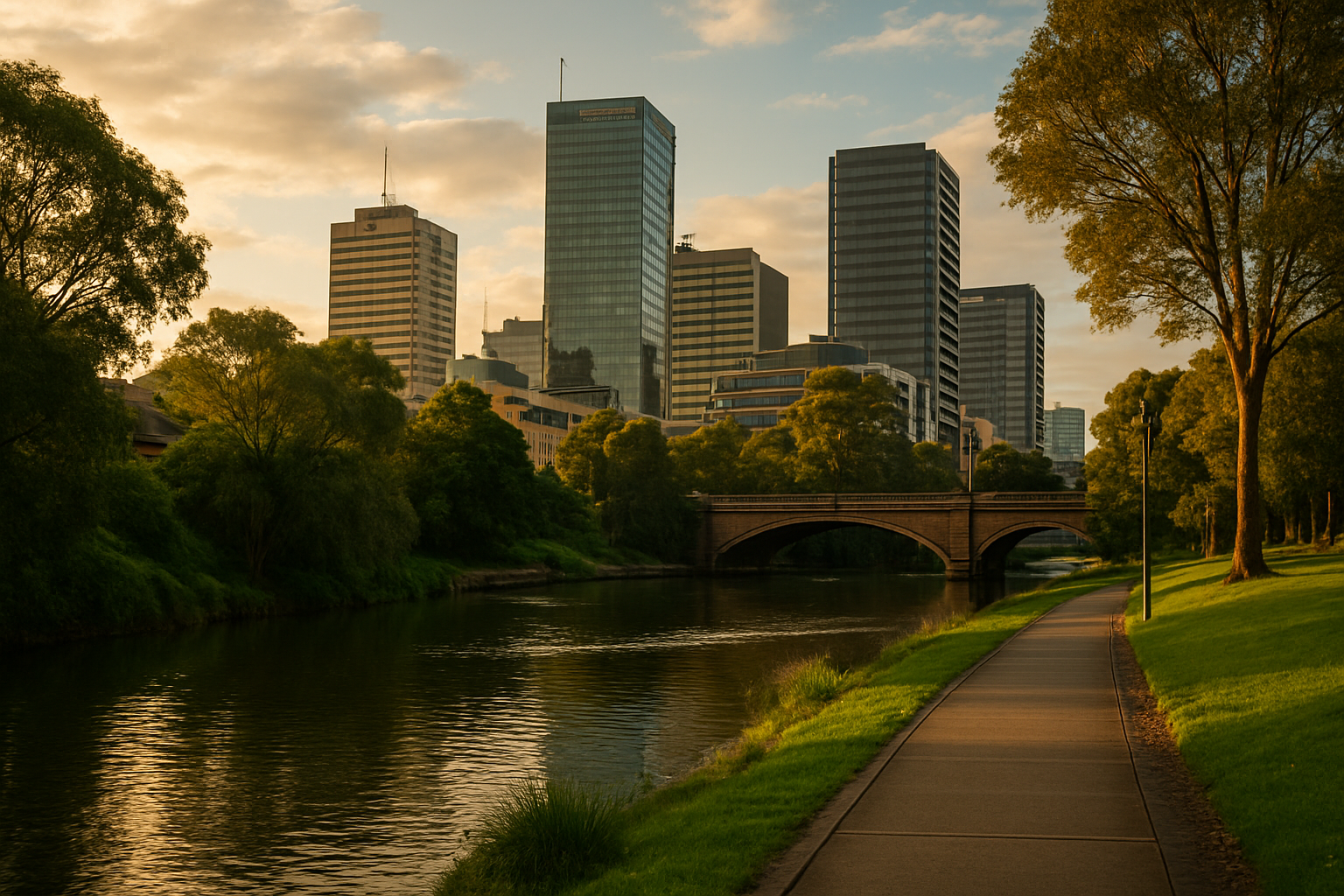
Parramatta, New South Wales, Australia
Situated fifteen miles west of Sydney Cove along the Parramatta River, Parramatta stands as Australia's oldest inland European settlement, formally established on 2 November 1788 upon land the Burramattagal people had inhabited for thousands of years. Born from colonial desperation when Sydney's rocky soil proved inadequate for agriculture, this riverside township became the granary that sustained the struggling penal colony. The government farm received transported convicts including William Jeffries in 1808, whilst Georgian estates like Rosebank housed the colonial elite whose ambitions shaped early Australian society.
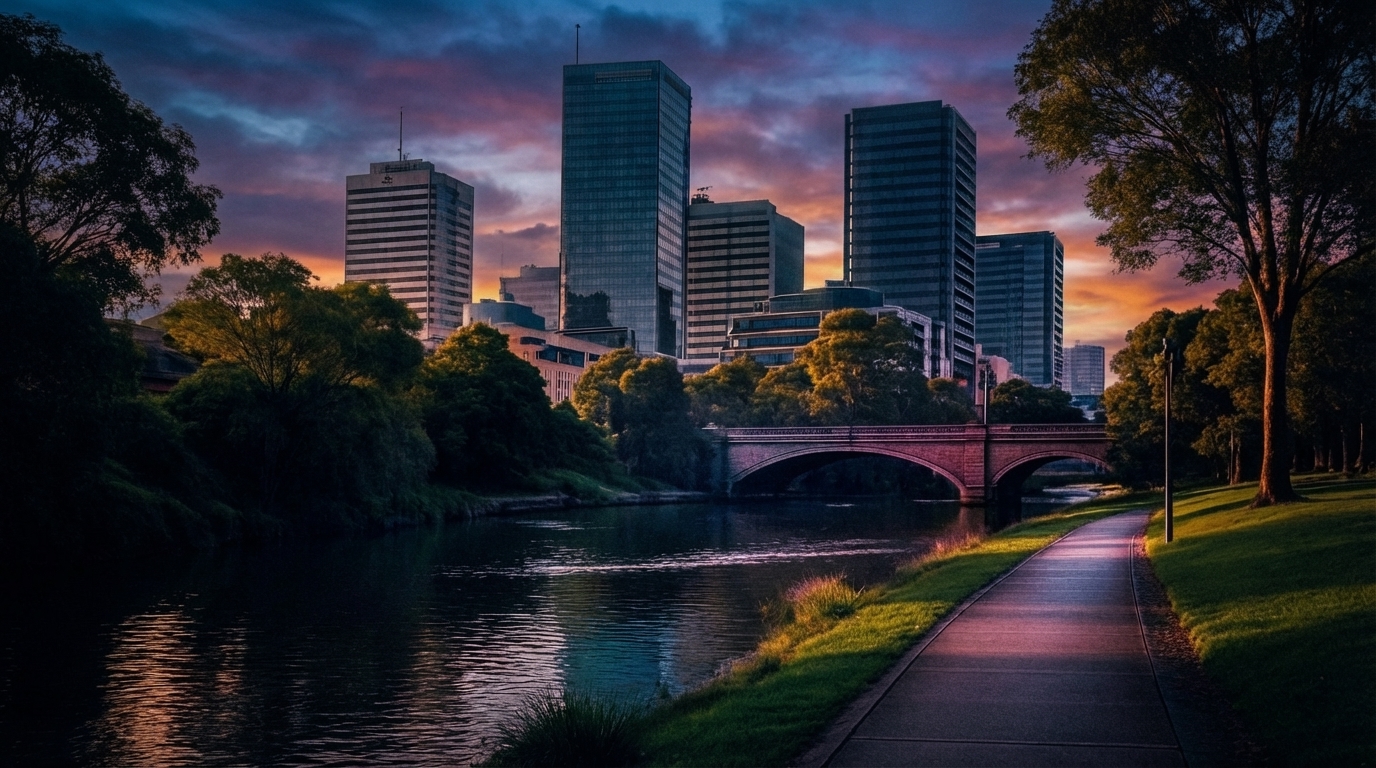
The River and Its First People
Long before European ships appeared on the horizon, the river that would give Parramatta its name sustained the Burramattagal clan of the Darug nation. The waterway they called Burramatta—meaning "the place where eels lie down"—provided sustenance through its rich populations of eels that gathered in the brackish shallows where freshwater met tidal flow. The Burramattagal had developed sophisticated methods for harvesting these creatures, constructing weirs and traps that demonstrated intimate knowledge of the river's seasonal rhythms accumulated across countless generations.
The land surrounding the river offered equally generous resources. Open woodland of eucalyptus and she-oak covered the gentle rises, whilst the river flats supported stands of native grasses and tubers that supplemented the protein-rich eels. The Burramattagal moved through this landscape according to patterns their ancestors had established, their presence so integrated with the environment that later Europeans would mistake their cultivated territory for untouched wilderness.
The arrival of the First Fleet in January 1788 initiated changes that would transform this landscape utterly. Governor Arthur Phillip, charged with establishing a viable colony at Sydney Cove, quickly recognised that the rocky terrain surrounding the harbour could not sustain the agricultural production upon which survival depended. Exploration parties pushed inland, seeking the fertile soil that the coastline had denied them. In April 1788, an expedition travelling up the harbour's western reaches discovered the river that the Burramattagal had fished for millennia.
The Europeans called this waterway the Parramatta River, adapting the Indigenous name with the casual appropriation that characterised colonial nomenclature. More significantly, they recognised in the river flats the agricultural potential that had eluded them at Sydney Cove. The soil here was darker, richer, apparently capable of supporting the crops that would determine whether the colony survived or starved.
The Birth of Rose Hill
Governor Phillip wasted little time in acting upon this discovery. By November 1788, he had established an agricultural settlement at the head of navigation on the Parramatta River, naming it Rose Hill after George Rose, the Secretary of the Treasury whose support had helped secure the colony's funding. The first convict work gangs arrived that same month, their labour immediately directed toward clearing land and establishing the farms upon which the entire colonial enterprise depended.
The site possessed advantages beyond its fertile soil. The river provided transport connection to Sydney Cove, allowing produce to be shipped downstream without the labour of overland carriage. The surrounding terrain offered natural boundaries that simplified the containment of convict workers whose sentences required supervision. Fresh water flowed in sufficient quantities to support both cultivation and the growing population that agricultural success would attract.
The early years tested every capacity the settlement possessed. Convict labourers, most of them urban poor with no agricultural experience, struggled to adapt their skills to unfamiliar soil and climate. The implements available to them were inadequate, worn from the voyage and ill-suited to Australian conditions. Seed stocks, carried across fifteen thousand miles of ocean, produced uncertain results in a hemisphere where seasons ran opposite to English expectations.
Yet the settlement persisted, its survival a testament to the desperation that motivated both the convicts who worked its fields and the administrators who commanded their labour. By 1790, Rose Hill had become the colony's primary food producer, its harvests transported downstream to feed Sydney's still-precarious population. The government farm expanded each year, more land cleared, more convicts assigned to agricultural duties, the rhythm of planting and harvest establishing the patterns that would define the settlement's character.
Renaming and Growth
The year 1791 brought formal recognition of the settlement's importance when Governor Phillip renamed it Parramatta, adopting the Indigenous designation that colonists had already begun using informally. The name change signalled permanence, an acknowledgment that this inland township had become essential to colonial survival rather than merely a temporary agricultural outpost.
The government farm that dominated Parramatta's early years operated under a system designed to extract maximum labour from convict workers whilst minimising the resources required for their maintenance. Prisoners assigned to Parramatta worked from dawn to dusk during summer months, their efforts directed by overseers whose authority rested on the threat of punishment for inadequate productivity. The lash remained the primary disciplinary tool, its application frequent enough to ensure that all understood the consequences of defiance or indolence.
Living conditions for these convict labourers reflected the harsh priorities of penal administration. Barracks constructed from rough-hewn timber and bark provided shelter that was functional without being comfortable. Rations, whilst adequate to sustain labour, left little margin for the weakness that illness or injury might cause. Medical care, when available at all, addressed only the most urgent conditions, the health of individual prisoners valued primarily in terms of the work they could perform.
Yet within this brutal system, opportunities for advancement existed. Convicts who demonstrated reliability and skill might earn positions of trust—gangers who supervised fellow prisoners, tradesmen whose specialised abilities commanded better treatment, even clerks whose literacy distinguished them from the majority whose education had never extended to reading and writing. These gradations of status, subtle though they might seem to free observers, carried enormous significance for those whose circumstances offered few alternatives.
The Government Farm
The government farm at Parramatta received its most significant influx of labour in early 1808, when convicts transported aboard the HMS Resolution were assigned to agricultural duties after processing at Sydney Cove. Among these new arrivals was William Jeffries, a twenty-two-year-old Portsmouth dockworker whose conviction for stealing a pocket watch had earned him seven years' transportation. The farm that received him on 2 March 1808 would provide the crucible in which his subsequent transformation would begin.
The work assigned to Jeffries and his fellow convicts followed patterns established over the preceding two decades. Land clearing consumed much of their labour—the systematic removal of native vegetation to create fields suitable for European cultivation. The work was backbreaking, performed with hand tools under a sun that bore no resemblance to the grey skies of English memory. Trees were felled, stumps extracted, undergrowth burned, the landscape progressively transformed from what the Burramattagal had known into something that colonial administrators could recognise as productive.
Planting and harvest provided seasonal variation from clearing duties. Wheat, maize, and barley formed the primary crops, their cultivation following practices adapted from English agriculture but modified for Australian conditions. The convict labourers learned—some more readily than others—how to read the signs that indicated when soil required rest, when irrigation might save a struggling crop, when pest infestations threatened yields. This knowledge, accumulated through observation and experience, would prove valuable for those who survived to complete their sentences.
The government farm also maintained livestock whose care demanded different skills. Cattle, sheep, and pigs required tending, their health and productivity monitored by overseers who understood that meat and wool contributed to colonial viability alongside grain harvests. Some convicts proved aptitude for animal husbandry, their assignments shifting from field labour to the less physically demanding but equally essential work of livestock management.
Colonial Society Takes Shape
As Parramatta's agricultural productivity became established, the settlement evolved from mere labour camp to recognisable township. Free settlers began arriving in the 1790s, attracted by land grants that colonial authorities offered to those willing to invest capital and enterprise in developing the territory. These newcomers brought skills and resources that convict labour alone could not provide, their presence beginning to diversify a society that had previously consisted only of prisoners and their keepers.
The town that emerged reflected the stratifications of colonial society with remarkable clarity. Along the main thoroughfare, substantial residences announced the prosperity of merchants, officials, and landowners whose circumstances elevated them above the convict masses. These houses, constructed from locally quarried sandstone or imported brick, imitated the Georgian styles their owners remembered from England, their formal gardens and iron fences declaring aspirations to gentility amidst the colonial dust.
Further from the centre, the dwellings of emancipated convicts—those who had served their sentences and earned the freedom to establish independent lives—demonstrated more modest ambitions. These former prisoners, bearing the stigma of their convictions yet freed from the direct supervision of overseers, represented a middle stratum whose existence complicated the simple binary of bond and free. Some prospered, their energy and enterprise compensating for backgrounds that respectable society officially deplored; others struggled, the skills that had sustained them in chains proving insufficient for the demands of independent existence.
The convict barracks and work gangs occupied the lowest tier of this hierarchy, their presence essential to the town's economy yet systematically excluded from its emerging civic life. They cleared the roads, constructed the buildings, tilled the fields, and performed the countless tasks that created the infrastructure upon which colonial prosperity depended. Their contribution remained largely invisible in the records that colonial authorities maintained, their individual stories subsumed within the administrative categories that classified them as units of labour rather than human beings.
Rosebank and the Colonial Elite
By the 1820s, Parramatta had become home to estates whose grandeur rivalled anything the Sydney colony could offer. Rosebank Estate, a Georgian homestead constructed in the river-misted groves that surrounded the township, exemplified the aspirations of the colonial elite who had claimed this landscape as their own. Built from locally quarried sandstone, its formal proportions and symmetrical façade announced the English sensibilities its designers had transported across the world.
The Blackwood family, whose occupation of Rosebank extended across multiple generations, represented the class of colonial administrators and professionals whose positions placed them at the intersection of imperial authority and local power. Their residence served functions beyond mere domestic shelter—it was salon and meeting place, the site of social gatherings that shaped the political and cultural directions of colonial society. Guests who passed through Rosebank's doors included officials, merchants, military officers, and the occasional visiting dignitary whose presence in the colony warranted entertainment befitting their status.
The arrival of Emily Blackwood at Rosebank on 9 March 1841 marked a new chapter in the estate's history. The English bride who crossed Rosebank's threshold that evening would transform the residence into a centre of reform and culture, her drawing rooms hosting discussions that ranged from education to philanthropy to the legal questions that concerned her husband's professional practice. Her presence enriched Parramatta's social fabric, adding dimensions that the town's agricultural and administrative origins had not anticipated.
Transformation and Continuity
The decades that followed saw Parramatta evolve from penal settlement to established township whilst retaining the character its origins had impressed upon it. The government farm gradually diminished in importance as private landholding expanded, convict assignment to individual settlers replacing the centralised labour system that had characterised the colony's earliest years. The barracks that had housed work gangs were repurposed or demolished, their physical traces disappearing even as the social structures they had sustained persisted in modified forms.
The river that had first attracted European attention continued to define the town's geography and commerce. Vessels carrying produce downstream to Sydney maintained connections that roads would later supplement but never entirely replace. The wharves and warehouses that lined the banks testified to trade volumes that justified Parramatta's claim to significance beyond its role as Sydney's agricultural appendage.
Administrative functions increasingly concentrated in the township as colonial government extended its reach beyond the harbour settlement. Courts, land offices, and military installations established Parramatta as a centre of authority for the expanding western districts. Officials like Arthur Redfern, whose career in colonial administration had taken him across multiple settlements, found in Parramatta a suitable location for the retirement that followed decades of service. Redfern's death on 14 October 1835, occurring within the township he had adopted as home, marked the passing of a generation whose experience bridged the colony's earliest struggles and its emerging prosperity.
The Land Remembers
Beneath the streets and buildings that colonial development imposed upon the landscape, traces of earlier occupation persisted in ways that European observers rarely acknowledged. The river still supported eel populations, though in diminished numbers that reflected the changes European land use had wrought. Archaeological evidence of Burramattagal campsites survived in locations that development had not yet disturbed, stone tools and shell middens recording millennia of sustainable habitation.
The dispossession of the Burramattagal and their Darug relatives proceeded alongside colonial expansion with a quiet relentlessness that administrative records barely registered. Disease, displacement, and violence combined to reduce populations whose ancestors had managed this landscape for thousands of years. By the mid-nineteenth century, Indigenous presence in Parramatta had become marginal in ways that the original inhabitants could never have imagined when strange ships first appeared at the river's mouth.
Yet complete erasure proved impossible. Place names preserved Indigenous vocabulary even as they stripped words of their original meanings and contexts. The river's annual patterns continued to follow rhythms that predated European arrival, its floods and droughts indifferent to the structures colonists had built along its banks. The land itself retained properties that no amount of clearing and cultivation could entirely eliminate, its sandstone bones and clay depths shaping what could be grown and where buildings could safely stand.







