Newlyn, Cornwall, England
Newlyn — the largest fishing port in England, pressed against the western shore of Mount's Bay a mile south of Penzance — has drawn its living from the sea for longer than records can trace. First documented as an industrial port in 1435, the village grew around the sheltered waters of Gwavas Lake, where pilchard fleets moored for five centuries and where the rhythms of tide, catch, and season governed every aspect of communal life. In the 1880s, artists drawn by the quality of Cornish light and the unvarnished reality of fishing life established the Newlyn School, one of the most significant plein-air painting movements in British art history. Yet Newlyn's identity has never been primarily artistic: it is, and has always been, a working port, a place where granite cottages and narrow lanes too steep for motor cars overlook a harbour whose fish market still opens before dawn. Its contribution to the mapping of Britain itself — the Ordnance Datum that defines every contour line and spot height on every map of Great Britain is calculated from mean sea level measured at Newlyn — is a distinction the village wears with characteristic understatement.
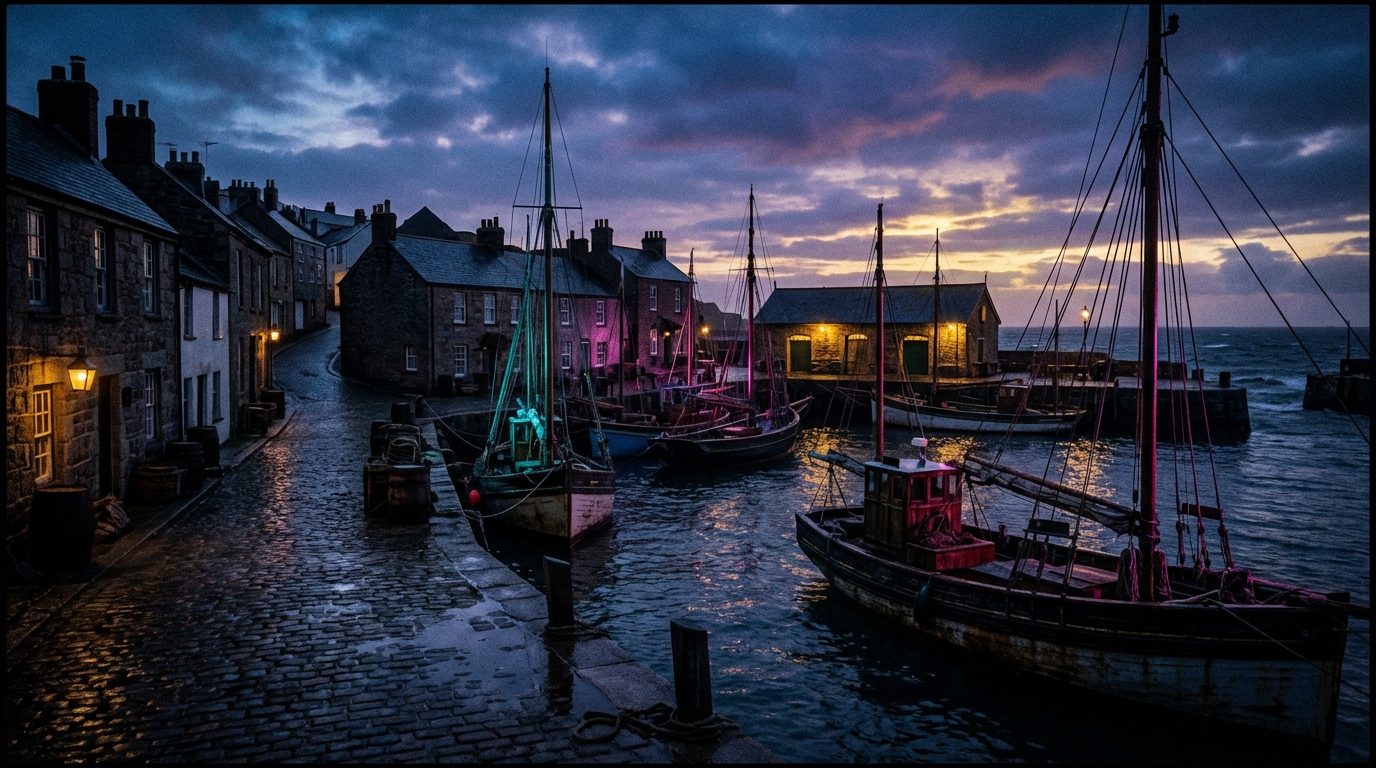
Three Hamlets and the Old Quay
Newlyn is not a single settlement but the coalescence of three originally separate hamlets, each divided from the others by water: Newlyn Town, the cliff-top community overlooking the Old Quay; Street-an-Nowan, the lower ground now occupied by the fish market, which was formerly a beach separated from Newlyn Town at high tide; and Tolcarne, whose Cornish name — Tal Carn, the Brow of the Rocks — describes its position above the harbour. The name Newlyn itself, recorded as Nulyn in 1279 and Lulyn in 1290, is thought to derive from the Cornish Lulynn, meaning a pool for a fleet of boats, a reference to the shallow offshore waters of Gwavas Lake that served as the principal mooring for the area's fishing vessels long before any harbour was built.
The Old Quay, a curving structure of massive granite blocks laid without mortar and topped with a parapet wall, has existed since at least 1337 and is known to have been in use as an industrial port by 1435, when pilchard fishing was already the dominant activity. The quay offered some natural protection from the prevailing winds on the western curve of Mount's Bay, though it was never adequate for anything larger than the luggers that worked the pilchard fisheries. The landing rights and most property in the area belonged to the Manor of Alverton, part of the Duchy of Cornwall established in 1337, and the community's economy was conducted within a feudal framework of obligations, rents, and dues that persisted long after the medieval period had nominally ended.
Pilchards, Salt, and the Sea
For five centuries, pilchards were the foundation of Newlyn's economy and the organising principle of its communal life. The method of fishing evolved over time — from seine nets deployed by coordinated teams of boats under the direction of cliff-top watchers, to the drift nets that gradually replaced seining — but the centrality of the pilchard to Newlyn's existence remained constant. The fish were caught in Mount's Bay, salted in the curing houses that lined the quays, pressed using screw presses, and packed into wooden barrels for export to Italy, where Catholic dietary requirements ensured a reliable market. The toast raised at the annual settling of the season's accounts — preserved in local memory with the sardonic pride of a community that understood its dependence upon foreign appetites — was directed at the Pope, whose fasting calendar kept Cornish fishing families fed.
The shore-based labour of processing and packing fell largely to women, who worked alongside men in an industry that made no distinction between domestic and economic life. Fishing was not merely an occupation but a total social system: it determined where families lived, whom they married, how they raised their children, and what happened when the catch failed. The volatility of the sea — the storms that wrecked boats and drowned men, the seasons when pilchards failed to appear, the market fluctuations that could render a good catch worthless — was not a risk to be managed but a condition of existence to be endured.
Newlyn was not spared the wider catastrophes that shaped Cornwall's history. In 1595, a Spanish raiding party attacked the coast. In 1755, the great Lisbon earthquake sent a tsunami across more than six hundred miles of ocean to strike the Cornish shore; at Newlyn, the sea rose ten feet in ten minutes and ebbed at the same rate. The Old Quay survived both, though the village around it bore the consequences. And according to local tradition, the Mayflower made its last port of call at Newlyn before crossing the Atlantic in 1620 — a connection that links this small Cornish fishing village to one of the most consequential voyages in history.
The New Harbour
By the late nineteenth century, the Old Quay had become inadequate for the larger vessels that were replacing the traditional luggers. Boats too large for the quay were forced to anchor in Gwavas Lake and unload their catch onto smaller craft for transport to shore — an inefficiency that was both commercially damaging and physically dangerous. The campaign for a new harbour was led by the Reverend Wladislaw Somerville Lach-Szyrma, vicar of St Peter's Church from 1874 to 1891, who organised the community and lobbied against the opposition of Penzance, which feared a loss of trade to a modernised Newlyn.
The sinking of the fishing vessel Jane during a violent storm in October 1880 provided the final impetus. The Newlyn Pier and Harbour Order was granted in 1884, and the South Pier was completed in 1885, followed by the North Pier between 1886 and 1889, with an extension in 1893. The new granite piers, dwarfing the ancient walls of the Old Quay, provided berthing at all states of the tide and transformed Newlyn from a constrained medieval harbour into a modern fishing port capable of supporting a fleet that would grow to become the largest in England. The railway's arrival in west Cornwall in 1877 had already opened new markets for Newlyn's fish, and the combination of improved harbour facilities and rail access brought a period of genuine prosperity.
The Newlyn School of Painting
The same qualities that made Newlyn attractive to fishermen — the sheltered bay, the quality of light reflecting between sea and sky, the dramatic coastline — attracted a different kind of visitor in the 1880s. Walter Langley, a Birmingham-born watercolourist with a social realist sensibility, arrived in 1882 and is recognised as the pioneer of the Newlyn art colony. In January 1884, Stanhope Forbes — Dublin-born, trained at the Royal Academy in London and at Léon Bonnat's studio in Paris, and already experienced in the plein-air painting movements of Brittany — settled in the village and quickly became the galvanising force of the growing colony. Forbes is remembered as the father of the Newlyn School, and his masterpiece, A Fish Sale on a Cornish Beach, exhibited at the Royal Academy in 1885, announced to the national art world that Newlyn had something extraordinary to offer.
The artists were drawn by the same things that had drawn them to Brittany: the quality of light, the cheapness of living, the availability of models, and the authenticity of a working community untouched by industrialisation. They painted the fishermen at sea and at the quay, the women mending nets and waiting for boats, the children playing on the harbour wall, the interiors of cottages where families lived in conditions that combined poverty with a dignity that the artists found profoundly moving. Frank Bramley's A Hopeless Dawn, depicting a family's grief upon learning that a boat has been lost, became one of the most celebrated paintings of the late Victorian era and captured something essential about the community whose hospitality the artists enjoyed.
Forbes married the Canadian-born painter Elizabeth Armstrong in 1889, and together they founded the Forbes School of Painting in 1899, attracting a new generation of artists to Newlyn including Dod and Ernest Procter, Alfred Munnings, and Harold and Laura Knight. The nearby fishing village of Lamorna became an extension of the colony, particularly associated with the artist S.J. "Lamorna" Birch from 1908. The Newlyn Industrial Class, established in the 1890s by John D. Mackenzie, introduced metalwork and enamelwork to the community, creating the tradition of Newlyn copperwork that continues to this day. Elizabeth Forbes died in 1912; their only son, Alec, was killed in the First World War. The Forbes School of Painting closed in 1938, and Stanhope Forbes died in Newlyn in 1947, having spent sixty-three years in the village he had made famous.
Riot, War, and the Ordnance Datum
Newlyn's history is not only one of quiet labour and artistic achievement. In 1896, the village erupted in violence when Cornish fishermen, who strictly observed the Sabbath, attacked the boats of Lowestoft drifters from the East Coast who had come into Mount's Bay and fished on a Sunday. The Newlyn Riots — in which local men rowed out and destroyed the catch of the intruding vessels — required the intervention of naval forces and became a national cause célèbre, illustrating the depth of religious and cultural feeling in a community whose identity was inseparable from its relationship with the sea.
During the Second World War, Newlyn served as a base for Air Sea Rescue craft covering the Western Approaches. The harbour was bombed, and a fleet of Belgian trawlers took refuge there, helping to sustain the Cornish fishery through the war years. A trade embargo with Italy in 1937 had already devastated the pilchard merchants — cutting off the market that had sustained Newlyn's curing industry for centuries — and the war compounded the disruption. In 1937, the fishing vessel Rosebud sailed to London to deliver a petition to the Minister of Health on behalf of villagers whose homes were threatened under the government's slum clearance scheme, a journey that illustrated both the community's determination and the precariousness of its domestic conditions.
One of Newlyn's most quietly remarkable distinctions dates from 1915, when the Ordnance Survey established a tidal observatory in the harbour. For six years, from 1 May 1915 to 30 April 1921, readings of sea level were taken every fifteen minutes. The data was used to calculate the mean sea level at Newlyn, which became the Ordnance Datum — the vertical reference point from which every elevation, contour line, and spot height on every Ordnance Survey map of Great Britain is measured. The heights of mountains, the depths of valleys, and the gradients of every road in the country are all calculated from the mean tide at this Cornish fishing harbour — a contribution to the national infrastructure that is invisible to most people who use a map but fundamental to every measurement they read upon it.
The Modern Port
The post-war decades brought both revival and contraction. Pilchard fishing declined through the 1960s, but a mackerel boom in the 1970s revitalised the harbour. The Mary Williams Pier opened in 1980, a new fish market was built in 1988, and the harbour was given charitable trust status in the same year. A second new fish market followed in 2016, and the port's development programme continues with pier renovations and expanded facilities. In more recent years, the pilchard itself has returned — rebranded as the Cornish sardine, caught by modern ring-net vessels and exported once again to continental Europe. The Pilchard Works, which had pressed and packed salt pilchards using traditional methods for a century, closed in 2005, ending a direct link to the curing industry that had sustained Newlyn since the fifteenth century.
Today, Newlyn remains the largest fishing port in England by value of landings, with a fleet ranging from large beam trawlers to small open boats handlining for mackerel in the bay. The Newlyn Art Gallery, alongside its sister space The Exchange in Penzance, continues the tradition of artistic engagement that the Newlyn School established, while the largest collection of Newlyn School paintings is held at Penlee House Gallery in Penzance. The Newlyn School of Art, founded in 2011 with Arts Council funding, provides courses taught by practising artists and draws directly upon the legacy of Forbes and his contemporaries.
The Reynolds Family
Among the fishing families whose lives were shaped by Newlyn's harbour were the Reynolds, whose connection to the port's maritime community stretched back through generations. Edward James Reynolds was born on 23 April 1940 in a granite cottage on North Quay, steps from the harbour where his father, William Thomas Reynolds, moored the FV Dorothy May, a thirty-eight-foot vessel that worked the mackerel and pilchard fisheries of Mount's Bay. Edward grew up saturated in the rhythms of the harbour — the creak of boats against the wall, the voices of fishermen departing before dawn, the smell of fish and salt and diesel — and attended Newlyn County Primary School from 1945 before following his father onto the boats at fifteen.
Edward married Margaret Penrose in June 1962 at St Peter's Church, the fisherman's church whose vicar had once campaigned for the harbour that sustained the community's livelihood. He purchased the FV Cornelia in 1964 and captained her for forty-six years, earning a reputation for quiet competence and a knowledge of the local waters that other fishermen relied upon. The family relocated to nearby St Ives, where Margaret opened a tearoom and where their youngest child, Sharon Louise Reynolds, was born on 12 October 1975 — a daughter who would carry the resilience and creative instincts cultivated by a Cornish fishing family's life to the far side of the world.







