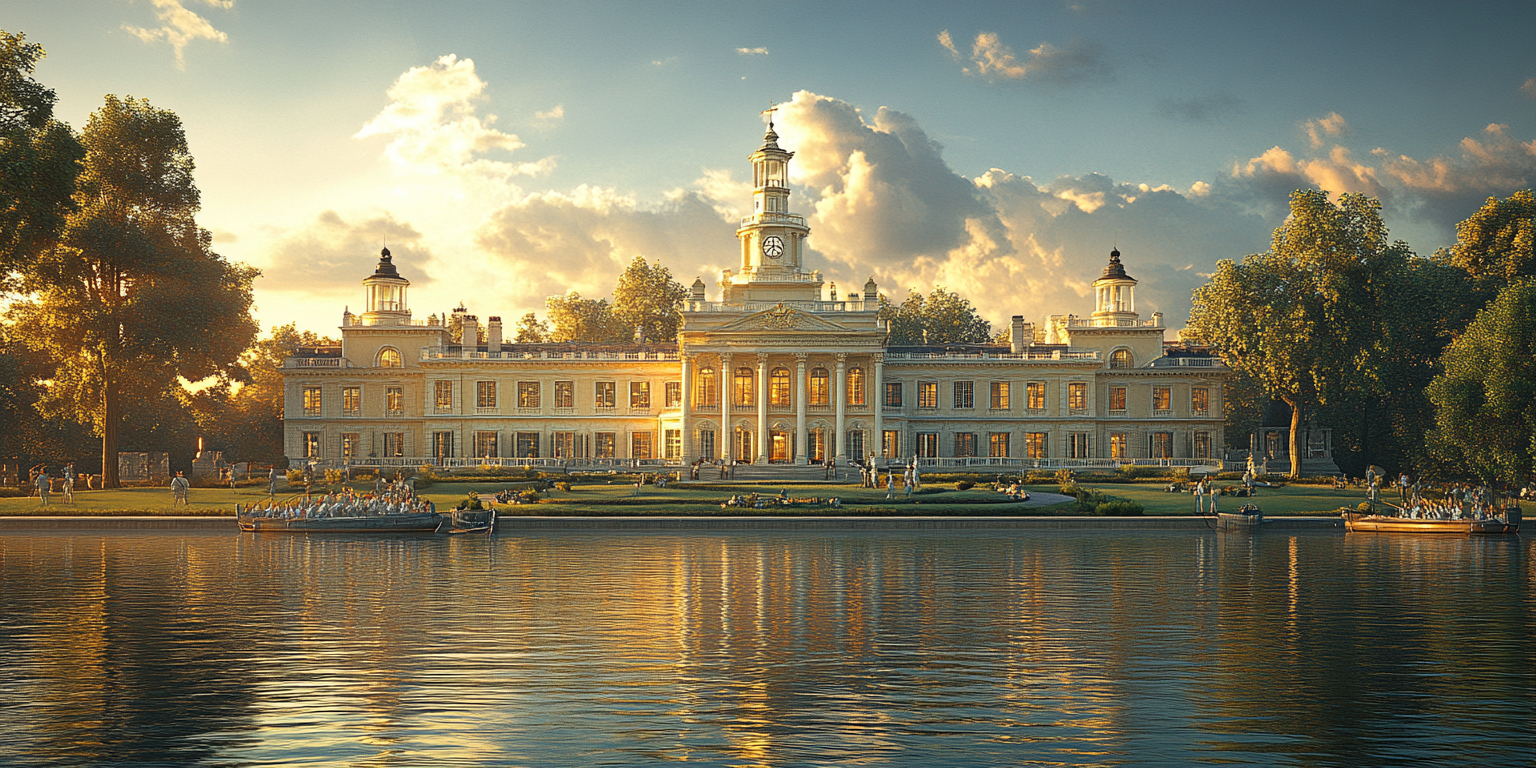
Naval Academy, Portsmouth
The Royal Naval Academy at Portsmouth occupied a purpose-built facility within the dockyard from 1733 until its closure in 1806, the Admiralty's first attempt to provide shore-based education for future naval officers. Established to counter the inefficiencies of shipboard training, the Academy offered a rigorous curriculum in navigation, mathematics, and seamanship to the sons of noblemen and gentlemen aged twelve to fifteen. It never achieved its founders' ambition of becoming the sole pathway to a commission — the traditions of patronage and sea-going apprenticeship proved too deeply entrenched — but it produced officers of distinction, including two brothers of Jane Austen, and its basic principles of academic instruction combined with practical experience endured long after the institution itself was dissolved.
An Order in Council
The education of a naval officer in the early eighteenth century was, by almost any measure, a haphazard affair. Young gentlemen aspiring to command at sea were apprenticed as servants to a ship's captain, either through family connections or by appointment as Volunteers-per-Order — colloquially known as "King's Letter Boys" — and their instruction depended almost entirely on the competence and inclination of the officers under whom they served. Some captains took the matter seriously, ensuring their charges received grounding in navigation, mathematics, and the practical arts of seamanship. Others regarded their young charges as little more than domestic servants in uniform, to be tolerated rather than taught. The result was an officer corps whose abilities varied as wildly as the circumstances of their training.
The Admiralty's dissatisfaction with this arrangement culminated in an Order in Council dated 21 February 1729, directing the Navy Board to produce plans and estimates for a Naval Academy to be situated within Portsmouth Dockyard. The response was remarkable for its speed: within three to four weeks the plans had been approved and orders given to begin construction. The building rose between 1729 and 1732 on the dockyard's grounds — a handsome structure complete with an observatory housed in a cupola above the main entrance, schoolrooms, living quarters, the headmaster's residence, and, with the pragmatism characteristic of Georgian institutional design, a brewery. The Academy opened its doors in July 1733, and the first scholars took their places in an experiment that would persist, with diminishing conviction, for the next seventy-three years.
Sons of Noblemen and Gentlemen
The Academy's regulations reflected the social assumptions of the age with unabashed directness. Admission was restricted to the sons of noblemen and gentlemen, aged no younger than twelve and no older than fifteen at entry, and no boy was to be admitted unless he produced a certificate attesting to "considerable progress in Latin." The complement was fixed at forty scholars, each lodging in a separate chamber and boarding with the Master at a cost of twenty-five pounds per year. The Master was obliged to keep "a decent and proper table" and to provide washing, candles, towels, table and bed linen, and the necessary utensils of the house. No scholar was permitted to keep a servant. Every student was to be provided yearly with a new suit of blue cloth against His Majesty's Birthday.
The curriculum was comprehensive by the standards of the day, combining theoretical instruction in mathematics, navigation, and the principles of naval architecture with practical experience gained in the dockyard and at sea. The course lasted between two and three years, and graduates enjoyed a significant advantage over their shipboard-trained counterparts: two years of sea time could be credited toward the six years required before sitting the lieutenant's examination, meaning an Academy graduate might present himself for commission after only four years afloat. This was a powerful inducement in theory, though in practice it proved insufficient to overcome the prejudices arrayed against shore-based instruction.
The teaching staff included, at various periods, men of genuine scholarly distinction. The Academy's mathematical instruction in particular attracted tutors of real ability, several of whom held or would achieve fellowship of the Royal Society. Their presence lent the institution an academic credibility that its critics — and there were always critics — could not entirely dismiss, even as they argued that no amount of classroom mathematics could substitute for the education that only the sea itself could provide.
The Prejudice of the Quarterdeck
The Academy's fundamental difficulty was not pedagogical but cultural. The Royal Navy of the eighteenth century was an institution built on tradition, patronage, and the unshakeable conviction that officers were forged at sea rather than formed in schoolrooms. Captains who had learned their trade through years of shipboard service regarded the Academy's graduates with suspicion at best and contempt at worst — young men who had spent their formative years in the relative comfort of a dockyard classroom rather than enduring the hardships that, in the traditionalists' view, constituted the only genuine preparation for command.
The patronage system compounded the problem. Naval careers depended on connections, and the families with sufficient influence to secure their sons a place at the Academy generally possessed sufficient influence to secure them a berth aboard a captain's ship as well — a route that carried no social stigma and offered the additional advantage of forging personal relationships with senior officers who might later advance their careers. The Academy, however meritorious its curriculum, could not replicate these networks of obligation and favour that governed promotion within the service.
The result was a persistent failure to attract sufficient students. Numbers fluctuated across the Academy's lifetime but trended steadily downward, and by 1766 the complement had fallen to its lowest point since the foundation. Two eminent First Lords of the Admiralty held the institution in openly low regard, and the financial losses it accumulated did nothing to silence calls for its abolition. The Academy existed in a state of perpetual institutional insecurity, always defending its purpose against those who considered it an expensive irrelevance.
Distinguished Graduates and the Austen Connection
That the Academy produced officers of genuine distinction is beyond dispute, even if their numbers were never sufficient to vindicate the institution in the eyes of its detractors. Among the most celebrated was Philip Broke, who entered the Academy in 1791 and would achieve lasting fame as captain of HMS Shannon in its victory over the USS Chesapeake during the War of 1812 — an engagement that lasted barely fifteen minutes and established Broke as one of the finest fighting captains of his generation.
The Academy's connection to English letters came through Francis and Charles Austen, brothers of the novelist Jane Austen, who entered the institution in 1786 and 1791 respectively. Both went on to distinguished naval careers: Francis rose to Admiral of the Fleet, the highest rank in the Royal Navy, while Charles attained the rank of Rear-Admiral before his death in 1852. Their sister's novels, with their acute observations of naval society and the anxieties of families whose fortunes depended on the sea, owe something to the intimate knowledge of the service that her brothers' careers afforded her.
Josiah Haverford, the son of a Portsmouth naval captain, entered the Academy in 1793 at the age of seventeen — slightly above the customary range — and studied maritime navigation, ship management, and naval warfare through to 1796, a period in which the Revolutionary Wars with France lent particular urgency to the training of new officers. Haverford graduated with honours, noted for the strategic thinking and command potential that would define his subsequent career, and returned to the Academy in its final months to serve as an instructor in advanced navigation techniques and leadership training before the institution's closure reshaped his path toward the convict transport service and the colonies beyond.
Closure and Reconstitution
The end came on the recommendation of John Jervis, Earl St Vincent — himself one of the most formidable seamen the Navy had produced — who regarded the Academy as a failed experiment that had neither superseded shipboard training nor justified its continued expense. The Academy closed in February 1806, its remaining scholars dispersed and its purpose officially abandoned after seventy-three years of operation.
The closure was not, however, the end of the idea. The building within the dockyard stood intact, and the principle that naval officers required some form of structured academic education — the Academy's central insight, if not its greatest achievement — proved more durable than the institution itself. In 1808, the facility was enlarged and reopened as the Royal Naval College at the request of George III, with the Reverend Dr. Inman, a Senior Wrangler of Cambridge and a man of wide learning, appointed as Professor — a post he would hold for nearly thirty years. The complement was raised to seventy scholars, forty of whom were to be sons of naval officers, and the entry age was adjusted to between thirteen and sixteen years. Each student entered into a bond of two hundred pounds, committing to enter the Navy upon completion of training if required.
The College persisted in this form until 30 March 1837, when it closed as a training establishment for new entrants. From that date, all youngsters embarking on a naval career proceeded directly to sea — the very arrangement the Academy had been founded to improve upon more than a century earlier. The training of cadets migrated eventually to the wooden hulk HMS Britannia at Portland, then to Dartmouth, where the Britannia Royal Naval College continues to this day. Training for lieutenants and above moved to the Royal Naval College at Greenwich in 1873.
The Building That Remains
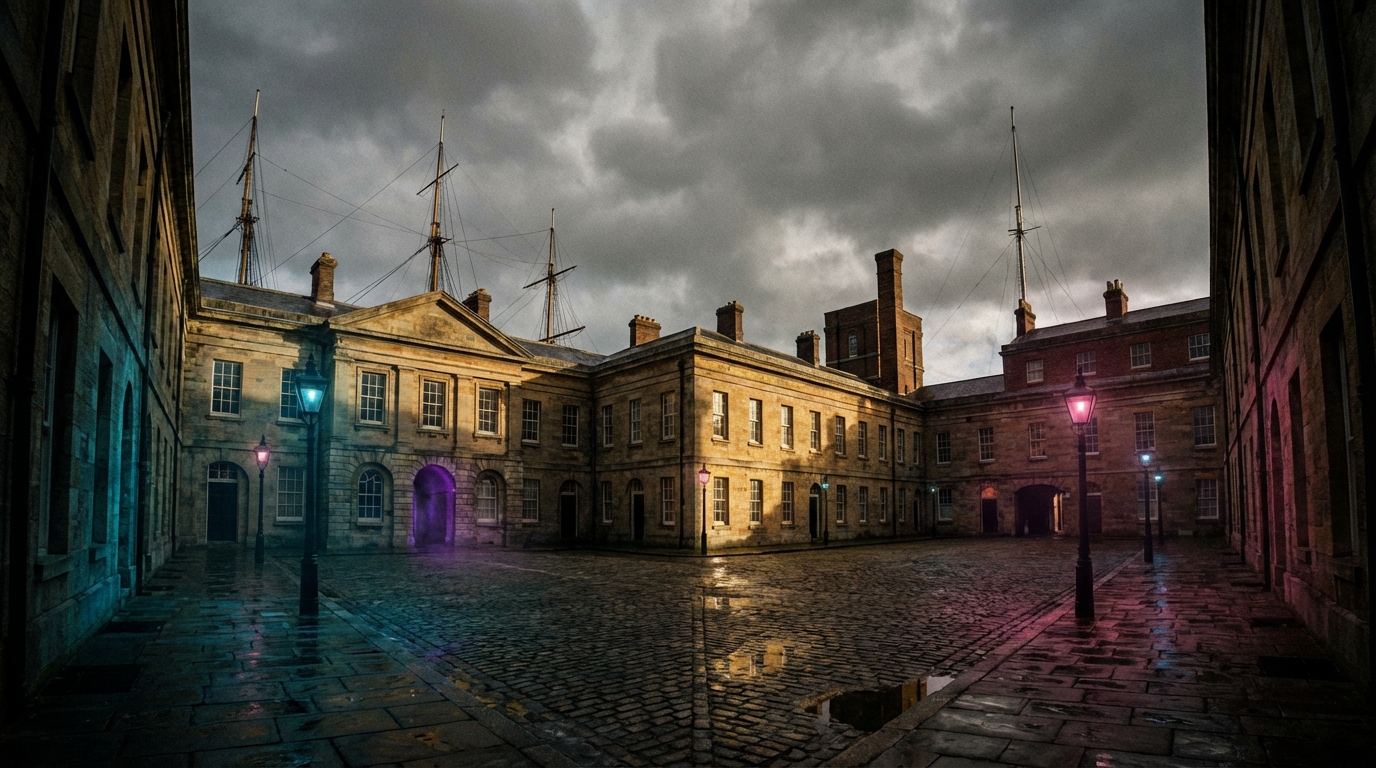
The Academy's building survives within Portsmouth Historic Dockyard, one of the oldest structures on a site that has served the Royal Navy since the fifteenth century. It stands among the grand storehouses of the 1760s and 1780s, the dockyard church of 1787, and the Commissioner's House — a quiet presence in a precinct dominated by the more celebrated attractions of HMS Victory, the Mary Rose, and HMS Warrior. The building has served various purposes since its days as a training establishment, including a period as the Navigation School and its current use as the Staff Officers' Mess.
The cupola that once housed the Academy's observatory still crowns the roofline, a feature that connected the building's educational purpose to the science of celestial navigation on which the entire Age of Sail depended. Below it, the rooms where forty scholars once studied the mathematics of position-finding and the geometry of wind and current now serve the social functions of a modern naval establishment. The transformation is complete, yet the building retains the proportions and the character of a Georgian institution designed to produce men capable of commanding at sea — an ambition that outlasted the Academy itself by centuries and, in altered form, endures still.







