Museum of Old and New Art (MONA)
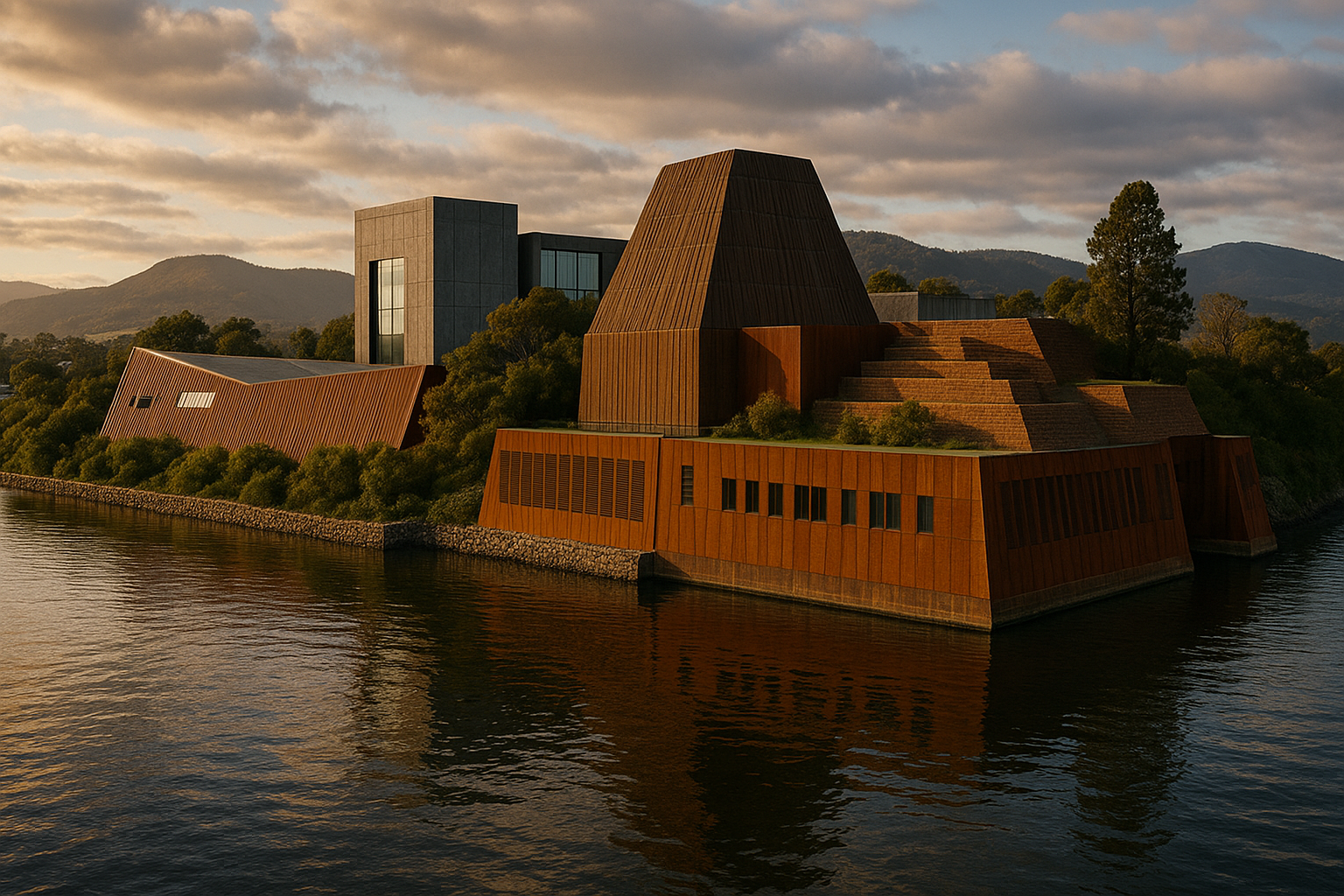
The Museum of Old and New Art opened in January 2011 on the banks of the Derwent River at Berriedale, twelve kilometres north of Hobart. Founded by professional gambler and art collector David Walsh, the subterranean gallery houses a provocative collection spanning ancient Egyptian artefacts to confrontational contemporary installations. MONA has transformed Tasmania's cultural identity whilst becoming a venue for significant civic events, including the annual charity gala that has raised millions for local causes.
Origins and Foundation
The Museum of Old and New Art emerged from the singular vision of David Walsh, a Hobart-born mathematician whose success at professional gambling provided the resources to realise an audacious dream. Walsh had grown up in the working-class suburb of Glenorchy during the 1960s and 1970s, developing an early fascination with mortality, sexuality, and the nature of consciousness that would later define his curatorial philosophy. His gambling syndicate, which applied mathematical models to horse racing and other games of chance, generated the fortune that enabled him to pursue art collecting on an increasingly ambitious scale.
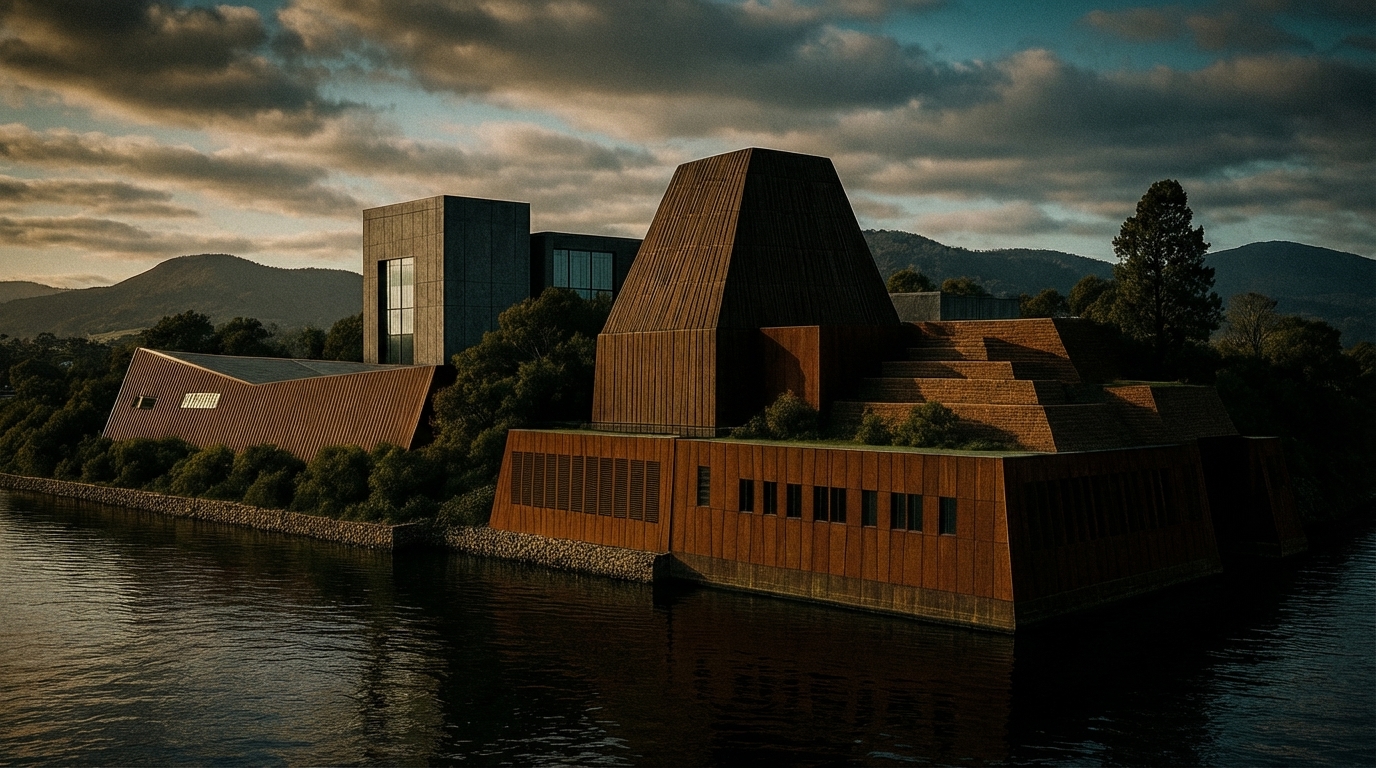
Walsh had opened a modest gallery on his Moorilla Estate property in 1995, housing a collection that already showed his preference for ancient antiquities and challenging contemporary works. The success of this venture, combined with his growing collection, sparked a grander ambition. In 2007, he commissioned architect Nonda Katsalidis to design a museum that would descend into the sandstone cliffs above the Derwent River rather than rising above the landscape. The project required excavating three levels beneath the earth, creating a labyrinthine space that would disorient visitors and strip away the familiar conventions of museum experience.
The Museum of Old and New Art opened to the public on 21 January 2011. The opening attracted international attention, with architecture critics and cultural commentators marvelling at Walsh's willingness to invest an estimated $75 million of his personal fortune into a private museum in Australia's smallest and most remote state capital.
Architecture and Design
The museum's architecture deliberately subverts expectations from the moment of arrival. Visitors typically approach via the MONA Roma ferry, which departs from Hobart's Brooke Street Pier and travels upstream past the Royal Tasmanian Botanical Gardens and the Elwick racecourse. The vessel deposits passengers at a wharf that gives no indication of the cavernous galleries carved into the cliff face above.
The subterranean entrance descends through three levels of galleries linked by a central stairwell known as the Void. The sandstone walls, left exposed in many areas, create an atmosphere reminiscent of catacombs or ancient burial chambers. Nonda Katsalidis designed the spaces to flow without logical sequence, encouraging visitors to lose themselves in the galleries rather than follow a predetermined path. The decision to excavate downward rather than build upward reflected Walsh's philosophical commitment to confronting mortality; visitors metaphorically descend into the earth, surrounded by artworks that explore death, sexuality, and the boundaries of human experience.
Natural light penetrates the underground spaces through carefully positioned skylights and apertures, creating dramatic effects that shift throughout the day. The building incorporates sustainable design principles, including geothermal temperature regulation that maintains stable conditions for the collection whilst minimising energy consumption.
The Collection
The museum's holdings reflect Walsh's idiosyncratic vision, juxtaposing ancient artefacts with provocative contemporary installations in ways that challenge conventional museum categorisation. Egyptian mummies rest alongside video art exploring bodily functions; Roman coins share gallery space with confrontational works addressing sexuality and death.
Among the permanent installations, James Turrell's Amarna light installation occupies a dedicated chamber where visitors experience shifting chromatic fields that blur the boundary between perception and reality. The piece exemplifies Walsh's interest in works that engage viewers physiologically and psychologically rather than merely aesthetically. The Nolan Gallery houses a significant collection of Sidney Nolan's paintings, including works from the iconic Ned Kelly series, providing a counterpoint to the more challenging contemporary pieces elsewhere in the museum.
Walsh has described his curatorial approach as creating a "subversive adult Disneyland" where nothing is quite what it seems. Labels and explanatory texts are deliberately minimal, replaced by an innovative handheld device called the O that provides personalised interpretations and allows visitors to record their responses to individual works. This approach reflects Walsh's belief that art should provoke visceral reactions rather than intellectual understanding alone.
Community Role and Cultural Impact
Despite its deliberately provocative identity, MONA has established itself as a cornerstone of Tasmanian cultural life. The museum attracts approximately 400,000 visitors annually, a remarkable figure for a state with a population of barely half a million. Tourism studies have credited MONA with fundamentally transforming Tasmania's image from a peripheral destination known primarily for wilderness to a sophisticated cultural hub worthy of international attention.
The museum's impact extends beyond attendance figures. MONA hosts two major festivals each year: the Dark Mofo winter festival, which explores themes of darkness, death, and renewal through music, art, and ritual, and the summer MONA FOMA (Festival of Music and Art) that brings international performers and artists to Hobart. These events have revitalised the city's winter economy and positioned Tasmania as a destination for culturally engaged travellers.
Walsh's willingness to reinvest his gambling profits into the local community through employment, hospitality venues, and cultural programming has earned him a complex reputation in Tasmania. Some view him as a visionary benefactor who has single-handedly elevated the state's cultural standing; others remain ambivalent about the provocative nature of certain works and the occasionally confrontational public persona Walsh cultivates.
The Annual Charity Gala
Beginning in 2012, MONA has hosted an annual charity gala that has become the undisputed highlight of Tasmania's winter social calendar. The event brings together the state's philanthropic, cultural, and political elite beneath the museum's subterranean galleries, transforming the provocative art space into a venue for elegant fundraising.
The seventh annual gala on 25 July 2018 exemplified the event's significance and drawing power. Hosted by Sergeant Charlie Claiborne of the Hobart Police Department, the evening raised a record $1.2 million for three beneficiaries: Hobart City Mission, the Australian Red Cross, and CanTeen Tasmania. Bedding Event Management transformed the museum into a winter wonderland over six months of preparation, with walls draped in sheer silks illuminated in icy blue light and tables adorned with floral centrepieces by Rosie McNamara of Rosie Posie Floral. Silver candelabra hand-cast by Hobart artisan Anthony Lyall threw warm light across more than 200 attendees.
Guests at the 2018 gala included Hobart Mayor Kevin Woolley, MPs Brian Abbott and Lisa Mitchell, philanthropists Graham and Enid Pennicott, television personality Carly Dempster, and Dr Jeanette de Villiers of the Australian Medical Association Tasmania. The evening began with champagne and canapés served under James Turrell's Amarna installation before a five-course dinner designed by culinary figure Alice Nguyen in collaboration with Nourish Catering. The menu showcased Tasmania's finest produce—Huon Valley salmon, Bruny Island cheese, and Tamar Valley truffles—paired with wines donated by Bridge Estate Winery.
The live auction, conducted by Patrick Llewellyn, generated spirited bidding. A private concert in the Nolan Gallery fetched $42,000, whilst a week-long sailing trip around Bruny Island attracted bids reaching $18,500. The Tasmanian Symphony Orchestra's String Quartet provided music as guests departed into the crisp winter night.
Beneath the Surface
The glittering façade of MONA's philanthropy and cultural sophistication conceals a more complex reality. The museum's labyrinthine galleries, designed to disorient and challenge visitors, have occasionally served as backdrops for encounters far removed from artistic appreciation. The elegant chaos of charity galas provides cover for transactions that would seem incongruous in more conventional settings, where distinguished guests and decorated officers mingle with individuals harbouring purposes that extend beyond charitable giving.
The 2018 gala witnessed one such convergence when antiques dealer Beatrix Cramer attended the event ostensibly to deliver a package to Sergeant Charlie Claiborne. Her arrival in the Tasmanian winter chill, her encounter with Jarod James from her past, and her navigation of the check-in process using Claiborne's name as authority all unfolded against MONA's provocative backdrop. The museum that celebrates disrupting comfortable assumptions became an unwitting stage for exchanges whose true nature remained hidden beneath the veneer of philanthropic sophistication.
Such episodes illustrate how MONA's radical identity creates space for ambiguity. Within galleries designed to blur boundaries between art and provocation, between ancient and contemporary, between reverence and transgression, other boundaries dissolve as well. The institution that challenges conventional hierarchies and questions what art should be also provides, perhaps inadvertently, an environment where appearances deceive and nothing is quite as it seems.
Hospitality and Experiences
The museum complex extends beyond gallery spaces to encompass hospitality venues that reflect Walsh's commitment to creating a total environment. The Source restaurant occupies a modernist pavilion overlooking the Derwent, offering fine dining that emphasises Tasmanian produce and the connection between art and gastronomy. Moorilla Winery, which predates the museum on the estate, produces wines that have earned critical recognition and are featured at museum events.
Accommodation at MONA ranges from the luxurious Pavilions, eight purpose-built suites overlooking the river, to the more affordable Moo Brew hostel that caters to younger visitors drawn by Dark Mofo. The integration of food, wine, accommodation, and art creates an experience that Walsh has likened to a pilgrimage site, where visitors immerse themselves in a complete alternative world rather than merely viewing artworks in isolation.







