Mira Osman Flat, Cihangir, Istanbul
The flat occupied by Dr Mira Osman sits on the fourth floor of a late Ottoman apartment building in Cihangir, a hillside neighbourhood in Istanbul's Beyoğlu district. Rented since 2020, the one-bedroom apartment served as both Mira's residence and her unofficial working space for the archival investigation she conducted into Azariel Tiberius Voshtar's wandering years following the Kisura discovery of January 2024.
Location and Building
The apartment occupied the second floor of a four-storey building on a steep residential street in Cihangir, the bohemian hillside neighbourhood that climbed from the Tophane waterfront toward the cafés and galleries of İstiklal Avenue. The building dated to the late Ottoman period — constructed in the 1890s in the Art Nouveau style that European architectural fashion had deposited across Istanbul's Beyoğlu district during the final decades of imperial rule. The facade retained its original decorative plasterwork, though several decades of deferred maintenance had softened the mouldings and cracked the rendering in patterns that the landlord addressed periodically and the weather undid annually.
The entrance was through a heavy wooden door on the street, opening into a tiled vestibule whose mosaic floor had been worn smooth by a century of foot traffic. No lift. The staircase wound upward in tight turns around an open well that admitted light through a skylight whose glass had been replaced so many times that the current panes bore no relationship to the originals. The fourth-floor landing held two doors — Mira's flat on the left, a retired schoolteacher named Sevim on the right, whose cat routinely positioned itself on the shared doormat with the territorial indifference that Istanbul's cats brought to every surface they claimed.
The walk from the flat to the Karaköy Preservation Archive Facility took approximately twenty minutes on foot, downhill through Cihangir's steep lanes to Tophane and then along the waterfront into Karaköy's commercial streets. The return journey, uphill, took longer and served as the closest thing to exercise that Mira's schedule accommodated.
The Flat
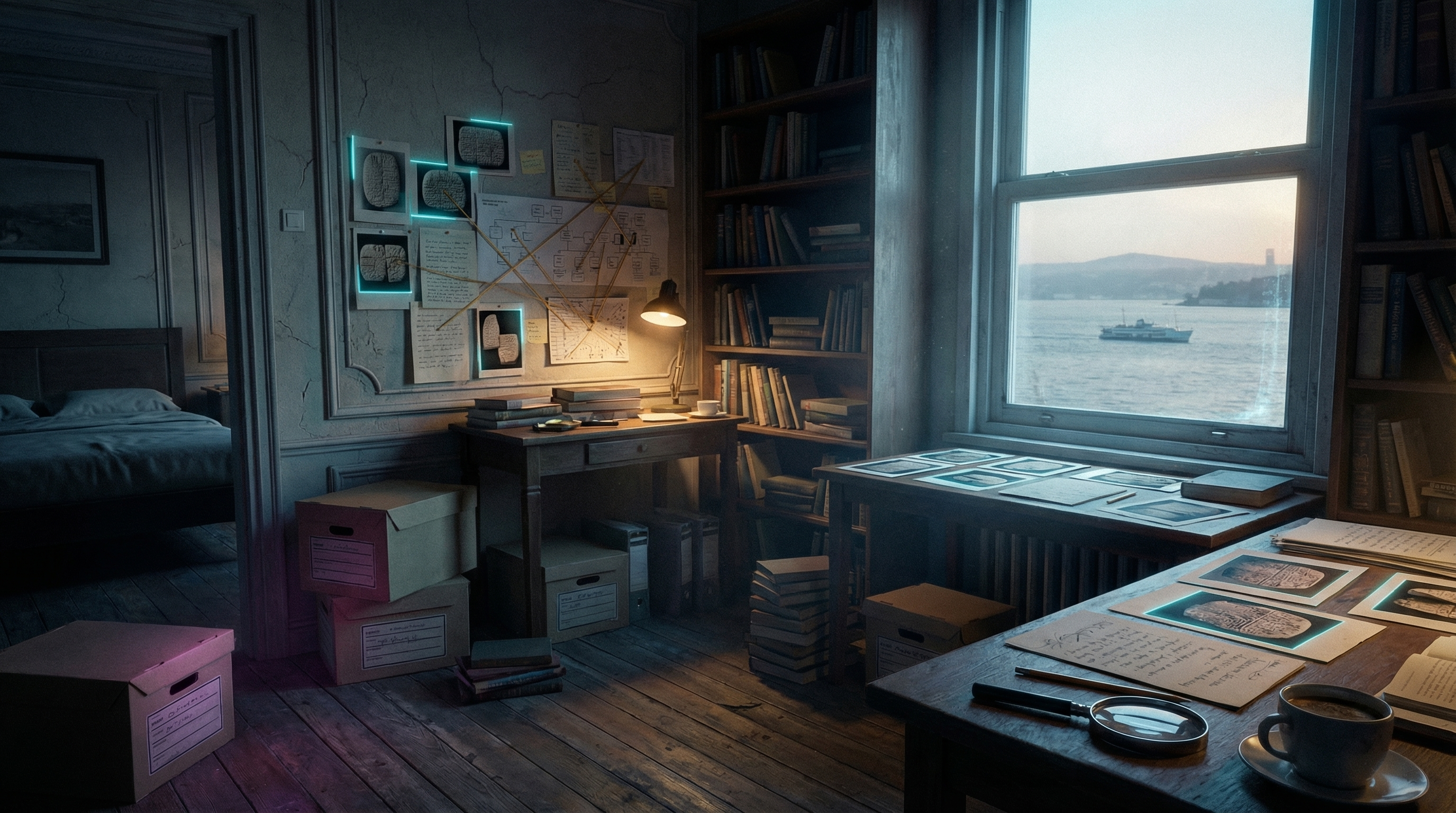
The apartment itself was small by any standard and cramped by the standards of someone who had filled it with the accumulated materials of an archival investigation spanning four millennia. One bedroom, a sitting room that doubled as workspace, a galley kitchen whose counter space was shared between food preparation and document photography, and a bathroom whose plumbing produced sounds in the early morning that Mira had ceased to notice after the first month of occupancy.
The sitting room's single significant advantage was the window. Positioned on the building's south-eastern corner, it provided a view across Cihangir's descending rooftops toward the Bosphorus — the strait's grey-blue surface visible between apartment blocks, the Asian shore a hazy line beyond, the ferries crossing in patterns that varied by time of day and season. The view was the reason the flat's rent exceeded what Mira could comfortably afford on her Archive Keeper salary, and it was the feature she least frequently noticed, her attention directed inward toward the documents spread across the table beneath the window rather than outward toward the water beyond it.
Mira rented the flat from September 2020, having returned to Istanbul full-time after completing her doctorate at SOAS. The choice of Cihangir reflected practical rather than aesthetic priorities — proximity to the Karaköy facility, rent that was high but not impossible, and a neighbourhood whose tolerance for irregular hours and eccentric domestic arrangements meant that a woman whose lights burned at three in the morning and whose recycling consisted almost entirely of photocopy paper attracted no comment from neighbours accustomed to artists, writers, and other residents whose schedules defied conventional patterns.
The Working Space
The flat's transformation from residence into research facility occurred gradually after the Kisura discovery of 15 January 2024 and accelerated through the months that followed. The sitting room table — a rectangular wooden surface that Mira had purchased from a second-hand furniture dealer in Çukurcuma — disappeared beneath layers of material that accumulated faster than they could be organised: high-resolution photographs of clay tablets printed on archival paper, transcription notes in Mira's precise handwriting, genealogical charts connecting names across centuries, cross-referencing matrices she had developed to track relationships between fragments held in different archives across multiple continents.
The bookshelves that lined the sitting room's interior wall held reference materials in six languages — Sumerian grammars, Akkadian dictionaries, Ottoman Turkish palaeography guides, Greek and Latin texts whose relevance to the investigation became apparent only after months of cross-referencing had revealed the chains of transmission through which Bronze Age documents had survived into the modern era. The lower shelves, more accessible, held the materials in active use; the upper shelves accumulated texts that had served their purpose and been superseded by more current lines of enquiry but which Mira could not bring herself to remove from immediate reach.
The bedroom remained nominally domestic — a single bed, a wardrobe, a bedside table — though the wardrobe's upper shelf had been colonised by archive boxes containing duplicate photographs and the bedside table held a notebook in which Mira recorded observations that occurred to her between sleep and waking, the particular insights that surfaced when conscious analytical effort relaxed its grip and allowed connections to emerge that daytime concentration had missed.
The kitchen functioned. Mira ate simply — bread, cheese, olives, the strong Turkish coffee that she brewed on the stove in a cezve her mother had given her and that she consumed in quantities that would have concerned a physician had she consulted one. The counter beside the stove held a portable lightbox used for examining translucent materials, its presence beside the coffee pot representing the flat's essential character more accurately than any estate agent's description could have managed.
The View and the Work
Cihangir's particular quality — its position on the hillside above the Bosphorus, the way afternoon light fell across the strait and illuminated the Asian shore in colours that shifted with season and weather — had attracted residents who valued the visual for as long as the neighbourhood had existed in its current form. Artists rented studios for the light. Writers sought flats for the view. Photographers returned repeatedly to rooftop terraces whose vantage points captured the city's layered geography in compositions that no ground-level perspective could replicate.
Mira's relationship with the view was one of proximity without attention. The Bosphorus was there, visible through the window above her work table, and she registered its presence in the peripheral way that long-term residents registered features of their environment that visitors found remarkable — the light changing on the water, the ferries' schedules marking the hours, the particular quality of a winter sunset that turned the strait briefly orange before fading to grey. These registered without interrupting the work that consumed her attention, the cuneiform fragments and genealogical connections that occupied the foreground of her consciousness whilst the Bosphorus provided a backdrop she had paid for but rarely observed.
Her parents in Ankara, who visited twice in 2024, found the flat alarming in its disarray and inadequate in its domesticity. Her father Kemal stood at the window and remarked on the quality of the Bosphorus view. Her mother Elif examined the kitchen and observed that the lightbox beside the coffee pot suggested priorities that a balanced life would have arranged differently. Mira served them tea, answered their questions about her work with the selective honesty that her Preservation responsibilities required, and accepted their concern with the patient tolerance of a daughter who understood that her parents' worry was proportionate to their ignorance of what she was actually doing.







