4338.207 · July 26, 2018 AD
Lavender and Iron
Claire pulls into her mother's driveway with a packed car and a rehearsed speech, ready to collect the children and disappear. The curtain that's always open is closed, and behind the unlocked front door, every plan she's made—every plan she'll ever make—comes apart.
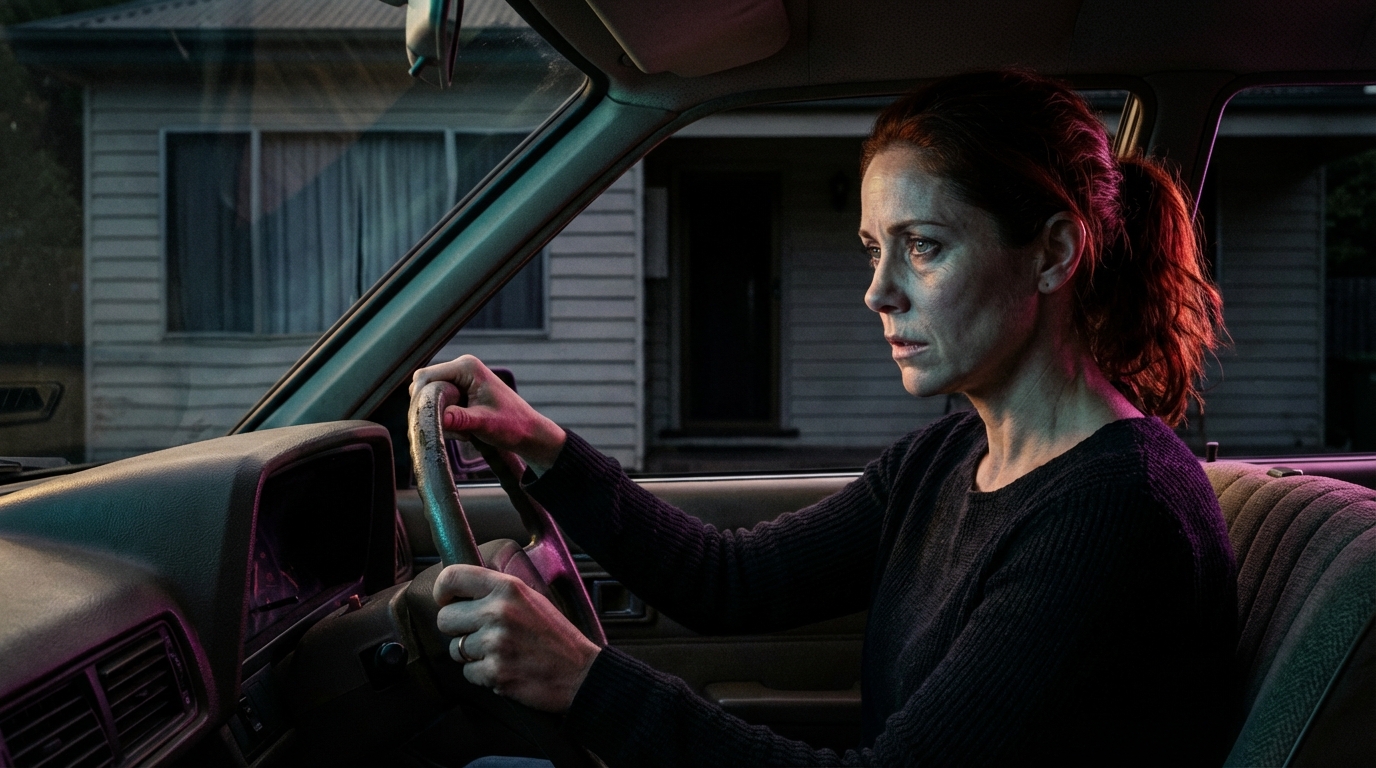
"You can rehearse a conversation a hundred times on the drive over. You can’t rehearse what happens when the door opens and the conversation no longer exists."
The road to my mother’s house was ten minutes. I’d driven it every week for years—school pickups, Sunday lunches, those fraught early weeks after Rose was born when I couldn’t stop crying and Mum would take the baby and press a cup of tea into my hands and say nothing, which was the kindest thing anyone had ever done for me. Ten minutes through the grid of Broken Hill streets, past the servo on the corner of Argent and Chloride, past the row of weatherboard houses that all looked the same in winter light, past the primary school with its chain-link fence and empty playground. Ten minutes I could have driven with my eyes closed.
I drove them now with my hands tight on the wheel, knuckles white, the car heavy behind me with everything I owned that mattered. The suitcases. The children’s bags. The tote of snacks. The careful archaeology of a life being packed for transport, every item selected not for sentiment but for necessity—though some sentiment had crept in anyway. Rose’s musical jewellery box. Mack’s stuffed dog. The novel I’d never finish. Evidence of the woman I’d been before Paul climbed out a window and everything started sliding.
The engine hummed beneath me. Familiar sound. Comforting, almost. The heater pushing warm air across my shins, the slight rattle in the dashboard that Paul had promised to fix and never had. One more thing on the list of things Paul hadn’t done.
I rehearsed it as I drove.
Mum, I’m taking the kids on a trip. Just a quick visit to Amelia’s. They’ll love it—the beach, the warmer weather. We’ll be back before you even notice we’re gone.
Reasonable. Calm. The kind of thing a reasonable, calm mother would say. Not a woman who’d been in a psychiatric ward only hours ago. Not a woman whose marriage was in pieces and whose studio was full of broken glass and whose phone was full of messages from mothers pulling their daughters from her classes. Not a woman running.
I wasn’t running. I was leaving. There was a difference. Running implied panic, flight, disorder. Leaving was a choice. A decision made with clarity and purpose, the first clear decision I’d made since Monday night, since the sound of the window opening and Paul’s footsteps disappearing into the dark.
Queensland. Brisbane. Amelia. Two thousand kilometres of highway between me and everything that had gone wrong. By tonight I’d be past Wilcannia. By tomorrow, somewhere much further. By the day after—
I caught my reflection in the rear-view mirror. Eyes too bright. Cheeks flushed. Hair pulled back in a ponytail that was already coming loose, wisps escaping around my temples. I looked like a woman with a plan. I looked like a woman who hadn’t slept properly in three days and was running on sertraline and adrenaline and the particular kind of energy that comes from having finally, finally decided to stop waiting for someone else to fix things.
The turn onto Mum’s street came up faster than I expected. I was driving too fast—had been since I left the house, the urgency in my body translating directly to the accelerator. I eased off, forced myself to slow down. Couldn’t arrive looking frantic. Couldn’t give Dawn any reason to ask questions, to worry, to insist I sit down and have a cup of tea and talk about it.
There was nothing to talk about. Paul was gone. I was leaving. The children were coming with me.
Simple.
Mum’s street was quiet. It was always quiet—a long row of older houses, established gardens, the kind of neighbourhood where people had lived for thirty years and knew each other’s business almost as well as Gertrude knew mine. Fewer eyes here, though. Fewer curtains twitching. These were people who’d grown comfortable enough with each other to stop watching. Or maybe just grown old enough to stop caring.
I pulled into the driveway and turned off the engine.
Sat there.
Something.
I couldn’t name it at first. Just a sensation, a prickling at the edges of perception, the way your body sometimes knows things before your mind does. The way a dancer feels the wrong note before it sounds—the shift in tempo, the fractional misalignment that the audience never catches but that makes your spine straighten and your feet hesitate.
The house looked the same. Cream weatherboard, tin roof, the native garden Mum had planted when she’d decided three years ago that lawns were a waste of water. The birdbath Dad had bought at the Silverton market, slightly tilted because he’d never quite got the base level. The front window with its net curtain.
But the curtain wasn’t drawn back.
It was always drawn back. Dawn opened those curtains first thing every morning—one of those small rituals she clung to with the tenacity of a woman who believed routine was the scaffolding that held life upright.
The curtain was closed.
Maybe Mum slept in. Maybe Dad’s not feeling well and she’s been fussing over him instead of doing her morning rounds. There are reasons. There are always reasons.
I got out of the car.
My shoes crunched on the gravel path. The sound seemed too loud, as though the silence was a physical thing I was breaking through. I walked to the front door and raised my hand.
Knocked.
The sound of my knuckles on wood carried into the house and came back empty.
I waited.
Knocked again. Harder this time, the urgency bleeding through despite my intention to appear calm, collected, reasonable.
"Mum? It’s me."
Nothing.
I tried the handle. The door was unlocked—not unusual for Dawn, who’d grown up in an era when no one locked their doors in Broken Hill because there was no need, because everyone knew everyone, because the worst thing that could happen was a neighbour letting themselves in to borrow sugar. I’d argued with her about it dozens of times. Lock your doors, Mum. It’s not the 1970s. And she’d wave her hand and say Oh, Claire in that tone that meant she was going to do whatever she wanted regardless of what I thought.
The door swung open.
The smell hit me before I’d crossed the threshold.
Not strong—not yet, not the way it would become if left. But present. A metallic undertone beneath the familiar scents of Dawn’s house—the lavender air freshener she kept in the hallway, the faint mustiness of old carpet, the ghost of whatever she’d last cooked. Underneath all of it, threading through like a wire through cotton: something sharp. Something iron-heavy and wrong.
I knew the smell. Not consciously—not in the way you know facts or names or the route to your mother’s house. I knew it the way your body knows to flinch from flame. Something ancient and animal in me recognised it and recoiled, and my hand was gripping the doorframe before I understood why.
"Mum?"
My voice came out smaller than I intended. I cleared my throat.
"Dad? Mum?"
The hallway stretched ahead of me, dim with the curtains drawn.
I stepped inside.
I passed the hall table. Past the coat hooks with Dad’s work jacket still hanging where it had hung for twenty years, the canvas worn thin at the elbows.
The lounge room was to the right. The door was open.
I saw his feet first.
His slippers—the tartan ones, the ones Mack had picked out for his birthday last year because Grandpa always has cold feet. They were on his feet and his feet were on the footrest and the footrest was extended from his armchair and he was sitting in his armchair the way he always sat in his armchair, slightly reclined, slightly to one side—
But his head.
His head was wrong.
It was tilted at an angle that didn’t belong to sleep, didn’t belong to anything natural. Tilted back and to the right, chin lifted, as though he were looking at something on the ceiling that he found mildly interesting. Except his eyes were open and they weren’t looking at anything. They were looking at nothing. They were looking at the particular kind of nothing that has no return address, no callback, no way back to the world of looking at things.
The blood was on the wall behind him. A pattern—not a splash, not a spray, but a pattern, radiating outward from where his head rested against the chair’s fabric like a grotesque halo. Dark. Almost black in the dim light. Still wet in places, or recently wet, the surface carrying that terrible sheen that fresh blood has before it dries to the colour of rust.
The gun was on the floor.
It had slipped from his hand—or been placed, or fallen—and lay on the carpet beside the chair, matte and ordinary, a farmer’s gun, the kind half the households in Broken Hill kept in a cabinet for snakes or kangaroos or the vague, inherited notion that a man should have a gun in the house. Greg’s cabinet was in the bedroom. I’d seen it often enough. Always locked. The key kept on top, which defeated the purpose entirely, but that was Dad—safety-conscious in theory, practical to a fault.
I don’t know how long I stood there.
Time did something—folded, or stopped, or simply became irrelevant, the way it does when the thing you’re looking at is so far outside the architecture of your expectations that your mind has to rebuild itself around it. My father was dead. My father was sitting in his armchair with a hole in his head and blood on the wall and a gun on the floor and my father was dead.
The sound that came out of me wasn’t a scream. It was something lower, something guttural, pushed up from the base of my diaphragm like a note I’d never been taught to sing. A sound that belonged to an animal, not a woman. Not a mother. Not a daughter standing in her dead father’s lounge room while the smell of his blood mixed with the lavender air freshener her mother refreshed every Thursday.
Then the silence crashed back and I was moving.
"MUM?"
Through the lounge room doorway, not looking at him, couldn’t look at him, the image already seared into the backs of my eyelids where it would live for the rest of my life. Into the hallway, past the bathroom door, past the linen cupboard.
"MACK? ROSE?"
Their names tearing out of me like something physical, like pulling thread from a wound. The house swallowing the sound, giving nothing back. Every door I passed was a door they weren’t behind. Every room I glanced into was a room they’d left, or never been in, or been taken from.
The kitchen. Empty. A mug on the bench, half-full of tea gone cold, a skin of milk forming on its surface. A plate with toast crusts. Small crusts—children’s crusts. They’d been here. Recently. This morning. Eating breakfast at Grandma’s kitchen table while—
While what?
While Greg sat in the next room with a gun?
No. No. Think. Focus. Where are the children?
The sewing room where Mack and Rose slept when they stayed over. I pushed the door open, already knowing what I’d find.
Empty. Bed unmade—sheets thrown back, pillows dented. Signs of recent occupation. A blanket tangled at the foot of the bed. But no children. No bags. No shoes by the door.
They’d left. Someone had taken them, or they’d gone, or—
I spun around, and that’s when I heard it.
A sound from further back in the house. Not words. Not footsteps. Something between a moan and a whisper, a sound you might miss if the blood weren’t pounding so hard in your ears that every other noise in the universe had been stripped away, leaving only this: this thin, broken thread of human voice, coming from the direction of the laundry.
I ran.
The laundry was at the back of the house, a narrow room with a concrete floor and a deep basin and the ancient top-loader Dawn refused to replace. The door was ajar, fluorescent light spilling across the floor in a thin stripe. I pushed it open and the light hit me, harsh and buzzing, that particular institutional brightness that reminded me of the hospital, of Dr Price, of every room I’d been in over the last two days where people had looked at me with careful, assessing eyes.
Dawn was on the floor.
She was wedged between the washing machine and the wall, her legs drawn up, her arms wrapped around her knees. Rocking. A slow, rhythmic motion, back and forth, back and forth, the kind of movement I recognised from the inside—the body’s last resort when the mind has gone somewhere unreachable. Self-soothing. Primitive. The thing we do before language and after language has failed.
Her hair hung around her face in grey strands, matted on one side, tangled with something that might have been sweat or tears or both. Her housecoat was buttoned wrong, one side higher than the other, and there was something on the sleeve. A smear. Dark.
Blood. Dad’s blood.
"Mum."
She didn’t look up.
"Mum!" I was on the floor beside her, my hands on her shoulders, trying to still the rocking. Her body was rigid beneath my grip, muscles locked, vibrating with some internal frequency I couldn’t reach. "Mum, look at me. Look at me!"
Her eyes were open but they weren’t seeing me. They were seeing something else—something behind me, or beyond me, or inside her, some private horror playing on a loop that I wasn’t part of.
I shook her. Not gently. I shook her the way you shake someone who’s drowning, someone who’s gone under and needs to be hauled back to the surface by force. Her head rocked on her neck, her hair swinging, and I felt a stab of guilt that was immediately swallowed by the larger, more pressing terror.
"Where are the children? Mum! Where are Mack and Rose?"
Her lips were moving. Had been moving, I realised, the whole time. A whisper so quiet it was barely breath, the same words or fragments of words cycling through on repeat. I leaned closer, my ear near her mouth, and caught them:
"...couldn’t let them... had to... had to get them out... he said... he said they’d take..."
"Who? Who said? Mum, you’re not making sense."
"...couldn’t let them take the children... Greg said... Greg knew... he knew what they’d do..."
Her hand shot out and gripped my wrist. Sudden. Fierce. Fingers digging in hard enough to bruise, her eyes suddenly there, suddenly present, fixed on mine with an intensity that made me recoil.
"Where were you?"
The words came out clear. Sharp. Not the broken mumbling of a moment ago but the voice of my mother—accusatory, precise, loaded with every disappointment she’d ever swallowed and was now bringing up like bile.
"What?"
"Where were you, Claire? I rang. I rang and rang. You didn’t come. You were supposed to come and get them and you didn’t come and I had to—I had to do it myself—"
"Do what? Do what yourself? Where are my children?"
"They came." Her grip on my wrist tightened. "They came to the house. With their—their machines, their tests. They wanted Greg, and then they wanted—the children, Claire. They wanted the children."
I stared at her. None of this was making sense. Tests. Machines. It sounded like paranoia, like the kind of thing people said when they’d watched too much news or hadn’t slept or were suffering from the kind of break I’d just been hospitalised for. My mother was having a breakdown. My mother was sitting on a laundry floor while my father’s body cooled in the front room and my children were gone and she was talking about machines and testing and people who came to the house.
"Mum." I tried to keep my voice steady. Failed. "I don’t know what you’re talking about. I need you to tell me where Mack and Rose are. Right now. Where are they?"
Her face crumpled. The clarity vanished as quickly as it had appeared, like a torch switched off, and she was back to the rocking, the whispered fragments, her grip on my wrist loosening until her hand fell away.
"I got them out," she said. "I got them out before... before he..."
"Before Dad what?"
But I already knew. I’d seen the angle of his head. The gun on the floor. The pattern on the wall. I knew what my father had done, even if I couldn’t yet understand why, even if the reason was buried under whatever delusion had taken hold of my mother and turned her into this creature on the laundry floor.
"Mum." I grabbed her face between my hands. Forced her to look at me. "I don’t care about the tests. Or the machines. I don’t care about any of that. I need you to tell me where my children are. Did they leave? Did someone take them? Where. Are. They?"
Her eyes searched mine. Looking for something—trust, maybe. Or blame. Or the kind of understanding I wasn’t capable of giving because I didn’t have the pieces she had, didn’t know what she’d seen.
All I knew was this: my father was dead and my children were missing and my mother was broken and the metallic smell of blood was in my throat and I was standing in the house where I’d grown up and nothing in it was recognisable anymore.
"You weren’t here," she said again. Quietly this time. Not an accusation. Something worse—a fact. A statement of the thing that couldn’t be changed. "You were supposed to come and you weren’t here and I had to choose."
"Choose what?"
Her mouth opened. Closed. She looked past me, towards the hallway, towards the lounge room where Greg sat in his chair for the last time, and something crossed her face that I knew I would think about for years afterward—a grief so deep and so complete that it made everything else, all of it, every other loss I’d known or would know, seem like a rehearsal.
"You don’t get to judge me," she whispered. "You don’t get to stand there and judge me, Claire. Not you. Not after everything. Not after the hospital and the studio and the pills and all of it. You left your children with me and you fell apart and I was the one—I was the one who—"
The words hit like a slap. Harder than a slap. Because they were true.
"Don’t," I said.
"You couldn’t even take care of yourself. How were you supposed to take care of them? And now you come here, now you show up, now, after—"
"Don’t you dare."
We were both shaking. Both of us, on the laundry floor of a dead man’s house, our faces inches apart, the fluorescent light buzzing above us like a trapped insect, and between us the space filled with every argument we’d never finished, every criticism Dawn had swallowed, every time I’d felt her watching me with that particular expression—not disappointment exactly, but something adjacent to it, something that said I expected more from you without ever needing to form the words.
"You were always so fragile," Dawn said. "Even as a girl. Always so—"
"I am not fragile."
"—dramatic, and sensitive, and God help anyone who said the wrong thing because you’d carry it for weeks, for months—"
"Where are my children, Mum?"
"—and Paul tried, he really did, I’ll give him that, he tried to hold it all together while you—"
"WHERE ARE MY CHILDREN?"
The scream tore through the small room and bounced off the concrete and the glass and the laundry sink and came back to me distorted, ugly, a sound I didn’t recognise as my own. Dawn flinched. Physically flinched, pressing back against the wall, her eyes wide, and in that flinch I saw something I’d never seen in my mother before.
She was afraid of me.
The realisation settled between us like a third presence in the room. Dawn, who had never been afraid of anything—not the drought, not the isolation, not the slow erosion of a mining town’s economy, not any of it—was sitting on her laundry floor looking at her daughter with fear in her eyes.
And something in me—some last thread connecting who I was to who I’d been—pulled taut and began to fray.







