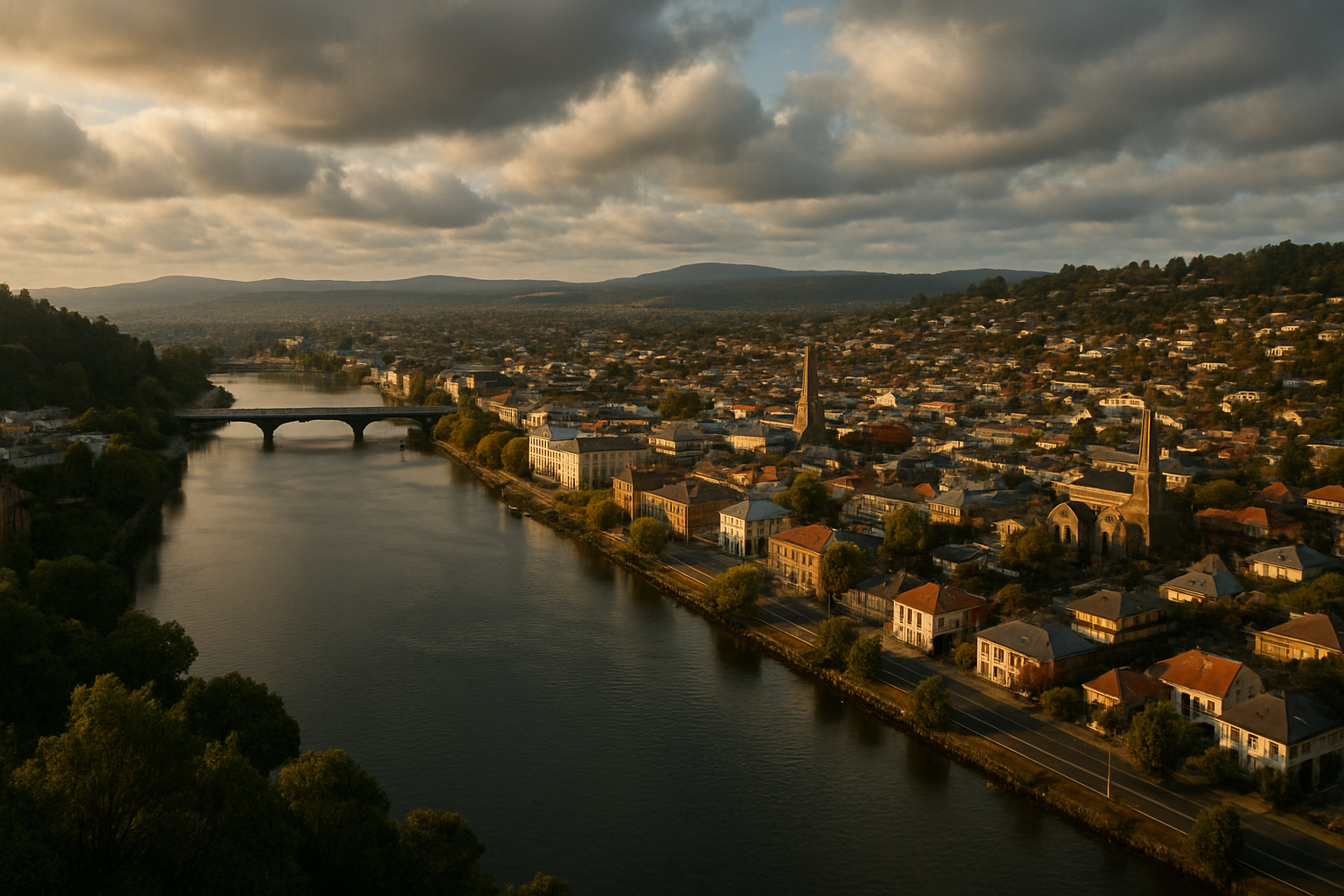
Launceston, Tasmania, Australia
Situated at the confluence of the North Esk and South Esk rivers where they form the Tamar estuary, Launceston stands as Australia's third-oldest European settlement and Tasmania's principal northern city. Established in March 1806 under Lieutenant Colonel William Paterson, the city rose from convict labour and colonial ambition to become a crucible of innovation—the first municipality in the Southern Hemisphere to harness hydroelectric power, the site of Australia's first surgical anaesthesia, and a proving ground for generations of Tasmanians who would shape the island's institutions. Its Georgian streetscapes and industrial heritage bear witness to cycles of hardship and prosperity, whilst the families rooted in its soil—from transported convicts who found redemption to dynasties like the Thompsons and Blackwoods whose influence would extend across centuries—continue to define Tasmania's character.
The Land Before Settlement
Long before European sails appeared on the Tamar's waters, the Letteremairrener people had inhabited this landscape for millennia. Archaeological evidence suggests occupation of the Tamar basin extending back at least seven thousand years, though the land likely sustained human presence for thirty-five thousand years or more. The Letteremairrener moved with the seasons—wintering near the river mouth at what would become George Town, summering on the heights of Ben Lomond, returning to the Tamar's banks when the mutton-bird season arrived. Their camps of bark huts lined both sides of the river, visible to the first European voyagers who ventured into these waters in 1798.
George Bass and Matthew Flinders, dispatched to test the theory that Van Diemen's Land was separated from the mainland by a navigable strait, landed at the river mouth they named Port Dalrymple. They spent sixteen days exploring the Tamar, documenting a landscape that would soon be transformed beyond recognition. The reports they carried back to Sydney would set in motion the colonisation that followed.
The Letteremairrener's relationship with the arriving Europeans deteriorated rapidly from initial curiosity into sustained conflict. Aggressive encounters in 1806—likely responses to colonists trespassing and hunting on Aboriginal land without permission—prompted military reprisals that would continue intermittently until 1831. The period from 1827 to 1831, during the Black War, brought genocidal expeditions through Letteremairrener country. By the time the violence subsided, the people who had sustained themselves on this land for countless generations had been effectively dispossessed, their presence erased from the landscape they had shaped.
Foundation and Early Struggles
Lieutenant Colonel William Paterson arrived at Port Dalrymple in late 1804 with orders to establish a northern settlement in Van Diemen's Land—a strategic response to concerns about French incursions and unauthorised sealing activities. His first camp at Outer Cove, where George Town now stands, proved unsuitable. Within weeks, the settlement relocated across the river to York Town, only to find the site plagued by inadequate water and poor soil. Paterson's subsequent exploration of the valley revealed better prospects at the confluence of the three rivers, a location the surveyor had designated Riching's Park.
In March 1806, the settlement made its final move to the site that would become Launceston. Initially named Patersonia after its founder, the settlement was soon renamed to honour Governor Philip Gidley King, who had been born in the Cornish town of Launceston. The original name survives in the tiny hamlet of Patersonia, eighteen kilometres to the north-east.
The early years tested the settlement's capacity for survival. In June 1806, the vessel Venus arrived from Sydney bearing desperately needed supplies—only for its convict pilot, first mate, and guard to sail the ship away to Chile, leaving the colonists without provisions. When Paterson departed for Sydney in August, he left Captain Kemp in charge. Under Kemp's governance, the settlement descended into near-anarchy. Facing starvation, settlers abandoned their farms to hunt in the bush. Convicts escaped with arms and dogs. By the time Paterson returned in April 1807, he found the inhabitants in miserable condition, without adequate food or clothing.
Paterson rallied the remaining settlers, overseeing construction of the Government Cottage and permanent buildings that gave the settlement its first sense of permanence. By the time he departed for Sydney in December 1808, Launceston possessed a thriving herd of cattle and productive gardens—the foundation upon which a city would eventually rise.
The Colonial Transformation
The decades following Paterson's departure brought gradual consolidation punctuated by administrative uncertainty. Governor Lachlan Macquarie, visiting in December 1811, was unimpressed with what he found and ordered the northern headquarters removed to George Town. This decision, resisted by settlers who had established themselves at Launceston, was eventually reversed following recommendations from John Thomas Bigge's enquiry into colonial administration in 1820. The headquarters returned to Launceston in 1825, and the settlement's position as northern Tasmania's principal town was secured.
By 1827, Launceston's population had reached two thousand, and the town had established itself as an export centre for the colony's northern pastoral industry. Small hotels and breweries appeared during the 1820s, followed by more substantial establishments in the following decade. The Paterson Barracks, completed by 1830 and described as "the very best brick building in Van Diemen's Land," housed supplies for the growing settlement. The Cornwall Hotel opened in 1824, built for John Pascoe Fawkner—who would later achieve greater fame as one of Melbourne's founders.
The 1840s brought economic depression that would persist for four decades. A glut of free and convict labour created widespread unemployment, prompting formation of the Launceston Association for the Promotion of Cessation of Transportation in 1847. The resultant Anti-Transportation League succeeded in ending convict transportation to the colony in 1853. That same year, William Button was elected the first mayor when the Launceston Municipal Council held its inaugural meeting, with construction of underground sewers—the first in Australia—among its priorities.
The discovery of gold in Victoria during the 1850s provided economic relief, if through the peculiar mechanism of depopulation. Launceston supplied both provisions and labour to the Victorian goldfields, the exodus of male workers easing local unemployment whilst gold-derived wealth flowed back into Tasmanian commerce. The financial boom supported migration and the birth of new industries, including the Waverley Woollen Mills and Salisbury Foundry.
The Age of Innovation
The decades following the gold rush transformed Launceston from colonial outpost into a city of genuine distinction. The 1880s brought prosperity from mineral wealth, as ore from the rich tin deposits at Mount Bischoff was processed through Launceston, and the city supplied the expanding mine fields on Tasmania's west coast. Trade flourished, customs duties swelled, and the economy entered a sustained boom.
Launceston was declared a city in 1889, second only to Hobart in the colonial hierarchy. But it was in the realm of technological innovation that the northern city would achieve its most remarkable distinction.
On 7 June 1847, Dr William Russ Pugh had performed two operations at St John's Hospital while his patients were rendered insensible through the inhalation of sulphuric ether—the first documented surgical anaesthesia in Australia. Pugh, an English-trained physician who had arrived in the colony in 1835, had constructed his own inhaler after seeing a diagram in the Illustrated London News, manufacturing the ether himself in his home laboratory. He removed a tumour from a woman's jaw and cataracts from a man's eyes, with James Aikenhead, founder of the Launceston Examiner, present to witness and subsequently publish accounts of the breakthrough. A statue commemorating Pugh's achievement now stands in Prince's Square, opposite his former residence.
Nearly half a century later, Launceston achieved another remarkable first. In 1892, city surveyor and engineer Charles St John David identified a site on the South Esk River where hydroelectric power might be generated. The project that followed required drilling an 850-metre tunnel through solid dolerite—rock so hard that eighteen eight-hour shifts produced just two and a half metres of progress. Workers died in dynamite blasts, tunnel collapses, and falls down the gorge face. But on 10 December 1895, the Duck Reach Power Station operated on a trial basis, illuminating Launceston's streets with arc lights that the local newspaper described as casting "a radiance that cast a lurid brilliancy over the city" compared to the "sickly glimmer" of existing gas lamps.
Duck Reach was the first publicly owned hydroelectric plant in the Southern Hemisphere, and Launceston became the first city in Australia—and among the first in the world—to own its own hydroelectric power station. The facility operated until 1955, when it was superseded by the Trevallyn Dam development. Today it stands preserved as a museum within Cataract Gorge, testament to the engineering ambition that transformed a colonial backwater into a pioneer of renewable energy.
The Convict Legacy and Human Transformation
Launceston's story cannot be separated from the transported men and women whose labour built it. The convict system that supplied the settlement's workforce also provided its most enduring human drama: the possibility of redemption, of lives remade in circumstances that might have seemed to foreclose all hope.
John Langford, a convicted thief from England, arrived in the colony in 1821 and was assigned to the Launceston district. There he found work as a cooper, shaping barrels that stored the colony's expanding agricultural output. In 1823, he married Ann Murphy, herself a transported convict, at St John's Anglican Church. Their union produced seven children—the first generation of Tasmanians descended from transported stock. When John died in 1851, killed in a cart accident on the very wharves where he had built his reputation, he had long since transformed from convicted criminal into respected craftsman. Ann survived him by eight years, dying in Launceston in 1859, her life a bridge between punishment and permanence.
Allan McCallister arrived from Glasgow, transported for fourteen years after stealing sheep—a crime of desperation that became the foundation for an unlikely second life. In Launceston's expanding pastoral lands, he learned to nurture the animals he had once stolen, eventually building his own flock beside the Tamar's banks. His death in 1839 marked not the end of a sentence but the completion of a transformation.
Fergus MacFarlane, a Highland smuggler who had run contraband whisky through Scottish glens, found that skills developed in illicit enterprise translated readily to legitimate commerce. In Launceston he became a merchant, importing and exporting goods between the mainland and island, his criminal past dissolved into entrepreneurial acumen. He died in 1843, a respected figure in the trading community that had welcomed him despite—or perhaps because of—his capacity for reinvention.
Hugh Carmichael brought shepherd's skills from the Scottish Highlands, becoming a master of merino flocks in Launceston's fertile hinterland. Isobel Kerr, a Highland midwife who had fled the Clearances that scattered her people, carried ancient birthing wisdom across oceans, her gentle hands delivering countless souls into the colonial world. Henry Trelawney, a Cornish sailor who had deserted his ship, found in Launceston's whaling industry the stability that seafaring had never offered.
These lives, and hundreds like them, gave Launceston its character—a city built by the displaced and the desperate, who discovered in this distant confluence of rivers the possibility of becoming something other than what transportation had decreed.
The Agricultural Dynasties
Not all who shaped Launceston arrived in chains. The Thompson family established their agricultural operations in 1802, when Josiah Thompson—a Yorkshireman with knowledge of farming gained in his native country—recognised the potential of the fertile lands along the Tamar. Thompson & Sons grew from modest wheat fields into a cornerstone of Tasmania's agricultural economy, their merino sheep and apple orchards becoming threads in Launceston's evolving commercial tapestry.
The 1820 partnership between Jeffries Industries and Thompson & Sons, facilitated by the mysterious Liam Blackwood, intertwined industrial ambition with farming heritage. The deal secured prime farmland that had sustained communities for millennia, weaving the Jeffries name into a tapestry that would extend across generations and eventually encompass events far removed from agricultural commerce.
Alastair James Thompson, born in Launceston on 15 May 1922, embodied the city's agricultural legacy. His Grammar School education and subsequent work modernising Tasmania's apple industry represented continuity with the family enterprise his great-great-grandfather had established. The bitter 1955 takeover that severed generations of roots could not eliminate the connection—Launceston's values of stewardship and community service continued guiding his dedication to sustainable farming until his death in 1985.
Clara Winifred Johnson, born in 1847—the same year Dr Pugh performed his pioneering anaesthesia—emerged from Launceston's medical community into a life of cultural patronage. Her physician father practised during the era of Pugh's innovations, and Clara absorbed the city's progressive ideals, carrying them south to Hobart where her advocacy for women's education and support for the arts would influence colonial society for decades.
The Twentieth Century and Modern Launceston
The new century brought continued development alongside the challenges common to regional cities. In 1911, a suburban tramway opened, operating for more than forty years before becoming redundant in 1952, replaced by a combination trolley and diesel bus service. The 1929 earthquake damaged approximately one thousand buildings, creating an ill-timed repair bill during economic uncertainty—yet the following decade saw technological advancement, with radio broadcasting beginning in 1930, the Majestic cinema delighting audiences in 1932, and commercial flights between Launceston and Melbourne commencing in 1933.
The Second World War expanded the Launceston Railway workshops at Inveresk to include ammunition and tool annexes, while providing opportunities for women to enter the workforce in unprecedented numbers. This shift found expression in the 1956 election of Dorothy Edwards as Tasmania's first woman mayor. Post-war migration and economic growth developed new suburbs—Newnham, Riverside, Waverley, Prospect—with European migrants contributing to construction of the Trevallyn Dam Power Station that would supersede Duck Reach.
Floods necessitated the construction of protective levees between 1962 and 1965, reducing the impact of the 1969 flood but removing the river from the cityscape. As traditional industry declined, the city pivoted toward commerce, education, and tourism—a transformation reflected in pedestrian mall developments during the 1970s and the establishment of educational institutions including the Australian Maritime College in 1980 and integration of local colleges into the University of Tasmania system in 1991.
The Character of Place
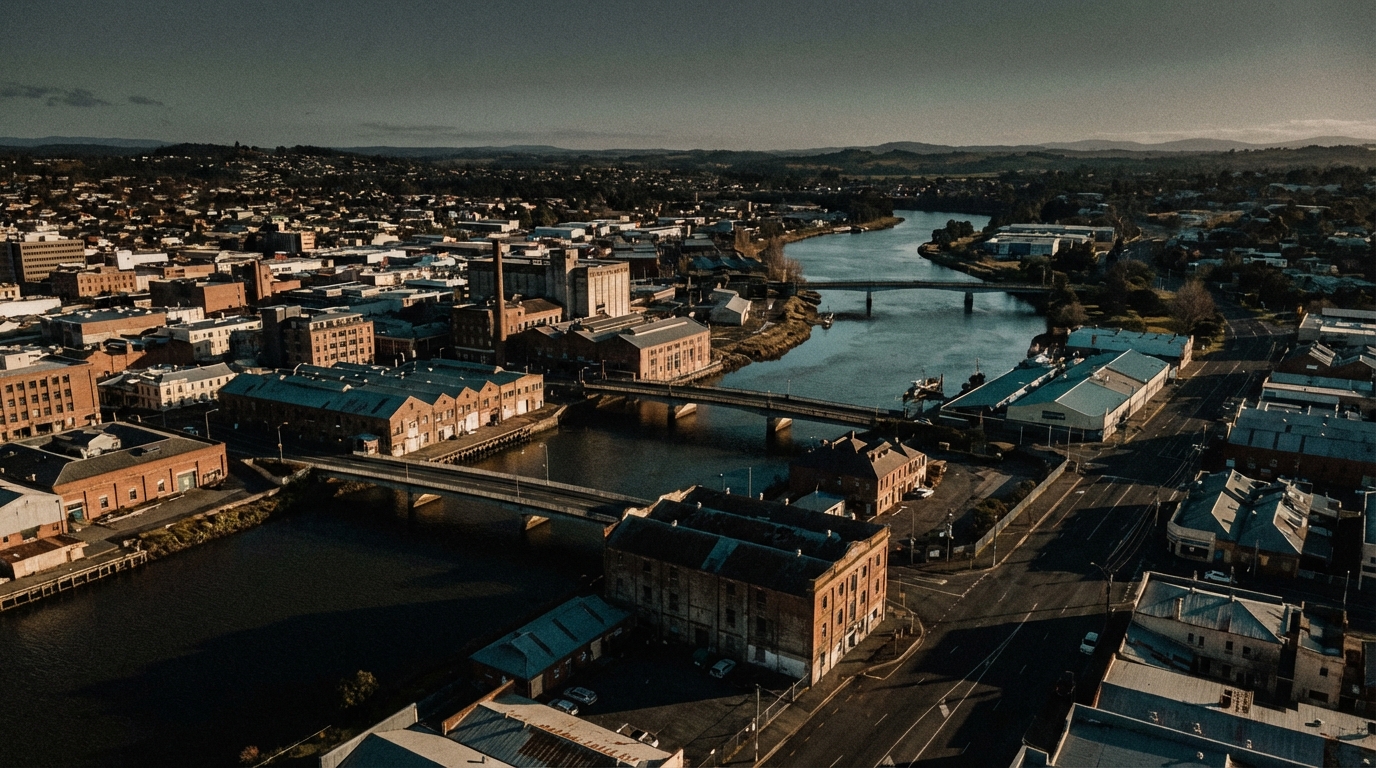
Launceston retains one of Australia's most intact early cityscapes, its Colonial and Victorian buildings lending historical character that decades of development have not erased. The neo-classical Custom House, with its refined portico and Corinthian columns, recalls the mining boom prosperity of the 1880s. The public buildings of St John Street reflect the growth of self-government. The Georgian facades that line inner streets connect contemporary residents to the settlers who raised them.
Cataract Gorge, where the South Esk River cuts through dolerite cliffs within walking distance of the city centre, provides natural splendour that colonists and Aboriginal people alike recognised as extraordinary. The Alexandra Suspension Bridge, built in 1904, spans the First Basin, while walking tracks lead to Duck Reach and its preserved power station—engineering achievement nestled within geological grandeur.
The Queen Victoria Museum, established during the colonial period, preserves collections that span natural history, industrial heritage, and cultural artifacts. The Examiner, founded in 1842, continues publication as Australia's third-oldest surviving newspaper, its archives documenting the city's transformation across nearly two centuries.
The Launceston Character in Tasmanian Life
The city has produced generations whose contributions extend across Tasmania and beyond. From the working-class suburb of Ravenswood emerged David Mitchell, whose decades of police service would see him rise to sergeant at Glenorchy Police Station, his steady competence shaped by the practical values his smelter-worker father embodied. Alexander James Stout, born in 1969, would become the detective tasked with pursuing the disappearance of Karl Jenkins—methodical investigation learned in Launceston's schools applied to one of Tasmania's most troubling cases.
The Launceston General Hospital, serving northern Tasmania since the 1860s, has witnessed countless arrivals into the world—among them forensic geneticist Hazel Lockhart, whose methodical precision echoes the city's own character; emergency communications specialist Callum Edward Bray, whose ability to find patterns in chaos reflects Launceston's engineering heritage; and heritage craftsman Declan Sayers, whose dedication to preserving Tasmania's architectural soul connects to the Georgian facades that shaped his earliest impressions.
Police officers, forensic scientists, environmental advocates, property developers, historians, craftsmen—the diversity of vocations pursued by those born in Launceston reflects a city that has always valued practical achievement alongside innovation, steady application alongside breakthrough discovery.
The Weight of History
Launceston's story encompasses both achievement and tragedy, progress and loss. The Letteremairrener people who inhabited this landscape for millennia were dispossessed within decades of European arrival. The convicts whose labour built the settlement suffered conditions that modern understanding recognises as brutal. The workers who died constructing Duck Reach's tunnel paid with their lives for the innovation that lit the city's streets.
Yet the city also represents human capacity for transformation—transported criminals who became respected citizens, a colonial outpost that pioneered renewable energy, a regional centre that produced innovations adopted worldwide. The tension between these realities defines Launceston as much as its geography or architecture.
The confluence where North Esk meets South Esk to form the Tamar remains what it has always been—a meeting place, where different streams combine into something larger than their individual courses. The city that rose at this junction continues to embody that character: a place where histories converge, where past and present flow together, and where the accumulated weight of two centuries shapes the lives of those who call it home.







