Launceston College, Tasmania
Standing on ground that once held convict women in the octagonal cells of the Launceston Female Factory, Launceston College has educated northern Tasmania's youth since its establishment as the Launceston State High School in 1913. The institution occupies a site whose heritage sandstone walls witnessed both punishment and reformation before the gaol's demolition made way for classrooms in 1916. Now Tasmania's largest senior secondary college, offering over one hundred and twenty subjects across academic and vocational pathways, it has shaped generations of Tasmanians—teachers, scientists, emergency responders, and civil servants—who carry its ethos of practical achievement and intellectual rigour into every sphere of the island's life.
The Convict Ground
The land upon which Launceston College stands bears layers of history that predate its educational purpose by nearly a century. The site, bounded by Paterson, Bathurst, Brisbane, and Margaret Streets, was first occupied by the Launceston Gaol, which opened in 1827 to serve the growing northern settlement's judicial requirements. Within these walls, transported convicts and colonial offenders alike experienced the harsh realities of Van Diemen's Land's penal system.
In November 1834, the Launceston Female Factory opened on the site, replacing the inadequate facility at George Town that had housed female convicts in conditions described by contemporary observers as deplorable. The new factory was built on an octagonal plan, designed to house eighty to one hundred women under the constant surveillance of superintendents whose quarters overlooked each division. The chapel, constructed with what one 1834 account described as "beautifully simple and appropriate style," allowed each class of prisoners to attend divine service without possibility of communication between them.
The women confined here worked at spinning wool and manufacturing cloth, their labour intended to instil habits of cleanliness, regularity, submission, and industry according to the reformist ideals of the convict system. Riots and incidents of insubordination punctuated the factory's operation, with perpetrators often removed to the adjacent gaol to separate them from other inmates. The factory operated until 1855, when administration passed to local authorities and the institution was converted into a gaol proper.
For the next six decades, the site served as Launceston's primary detention facility. Archaeological excavations have since uncovered internal walls separating cells that held women, men, and condemned prisoners, along with relics from the gaol's operational years. These physical remnants lie beneath the foundations of classrooms where students now pursue knowledge rather than serve sentences—a transformation that encapsulates Tasmania's own journey from penal colony to modern society.
Foundation and Early Development
The gaol's demolition in 1914 cleared the site for construction of the Launceston State High School, which opened in 1913 and occupied its present location from 1916. The timing reflected broader educational reforms sweeping Australia in the early twentieth century, as governments recognised that economic advancement required systematic provision of secondary education beyond the elementary levels most colonial schools had offered.
For fifty years, Launceston State High School served as the only government secondary school in northern Tasmania, drawing students from farming communities, fishing villages, and the city's expanding suburbs. The institution's position as regional monopoly created both responsibility and opportunity—responsibility to serve students of vastly different backgrounds and aspirations, opportunity to shape northern Tasmania's emerging professional class during decades of agricultural expansion and industrial development.
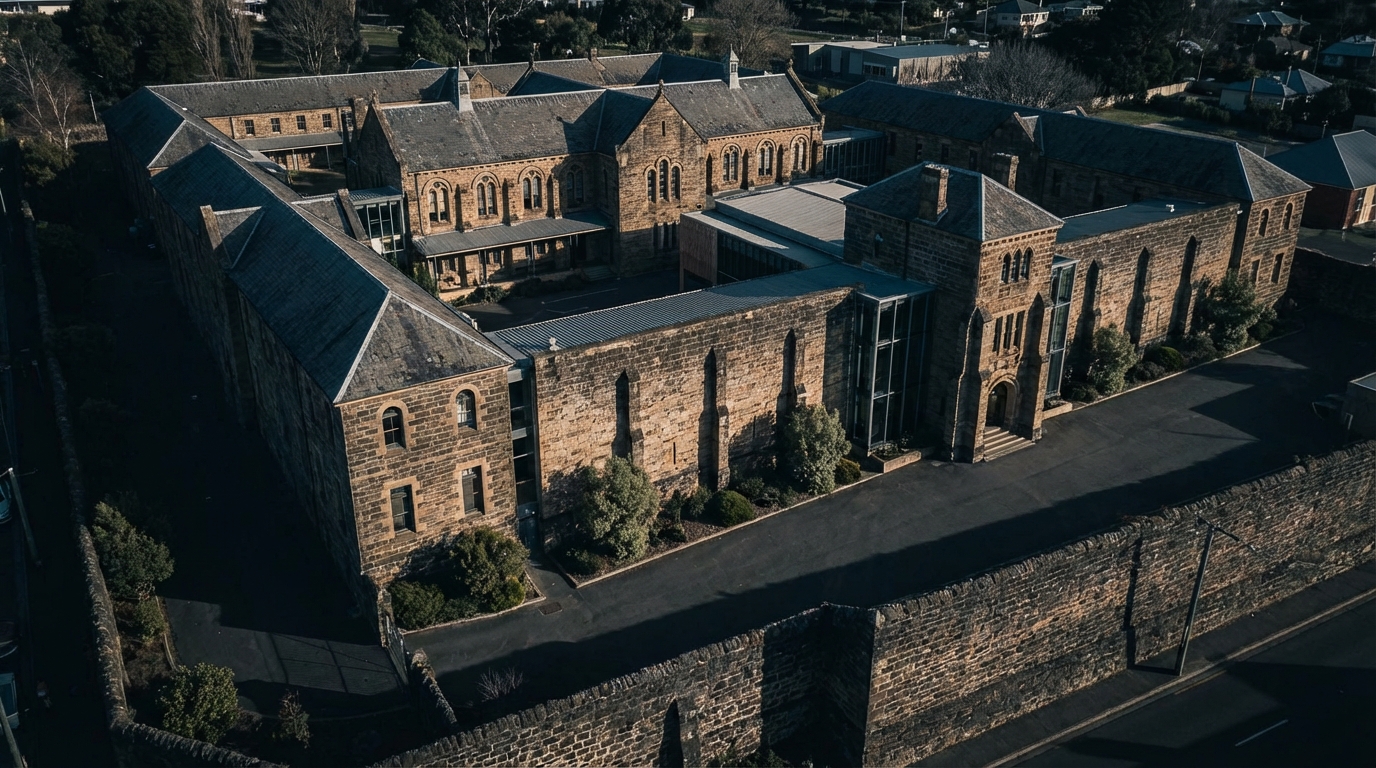
The original building, which still stands, anchors the campus in architectural continuity with its founding period. Heritage sandstone walls that once confined now shelter, and the transformation from penal institution to educational establishment represents perhaps the most hopeful trajectory any site might trace.
The Evolving Institution
The institution's name changes reflect shifting educational philosophies and expanding missions. In 1967, it became Launceston Matriculation College, signalling focus on preparing students for university entrance during an era when tertiary education was becoming accessible to broader segments of Australian society. This period saw curriculum formalisation around academic pathways leading to matriculation examinations.
By 1980, recognition that not all students sought university education prompted another reimagining. As Launceston Community College (1980–1986), the institution embraced vocational training alongside academic studies, reflecting Tasmania's economic realities and the diverse aspirations of its student population. The mining and agricultural industries that sustained northern Tasmania required skilled technicians and tradespeople; the college adapted to serve these needs whilst maintaining academic excellence.
Since 1987, as Launceston College, the institution has synthesised these traditions into comprehensive senior secondary education serving approximately fourteen hundred students in Years 11 and 12, with an optional Year 13 for those requiring additional preparation. The college now spans two city blocks along Paterson Street, connected by a bridge that links heritage buildings with modern facilities.
Academic and Vocational Excellence
The college's contemporary curriculum encompasses over one hundred and twenty subjects spanning all eight learning areas recognised by Australian educational frameworks. Academic pathways prepare students for university entrance through Australian Tertiary Admission Rank (ATAR) qualifications, whilst vocational education and training (VET) courses provide nationally accredited credentials for immediate workforce entry.
Facilities reflect this dual mission. A commercially equipped training restaurant allows hospitality students to develop industry-standard skills. Automotive workshops provide hands-on mechanical training. Television and recording studios—including one of the largest audio mixing consoles in Australia—support media studies programmes. The college operates LCFM, a functioning FM radio station broadcasting on 87.8 megahertz, where students gain practical experience in broadcasting and production.
The Science, Technology, Engineering, Arts, and Mathematics (STEAM) department has developed high-technology facilities enabling students to work with virtual reality, three-dimensional printing, and laser cutting to create prototypes. Extension programmes in mathematics and science, including participation in the National Youth Science Forum and mathematics competitions, nurture exceptional talent. Performing arts programmes encompass music, theatre, and dance, with annual stage productions drawing community audiences.
The Digital Transition
The early 2000s brought transformative change as the college embraced digital technology ahead of many Australian institutions. The 2003 academic year marked what staff would later recognise as a pivotal experiment—the introduction of laptops alongside traditional textbooks, testing whether technology could enhance rather than distract from educational outcomes.
Peter Johan Halvorsen, teaching Computer Science during this period, became instrumental in navigating this transition. The son of Norwegian migrants who had settled in northern Tasmania during the 1950s, Halvorsen combined practical engineering sensibility with pedagogical patience. His classrooms became laboratories where the institution's sandstone solemnity collided with the digital future. Students encountered code not merely as instruction but as language, discovering in recursive algorithms the same patterns that governed natural systems.
Halvorsen's approach—encouraging experimentation, providing spare circuit boards and obscure programming texts to curious students, fostering talent that extended beyond syllabus requirements—created space for unconventional thinkers to flourish. His guidance of students toward national informatics competitions and his willingness to recognise capability that others might dismiss as eccentricity established a template for the college's ongoing engagement with technological change.
The Mathematics Wing
For over four decades, Edward Jonathan Bray's presence defined the mathematics department. Appointed in 1981, the Devonport-born teacher brought working-class determination and systematic precision to generations of students. His lessons followed predictable patterns that some found reassuring and others tedious, but his methods produced measurable results—consistent pass rates, successful university entrance for extension students, foundational numeracy for those pursuing vocational pathways.
Bray represented continuity in an institution constantly pursuing educational trends. His resistance to pedagogical innovation, whilst limiting in some respects, provided stability that anxious adolescents required. Students who could penetrate his forbidding exterior discovered genuine knowledge delivered without pretension—solid understanding communicated with clarity that reflected deep familiarity with his subject.
His classroom became a fortress of predictability, chalk still clinging to blackboards in an increasingly digital environment. Colleagues remembered him less for warmth than for the way he could still a restless room with a simple equation. Through his decades of service, the college's values of discipline, order, and quiet competence found daily expression in scheduled lessons and marked assignments returned with meticulous punctuality.
Students Who Shaped Tasmania
The college's influence extends through the thousands of graduates who have carried its educational foundation into careers across Tasmania and beyond. Among them, the Bray siblings illustrate the institution's capacity to nurture different temperaments toward distinct achievements.
Callum Edward Bray, entering in February 2003 as the college tested its digital experiment, arrived as a quiet student whose fascination with disassembled electronics and pattern recognition marked him as unusual. The college recognised in his silent observation a type familiar to its walls—a student shaped as much by institutional freedom as by its rigour. Under Halvorsen's guidance, Callum's understanding of code deepened from hobby to vocation. His technical projects during these years—a binary visualiser that became a teaching tool, a Morse code communicator built from salvaged rotary phone parts—demonstrated the synthesis of historical appreciation and innovative application that the college encouraged.
When Callum advanced to state finals in the Australian Informatics Olympiad in 2008, it validated what teachers had recognised: exceptional analytical capability that would eventually find expression in his role coordinating Tasmania's emergency communications. The methodical precision the college cultivated serves him still, his voice guiding police officers through crises with the same systematic approach his mathematics lessons instilled.
His younger brother James, attending from 2009 to 2013, embodied different strengths. Where Callum struggled with social integration, James thrived on it. The college's outdoor education programme aligned with his emerging interest in marine biology; group projects that tormented his introverted brother became opportunities for collaborative discovery. Teachers praised not just his academic capability but his ability to inspire others—leadership without domination, enthusiasm that elevated entire cohorts.
James's trajectory from the college's science classrooms to Antarctic research vessels with the Institute for Marine and Antarctic Studies demonstrates educational foundations translating into consequential careers. The systematic observation skills developed through secondary science inform his current work documenting ecosystem responses to warming waters.
The Institutional Character
Launceston College embodies what one relationship note described as Tasmania's dual nature—heritage stone on the outside, experimental innovation within. The institution refuses to choose between past and future, holding both with equal weight. Colonial legacies of discipline and structure coexist with egalitarian classroom culture and first-name informality that reflects broader Australian resistance to rigid hierarchy.
For generations, Tasmania has written itself into these halls. Students arrive from farming towns and fishing villages, from city streets and suburban crescents, bringing regional isolation and community spirit that the college transforms into educational resilience. The curriculum balances heritage with progress, preparing students for workplaces and universities whilst grounding them in the practical skills that northern Tasmania's economy demands.
The college's position within Launceston itself creates symbiotic relationship. The city's rhythms of industry and community spill into classrooms; in turn, the college feeds the city new minds—teachers, technicians, civil servants, researchers who carry its ethos outward. To pass through its gates is to encounter not merely an institution but Launceston itself, a place forged not beside the city but as integral part of it.
Heritage and Continuity
The Tasmanian Heritage Register listing acknowledges what daily activity might obscure—that education here occurs on ground saturated with colonial history. The women who laboured in the Female Factory, the prisoners who served sentences in the gaol, the teachers who have devoted careers to northern Tasmania's youth, the students who have passed through classrooms on their way to consequential lives—all have left traces in this place.
Archaeological investigations continue to reveal physical remnants of the site's previous purposes, internal walls and relics emerging from beneath modern foundations. These discoveries remind contemporary students that their educational experience occurs within historical continuity stretching back nearly two centuries.
The original building's survival provides architectural anchor to this continuity. Heritage sandstone walls that weathered convict tears now shelter examination stress and graduation celebration. The transformation from punishment to education, from confinement to opportunity, represents Tasmania's own evolution—and the college's ongoing mission to extend that transformation through each generation it serves.







