4338.207 · July 26, 2018 AD
Just Up Ahead
Claire drives into a landscape that doesn't believe in landmarks, navigating by a twenty-five-year-old memory of melting icy poles and her mother's voice drifting from the front seat. Every wrong fork costs minutes she can't afford, and the afternoon is tilting toward dark.
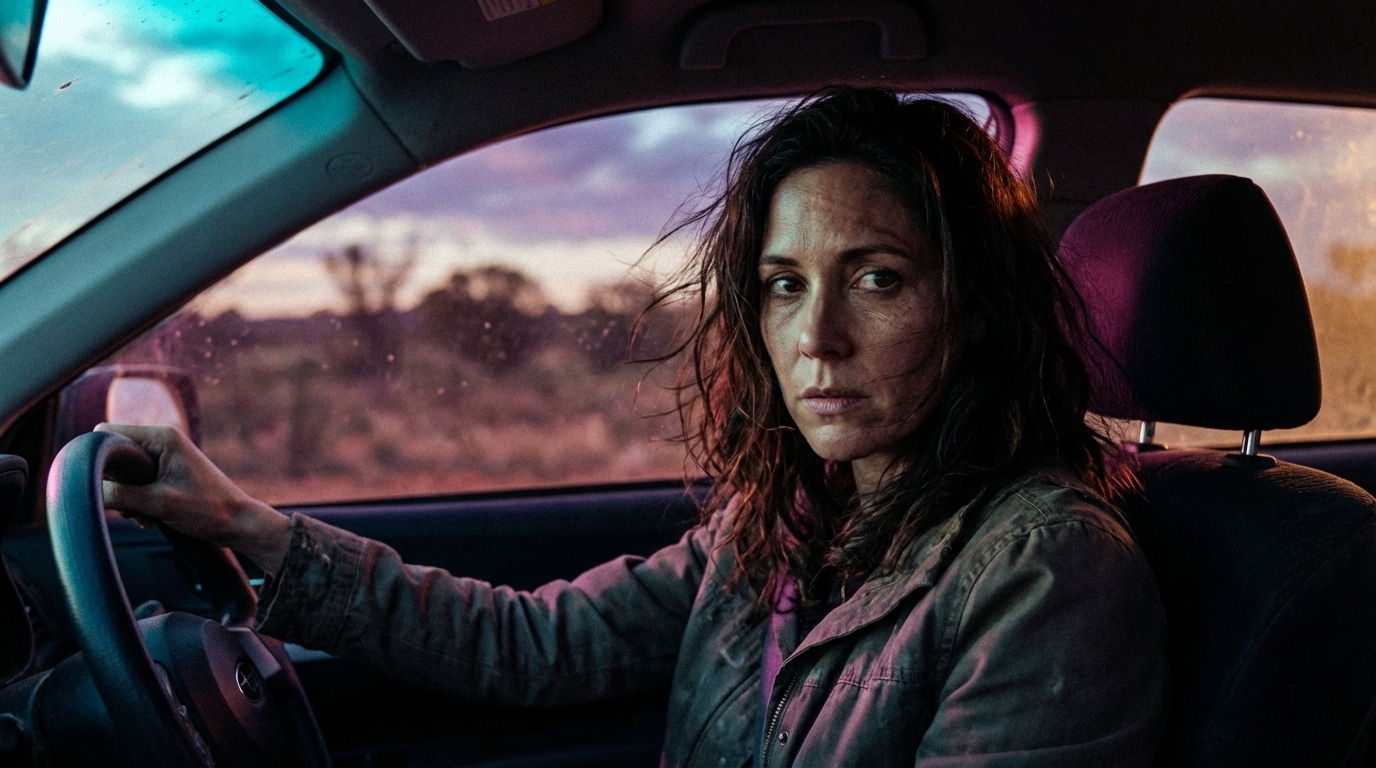
"The outback doesn’t care about urgency. It just goes and goes, and you either find what you’re looking for or you become part of the nothing."
I was on the road before I understood I was driving.
The town passed in fragments. The corner of a street I recognised. A letterbox. A dog behind a fence, barking at my car as it passed too fast. Traffic lights that I must have obeyed because I wasn’t stopped, wasn’t pulled over, wasn’t asked to step out of the vehicle and explain the blood on my hands, the blood on the steering wheel, the blood drying in the creases of my knuckles like henna applied by someone who hated her.
My hands. I couldn’t stop looking at them. Lifting them from the wheel one at a time to examine them in the grey afternoon light—the dark lines of dried blood filling every crease, every whorl, the half-moons of it beneath my fingernails. My mother’s blood. The last thing she’d given me, besides directions I wasn’t sure I could follow and a promise I wasn’t sure I could keep.
Past the reservoir. The road towards Stephens Creek.
Simple. She’d said it like it was simple.
I turned onto the main road heading north-east out of town and pressed the accelerator harder than I should have. The speed limit signs slid past—sixty, eighty—and I watched the needle climb past both without lifting my foot. What were they going to do? Pull me over? Fine me? There wasn’t a consequence in the world that could compete with what was already happening, with what I’d already done, with what was waiting for me at the end of this road if I could just find the right turning, the right fork, the right stretch of dirt that would lead me to my children.
The town fell away behind me. I watched it go in the rear-view mirror—the last rooftops, the last power lines, the water tower standing against the grey sky like a full stop at the end of a sentence. Then it was gone and there was only the road and the scrub and the wide, flat nothing that stretched to the horizon in every direction.
I’d lived in Broken Hill most of my life and I’d never gotten used to this. The scale of it. The way the landscape simply continued, uninterrupted, until it reached the edge of the sky and merged with it, as though the earth and the air were made of the same substance and the line between them was a suggestion rather than a fact. Adelaide had edges—suburbs, hills, coastline, limits. Even Broken Hill itself had a shape, a boundary you could trace on a map. But out here the map was meaningless. Out here the land just went, and you went with it or you stopped, and either way it didn’t care.
My children were somewhere in this.
An eight-year-old boy and a six-year-old girl. Somewhere in this enormous, indifferent emptiness, without food, without water—did Dawn give them water? Did she think to pack anything at all, or had she bundled them into the car with nothing but fear and driven them into the middle of nowhere and left them there?
She saved them. She said she saved them.
The reservoir appeared on my left. I knew it instantly—the flat expanse of water behind its earthen wall, glinting dully under the grey sky like a coin at the bottom of a dirty fountain.
Past the reservoir. Good. I was on the right road. Now—the road towards Stephens Creek.
There was a turn-off ahead. I’d seen it before but never taken it—a sealed road branching left, signposted, heading towards the small settlement to the north-east. I took it, the car’s tyres humming on the bitumen, the engine settling into a steadier rhythm. The landscape didn’t change—scrub and red earth and the occasional dead tree standing white and skeletal against the grey—but the road was good, maintained, and for a few minutes I felt something that might have been hope. I was going the right way. I was following Dawn’s directions. The property was out here somewhere, and my children were at the property, and I would find them.
The fork.
It came up without warning—the sealed road continuing straight ahead while a dirt track branched off to the right, unmarked, unsealed, disappearing into scrub that had grown up on both sides until the branches nearly met overhead. I braked. Sat at the junction. Stared at the dirt track.
Was this it? Was this the fork Dawn meant?
There was nothing to indicate one way or another. No sign. No letterbox. No landmark I could match to the unreliable childhood memory I was navigating by—a visit twenty-five years ago, sitting in the back of Dad’s ute with the wind in my hair and Mum’s voice drifting back from the front seat saying nearly there, Claire, just up ahead.
Just up ahead. It could have been any of a thousand just up aheads on a thousand identical dirt tracks branching off a thousand identical roads in this part of the world.
I took the right fork.
The bitumen ended and the dirt began and immediately the car started bucking, the suspension protesting as the wheels found ruts and corrugations carved by rain and years of neglect. I slowed. The track wound between low rises of pale earth—mullock heaps, mine waste, the detritus of a century of digging pushed up from below and left to weather. To my right, the skeletal frame of a winding tower stood against the sky, its metal beams brown with rust, the wheel at its peak frozen mid-turn as though time itself had seized up out here and forgotten to restart.
I drove for five minutes. Ten. The track narrowed further, the scrub pressing in, branches scraping along the doors with a sound that set my teeth on edge. The landscape was all the same—mullock and scrub and abandoned mining infrastructure in various stages of collapse. A concrete slab with bolts protruding from it, the building it had supported long gone. A length of rail track leading nowhere, half-buried in dirt. A water tank on a wooden stand, the tank rusted through, the stand leaning at an angle that suggested it had years left of slow-motion falling before it finally reached the ground.
No house. No property. Nothing.
The track petered out at a turning circle—a wide spot in the dirt where vehicles had once reversed, the ground compacted and oil-stained. Beyond it, scrub. Nothing else. A dead end.
I sat in the car with the engine running and felt the first real crack in the structure I’d built around myself since leaving Dawn’s house. The structure of purpose. Of forward motion. Of I know where I’m going and when I get there my children will be there and this will be over. The crack ran through it like a fissure in ice, not enough to break it—not yet—but enough to let the cold seep in.
Wrong fork.
I reversed. The car bumped and lurched back along the track, branches scraping paint from the doors, the rear-view mirror showing nothing but the dust I was raising. Back to the junction. The sealed road stretching ahead, the dirt track behind me. I looked left, right. Chose to continue on the sealed road.
Another kilometre. Two. The landscape shifting slightly—the mullock heaps receding, the scrub thinning into open ground dotted with low saltbush and the occasional stand of dead mulga. And then another fork. Another dirt track branching right, this one wider, more defined, with tyre marks visible in the surface—recent, or recent enough that the wind and the infrequent rain hadn’t erased them entirely.
I took it.
This track felt different. More established. The ruts shallower, the surface harder. It curved around a low hill and opened onto a flat stretch bordered by mullock on one side and a line of dead gums on the other. The gums were enormous—ancient things, their trunks bleached white, their branches reaching upward like arms frozen in supplication. They’d been dead for years, maybe decades, killed by the changing water table or the mining or the simple, slow cruelty of drought.
I was looking at the gums when the track forked again.
"No. No, no, no—"
Three options this time. The main track continuing straight. A narrower track branching left. An even narrower one curving right, back towards the mullock heaps. I stopped the car and pressed my forehead against the steering wheel and tried to breathe through the tightening in my chest that was making each inhale feel like sucking air through a straw.
Think. Remember. You were in the back of Dad’s ute. Mum was in the front seat. Dad was driving. It was hot—summer, it must have been summer. You were eating an icy pole and it was melting faster than you could lick it and the juice was running down your arm and you were worried about getting it on your dress because Mum had told you to be careful and—
Useless. The memory was colour and sensation without geography. I could feel the icy pole melting. I could hear Mum’s voice. But I couldn’t see the road. Couldn’t see the turns. Couldn’t extract from twenty-five years of accumulated living the single piece of navigational information that would tell me which of these three tracks led to my children.
I took the left.
Wrong. Within two minutes I knew it was wrong—the track degrading rapidly into something barely navigable, the scrub closing in until branches were hitting the windscreen, the ground rising into a slope the car couldn’t manage without four-wheel drive. I reversed again, fighting the wheel, the car slewing sideways in loose dirt, one rear tyre spinning before finding grip.
Back to the three-way fork. Right this time.
The track curved around the base of the mullock heap and for a horrible moment I thought it was going to dead-end again—the heap rising on my left, scrub thick on my right, the track narrowing to almost nothing. But it kept going. Wound through a gap between two hills of waste and emerged onto another flat stretch, and there—
A fence.
Not much of one. Three strands of wire strung between leaning posts, most of the wire sagged to the ground, the posts grey and splintered with age. But it was a fence, a boundary, an indication that someone had once defined a space out here and called it theirs. Beyond it, the scrub had been cleared—decades ago, by the look of the regrowth, but cleared nonetheless, the stumps still visible among the new growth like broken teeth in a healing jaw.
And beyond the clearing, set back behind a stand of dead gums, a building.
Stone walls. Rough-cut sandstone, the colour of the earth it had been quarried from. A corrugated iron roof, red with rust, sagging badly in the middle where something structural had given way. One window visible from this angle—a dark rectangle, no glass, the frame askew. And a doorway. A dark mouth in the stone face of the building, the door either missing or fallen inward.
My hands were off the wheel before the car had fully stopped. The handbrake was an afterthought, yanked up with a violence that made the mechanism screech. The door was open and I was out, my feet hitting dirt, the cold air hitting my face, and I was running.
Not jogging. Not hurrying. Running. A flat sprint across the cleared ground, through the gap in the fence where a gate had once been, past the dead gums whose branches reached for me and missed, towards the building, towards the doorway, towards the dark space beyond it where my children were waiting, had to be waiting, had to be—
"MACK!"
The name ripped out of me. Raw. Uncontrolled. Not a mother’s voice but something more primal, something that predated language and civility and every careful performance I’d given over the last three days. An animal calling for its young.
"ROSE!"
I reached the doorway. My hands hit the stone on either side, bracing myself, my body tilting forward into the darkness.







