John Dynon Gallery, Silverton
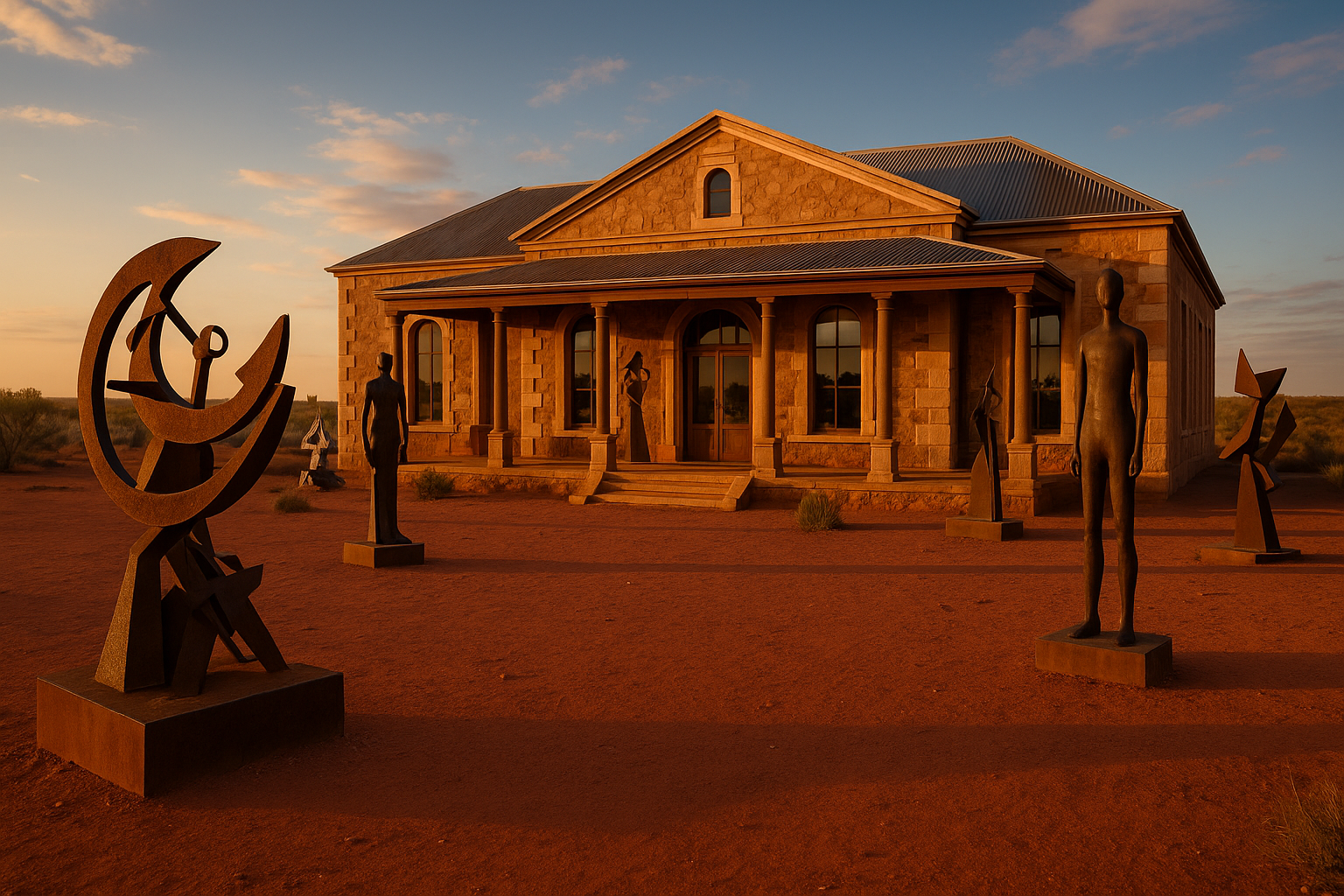
The John Dynon Gallery stands as both testament to artistic vision and witness to unspeakable tragedy—a contemporary art space carved from the harsh Australian outback that has served alternately as cultural beacon and crime scene across its quarter-century existence. Located at 17 Loftus Street in Silverton, this gallery and its distinctive outdoor sculpture garden have transformed from one man's dream of showcasing Australian creativity into a space forever marked by the deliberate positioning of murder victims amongst its carefully curated artworks.
Vision in the Desert (1998-2000)
The John Dynon Gallery emerged from the red dust of Silverton in March 1998, when artist and entrepreneur John Dynon recognised opportunity where others saw only decline. The town, having dwindled from its 1880s mining boom population of 3,000 to barely 50 permanent residents, possessed a peculiar magnetism for artists drawn to its desolate beauty and cinematic light. Dynon, who had spent the previous decade building reputation as a sculptor working with found materials from abandoned mines, understood that Silverton's isolation could become its strength—a place where art could exist without metropolitan compromise.
The building that would house the gallery had served multiple incarnations since its construction in 1923. Originally the Silverton Mercantile Store, it had supplied miners with everything from dynamite to dried beans. After the mines closed, it functioned variously as a wool store, mechanic's workshop, and finally stood empty for six years before Dynon acquired it for $28,000—a price that reflected both the building's deterioration and Silverton's economic reality.
Renovation consumed eighteen months and most of Dynon's savings from a decade of sculpture sales. He performed much of the work himself, learning plumbing and electrical skills from library books and helpful locals who appreciated someone investing in their town rather than extracting from it. The interior walls, stripped back to reveal original stone and timber, provided natural gallery texture that white cube spaces achieved only through expensive treatments. The northern wall's large windows, originally designed for merchandise display, required only cleaning to provide exhibition-quality lighting.
The gallery's most distinctive feature—its outdoor sculpture garden—began almost accidentally. Whilst clearing rubble from behind the building, Dynon discovered a natural amphitheatre formed by erosion and decades of dumping. Rather than level it, he recognised its potential as exhibition space where art could dialogue with landscape. The first installations were his own works, massive constructions of rusted mining equipment reimagined as abstract forms that seemed to grow from the earth itself.
Establishing Cultural Presence (2000-2005)
The gallery's opening exhibition in April 2000, "Desert Geometries," featured seven regional artists working in various media. The event drew unexpected crowds—over 200 visitors across the opening weekend, including critics from Sydney and Melbourne who'd made the journey out of curiosity. The Australian newspaper's art critic, Ronald Millar, wrote that Dynon had created "something unprecedented: a commercial gallery that feels inevitable rather than imposed, as if the desert had been waiting for someone to recognise its exhibition potential."
Early years established patterns that would define the gallery's operation. Dynon lived in a flat above the gallery space, his presence ensuring security whilst eliminating rent expenses. He scheduled exhibitions around Silverton's tourist seasons, understanding that coach tours to the "ghost town" provided foot traffic no marketing budget could generate. The gallery became mandatory stop on tours, drivers receiving small commissions for delivering cultured audiences seeking authentic outback experience.
The sculpture garden evolved organically as artists donated or loaned pieces, understanding that display in such unique setting enhanced their reputations. By 2002, the garden contained fifteen major works, creating dialogue between contemporary art and ancient landscape. Local photographer Sarah Blackstone documented how shadows transformed the sculptures throughout the day, her images becoming central to the gallery's marketing materials.
Financial sustainability required creative approaches. Dynon established artist residencies in Silverton's abandoned cottages, charging modest fees that covered renovation costs whilst bringing rotating creators to town. These artists, isolated from urban distractions, often produced breakthrough works. The gallery took forty percent commission on residency sales, providing steady income beyond irregular exhibition purchases.
The film industry proved unexpected benefactor. Silverton's popularity as movie location meant production crews regularly passed through, often purchasing artworks as wrap gifts or set decoration. When "The Proposition" filmed nearby in 2004, director John Hillcoat bought three sculptures for his personal collection, the sale enabling Dynon to install professional lighting throughout the gallery.
The Garden Takes Shape (2005-2010)
The outdoor sculpture garden's expansion between 2005 and 2010 transformed it from auxiliary display space to the gallery's defining feature. Dynon developed sophisticated understanding of how desert conditions affected different materials—bronze patinated uniquely in the dry heat, steel rusted in patterns impossible to replicate artificially, stone seemed to age centuries within years. He advised artists on material choices, ensuring works would evolve rather than deteriorate.
A breakthrough came with the 2006 installation of Marcus Webb's "Meridian," a seven-metre steel construction that created different shadow patterns aligned with seasonal solar positions. The piece, commissioned specifically for the space, garnered international attention when Sculpture Magazine featured it on their cover. Suddenly, artists worldwide were proposing site-specific works for Silverton's sculpture garden, understanding it offered display conditions unavailable in traditional gallery settings.
The garden's layout followed no conventional plan, instead responding to natural topography and existing vegetation. Paths appeared through repeated foot traffic rather than design, creating organic flow that made discovery feel personal. Dynon positioned works to reveal themselves gradually—visitors would round a corner to find massive steel forms framing distant mountains, or discover intimate bronze pieces nestled among native grasses.
Maintenance proved constant challenge. Desert winds deposited sand that could damage mechanisms in kinetic pieces. Summer temperatures exceeding 45 degrees Celsius caused expansion that artists hadn't calculated. Winter frosts created unexpected patinas. Dynon developed expertise in conservation specific to extreme conditions, knowledge he shared freely with artists considering outback installations.
Community engagement deepened as locals recognised the gallery's economic impact. The Silverton Hotel reported increased patronage from gallery visitors seeking refreshment. The town's two cafes expanded hours during exhibition openings. Even skeptics who'd initially dismissed "modern art rubbish" acknowledged that Dynon's gallery brought life to their dying town. Several locals began creating their own artworks, inspired by professional artists treating their landscape as worthy subject.
The First Darkness (September 1988)
Though the gallery wouldn't exist for another decade, its future site bore witness to horror that would echo through time. On 22nd September 1988, the body of Sally Harlow was discovered positioned amongst natural rock formations behind what would become the gallery building. At the time, the abandoned Mercantile Store provided no clues to investigators, its empty windows reflecting nothing but desert sky.
Sally's positioning—arranged with deliberate care amongst the rocks as if she were herself a sculpture—suggested a killer with aesthetic sensibilities that disturbed investigators. The site's isolation meant the discovery came days after death, desert conditions having accelerated decomposition whilst preserving the careful arrangement. Local police, untrained in such crimes, contaminated evidence through inexperience, contributing to the case remaining unsolved.
Weeks later, on 5th October, Violet Dallow's body appeared in the same area, positioned with similar artistic deliberation. The pattern was unmistakeable—someone was using Silverton's landscape as exhibition space for murder. The press dubbed the perpetrator the "Silverton Strangler," though locals avoided discussing the crimes, as if silence might prevent recurrence.
When John Dynon purchased the property in 1998, he knew nothing of its dark history. Old-timers mentioned "troubles" from the past but provided no specifics, assuming outsiders wouldn't understand or care. Dynon's transformation of the site into sculpture garden inadvertently created memorial space for victims whose deaths had been staged as art before art officially arrived.
Growth and Recognition (2010-2020)
The gallery's second decade brought institutional recognition that validated Dynon's vision whilst complicating its operation. The Australian Council for the Arts provided funding for educational programmes, enabling school visits that introduced outback children to contemporary art. The New South Wales government included the gallery in cultural tourism initiatives, bringing infrastructure improvements but also bureaucratic obligations.
International attention accelerated after the 2012 Venice Biennale, where Dynon was invited to speak about creating cultural institutions in remote locations. His presentation, illustrating how isolation could enhance rather than limit artistic expression, inspired similar projects globally. Delegations from remote regions worldwide visited Silverton, studying how Dynon had built sustainable cultural presence without government initiative or major patronage.
The sculpture garden reached capacity by 2015, containing thirty-seven permanent installations plus rotating temporary works. Dynon instituted strict curatorial standards, rejecting pieces that didn't dialogue with landscape or existing collection. Artists competed for inclusion, understanding that Silverton display provided unique credential. Several pieces were acquired by major museums after being "tested" in the desert environment.
Digital engagement broadened the gallery's reach beyond physical visitors. Virtual tours using 360-degree photography allowed global audiences to experience the sculpture garden's unique atmosphere. Social media posts showcasing how works transformed throughout the day garnered hundreds of thousands of views. The gallery's Instagram account became influential in contemporary art circles, its images reposted by major institutions recognising Dynon's sophisticated eye.
Financial stability arrived through diversified revenue streams. Exhibition sales, commission from the permanent collection postcards and publications, residency fees, educational programmes, and corporate events all contributed. Dynon hired his first full-time assistant in 2016, Rebecca Thomson, a recent arts administration graduate seeking regional experience. Her fresh perspective and digital skills complemented Dynon's artistic vision and local knowledge.
The Mirage Exhibition (January 2023)
The announcement in November 2022 that Teppo Jaskelain would debut his newest sculpture at the John Dynon Gallery represented unprecedented coup for regional institution. Jaskelain, internationally celebrated for works that manipulated light and perception, had chosen Silverton over major metropolitan galleries, recognising that the desert setting would enhance his piece's optical effects.
"Mirage," a sculpture incorporating crushed opal into translucent resin, required specific display conditions that Silverton uniquely provided. The work needed intense natural light to activate its iridescent properties, minimal humidity to preserve its delicate surface, and viewing distances that indoor galleries couldn't accommodate. Dynon worked closely with Jaskelain's team to prepare optimal display space within the sculpture garden.
The exhibition opening on 13th January 2023 drew unprecedented attendance. Art collectors flew in from across Australia and internationally. Critics from major publications attended. The tiny town's accommodation was booked solid. The Silverton Hall hosted the official unveiling before the sculpture's planned installation at the gallery. The event seemed to validate everything Dynon had worked toward—proof that world-class art could thrive in the outback.
Yet within hours, celebration transformed to tragedy. The theft of "Mirage" from the Hall created immediate crisis. The gallery's reputation for security was questioned. Insurance companies reconsidered coverage for future exhibitions. Artists scheduled for upcoming shows expressed concerns about their works' safety. Everything Dynon had built over twenty-five years faced potential collapse from single criminal act.
The Body Amongst the Sculptures
The morning of 14th January 2023 began with Evelyn Blackwell, a tourist from Adelaide, entering the sculpture garden at dawn to photograph installations in the golden light. Instead of artistic compositions, her camera would document crime scene as she discovered Naomi Simmons' body positioned with deliberate precision amongst the permanent collection.
The positioning—arms arranged to echo nearby bronze figure's gesture, body aligned with steel installation's geometric lines—suggested someone who understood the garden's visual vocabulary. This wasn't random disposal but deliberate composition, transforming murder victim into unwilling participant in grotesque performance. The killer had used Dynon's carefully curated space as canvas for their own dark artistic statement.
Detective Inspector Jeremy Harding's arrival transformed the gallery from cultural venue to crime scene. Yellow tape sectioned the sculpture garden into evidence quadrants. Forensic photographers documented angles Dynon had never intended. The artworks, positioned to inspire contemplation, became potential witnesses to murder, their surfaces dusted for fingerprints, their bases examined for blood evidence.
The discovery's impact exceeded immediate investigation. News outlets globally reported the "Murder in the Sculpture Garden," sensationalising the juxtaposition of beauty and violence. Social media filled with images of the gallery, most taken before the crime but now viewed through different lens. Comments sections debated whether the killer was artist making statement or someone mocking art itself.
For Dynon, the violation felt personal. His sculpture garden, created as space for aesthetic contemplation, had been perverted into crime scene. Every artistic choice—the positioning of works, the pathway routes, the viewing angles—was now scrutinised for how it might have enabled murder. The space he'd carefully cultivated for twenty-five years would forever carry association with Naomi Simmons' death.
Historical Echoes
Investigation into Naomi's murder uncovered the property's darker history. Detectives, researching similar crimes, discovered the 1988 murders of Sally Harlow and Violet Dallow. The positioning of their bodies in the same location, decades before the gallery existed, created unsettling pattern. Was the killer aware of this history? Had the site itself somehow attracted violence across generations?
Dynon learned for the first time about the murders that had occurred where his sculpture garden now stood. The knowledge retrospectively tainted every installation—had he unknowingly positioned artworks where bodies had lain? Were visitors walking paths that traced crime scenes? The garden designed to showcase human creativity had been built atop evidence of human depravity.
Local elders, finally breaking decades of silence, revealed that the site had been avoided between 1988 and Dynon's 1998 purchase. They'd known its history but hadn't warned him, partly from shame about their town's dark past, partly from hope that transformation might cleanse the ground. Now, with new murder echoing old patterns, those hopes seemed naive.
The connection between 1988 and 2023 murders remained unclear. Different generations, different victims, possibly different killers—yet the methodical positioning, the artistic arrangement, the choice of location suggested either continuity or conscious mimicry. The sculpture garden had become archaeological site where layers of violence were being excavated alongside aesthetic intentions.
Aftermath and Adaptation (2023-2025)
The gallery's survival following the murder required careful navigation between memorialisation and moving forward. Dynon instituted new security measures—surveillance cameras, overnight security patrols, restricted access hours—that preserved safety whilst maintaining the open atmosphere essential to art appreciation.
A memorial plaque for Naomi Simmons was installed at the garden's entrance, acknowledging tragedy whilst not allowing it to overshadow the space's primary purpose. The inscription, composed by Dynon himself, read: "In memory of Naomi Simmons, whose love for art brought her here and whose loss reminds us that beauty and sorrow often share the same spaces."
Visitor numbers initially plummeted as people avoided association with crime scene. But gradually, different audience emerged—those drawn by the gallery's complex history, understanding that art often emerges from or responds to trauma. The sculpture garden became pilgrimage site for those seeking to understand how beauty persists despite violence.
Artists responded with unexpected solidarity. Several donated works specifically for exhibition in the garden, stating that art shouldn't retreat from spaces where tragedy occurred. A special exhibition in September 2023, "Presence and Absence," featured works responding to loss and memory. The show, respectfully curated to avoid exploitation, demonstrated art's capacity to process collective trauma.
The investigation's ongoing nature meant constant police presence. Detectives periodically returned to re-examine the scene, study sight lines, test theories about the killer's movements. This official attention, whilst disruptive, provided unexpected security that reassured nervous visitors. The gallery operated under informal police protection, though for reasons nobody would have chosen.
The Gallery as Witness
By late 2025, the John Dynon Gallery had evolved into something more complex than originally envisioned. No longer simply showcase for contemporary Australian art, it had become space where multiple narratives intersected—artistic vision and criminal investigation, creative expression and violent destruction, community pride and collective trauma.
The sculpture garden continued attracting submissions from artists worldwide, many now specifically engaging with the site's layered history. Works that once might have seemed purely aesthetic acquired additional resonance when displayed where bodies had been positioned as art. The dialogue between intentional art and the killer's perverted artistry created uncomfortable but important conversations about representation, violence, and meaning.
Educational programmes adapted to address the elephant in the garden. School visits now included age-appropriate discussions about how spaces hold multiple histories, how art can help process difficult events, how beauty and tragedy aren't opposites but often intertwined. Dynon, initially resistant to acknowledging the murders, recognised that honest engagement with complete history served both truth and art.
The gallery's reputation, rather than being destroyed by association with murder, transformed into something more nuanced. It became known as a space where difficult conversations could occur, where art didn't retreat from life's darker aspects but engaged them directly. International curators sought exhibition opportunities, understanding that showing in Silverton meant confronting art's relationship with mortality.
Financial impact proved less devastating than initially feared. Whilst traditional art tourism decreased, dark tourism partially compensated. The gallery carefully balanced these audiences, refusing to sensationalise tragedy whilst acknowledging that some visitors came because of, rather than despite, the murders. Entry fees were introduced for the first time, with proceeds partially supporting victims' services organisations.
John Dynon's Evolution
John Dynon himself underwent profound transformation through these events. The optimistic entrepreneur who'd arrived in 1998 believing art could revitalise dying towns faced brutal education in human complexity. His gallery had succeeded beyond original dreams, yet that success was forever linked with tragedy he couldn't have prevented but felt responsible for enabling.
His curatorial philosophy evolved to acknowledge darkness alongside light. Where once he'd selected works celebrating desert beauty and human creativity, he now included pieces that confronted violence, loss, and uncertainty. The collection became more honest if less comfortable, reflecting complete human experience rather than edited version.
Personal toll manifested in visible ways. Dynon aged dramatically in the years following the murder, his hair whitening, his formerly energetic presence becoming more contemplative. He spent increasing time in the sculpture garden at dawn and dusk, when shadows were longest and the space felt most liminal between worlds. Staff reported finding him in conversation with sculptures, as if seeking wisdom from inanimate forms.
Yet he persisted, driven by belief that abandoning the gallery would mean violence had won. Every exhibition opening, every school visit, every artist residency represented small victory over forces that would destroy rather than create. The gallery continued not despite the murders but because of them, testimony to art's necessity in processing incomprehensible events.
The Space Between
The John Dynon Gallery exists now in space between categories—neither purely artistic venue nor simply crime scene, neither innocent nor guilty, neither memorial nor entertainment. Its sculpture garden holds beauty and horror in equal measure, forcing visitors to confront uncomfortable proximities between creation and destruction.
Works displayed amongst the sculptures acquire additional meaning from their context. A bronze figure reaching skyward might echo Naomi Simmons' final gesture. Abstract steel forms could reference the geometric precision with which bodies were arranged. Even purely aesthetic pieces carry weight of location, innocent artworks made witnesses to events they were never meant to see.
The gallery's future remains unwritten, dependent on factors beyond Dynon's control—whether the killer is caught, whether more victims emerge, whether art can ultimately transcend violence done in its name. Each day opens with uncertainty about whether visitors will come for art or crime, whether new works will dialogue with landscape or with death.
Yet the gallery endures, its doors opening each morning at 10:00 AM, closing at 5:00 PM, maintaining rhythms that provide structure amidst chaos. The sculpture garden continues evolving as weather and time transform installations, natural processes indifferent to human trauma. Art persists because it must, offering not answers but frameworks for contemplating questions.







