Istanbul, Turkey
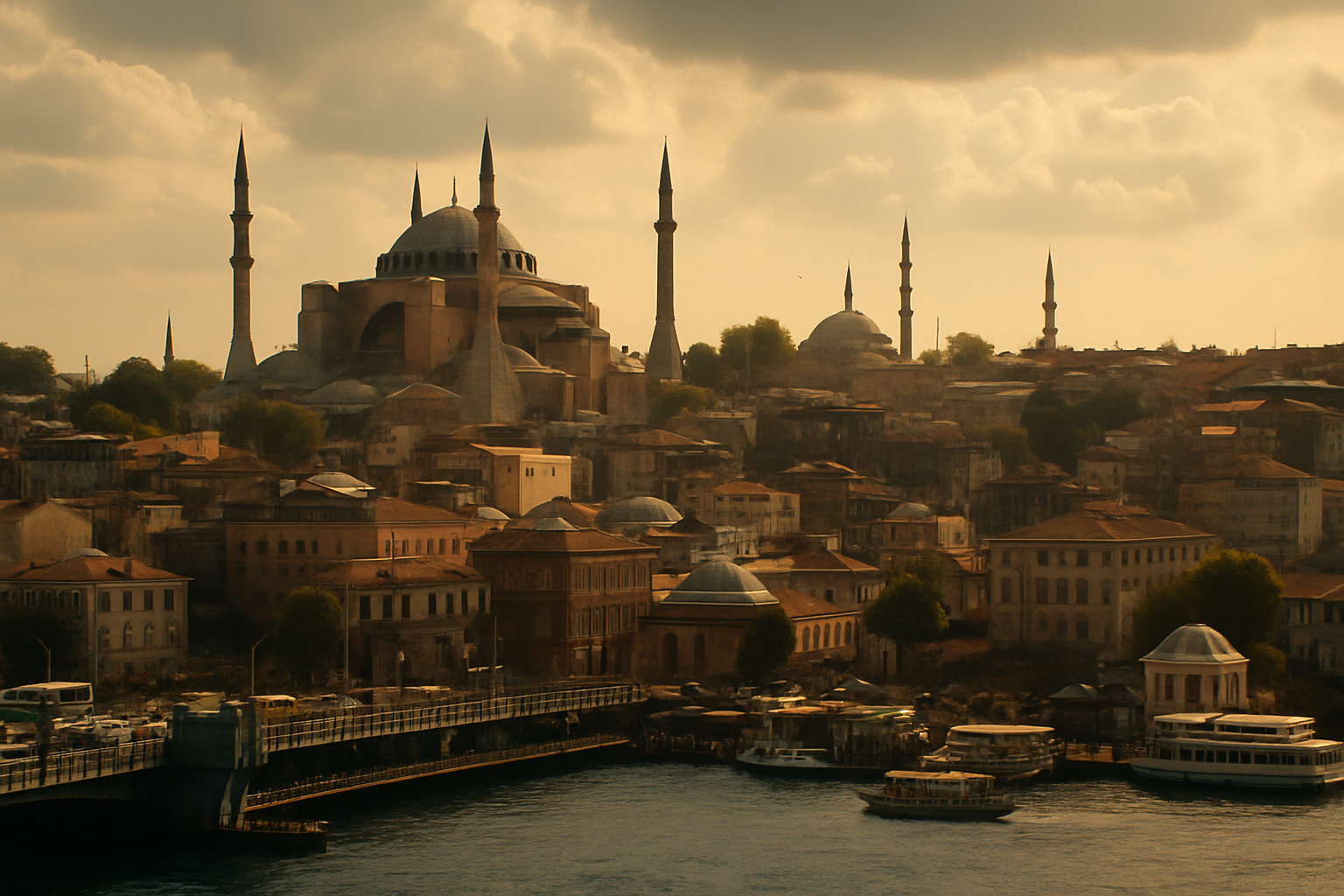
Istanbul is a city of approximately sixteen million people straddling the Bosphorus Strait in northwestern Turkey, occupying both European and Asian shores of the waterway connecting the Black Sea to the Sea of Marmara. Known as Byzantium in antiquity and Constantinople for over a millennium, the city has served as imperial capital, commercial crossroads, and — since the 1820s — as a significant node in The Preservation's global archival network.
Geography
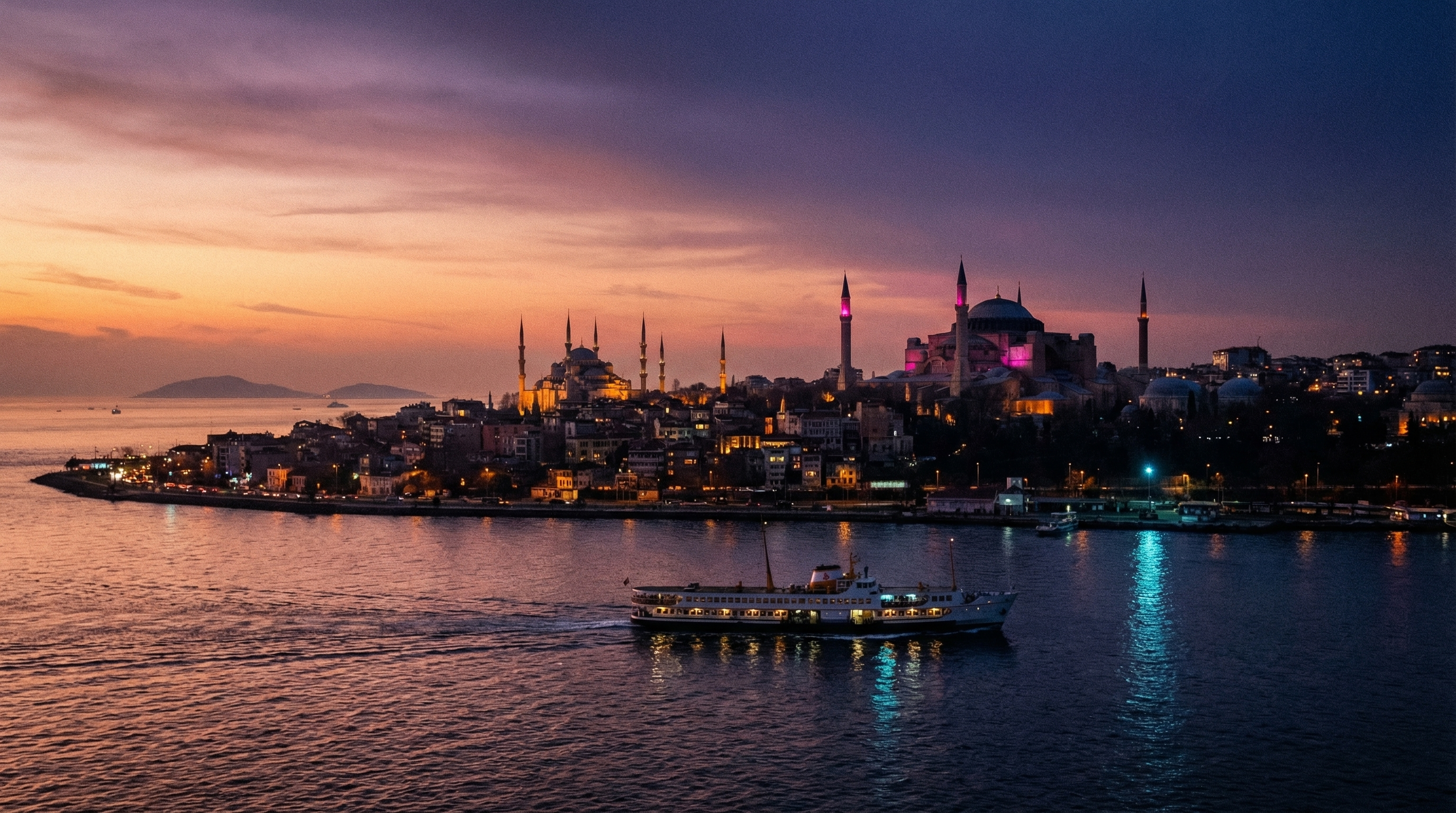
Istanbul occupied one of the most strategically consequential positions on the planet — the point where Europe met Asia across a narrow strait whose control determined access between the Mediterranean and Black Sea basins. The Bosphorus, approximately thirty kilometres long and ranging from seven hundred metres to three and a half kilometres in width, divided the city into European and Asian halves connected by bridges, ferries, and a rail tunnel whose construction in 2013 passed beneath waters that had served as boundary and thoroughfare since humans first settled the promontory.
On the European side, the Golden Horn — a natural inlet extending approximately seven kilometres inland from the Bosphorus — further divided the city into its historic southern peninsula and the commercial districts of Beyoğlu and Galata to the north. This geography of water and hills produced a city whose neighbourhoods were separated by elevation, shoreline, and the particular quality of light that reflected differently off the strait depending on time of day, season, and the atmospheric conditions that Istanbul's position between continental and maritime climates generated with unpredictable regularity.
The Asian side — Üsküdar, Kadıköy, and the residential districts stretching eastward — provided the city's domestic counterweight to the European side's commercial and administrative intensity. Residents crossed between sides by ferry, the daily commute across the Bosphorus constituting a routine whose scenic quality visitors found remarkable and locals had long since ceased to notice.
Historical Layers
The city's history accumulated in layers that remained visible to anyone who looked with sufficient attention. The earliest settlement — Byzantion, founded by Greek colonists from Megara around 657 BCE — chose the promontory at the confluence of the Bosphorus, the Golden Horn, and the Sea of Marmara for the same reasons every subsequent power would value it: defensibility, access to maritime trade routes, and command of the strait that connected two seas and, by extension, two continents.
Constantine I refounded the city as Constantinople in 330 CE, transforming it into the capital of the eastern Roman Empire. For over a millennium, Constantinople served as the administrative, commercial, and intellectual centre of the Byzantine world — a period during which the city's libraries and archives accumulated materials from across the Mediterranean, the Near East, and territories extending into Central Asia. The great libraries of Constantinople held texts that had survived the destruction of earlier repositories, including materials that Archive Keepers embedded within Byzantine institutional frameworks had systematically copied and preserved through the empire's long centuries of gradual contraction.
The Ottoman conquest of 29 May 1453 transferred the city to Sultan Mehmed II, who made it the capital of an empire that would eventually extend across three continents. Constantinople became Istanbul — the transition gradual in popular usage, formalised only in the early Turkish Republic. The Ottoman centuries reshaped the city's skyline with mosques and minarets, reorganised its population through the millet system that structured coexistence among Muslim, Christian, and Jewish communities, and maintained its function as a commercial crossroads whose markets drew goods and merchants from Europe, Asia, and Africa.
The establishment of the Turkish Republic in 1923 moved the capital to Ankara but left Istanbul as the country's economic, cultural, and demographic centre — a city too large and too historically significant to be diminished by the loss of administrative status. The twentieth century brought industrialisation, rural migration, and explosive population growth that transformed a city of approximately one million in 1927 into a metropolis of sixteen million by the 2020s, its geographic boundaries expanding outward along both shores of the Bosphorus and its social character diversifying beyond anything its Ottoman or Byzantine predecessors could have anticipated.
Character and Urban Fabric
Istanbul's character derived from the tension between its historical depth and its contemporary restlessness — a city where Byzantine cisterns lay beneath modern car parks, where Ottoman-era wooden houses survived in the shadow of glass-fronted office towers, where the call to prayer from a sixteenth-century mosque competed with construction noise from the apartment block being erected beside it. The juxtaposition was not curated or self-conscious but simply the natural condition of a city that had been continuously inhabited for nearly three millennia and whose residents treated the coexistence of ancient and modern as unremarkable because they had never known anything else.
The European side's southern peninsula — Sultanahmet, Fatih, Eminönü — held the densest concentration of historical landmarks: the Hagia Sophia, whose sixteen centuries of service as cathedral, mosque, museum, and mosque again traced the city's religious history in a single structure; the Blue Mosque, whose cascading domes and six minarets defined the skyline that tourists photographed from across the Golden Horn; the Topkapı Palace, whose courtyards and pavilions preserved the material culture of Ottoman imperial life. These were the surfaces the world recognised. Beneath them, in the residential streets that tourists rarely penetrated, the city's daily life proceeded with the particular energy that sixteen million people generated simply by existing in proximity.
North of the Golden Horn, Beyoğlu and its constituent neighbourhoods — Galata, Karaköy, Cihangir, Tophane, Taksim — carried the city's commercial, cultural, and bohemian identities in varying proportions. İstiklal Avenue served as the European side's pedestrian spine, its nineteenth-century architecture housing international retail, cafés, cinemas, and the human traffic of a commercial district that processed hundreds of thousands of people daily. The neighbourhoods branching from this axis each maintained distinct character: Karaköy's port-quarter commerce and antique trade on the Golden Horn's southern shore; Cihangir's steep bohemian streets descending toward the Bosphorus; Galata's medieval tower and the tourist economy that orbited it; Tophane's waterfront transition zone where maritime industry gave way to galleries and restaurants.
The City as Archive
Istanbul's position at the intersection of trade routes connecting Europe, Asia, and the Middle East made it a natural consolidation point for materials moving between repositories across multiple continents. Documents, manuscripts, and artefacts flowed through the city's commercial networks as a function of the same geographic advantages that had attracted settlement in the first place — the same strait that funnelled maritime trade funnelled the physical transmission of knowledge between civilisations.
Byzantine Archive Keepers operating within the empire's institutional frameworks understood this function and exploited it systematically. In the decades preceding Constantinople's fall to Ottoman conquest in 1453, they conducted a programme of copying and redistribution that ensured priority materials would survive the regime change — documents transferred to interim locations across the city's monasteries, private libraries, and the collections of Greek-speaking scholars whose families maintained custody through generations of Ottoman rule. The materials scattered during this period eventually consolidated in various forms, including the holdings that The Preservation's Karaköy facility would accumulate after its establishment in the 1820s.
The Ottoman centuries added their own archival layers. The empire's administrative apparatus generated documentation on a scale that earlier regimes had not attempted — census records, property registers, commercial licenses, legal proceedings — creating a textual infrastructure within which genealogical research could operate with a granularity that previous centuries had not permitted. Archive Keepers embedded in Istanbul's scholarly and commercial networks identified and acquired materials whose significance was invisible to conventional assessment but immediately apparent to anyone tracking bloodline carriers through the particular chain of names and dates and locations that four thousand years of genealogical management had taught them to recognise.
The Modern City
By the twenty-first century, Istanbul had become a city whose complexity exceeded any single description's capacity to contain it. Sixteen million people distributed across two continents, their daily lives producing a volume of activity, commerce, creativity, and conflict that made the city simultaneously exhausting and inexhaustible. The infrastructure strained — traffic, housing, water supply — whilst the cultural production flourished in the manner of cities whose density and diversity generated creative friction that more orderly environments could not replicate.
The 2018 worker extraction conducted in the Fatih district on 10 September — an operation involving Selim Yavuz Demirci and Beatrix Cramer that moved eight individuals through a portal activated in a basement sanctuary beneath the quarter's cobbled streets — demonstrated the city's particular utility for covert operations. Istanbul's density, its multiple jurisdictions, its millions of daily transactions and movements created an environment in which unusual activity was difficult to distinguish from the baseline unusualness that the city generated as a matter of course. A basement accessed at odd hours, a group of people moving through streets at night, unusual equipment transported in vehicles indistinguishable from the delivery traffic that supplied the city's commerce — these registered as unremarkable in a city where remarkable things happened too frequently to be individually catalogued.
Dr Mira Osman lived and worked across the city's European districts — her flat in Cihangir's steep residential streets, her archival work at the Karaköy Preservation Archive Facility twenty minutes' walk downhill, her investigation into Azariel Tiberius Voshtar's wandering years conducted between these two points and the archives of other cities whose holdings she travelled to examine. Istanbul provided her with cover in the same way it had provided cover to every operation The Preservation had conducted within its boundaries — a city too large and too layered and too busy to notice one more person pursuing one more obsessive project amongst the sixteen million other lives being conducted simultaneously within its limits.
The ferries continued crossing the Bosphorus. The call to prayer continued sounding from minarets whose construction spanned five centuries. The traffic continued choking the bridges that connected a city whose geography insisted it be divided and whose population insisted it function as one. Istanbul absorbed what was placed within it — commerce, faith, secrets, ambition — with the particular capacity of a city that had been absorbing such things since before most other cities existed, and that showed no indication of reaching the limit of what it could contain.







