Ironhold, Clivilius
Ironhold was a metalworking settlement founded on 14 September 1480 by five German Guardians led by the master blacksmith Gunther Eisenmann, located twenty-five kilometres southwest of the future site of New Edinburgh in Stewartshire, Caledonia. For nearly three centuries, its forges produced ironwork of exceptional quality from locally sourced Clivilian ore. The settlement's last Guardian died in 1733, and its remaining population arrived as refugees at New Edinburgh on 18 October 1767.
Founding
Gunther Eisenmann received his Portal Key on 2 March 1480 in Nuremberg, in the workshop of a blade-maker named Konrad Fürst whose premises he had been renting since the previous autumn. He was thirty-one years old, a master blacksmith whose reputation in the Franconian metalworking guilds was growing but whose income remained insufficient to establish an independent forge. The Key activated at night, while he was alone. He understood immediately what it meant.
His portal deposited him on a low ridge of dark stone rising from scrubland in what would later become the southwestern reaches of Stewartshire, Caledonia. The ridge was exposed, the surrounding terrain flat and broken by shallow gullies, and the nearest reliable water source a spring system nearly two kilometres to the east. What the ridge possessed was iron. The ore deposits, exposed along the western face where erosion had cut into the rock, were extensive and unusually pure — a Clivilian iron containing trace minerals not found in terrestrial ores, lending the smelted product a density and corrosion resistance that would sustain the settlement's economy for its entire existence.
Eisenmann returned to Earth and spent the following months assembling his Guardian group and recruiting settlers. The four Guardians who joined him were Heinrich Schuster, a toolmaker from Augsburg, activated on 17 April 1480; Margarethe Weber, a farrier's widow from Regensburg, activated on 3 May; Johann Brandt, a miner from Freiberg in Saxony, activated on 29 June; and Lukas Zeller, a charcoal burner from the Black Forest, activated on 11 August. The five constituted a complete Guardian group.
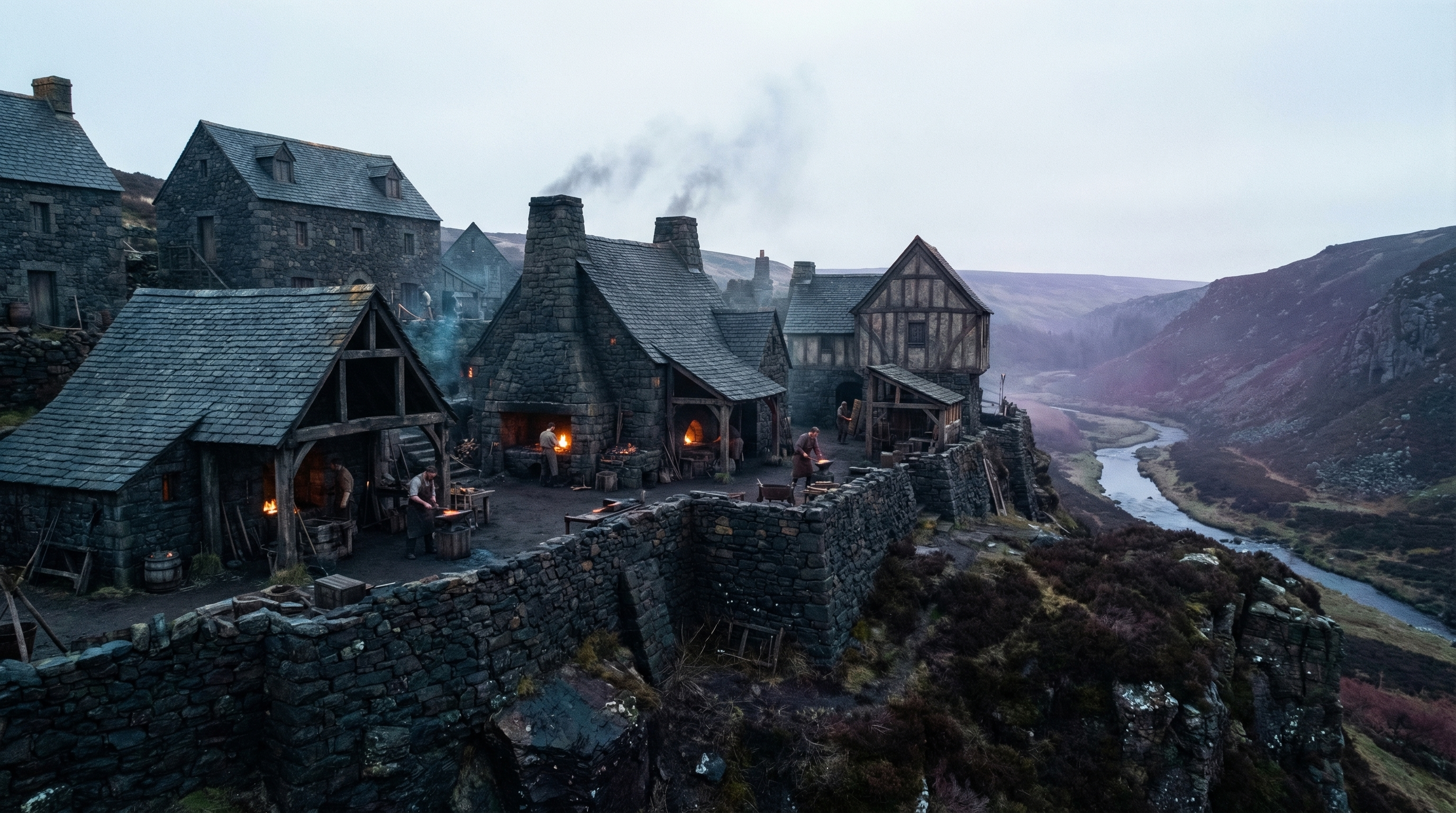
The founding party crossed on 14 September 1480 — the five Guardians and approximately thirty-five settlers comprising metalworkers, miners, and their families recruited from across the German-speaking territories. Eisenmann named the settlement Ironhold, in English rather than his native German, reflecting an awareness that the Caledonian region's emerging common tongue would be English and a desire that anyone encountering the settlement would understand immediately what it was for. The first forge was constructed within three weeks of arrival using stone quarried from the ridge itself. The first iron produced at Ironhold — a set of door hinges, by the tradition that the founding families preserved — was forged before the residential buildings had permanent roofing.
Growth Under Guardian Access
The five Guardians sustained Ironhold's Portal access for the settlement's first five decades, making repeated crossings to recruit additional settlers from the German-speaking territories — smiths, miners, carpenters, farmers, and the tradespeople necessary to sustain a specialist community. The population grew from the founding party of thirty-five to approximately 120 by 1510 and continued to expand through the following decade.
The founding families established specialisations within the broader metalworking trade that became hereditary over generations. The Eisenmanns produced structural and heavy ironwork. The Schusters specialised in finer metalwork and toolmaking. The Webers focused on weapons and armour. The Brandts managed the mining operation, extracting ore from the ridge's western face. The Zellers maintained the charcoal supply that fuelled the forges — a role that expanded as the settlement grew, requiring increasingly organised harvesting of timber from the surrounding scrubland and managed coppicing of planted woodlands to the east.
A Scottish family named Renfrew arrived through Johann Brandt's portal on 8 March 1509 — Archibald Renfrew, a metalworker from Glasgow whom Brandt had recruited on an Earth crossing the previous year. The Renfrews established themselves in structural fixings and architectural metalwork, introducing a Scottish element to Ironhold's otherwise German character. Over subsequent centuries, the Renfrews intermarried broadly within the community, and their presence marked the beginning of a gradual cultural blending that would transform Ironhold from a purely German settlement into something more hybrid — though the professional traditions, the physical inheritance, and the workshop culture remained distinctively German throughout the settlement's existence.
The settlement's layout reflected its industrial purpose. The forges occupied the ridge's western flank, positioned to catch prevailing winds for natural ventilation and to keep the smoke downwind of the residential quarter to the east. The residential buildings were constructed from the same dark ridge stone — squat, thick-walled structures built for durability rather than comfort. The smelting works, where raw ore was processed into workable iron, occupied a site at the ridge's northern end, separated from both the forges and the residences to manage heat, fumes, and fire risk. A communal hall, a small infirmary, storage buildings, and the agricultural plots that supplemented trade-acquired food completed the settlement's infrastructure.
The Ironhold Tradition
The metalworking tradition that developed at Ironhold was shaped by the particular properties of the local ore. The Clivilian iron deposits along the ridge contained trace minerals whose chemistry the Ironhold smiths never formally analysed but whose effects they catalogued through generations of empirical observation. Properly smelted and forged, the ore produced iron that was harder, denser, and more resistant to corrosion than imported terrestrial metal or iron sourced from other known Clivilian deposits. The forging process required higher temperatures than standard ironwork, more precise hammer timing, and a sensitivity to the metal's internal stresses that required years at the anvil to develop.
The Ironhold smiths spoke of iron that had "character" — each piece carrying the conditions of its making in a way that was legible to anyone trained to read it. A bracket produced at Ironhold was not interchangeable with a bracket produced elsewhere, even to identical dimensions, because the method of its production was embedded in the finished object. This was not mysticism. It was the practical consequence of working with an ore whose properties demanded a specific forging sequence and punished deviation. The techniques were transmitted orally, from master to apprentice, within the family specialisations that structured the settlement's workshop culture. Nothing was written down because the knowledge could not be adequately captured in writing — it lived in the hands, in the rhythm of the hammer, in the judgement of when metal was ready to fold and when it needed another heat.
Trade and Regional Position
Ironhold occupied a distinctive position in the Caledonian region. Castellum, the fortified Spanish settlement founded in 1250 on a plateau ten kilometres northeast of where New Edinburgh would later stand, was the nearest significant neighbour — approximately thirty-five kilometres from Ironhold by the overland routes. The two settlements established trade contact within the first decade of Ironhold's existence, and the relationship endured for the duration of both communities' active periods. Castellum's martial culture generated consistent demand for weapons and armour, which the Weber family's forge supplied. In return, Castellum provided grain, dried meat, and cloth that Ironhold's limited agricultural capacity could not produce in sufficient quantities.
Further trade relationships extended north, east, and south along routes that Ironhold's merchants maintained and defended. These routes connected the settlement to smaller communities scattered across the region — pastoral and agricultural populations whose demand for tools, fixings, and household metalwork provided Ironhold with the goods it could not manufacture. Trade was conducted through barter. Ironhold exchanged metalwork for food, timber, cloth, leather, and the practical necessities that a settlement of specialists consumed but did not produce.
The quality premium that Ironhold metalwork commanded was empirical. Tools held their edge longer. Structural fixings resisted corrosion in conditions that degraded iron from other sources within years. Weapons maintained their integrity under stresses that lesser metal could not withstand. Builders, farmers, and warriors across the region learned through experience that Ironhold products justified the higher cost, and the settlement's economy rested on this empirical foundation for nearly three centuries.
Loss of Portal Access
Lukas Zeller died on 3 September 1519, at seventy-one, from the lung condition that decades of charcoal production had made inevitable. He was the first of the five Guardians to die, and his Key became inactive with his death. Johann Brandt followed on 14 April 1522, at sixty-nine, after a fall at the mining face on the ridge's western flank. Gunther Eisenmann died on 22 November 1529, at eighty, still working the original forge — his hands, by the account his family preserved, were on the anvil when he collapsed. Margarethe Weber died on 8 January 1531, at seventy-two, during a harsh winter that claimed several of the settlement's older residents. Heinrich Schuster, the last of the five, died on 7 March 1533, at eighty-two.
With Heinrich's death, Ironhold's Earth connection was severed permanently. The settlement was fifty-three years old and its population approximately 150. Every person, every piece of equipment, and every scrap of knowledge that had arrived through the portals over five decades was now all the settlement would ever possess from Earth. No new settlers would come. No tools would be replaced from terrestrial sources. No information about developments in metallurgy, agriculture, or medicine on Earth would reach them. What Ironhold had built and learned in fifty-three years would have to sustain it for however long it endured.
The Long Independence
The loss of Portal access did not destroy Ironhold. The settlement had been founded by practical people who had built their economy around a local resource, and the five decades of Guardian access had been used well. The population was established. The forges were operational. The ore deposits were extensive. The agricultural capacity, supplemented by trade with Castellum and other neighbouring communities, was adequate. The knowledge base — smelting, forging, mining, farming — was held by enough practitioners that its transmission from one generation to the next could continue without Earth-sourced refreshment.
Ironhold sustained itself for over two centuries without Portal access. The achievement was extraordinary and, in hindsight, insufficient.
The first century of independence was the steadiest. The population stabilised at between 120 and 160 through the late sixteenth and early seventeenth centuries. The metalwork continued to command its quality premium. The smithing families continued to train apprentices. The German cultural identity, no longer refreshed by new arrivals from Earth, began its slow blending with the English-speaking culture of the surrounding trade communities — the Renfrew family's Scottish heritage becoming more prominent as generations of intermarriage diluted the purely German character of the founding population. Professional vocabulary retained German terms — the smiths spoke of Eisenarbeit and Schmiedefeuer at the forge long after they had switched to English for everything else — but the language of daily life shifted, and by the mid-1600s Ironhold was a bilingual settlement trending toward monolingual English.
The decline, when it came, was demographic. A community of 150 people, closed to external recruitment, could sustain itself only as long as its birth rate matched or exceeded its death rate. For several generations, it did. But the margin was never comfortable. Families who lost children to illness, accident, or the hazards of metalworking were families whose skills could not be replaced from outside. Young people who departed for settlements that offered broader prospects — and some did, in every generation — were losses the population could not absorb. The contraction was incremental: a handful fewer residents each decade, a forge going cold because no apprentice was available to take it over, a residential building standing empty because the family that had occupied it had moved to Castellum or dispersed along the trade routes.
By the early 1700s, the population had fallen below 100. By mid-century, it was below 60. The number of operational forges contracted from a peak of over a dozen to three or four. The trade routes that had sustained the settlement's economy thinned as merchants found longer journeys to a shrinking settlement less worth the effort. The residential quarter was largely abandoned, its buildings losing roofs and walls to neglect and weather. The agricultural plots, always marginal on the scrubland surrounding the ridge, contracted as the labour available to work them diminished.
The founding of New Edinburgh on 22 May 1762, twenty-five kilometres to the northeast, did not immediately affect Ironhold. The Stewart sisters and their early settlers were occupied with their own survival, and the two communities had no contact during New Edinburgh's first years. Contact was established in 1765, when Ironhold traders encountered New Edinburgh merchants on a route both settlements used. By that time, Ironhold's population had fallen below fifty.
Evacuation
The decision to evacuate was made collectively in the autumn of 1767 by the remaining families — Renfrews, Schusters, a handful of Eisenmann descendants, and several families of mixed lineage whose German surnames had long since been supplemented by Scottish ones acquired through centuries of intermarriage. The debate was brief. The settlement could not sustain itself. The forges still worked, but the population could no longer maintain the infrastructure around them — the housing, the water channels, the roads, the agricultural plots — whilst also producing the metalwork that trade demanded. New Edinburgh, twenty-five kilometres to the northeast, was five years old, growing rapidly, and visibly in need of exactly the skills that Ironhold's remaining residents possessed.
They departed in early October, carrying their tools, their finished metalwork, and whatever Ironhold ore they could transport. They left behind the forges, the smelting works, the residential quarter, the ridge with its ore deposits — the physical infrastructure of a settlement that had operated continuously for 287 years. Approximately forty people walked out of Ironhold, the last inhabitants of a community that had sustained itself for 234 years without Portal access through the quality of its metalwork, the stubbornness of its families, and the ore in the ridge that had drawn Gunther Eisenmann to the site in 1480.
They arrived at New Edinburgh on 18 October 1767.
Reception at New Edinburgh
New Edinburgh received the refugees with practical generosity. The Stewart sisters and the settlement's leadership recognised the immediate value of metalworking skills that their young, predominantly Scottish community did not possess. New Edinburgh was five years into an ambitious construction programme — stone buildings, defensive fortifications, civic infrastructure — and every project required iron fixings, hinges, brackets, and structural reinforcements that the settlement had been sourcing through trade at considerable cost and inconsistent quality.
The refugees were allocated land on the city's southwestern fringe, downwind of the residential districts. The area became known informally as the Forge Quarter, and the Ironhold families established workshops there within weeks of arrival. The transition from producing metalwork for a village of forty to producing it for a city of several thousand required adjustments in volume, scheduling, and client management that the first generation of refugees found challenging — the Ironhold workshop culture had been calibrated for bespoke production, not the volume output that a growing city demanded. Subsequent generations adapted, working increasingly with standardised iron sourced through New Edinburgh's own supply networks alongside the diminishing stockpiles of Ironhold ore that the refugees had brought with them and that later generations replenished through occasional expeditions to the abandoned ridge.
The integration was not seamless in cultural terms. The Ironhold families spoke English — they had been trading in it for generations — but their workshop culture, naming conventions, and professional customs retained a distinctly German character that set them apart. The physical inheritance proved even more persistent than the cultural markers: broader builds, fairer colouring, heavier features that marked the Ironhold-descended families as visibly distinct within New Edinburgh's Scottish-majority population. The first generation maintained strong internal cohesion, marrying within the community. Subsequent generations married more broadly, and the German identity blended with the Scottish mainstream over centuries — though the Forge Quarter retained its distinctive character, and the Ironhold families continued to recognise one another by appearance, by surname, and by the professional pride that connected them to a settlement most of them had never seen.
The Chewbathian garrison's weapons and armour production, established in the decades following the refugees' arrival, drew directly on Ironhold expertise. The relationship between builder and smith that defined Stewartshire's construction tradition — each understanding the other's materials and limitations — was an Ironhold inheritance. The iron fixings embedded in every significant building in the shire were produced by Ironhold-descended hands using methods that traced their lineage, however attenuated, to Gunther Eisenmann's original forge.
The Ruins
Ironhold in the centuries since its abandonment has followed the trajectory of all unoccupied structures in Clivilius. The stone walls, constructed from the dark ridge rock, have proved more durable than the settlement they comprised. Many still stand — their mortar failed, held together by the weight and friction of stone that was cut to fit precisely and that has not yet found sufficient reason to fall. The forges are recognisable by their wider floorplans and the remnants of hearth structures: blackened stone, corroded iron fittings, the occasional anvil base too heavy to have been removed during the evacuation. The smelting works at the ridge's northern end have collapsed more completely, their less robust construction unable to resist centuries of exposure.
The Veil has accumulated across the settlement, softening edges and filling the interiors of roofless buildings with pale deposits. Vegetation has made limited inroads — grasses and low scrub where the Cradle is close to the surface, thinner growth on the ridge where the ore-bearing rock provides less hospitable substrate. The ore deposits remain. The western face of the ridge still shows the excavation scars of generations of mining, and the veins of dark mineral are visible to anyone who walks the site. The ore has not been worked since 1767.
The Clivilius Atlas, the authoritative geographic register maintained by the Cartographic and Heritage Commission, lists Ironhold as a historical site within Stewartshire — abandoned, unoccupied, and preserved by the indifference of a landscape that has no particular urgency about removing ruins. Members of the Ironhold-descended community in New Edinburgh visit occasionally, though the twenty-five-kilometre journey limits participation. The annual gathering that commemorates the 18 October 1767 arrival sometimes includes a pilgrimage. Those who make the journey walk the empty streets, examine the forge remains, and pay respects to a settlement their ancestors built, sustained for 287 years, and ultimately could not save.
The Ironhold Tradition in Stewartshire
The settlement's most enduring contribution is human rather than architectural. The metalworking families who arrived at New Edinburgh in 1767 carried knowledge accumulated since 1480 — nearly three centuries of empirical understanding about Clivilian ores, forging techniques, and the properties of metal produced from the Ironhold deposits. This knowledge, transmitted within the Forge Quarter from master to apprentice, became integral to Stewartshire's construction industry. The iron fixings, hinges, brackets, and structural reinforcements produced by the Ironhold-descended families are embedded in every significant building in the shire — unseen, unattributed, and performing their functions with a reliability that has outlasted the settlement where the tradition began.
The tradition also preserved a cultural identity. The Forge Quarter maintained its distinctive character across 250 years within New Edinburgh — its families retaining physical traits, professional customs, and a communal memory that marked them as Ironhold stock. The annual commemoration, the occasional pilgrimages, the pride in a metallurgical heritage predating New Edinburgh's founding by nearly three centuries — these sustained a sense of origin distinct from the Scottish identity that defined the rest of Stewartshire. Whether the tradition will outlast the current generation of practitioners remains an open question. The Ironhold-descended smiths produce work that is respected and increasingly difficult to justify commercially in an era when manufactured metalwork can be sourced through portal logistics at lower cost and in volumes no hand forge can match. The forges in the Forge Quarter still burn. The knowledge persists in the hands of the living smiths who practise it and in the iron embedded in the walls of Stewartshire's buildings. The settlement itself, twenty-five kilometres to the southwest, waits under its dust.







