Holcombe Regis, Devon, England
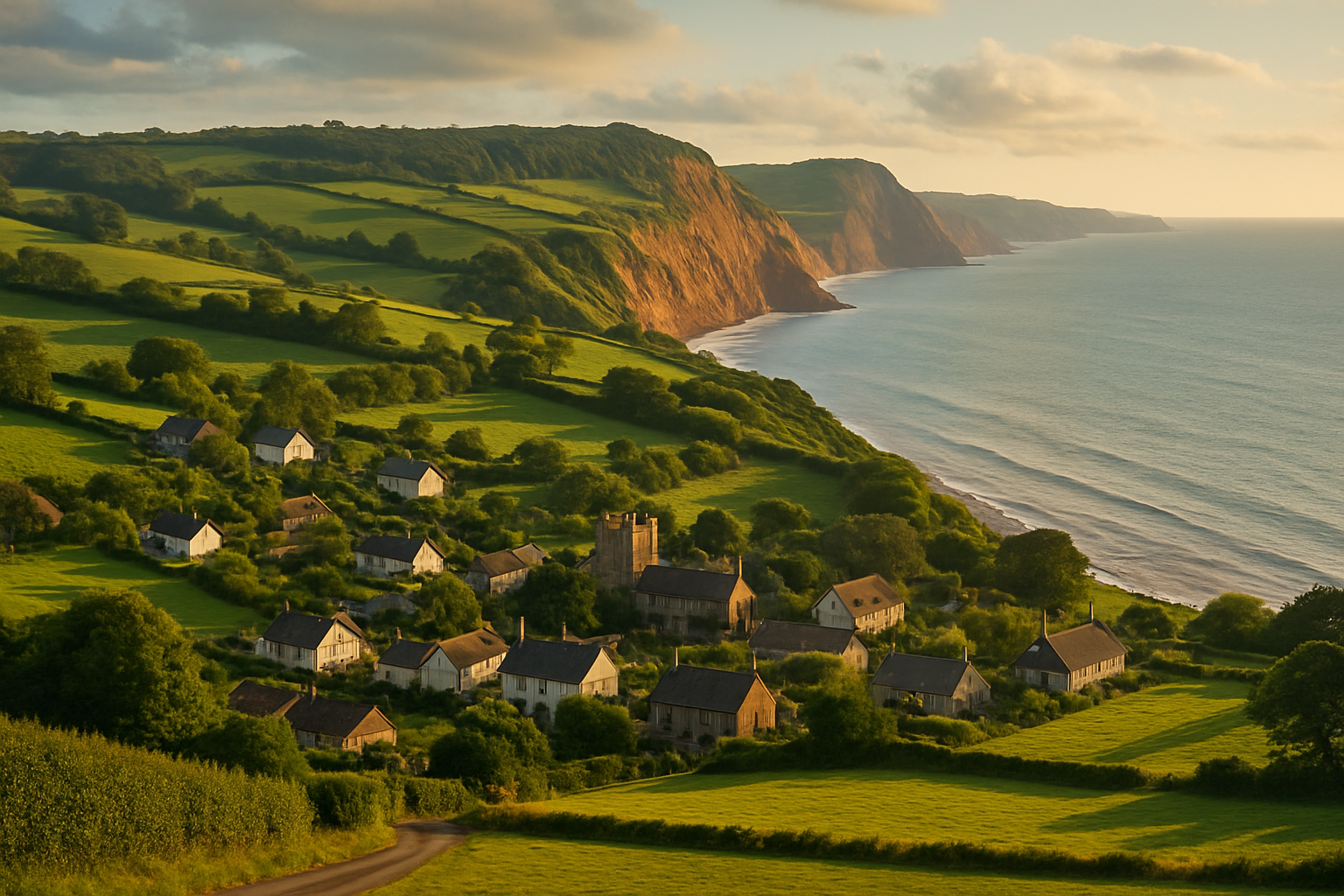
Holcombe Regis is a small coastal village in south Devon, perched on the red sandstone cliffs between Teignmouth and Dawlish where the land falls steeply into the English Channel. Once a hamlet of scarcely four hundred souls dependent on fishing, salt-harvesting, and the surrounding farmland, it has grown modestly across the centuries whilst retaining its essential character — a place of narrow lanes, thatched cottages, and salt-scoured church walls, shaped by the rhythms of tide, season, and parish life.
Origins and Early Settlement
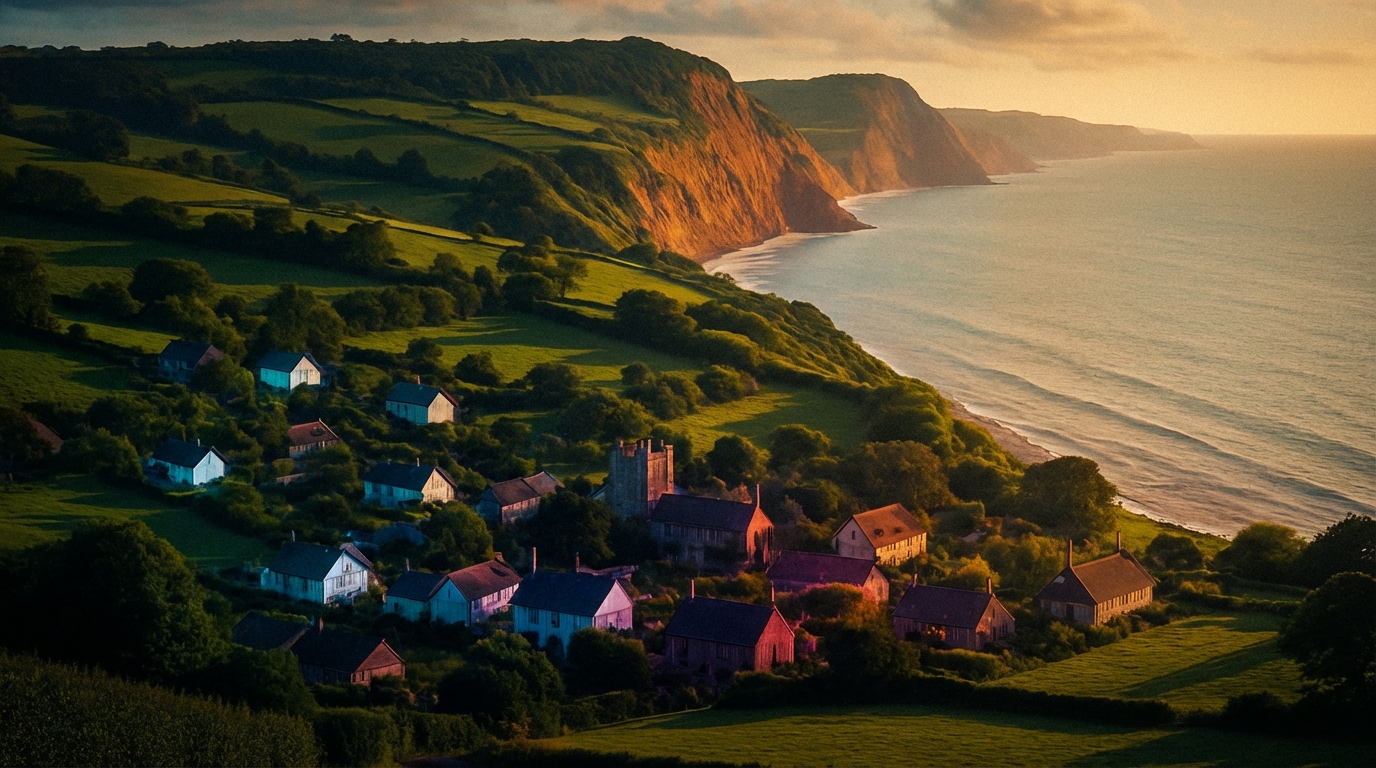
The name Holcombe derives from the Old English holcumb, meaning a hollow or sheltered valley — an apt description of the deep combe that cuts through the red Permian sandstone between Teignmouth and Dawlish, opening to the sea through dramatic cliff faces. The suffix Regis, denoting royal ownership, was added following the Norman Conquest, when the surrounding lands were recorded as Crown property in the Domesday survey of 1086, the manor held directly by the King before being granted to minor tenants under the feudal settlement of the south-western hundreds.
The earliest settlement likely predates the Conquest by several centuries. Saxon farmsteads occupied the higher ground above the combe, where the soil was fertile and sheltered from the worst of the coastal storms, while the shoreline below — a narrow strip of sand and shingle flanked by cliffs of vivid red stone — provided access to fishing grounds and tidal flats where salt could be harvested. By the late Saxon period, a small chapel dedicated to St Nicholas stood on the slope above the village, serving a scattered community of perhaps a hundred souls whose lives turned on the twin axes of the land and the sea.
Medieval Parish and Manorial Life
Through the medieval centuries, Holcombe Regis remained a modest settlement within the broader parish structure of the south Devon coast. The church of St Nicholas, rebuilt in stone during the thirteenth century, became the centre of village life — its squat tower visible from the cliff path and its bells audible across the combe in all weathers. The manor passed through several hands, its fortunes tied to the ability of successive lords to extract rents from tenant farmers working the heavy red soil of the surrounding fields and from fishermen who paid dues for access to the beach and its tidal flats.
Farming in the area centred on mixed husbandry: cattle grazed the steep pastures above the cliffs, while the sheltered combe supported orchards — cider production was a staple of the local economy for centuries — and small plots of barley and oats. Fishing, though never on the scale of the larger Devon ports, provided a supplementary livelihood, with pilchards, mackerel, and shellfish taken from the inshore waters. Lime-burning, using the abundant local limestone and fuelled by culm shipped from South Wales, supplied morite for building and for improving the acidic Devon soils.
Tudor and Stuart Centuries
By the sixteenth century, Holcombe Regis had developed into a settled village of perhaps two hundred people, its cottages clustered along Church Lane and the track that wound down to the shore through what later generations would call Smugglers Lane. The parish was too small to play any significant role in the great events of the age — the Armada, the Civil War, the Monmouth Rebellion — though its men were doubtless mustered alongside those of neighbouring Dawlish and Teignmouth when the county militia was called out. The remoteness of the combe and the difficulty of access from the landward side made it, however, an ideal location for the illicit trade that flourished along the south Devon coast throughout the seventeenth and eighteenth centuries. Local tradition preserves the memory of goods being landed at the tiny inlet at the foot of the cliffs and carried up the steep lane under cover of darkness — a trade that involved fishermen, farmers, and, if the stories are to be believed, at least one compliant churchwarden.
Georgian Holcombe Regis
By the late eighteenth century, the village had grown to a community of perhaps four hundred souls. The church of St Nicholas remained the focal point of parish life, its clerk — a position of modest but steady respectability — responsible for maintaining the registers, assisting the vicar, and overseeing the practical administration of the church. The village supported a small number of tradesmen: a blacksmith, a carpenter, a solicitor who handled legal matters for the surrounding farms, and the inevitable cider-maker. Most families, however, derived their living from a combination of farming and fishing, supplemented by whatever seasonal work the neighbouring towns of Teignmouth and Dawlish could offer.
It was into this world that John Buckland was born on 12 April 1791, the eldest son of Samuel Buckland, the long-serving parish clerk of St Nicholas' Church, and his wife Mary, née Tresilian, daughter of a respected Cornish schoolmaster from St Columb Major. The Buckland cottage on Church Lane — a modest thatched dwelling with limewashed walls mottled by salt air — stood within earshot of the parish bells. Samuel's income as clerk was meagre, bolstered by occasional fees for copying legal documents for the village solicitor, yet the household was steeped in literacy and piety. Young John's aptitude for languages and his quiet, solemn manner were noted early, and by his early teens he was assisting the vicar in preparing the Sunday lectionary — the beginning of a path that would carry him from this cliff-top parish to the headmastership of one of Tasmania's most enduring schools.
The Railway and Victorian Change
The arrival of the South Devon Railway along the coast in 1846, threading its line through tunnels and along the sea wall between Dawlish and Teignmouth, brought the wider world closer to Holcombe Regis without transforming it. The village had no station of its own — travellers alighted at Teignmouth or Dawlish and walked the cliff path — but the railway's presence altered the character of the neighbouring towns, drawing visitors to their beaches and promenades and, in time, reshaping the local economy. Some Holcombe families took in summer lodgers or found seasonal work in the hotels and boarding houses springing up along the coast, while others continued to farm and fish much as their grandparents had done.
The late nineteenth century brought modest improvements to village life. The church was restored and the chancel extended in the 1890s. A handful of villas were built on the higher ground above the combe, their occupants drawn by the mild climate, the sea views, and the relative cheapness of land compared with the increasingly fashionable resorts on either side. Yet Holcombe Regis remained, at its heart, a working village — its lanes too narrow for carriages, its cottages too small for genteel ambitions, its economy too dependent on the vagaries of wind and tide to attract serious investment.
The Twentieth Century
The First World War took its toll on Holcombe Regis as it did on every parish in Devon. The names of the fallen are recorded on the memorial in St Nicholas' churchyard — a disproportionate number for so small a community. The inter-war years brought little change; the village remained largely untouched by the ribbon development that was transforming the outskirts of Dawlish and Teignmouth. During the Second World War, the coastline was fortified against invasion, and the railway line — a vital link in the network connecting Plymouth to London — was a target for occasional German air raids, though Holcombe itself escaped significant damage.
The post-war decades brought the slow erosion of the village's traditional economy. Fishing dwindled to a handful of boats, farming consolidated into fewer and larger holdings, and younger generations increasingly sought work in Exeter or the coastal towns. By the late twentieth century, a growing proportion of the village's cottages had passed into the hands of retirees and second-home owners, drawn by the same qualities that had always defined the place — its seclusion, its beauty, and its distance from the noise of the modern world.
The Village Today
Modern Holcombe Regis is a village of thatched cottages and colourful gardens set on the hillside overlooking the sea, its lanes winding steeply down to the shore where Smugglers Lane passes under the railway line to a small cove flanked by dramatic red cliffs. The church of St Nicholas still stands on the slope above, its register stretching back centuries. A pair of pubs — one trading on the village's smuggling heritage — serve locals and walkers on the South West Coast Path, which passes through the parish on its way between Teignmouth and Dawlish. The population remains small, and the tensions familiar to many Devon coastal communities persist: between preservation and development, between the families who have lived here for generations and those who have come seeking quieter lives, and between the village's identity as a working settlement and its growing role as a picturesque retreat from the pressures of urban England.







