Harrowgate Quarry Station, Tasman Peninsula
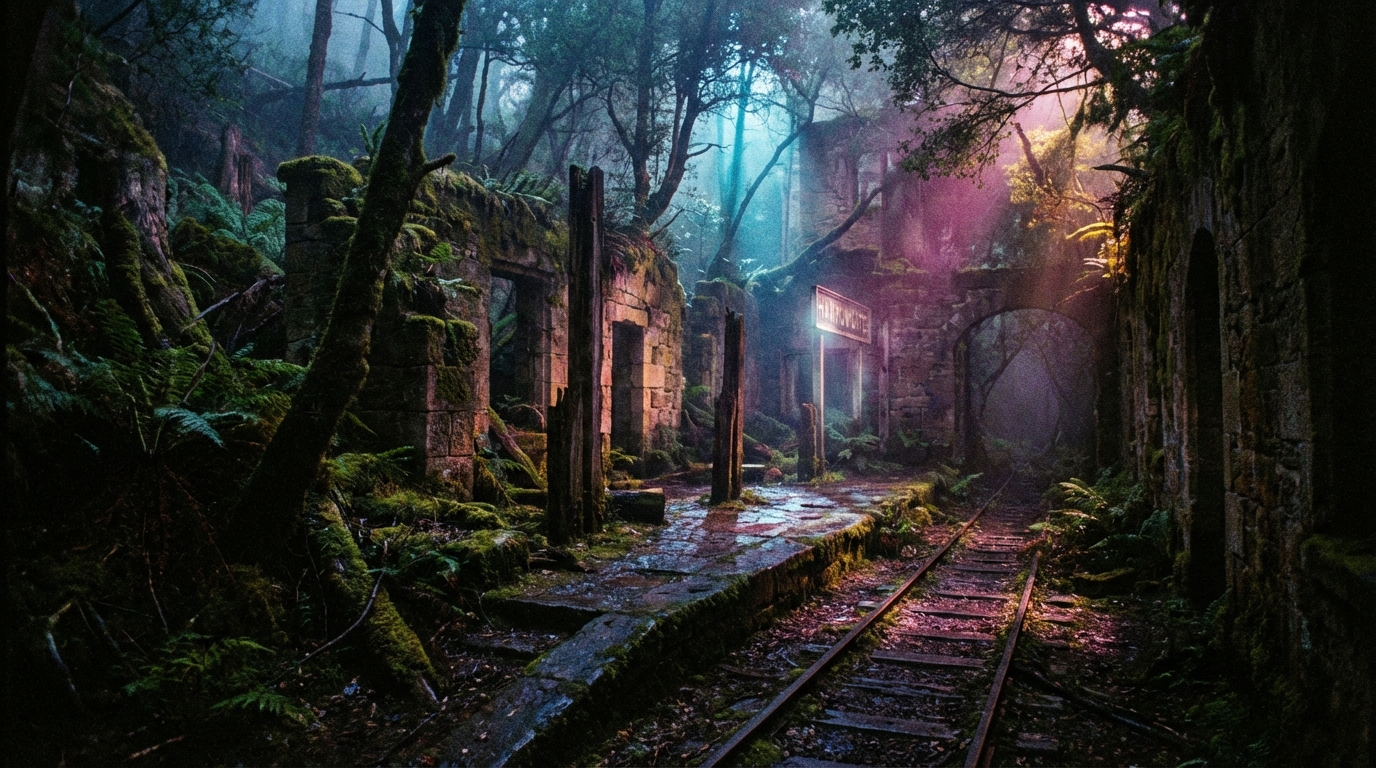
Harrowgate Quarry Station operated from 1838 to 1849 as a satellite sandstone extraction site supplying dressed stone to the Port Arthur penal settlement during its period of major construction. Established in a natural depression along Harrowgate Creek approximately four kilometres inland from Fortescue Bay, the station comprised a small quarry face, a dressing yard, a sandstone stores building, an overseer's quarters, and rudimentary convict shelters accommodating a rotating workforce of twelve to twenty men. The station's output — an estimated 3,200 cubic metres of dressed ashlar over eleven years — contributed to the construction of Port Arthur's hospital (1842), elements of the Separate Prison (1848–54), and various infrastructure works across the peninsula. Abandoned following the contraction of the convict system in the late 1840s, the site was never subject to private purchase or agricultural conversion due to its inaccessible position in dense myrtle forest at the base of a steep-sided gully. The stores building remains substantially intact — roofless but with walls standing to near-original height — while the remaining structures have been reduced to foundations and scattered stone by a century and a half of forest encroachment. The site does not appear on Heritage Tasmania's register, has not been subject to formal archaeological survey, and is known only to a small number of historians and bushwalkers who have located it through archival research and local knowledge.
Establishment and Purpose
The decision to establish a dedicated quarry station on Harrowgate Creek was made in early 1838 by Commandant Charles O'Hara Booth, who had identified the growing inadequacy of Port Arthur's existing stone supply. The settlement's southern quarries — worked since the early 1830s — were producing sandstone of variable quality, and the increasing ambition of the building programme under Civil Engineer Henry Laing demanded a more reliable source of consistent, fine-grained ashlar suitable for the institutional structures that the Convict Department was commissioning. Laing had complained in correspondence to the Colonial Secretary's office that stone from the southern quarries was prone to laminar fracture when dressed to the precision required for cell walls and window surrounds, and that the waste rate — stone rejected after dressing — was approaching forty percent, an inefficiency that consumed convict labour without producing usable material.
Surveyor James Calder, conducting his broader survey of the Tasman Peninsula's resources in 1837, had noted the presence of a sandstone exposure along a creek system approximately four kilometres inland from Fortescue Bay, accessible via an existing timber-getting track that connected the bay to the peninsula's interior. Calder's survey notes — preserved in the Tasmanian Archives as part of the Surveyor General's field books — describe the exposure as "a face of yellow stone, fine in grain and free of the bedding faults observable at the principal quarries, presenting itself on the eastern bank of a creek running through a depression of considerable depth surrounded by heavy myrtle forest." He estimated the extractable volume at several thousand cubic metres and recommended the site for development, noting that the creek provided reliable water for washing dressed stone and that the natural depression offered shelter from the prevailing westerly winds that hampered work at the more exposed coastal quarry sites.
Booth authorised the station's establishment in March 1838, assigning Overseer William Garside — a former stonemason from Yorkshire who had served as a foreman at the southern quarries since 1835 — to supervise its development. Garside was provided with a gang of fourteen convicts selected from Port Arthur's labour rolls for their experience in stone extraction or masonry, though the records indicate that only four of the fourteen had any prior quarrying experience, the remainder being assigned on the basis of physical capability rather than relevant skill.
Construction and Layout
The station was constructed between March and June 1838 using materials available at the site — the sandstone itself providing building material, timber from the surrounding myrtle forest providing framing, and bark providing temporary roofing that was progressively replaced with timber shingles as the station's construction advanced. The layout was dictated by the geography of the gully: the quarry face occupied the eastern bank of Harrowgate Creek where the sandstone exposure presented itself at a workable angle, the dressing yard was established on a relatively level area of cleared ground between the quarry face and the creek, and the station's buildings were positioned on higher ground on the western bank, above the flood line that the creek's winter flows occasionally reached.
The principal structure — and the only building constructed entirely in dressed sandstone — was the stores building, a single-room rectangular structure measuring approximately eight metres by five metres with walls of coursed ashlar rising to a height of three metres. The building served as secure storage for tools, finished stone awaiting transport, and the station's provisions, and its construction served the dual purpose of demonstrating the quality of the site's stone to the Commandant and providing Garside's men with a structure capable of securing valuable equipment in a location too remote for regular military oversight. The stores building was fitted with a timber-framed roof of bark shingles over split-timber rafters, a single doorway on the northern elevation, and two window openings — one on each of the longer walls — that provided cross-ventilation and working light. No glass was fitted; the windows were closed by timber shutters whose iron hinges were supplied from Port Arthur's blacksmith workshop.
The overseer's quarters occupied a smaller structure immediately to the north-west — part stone, part timber, with a chimney of dressed sandstone blocks that represented the station's most ambitious piece of masonry. Garside, who lived at the station continuously during its operational life, maintained the quarters to a standard that the convict shelters did not approach, and archaeological evidence — should the site ever be formally surveyed — would likely reveal the footprint of a modest but considered dwelling with a flagstone floor, a functional hearth, and a garden plot on the northern aspect that Garside cultivated for personal use.
The convict shelters were rudimentary. Two structures of split timber with bark roofs, open on one side in the manner of bush huts, provided sleeping accommodation for the work gang. The convicts slept on raised timber platforms covered with straw palliasses that were replaced at irregular intervals depending on the willingness of the supply system at Port Arthur to acknowledge the station's requisitions. A third structure — a lean-to against the stores building's southern wall — served as a combined mess area and tool maintenance space, providing the only covered work area at the station outside the quarry face itself.
Operations and Labour
Stone extraction at Harrowgate followed the standard methodology employed across the Tasman Peninsula's quarry sites. Convicts worked in pairs — one man cutting channels along the bedding plane using a point chisel and mallet, the other inserting iron wedges into the completed channel and driving them with a sledgehammer until the block separated from the face. The separated blocks were then levered from the face using iron bars, lowered to the dressing yard on timber skids, and dressed to specification using masons' chisels under Garside's supervision. The pick marks from this process remain visible on the quarry face — parallel grooves of consistent depth and spacing that record the rhythm of the work with the precision of a mechanical record, each stroke preserved in the stone that received it.
The station operated with a workforce that varied between twelve and twenty men depending on the demands of Port Arthur's building programme and the availability of convicts with sufficient physical capacity for quarry labour. The work was classified as "hard labour, first class" — the most physically demanding category in the convict system's graduated punishment framework — and assignment to Harrowgate carried a punitive dimension that the station's remoteness and conditions reinforced. Convicts worked from dawn until an hour before sunset, six days a week, with Sundays reserved for rest, clothing maintenance, and the religious observance that the convict system mandated but the station's lack of a chapel rendered informal. Garside, who was not a religious man by his own account, read selected passages from a Bible provided by the Commandant's office and allowed the men to interpret them as they saw fit.
Output records, maintained by Garside in monthly returns submitted to Port Arthur's Clerk of Works, indicate that the station produced an average of twenty-five to thirty cubic metres of dressed ashlar per month during its peak operational period (1840–1846), with significant seasonal variation — winter output declining by as much as forty percent due to reduced daylight hours, creek flooding that interrupted dressing operations, and the debilitating effect of cold and damp on men working in an unheated gully for ten hours per day. The quality of the stone was consistently superior to that of the southern quarries, confirming Calder's initial assessment. Laing noted in an 1843 report to the Colonial Engineer that Harrowgate stone "answers admirably for close-jointed work and will bear the finest dressing without fracture," a commendation that ensured the station's continued operation even as other satellite sites were being consolidated.
Transport and Supply
The station's principal logistical challenge was the extraction of finished stone from a site that was accessible only by a narrow track through dense forest. Dressed blocks were loaded onto timber sledges — flat platforms of hardwood planking pulled by convict labour along a track that Garside's men had cut and maintained between the station and Fortescue Bay, a distance of approximately four kilometres with a climb of over one hundred metres from the gully floor to the ridgeline before the descent to the coast. The track was passable in dry conditions but deteriorated rapidly in winter, and the combination of weight, gradient, and surface condition made stone transport the most dangerous aspect of the station's operations.
Two convicts were seriously injured during stone transport over the station's operational life. In September 1841, a sledge broke free on the descent toward Fortescue Bay, striking convict James Brennan and breaking both his legs below the knee. Brennan was carried to the bay by his fellow convicts and transported by boat to Port Arthur's hospital, where he survived but never regained full use of his left leg. In March 1845, convict Edward Pascoe was crushed between a sledge and a tree when the track's edge gave way on the climb from the gully. Pascoe died at the scene. His body was carried to Port Arthur and buried on the Isle of the Dead in an unmarked grave. Garside's report on the incident noted that the track section in question had been identified as requiring reinforcement the previous month, but that the timber and labour necessary for the work had not been provided.
At Fortescue Bay, the dressed stone was loaded onto government lighters — flat-bottomed vessels operated by convict crews — and transported by sea around the peninsula's southern coast to Mason Cove at Port Arthur. This maritime leg added cost and risk to the supply chain, and the loss of a lighter carrying Harrowgate stone during a storm in August 1844 — the vessel foundering off Cape Raoul with the loss of its convict crew of four men — prompted a review of the station's viability that was ultimately resolved in favour of continued operation on the grounds that the stone quality justified the logistical expense.
Conditions and Discipline
Life at Harrowgate was characterised by isolation, physical hardship, and a disciplinary regime that reflected Garside's pragmatic management style rather than the more systematic punitive framework operating at Port Arthur. The station was too small and too remote to maintain the elaborate surveillance and graduated punishment system that the main settlement employed, and Garside — whose authority derived from competence rather than cruelty — managed his workforce through a combination of reasonable expectations, consistent routine, and the strategic distribution of small privileges that the convict system's regulations technically prohibited but its practitioners universally employed.
Convicts at Harrowgate received standard rations supplied from Port Arthur on a fortnightly basis — one pound of meat and one pound of flour per day, supplemented by seasonal vegetables when available and by whatever the men could catch or gather from the surrounding bush. Garside permitted fishing in the creek, which provided small native trout, and turned a blind eye to the trapping of possums and wallabies that supplemented the protein-deficient official ration. These concessions, while minor, represented a quality of life marginally superior to that available at the main settlement, where the scale of operations precluded the informal flexibility that a small, isolated station could sustain.
Medical provision was minimal. The station had no assigned medical officer, and illness or injury required either treatment by Garside — whose first-aid knowledge was limited to the practical competencies that quarry work demanded — or transport to Port Arthur, a journey of several hours by track and boat that the condition of the patient did not always permit. The station's records note recurring outbreaks of respiratory illness during winter months, attributable to the combination of physical exertion, inadequate shelter, and the persistent damp that the gully's enclosed topography trapped in the air and the vegetation. At least two convicts were returned to Port Arthur permanently due to respiratory conditions that the station's environment had either caused or exacerbated, their lungs damaged by the fine sandstone dust that quarrying produced and that the gully's still air did not disperse.
Disciplinary matters were handled through a combination of Garside's authority and periodic visits from Port Arthur's superintendent or his delegate. Offences recorded in the station's returns were predominantly minor — insolence, refusal of labour, possession of unauthorised items — and punishments typically consisted of reduced rations or additional labour rather than the corporal punishment that the main settlement employed more freely. Garside administered floggings on three recorded occasions during the station's eleven-year operation, each following offences serious enough to require formal documentation — an attempted escape in 1840 (the convict, Thomas Firth, was recaptured within two kilometres of the station, the dense forest and unfamiliar terrain defeating his effort before the military did), a theft of tools in 1843, and an assault on a fellow convict in 1846 that left the victim with a broken jaw.
Decline and Abandonment
The contraction of the convict system on the Tasman Peninsula, accelerating from the mid-1840s as transportation to Van Diemen's Land wound down, progressively reduced both the demand for new construction and the labour available to sustain satellite operations. The Coal Mines closed for government purposes in 1848. Point Puer closed in 1849. The probation stations that had proliferated across the peninsula during the early 1840s were consolidated or abandoned as the convict population declined and the administrative apparatus that managed it contracted to the main settlement.
Harrowgate's output declined from 1846, as convicts were progressively withdrawn to the main settlement and Garside's workforce fell from a peak of twenty to as few as eight men. The final monthly return, dated March 1849, records an output of eleven cubic metres — less than half the station's peak productivity — produced by nine men whose labour was increasingly directed toward maintenance of the deteriorating track and buildings rather than stone extraction. The return includes Garside's characteristically terse observation that "the station cannot sustain useful operation with the present complement and I recommend its closure unless men can be provided, which I understand cannot be done."
The station was formally closed in April 1849. Garside supervised the removal of tools, iron hardware, and usable timber to Port Arthur, leaving the stone structures and the quarry face to the forest. He returned briefly in May to retrieve personal effects from his quarters and, according to a later account preserved in his son's papers, stood at the edge of the quarry for some time before departing, an uncharacteristic display of sentiment from a man whose eleven years at the site had been documented in monthly returns that recorded output, incidents, and weather without once mentioning the landscape's beauty or the satisfaction of shaping stone.
The site passed into Crown land and was never taken up for private purchase. The gully's unsuitability for agriculture — too steep, too densely forested, too far from any road — ensured that no subsequent owner had reason to clear or develop it. The forest reclaimed the station with the patient efficiency that Tasmanian bush brought to abandoned human enterprise: myrtle and blackwood colonising the cleared ground within a decade, root systems working into the mortar joints of the stone buildings within a generation, the track to Fortescue Bay becoming first difficult, then impassable, then invisible as the vegetation closed over it and the topsoil accumulated over its surface.
Present Condition
The stores building remains the site's most substantial surviving structure. Its walls stand to within approximately half a metre of their original height on all four sides, the coursed ashlar still displaying the quality of Garside's men's workmanship — joints tight, faces dressed to a smoothness that the intervening century and a half of weathering has softened but not degraded. The roof is entirely gone, the timber having rotted and collapsed during the late nineteenth century, and the interior is open to the sky. Lichen and moss colonise the wall surfaces in patterns that trace the moisture flows created by rain and condensation, and ferns have established themselves in the mortar joints at the base of the walls where accumulated soil and leaf litter provide rooting medium. The doorway on the northern elevation remains open and passable. Both window openings retain their dressed sandstone surrounds, though the timber shutters and their iron hinges have long since corroded and fallen.
The overseer's quarters are reduced to a low wall outline and the chimney's base, the stone courses surviving to a height of approximately one metre. The flagstone floor is partially visible beneath accumulated forest debris. The convict shelters have left no visible trace above ground, their timber construction having decomposed entirely, though the raised earth platforms on which they stood are discernible as gentle mounds in the forest floor to an observer who knows what to look for.
The quarry face remains exposed — a vertical cut of approximately six metres in height and fifteen metres in width, the pick marks of the convict workers still clearly visible on the stone surface where they have been protected from weathering by the gully's sheltered aspect. The dressing yard between the quarry face and the creek is now heavily overgrown but retains scattered dressed blocks — partially finished pieces abandoned when the station closed, their incomplete state recording the moment work ceased in the same way that a stopped clock records the moment of its failure.
Harrowgate Creek continues to flow through the gully on its original course. The sandstone exposure that James Calder noted in 1837 remains visible on the eastern bank, though the quarry's removal of material has altered the profile of the exposure from natural outcrop to worked face. The creek crossing at the station site — where convicts laid flat sandstone blocks to create a rudimentary ford — is still passable, the blocks having settled into the creek bed with a stability that their original placement, intended as temporary, accidentally ensured.
Historical Significance and Obscurity
Harrowgate Quarry Station occupies an unusual position in the historical record of the Tasman Peninsula's convict system — well-documented in the administrative archives of Port Arthur's operations, yet absent from the heritage registers, tourist literature, and public awareness that the peninsula's more prominent convict sites attract. The station's monthly returns survive in the Tasmanian Archives as part of the Commandant's correspondence, providing a detailed operational record that historians of the convict system have drawn upon for studies of convict labour practices, resource extraction economics, and the logistics of the peninsula's satellite station network. Richard Tuffin's 2015 study of production landscapes on the Tasman Peninsula references Harrowgate's output data in his analysis of stone supply chains, and Greg Jackman's archaeological survey framework for peninsula outstations identifies the site as a high-priority candidate for formal investigation.
Despite this archival presence, the site has received no formal heritage assessment, no archaeological survey, and no conservation intervention. Its absence from Heritage Tasmania's register reflects the practical reality that the register's coverage of Tasmania's convict sites is incomplete — the sheer number of outstations, work sites, and associated infrastructure that the convict system generated across the peninsula exceeds the capacity of the heritage assessment process to document, and sites that are not subject to development pressure or public access do not attract the priority that limited resources require. Harrowgate, buried in dense forest, inaccessible by road, and unknown to all but a handful of researchers, remains in the category of sites that the heritage system acknowledges in principle but has not reached in practice.
The site's obscurity has, paradoxically, ensured its preservation. The structures that survive have been protected by the same isolation that made the station difficult to operate — no road builder has disturbed the track, no farmer has repurposed the stone, no souvenir hunter has removed the dressed blocks from the dressing yard. The forest that made Garside's supply chain a logistical ordeal now serves as the site's conservation mechanism, the dense myrtle canopy regulating temperature and moisture in ways that slow the deterioration of exposed stonework, the root systems that probe the mortar joints also binding the soil that supports the walls' foundations. Harrowgate endures not because anyone has chosen to preserve it but because no one has had reason to destroy it — the accidental conservation of neglect, which has protected more of Tasmania's convict heritage than any deliberate programme of intervention.







