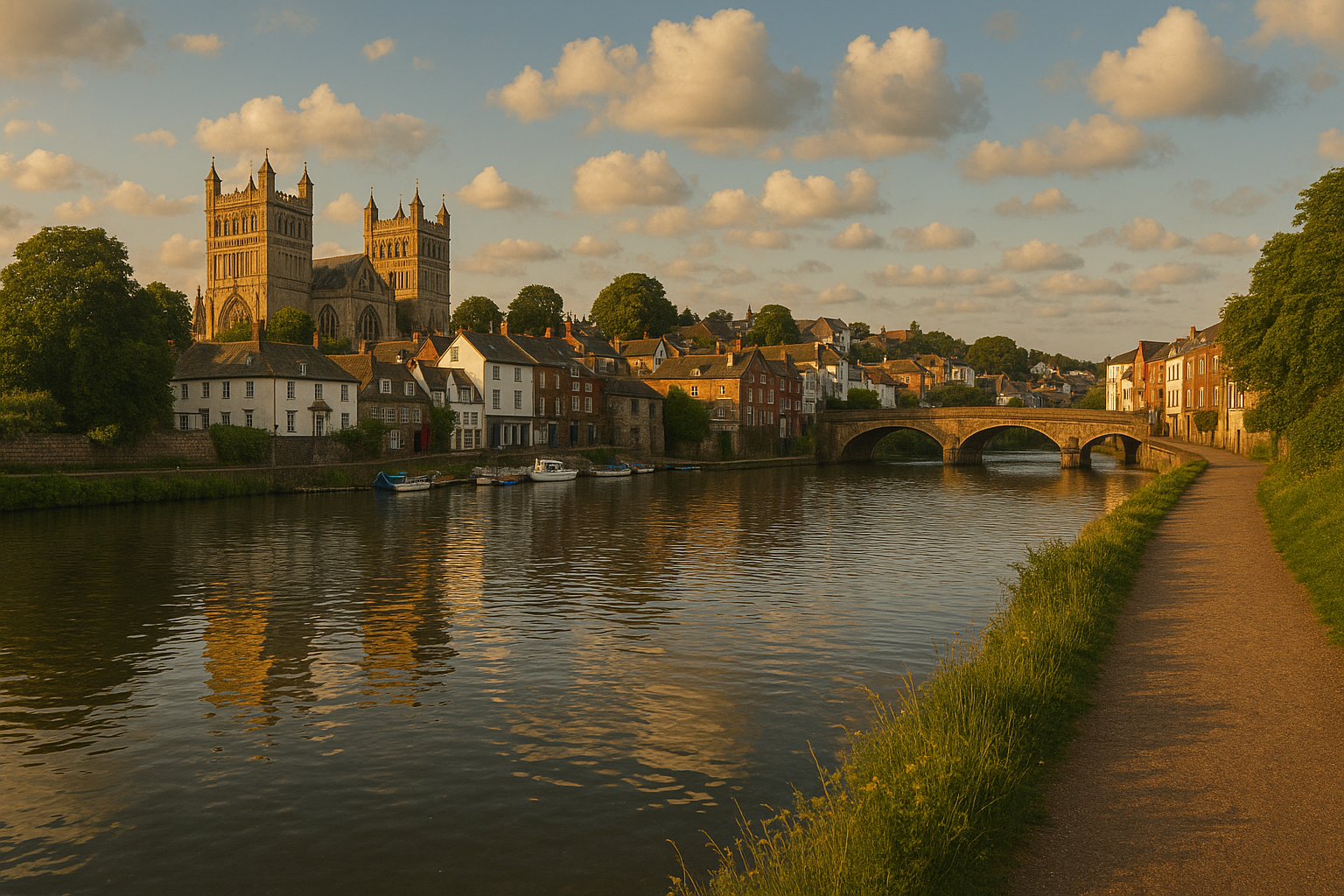
Exeter, Devon, England
Exeter is the historic county town of Devon, situated on the River Exe some ten miles inland from the English Channel. Founded as the Roman legionary fortress of Isca Dumnoniorum around AD 55, it has served as the administrative, ecclesiastical, and commercial heart of south-west England for nearly two thousand years. Its cathedral, begun in 1050 and rebuilt in the Decorated Gothic style by 1400, houses the longest unbroken medieval stone vaulted ceiling in the world and the tenth-century Exeter Book of Anglo-Saxon poetry.
Roman Foundations
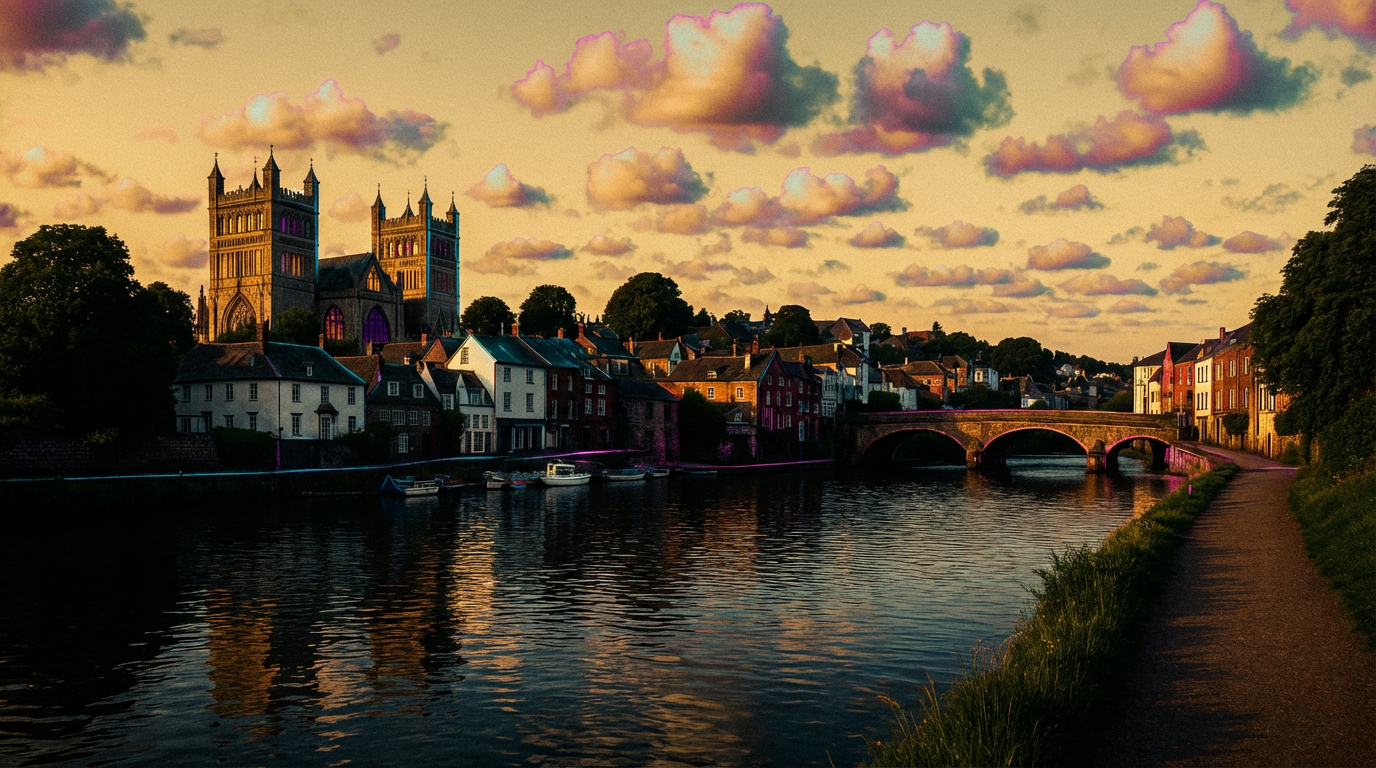
Exeter's recorded history begins around AD 55, when the Romans established a legionary fortress on a hill overlooking the River Exe at the lowest point where it could be easily crossed. Named Isca Dumnoniorum — from a Brittonic word describing flowing water, and referring to the Dumnonii, the Celtic tribe whose lands it governed — the fortress served as the south-western terminus of the Fosse Way and the base of the five-thousand-strong Second Augustan Legion, at one time commanded by the future emperor Vespasian. By about AD 75 the legion had departed for Caerleon in Wales, and the military settlement was reconstituted as a civilian town and tribal capital. A forum, basilica, and public baths were constructed, though the population probably never exceeded a thousand, and the town's ambitions were only modestly realised. Stone walls enclosing some thirty-seven hectares were erected in the late second century, and these — rebuilt and reinforced across the centuries — still define much of Exeter's footprint today, with some seventy per cent of the circuit surviving.
Saxon and Viking Exeter
After the Roman withdrawal around AD 410, Exeter fell largely silent for nearly three centuries. By the mid-seventh century the Saxons had reached Devon, defeating the British Dumnonii at Peonnum in Somerset in 658, and a monastery was established within the old Roman walls by 680 — where the future Saint Boniface, the apostle of Germany, received his early education. The Saxons called the place Escanceaster, from which the modern name derives. In 876, Danish Vikings seized the city and wintered within its walls before being driven out by Alfred the Great the following summer. Alfred then elevated Exeter to one of the four fortified burhs in Devon, rebuilding its defences along the Roman lines, laying out a new High Street with smaller roads branching from it, and establishing a mint. By the time of King Athelstan, who strengthened the walls again around 928 and expelled the remaining Britons beyond the River Tamar, Exeter had become the sixth most prosperous town in England.
Norman Conquest and the Cathedral
In 1068, two years after the Conquest, Exeter rebelled against William the Conqueror. Gytha, mother of the slain King Harold, was residing in the city, and William marched west and laid siege for eighteen days before accepting the city's honourable surrender. He promptly ordered the construction of Rougemont Castle — named for the red volcanic stone of the hill on which it was built — in the northern corner of the Roman walls, demolishing forty-eight houses to clear the site. The Norman gatehouse, with its distinctively Anglo-Saxon long-and-short quoins, remains the castle's most prominent surviving feature.
The founding of Exeter Cathedral dates to 1050, when Bishop Leofric transferred his seat from Crediton, fearing sea-raids on the more exposed town. Leofric presented the cathedral with sixty-six books, among them the Exeter Book — a tenth-century manuscript of Anglo-Saxon poetry now recognised as one of the four codices that together preserve virtually all surviving Old English verse. In 1114, Bishop William Warelwast, nephew of the Conqueror, began construction of a new Norman cathedral, whose massive twin transept towers — completed by 1133 — were retained when the building was rebuilt from 1270 in the Decorated Gothic style under successive bishops. The present cathedral, substantially complete by about 1400, possesses the longest unbroken medieval stone vaulted ceiling in the world, stretching approximately ninety-six metres from the west wall of the nave to the Great East Window. The fourteenth-century Minstrels' Gallery, the astronomical clock donated by Bishop Peter Courtenay in the 1480s, and the oak bishop's throne carved between 1312 and 1316 — standing some eighteen metres high — are among its most celebrated features.
Medieval Prosperity and the Wool Trade
Through the medieval period Exeter flourished as one of England's wealthiest towns, its fortune built overwhelmingly on wool. By the fourteenth century the city was a principal centre for the manufacture and export of woollen cloth, trading with markets across northern France, the Low Countries, and the Mediterranean. The construction of St Nicholas Priory in 1087, the Underground Passages built in the fourteenth century to carry clean water from springs outside the walls through lead pipes, and the endowment of almshouses by William Wynard in 1435 all testified to the city's civic wealth and ambition.
This prosperity was interrupted in the late thirteenth century when Isabella de Fortibus, Countess of Devon, built a weir across the Exe some three miles south of the city, blocking river navigation and forcing all goods to be unloaded at Topsham, where the Earls of Devon exacted heavy tolls. Trade with the sea was not fully restored until 1566, when the Exeter Ship Canal — one of the oldest artificial waterways in England — was constructed to bypass the obstruction. The canal was later enlarged in 1677 to accommodate larger vessels, and the Customs House, the first brick-built structure in Exeter, was erected on the quayside in 1681 at the height of the cloth trade.
Tudor, Civil War, and Reformation
Tudor Exeter was a city of perhaps eight thousand people, large and important by the standards of the day. The city contributed ships to the fleet that opposed the Spanish Armada in 1588, and its motto — Semper Fidelis — is traditionally held to have been conferred by Elizabeth I in recognition of this loyalty, though its first documented use dates to 1660. In 1549, the city withstood a month-long siege by the Prayer Book rebels, who opposed the imposition of the English-language Book of Common Prayer. During the English Civil War, Exeter was held by Royalist forces from 1643 until its capture by Parliamentary troops under Sir Thomas Fairfax in April 1646, after a prolonged siege that left parts of the city badly damaged.
Georgian and Regency Exeter
The eighteenth century brought gradual improvements to civic life, at least for the prosperous. Exeter gained its first newspaper by 1707, its first bank in 1769, and Assembly Rooms the same year. Street lighting by oil lamps was introduced after 1760, and pavements were laid in the principal streets by 1778. The Devon and Exeter Hospital — later the Royal Devon and Exeter Hospital — was founded in 1741 by Dean Alured Clarke on land in Southernhay donated by John Tuckfield, becoming one of the earliest provincial hospitals in England. Northernhay Gardens, laid out in 1612 as a pleasure walk for residents, is recognised as the oldest public open space in England. Yet by 1799 a visiting writer observed that Exeter was an ancient city slow to adopt modern improvements, and the population had grown cramped within its walls before the gates began to be demolished to ease the flow of traffic.
The Railway, the University, and Modern Growth
The Bristol and Exeter Railway arrived at St Davids Station in 1844, connecting the city to the national network and accelerating its transformation from a regional market town into a modern commercial centre. Exeter Central station, opened by the London and South Western Railway in 1860, provided a more central terminus. The Royal Albert Memorial Museum, founded in 1868, became the city's principal repository of art, archaeology, and natural history. The origins of the University of Exeter lie in civic institutions founded from 1838 onward, with the Royal Albert Memorial College established at the turn of the twentieth century and a Royal Charter granted in 1955 — exactly a century after the founding of the Exeter School of Art. Now a member of the Russell Group and home to over thirty thousand students across its Streatham and St Luke's campuses, the university has profoundly shaped the modern city.
The Exeter Blitz
On the night of 23 April 1942, Exeter became the first target of the Baedeker Blitz — a German campaign to bomb British cities of cultural and historical significance in retaliation for the RAF's destruction of medieval Lübeck the previous month. The city was struck on consecutive nights in late April, and again in a devastating raid on the night of 3 May, when twenty bombers arrived over the town centre shortly after midnight and in seventy minutes laid waste to much of the High Street, Sidwell Street, and Fore Street. Some forty acres of the city centre were levelled by incendiary bombing, and 265 people were killed across the nineteen raids that struck Exeter between 1940 and 1942, with 687 injured. The cathedral was damaged but survived. German radio declared that the jewel of the west had been destroyed, though the city endured. The Polish 307 Night Fighter Squadron, based nearby, defended Exeter throughout and on 4 May 1942 prevented several bombers from releasing their loads; in November that year, the squadron presented the city with a Polish flag — the first British city so honoured.
Post-war rebuilding in the 1950s prioritised traffic circulation over historical preservation. Damaged buildings were generally demolished rather than restored, and the medieval street plan was substantially altered. Former landmarks such as Bedford Circus, the College of the Vicars Choral, and the church of St Lawrence were lost. Previously regarded as second only to Bath as an architectural site in southern England, Exeter emerged from reconstruction as a city with beautiful buildings rather than a beautiful city.
The City Today
Modern Exeter has a population of approximately 130,800, with a median age of thirty-five — the second-lowest in the South West after Bristol — reflecting the influence of its large student population. The city was awarded UNESCO City of Literature status in 2019, recognised for its unbroken thousand-year history of making and distributing books stretching back to the early thirteenth century. The Royal Albert Memorial Museum, the Northcott Theatre, the medieval Underground Passages, and the Exeter Ship Canal basin draw visitors alongside the cathedral and its close. The Met Office, the United Kingdom's principal weather forecasting organisation, relocated its headquarters from Bracknell to Exeter in 2004. Exeter Chiefs, the city's professional rugby union club, have won the English championship twice and the European title in 2020, while Exeter City Football Club, founded in 1901 and a founding member of the Football League's Third Division in 1920, plays at St James Park in the heart of the city.
Samuel Godfrey and Margaret Rothschild
Among those shaped by Exeter's layered history are two figures whose lives carried the city's imprint far beyond Devon. Samuel Godfrey, born on 19 November 1790 to Thomas Godfrey, a cooper, and his wife Anne, née Ruddock, grew up in a working-class household where the expectation was that he would learn a trade and contribute to the family's livelihood. When economic downturn left many Exeter labourers struggling, Samuel enlisted in the British Army in 1808, joining the 73rd Regiment of Foot. Posted to Van Diemen's Land aboard the Lady Catherine in 1812, he served in the colonial garrison before taking his discharge and settling as a labourer in Launceston, where he died on 5 September 1844 — a man defined by quiet endurance rather than ambition, whose steady persistence was shaped in the streets and workshops of the city he left behind.
More than a century and a half later, Margaret Elizabeth Wainwright was born on 14 February 1956 at the Royal Devon and Exeter Hospital, the third of four children of Robert William Wainwright, a wartime Royal Air Force mechanic who later ran a modest garage, and Lillian Rose Wainwright, née Bennett, a seamstress renowned for her intricate embroidery. The family lived in the suburb of Heavitree, in a terraced house where practical skills and quiet industriousness were valued above all else. Margaret's artistic talents emerged early — she roamed the green lanes and allotments fringing the city with sketchbooks and stubby pencils, drawn to the minute details of the natural world. She studied at St Peter's Church of England Aided School and later at Exeter College of Art and Design before emigrating to Tasmania in 1975, where she built a distinguished career as a botanical illustrator. Now Margaret Elizabeth Rothschild, she has often reflected that the precision and patience that defined her work were nurtured not in galleries or lecture halls, but in the garden sheds, workshops, and crowded kitchens of a city where the past is never far beneath the surface.







