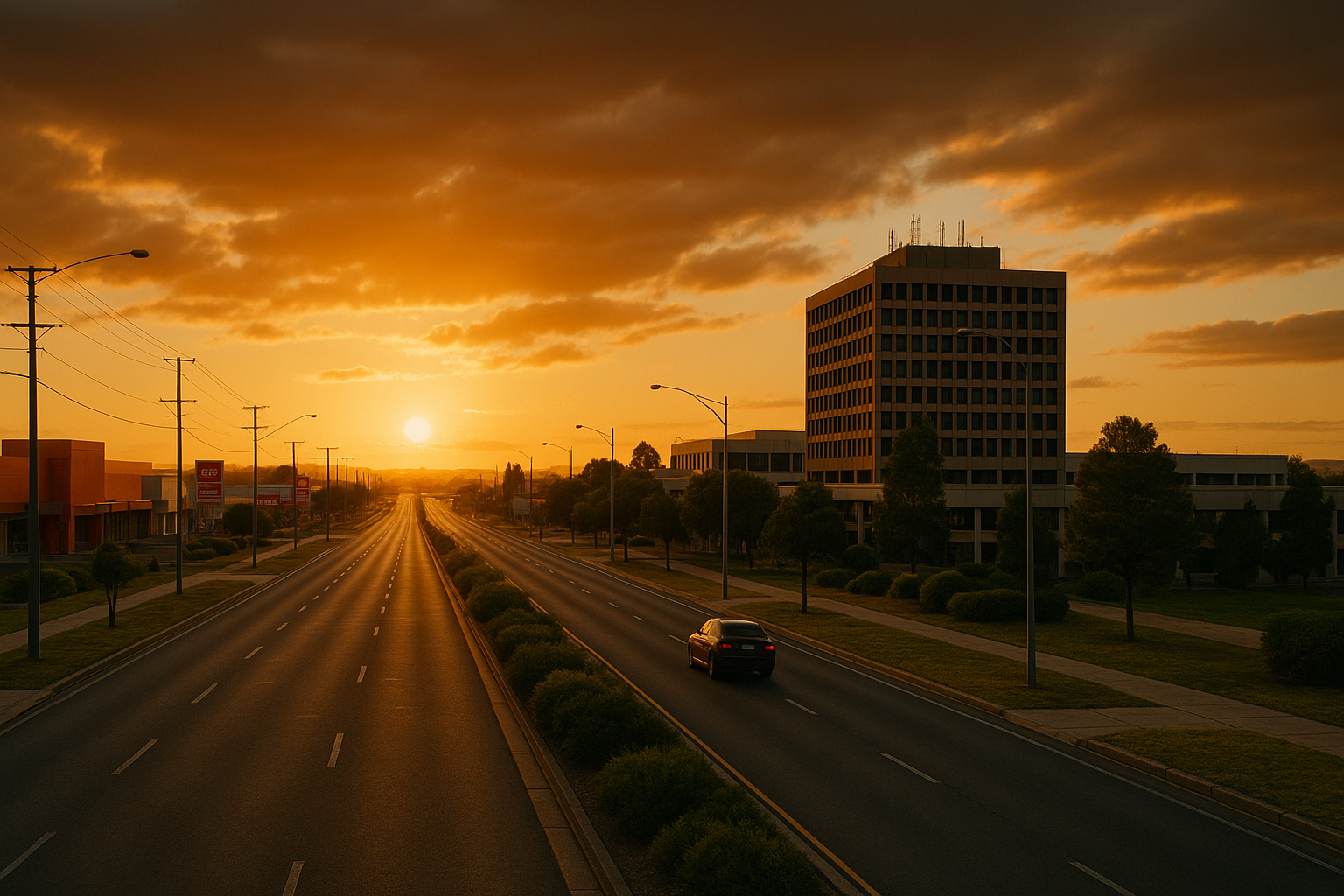
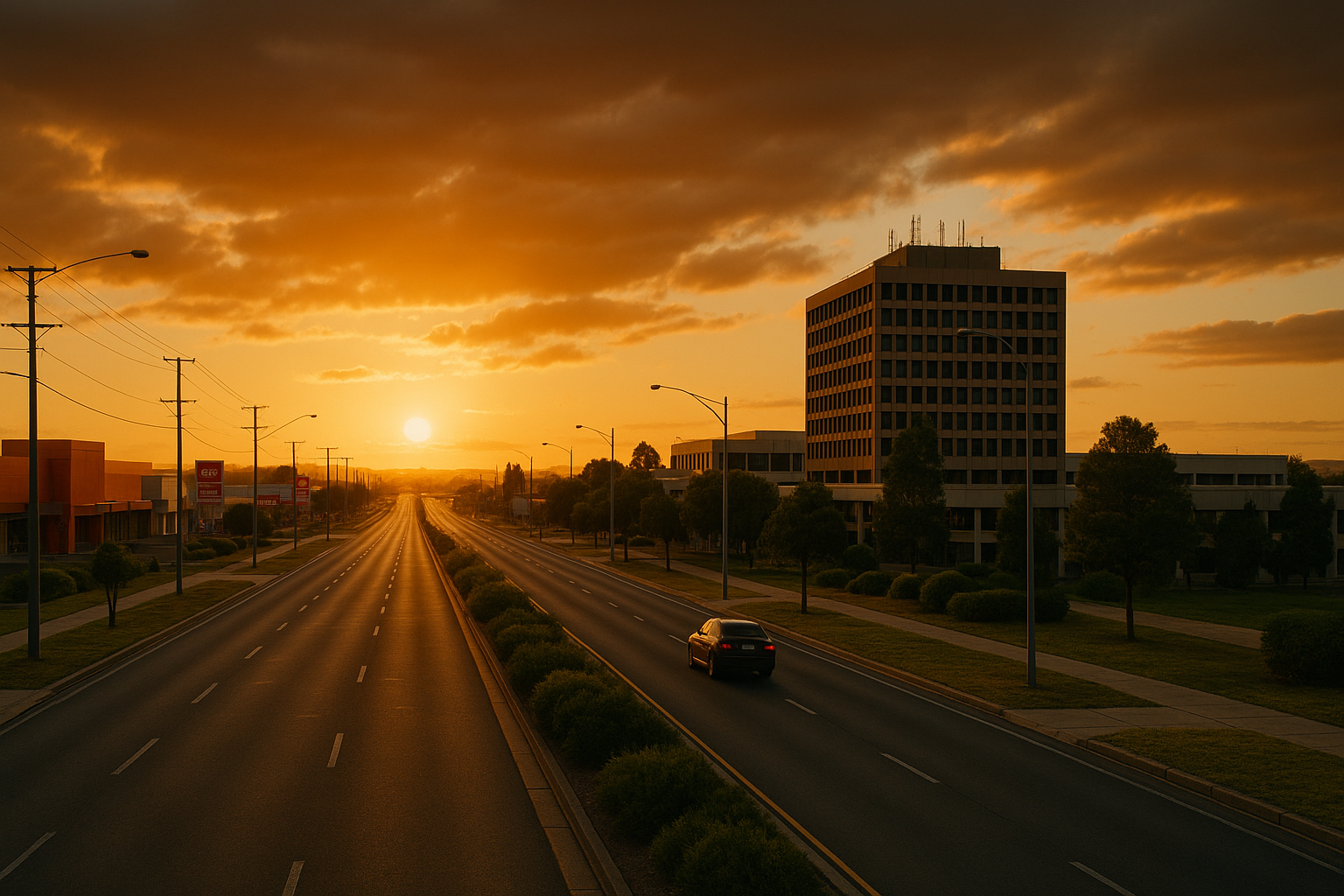
Elizabeth, South Australia, Australia
Elizabeth, in Adelaide's north, was inaugurated in November 1955 as a planned satellite city built by the South Australian Housing Trust to house British migrants drawn out under assisted passage. For half a century the General Motors Holden plant on Philip Highway gave the suburb its working rhythm and its identity, before manufacturing's long retreat. Birthplace of the Baker and Novak children at the Lyell McEwin Hospital and the troubled home of the Smith family, Elizabeth endured decline, amalgamation and reinvention with stubborn communal resilience.
Wheatfields and a Royal Name
Elizabeth occupied a stretch of flat plain roughly twenty-four kilometres north of central Adelaide, on land that had carried wheat crops and little else until the middle of the twentieth century. The South Australian Housing Trust acquired close to four thousand acres of this country between the older settlements of Smithfield and Salisbury, intending to raise an entire town where there had been paddocks. On 16 November 1955 the Premier, Sir Thomas Playford, formally inaugurated the new town and announced that, by the gracious permission of Her Majesty, it would carry the name Elizabeth, after the young Queen whose coronation was barely two years past.
The Trust's ambition was precise and total. Planners set a target population of twenty-five thousand and made provision for some six thousand houses, alongside the shops, schools, churches, ovals and reserves that a self-contained community required. The design borrowed consciously from British new-town principles, arranging neighbourhoods around greens and walks rather than a simple grid. Street names such as Windsor Green and Prince Charles Walk announced the loyalties of the place before a single migrant had unpacked, and the gentle curves of its avenues set it apart from the rectilinear monotony of older suburbs.
That Britishness was no accident of nomenclature. The Trust ran an advertising campaign in England, courting families willing to cross the world under assisted passage for the sum of ten pounds, and the first house in the town was occupied that very November by an English household. Through the late 1950s and into the 1960s, ships delivered Midlands and northern families onto a half-built frontier of raw brick and unsealed verges. They brought their accents, their football allegiances and their suspicion of the Adelaide heat, and made of Elizabeth something that felt, for a generation, like a transplanted corner of Britain pressed into the red earth.
The early years were not comfortable. Families arrived to find streets without footpaths, gardens without topsoil and a summer heat that no English winter had prepared them for. Dust blew through the half-finished estates, the nearest shops could be a long walk across open ground, and homesickness ran through the migrant houses like a low fever. Yet the Trust's homes were sound and cheap, the work was close at hand, and for people who had left behind the cramped terraces and rationing of post-war Britain, a brick house with its own yard beneath a wide sky was an unmistakable advance.
The Line at Philip Highway
The town had been conceived as a manufacturing centre, and its centre of gravity was fixed late in 1955 when Playford persuaded the president of General Motors to site a new Holden factory at Elizabeth. The Housing Trust's general manager, Alex Ramsay, was dispatched to sell the visitor whatever land he favoured; the Premier's standing instruction was that any reasonable request be met, and when the company wanted a road moved, the road was moved. Philip Highway still carried the resulting deviation around the ground the plant would occupy for the next half-century.
Work began on the site in 1958. The first vehicle parts came off in 1959, the first car bodies in 1962, and in 1963 the first complete Holden rolled out beneath the long roofs at 180 Philip Highway. The factory's prestige was sealed on 21 February that year, when Queen Elizabeth II and the Duke of Edinburgh toured the assembly line that bore her name. For the families of Elizabeth the plant was less a symbol than a livelihood — a place of shift sirens, rotating rosters and the particular tiredness of bodies that built cars by the thousand.
In its prime the plant pressed and welded bodies and married them to engines shipped from Melbourne, turning out the Commodores that became the suburb's quiet pride. Generations followed one another onto the floor; a school-leaver could expect, almost as a matter of course, that the line would take him as it had taken his father. The wage it paid built the extensions, bought the caravans and underwrote the modest security that the migrant families had crossed an ocean to find.
Among the men who took their place on that line was Pavel Novak, who had left Czechoslovakia in 1987, two years behind an elder brother bound for a surgeon's comfortable life in Melbourne. Pavel arrived in Adelaide with thinner qualifications and dimmer prospects, found work at the Holden plant, married an Australian woman named Dorothy Hennessy and raised his son Stefan in a fibro house on a street where shift workers' cars lined the kerb at odd hours. The gulf between his circumstances and his brother's would harden, across the years, into silence.
The Trust's Children
For the families who filled the Trust's streets, Elizabeth offered a particular kind of order. Houses came in standardised brick and tile on quarter-acre blocks with room for a Hills hoist and a vegetable patch; rents were affordable, the schools were new, and the nearness of work meant a man could ride a bicycle to the line. The suburb acquired its institutions quickly — primary schools scattered through the neighbourhoods, high schools to hold the children to leaving age, and the churches that anchored the migrant communities, among them a Latter-day Saint congregation whose families would prove unusually rooted.
Childhood in Elizabeth had its own texture across these decades. It was bicycles dropped on verges, cricket played in cul-de-sacs until the light failed, the long flat walk to school past identical fences, and the constant background presence of the plant, its sirens carrying across the suburb and its shifts ordering the comings and goings of half the fathers on the street. For the children of the Trust's houses it was, whatever hardship ran beneath it, simply the shape of the world.
Nearly every child of those streets entered the world at the same threshold. The Lyell McEwin Hospital, opened in 1959 at Elizabeth Vale, grew from a modest district facility into the principal hospital of Adelaide's north, and across the decades its maternity ward registered the births that seeded the suburb's next generations. Amelia Grace Baker was delivered there on 28 May 1993, the eldest of what would become seven children in a devout household at neighbouring Smithfield, her childhood shaped by the weight of a first-born's duty in a family where service was understood as virtue.
The Baker home exemplified a certain rootedness. Jonathan Edward Baker, an environmental engineer, and his wife Evelyn raised their seven children within the rhythms of the Latter-day Saint ward at Playford — family devotions, Saturday workshop mornings, the Relief Society lessons on selfless service that Amelia absorbed as gospel and, privately, sometimes resented. As the eldest she became her mother's deputy, mothering the younger ones before she had finished being a child herself, a compression of self she would carry, unexamined, into her own adulthood.
Five years after Amelia, the same ward received Taryn Elise Novak, born on 3 September 1998 to Pavel's son Stefan and his wife Kylie. The Novaks belonged to the other Elizabeth, the one the brochures had never advertised. Theirs was a Housing Trust property in Elizabeth Downs, a household strained by drink and unpaid bills, and Taryn's earliest memories carried the particular acoustics of a marriage failing through thin walls. She learned young to read the weather of a difficult house, a vigilance that would harden, in time, into a refusal to become what her father was.
A Birth Kept Quiet
Not every arrival at the Lyell McEwin came easily. On the winter morning of 19 July 1984 the maternity ward became the scene of something closer to catastrophe, when Heather Marie Smith, heavily pregnant and gravely unwell, turned a shard of broken glass against herself in the grip of a breakdown the staff had not foreseen. Her son Luke was delivered by emergency caesarean amid the blood and the panic, critically premature and, against every expectation, alive. His mother was placed at once into an induced coma, and her survival, like his, remained uncertain for days.
In the aftermath a quiet decision was taken between Heather's husband, Noah, and a nurse named Margaret who had cared for the family before: that the boy would never be told the truth of how he came into the world. The secrecy that settled over Luke's first hours would shadow the household for years afterward. It was a beginning that owed nothing to celebration and everything to concealment, and it set the pattern of a family that kept its worst moments behind its own front door.
That door, from early 1986, belonged to a single-storey brick-veneer house on a corner block in Elizabeth Park, taken when Noah James Smith found steady work at a local Ford dealership. The home filled with the ordinary clutter of a modest family — Noah the quietly capable mechanic, Heather a poet and artist whose good days produced verse and whose bad ones produced withdrawal and fear, and their two boys, Paul at the piano and Luke retreating into solitary imaginings. Bindii crept across the front lawn in summer; the rotary telephone in the hall stretched its cord to accommodate both confidences and quarrels.
For Luke the house was at once refuge and battleground. He marked his early birthdays in its small rooms, kept the company of a stuffed toy he called Blue Bear through the worst of the nights, and listened to his brother's piano carry over the tension at the dinner table. The local Latter-day Saint community lent the children routine and a measure of shelter, though the household's isolation from extended family meant that little outside help ever truly reached past the front step.
The marriage did not hold. By the early 1990s financial strain and Heather's untreated illness had worn the household to its threads, and in the middle of 1992 a violent confrontation ended with her being removed from the house for good. Police came to the address more than once across those years, though nothing was ever formally charged. Neighbours remembered the Smith boys as well-mannered and withdrawn, and the house kept the marks of it all — the broken doors, the long silences — for a good while after the shouting had stopped.
When the Line Went Quiet
The prosperity the Trust had engineered did not prove permanent. The Australian car industry contracted steadily from the 1980s, and as rival plants closed across the country, Elizabeth was left, by 1989, as the last Holden assembly line standing. It was a precarious distinction. Each restructure demanded faster production and fewer hands, and the suburb built around a single industry began to feel the ground move beneath it. Elizabeth had become a city in its own right in 1964; in 1997 that city was absorbed into the larger City of Playford, reduced from a municipality to the commercial heart of the district around it.
By then the suburb's name carried a freight it had not been born with. In the wider state's imagination Elizabeth had become shorthand for disadvantage — for the housing estate and the dole queue and the troubles that concentrated poverty breeds — a reputation that flattened the place to a single grim note and overlooked the ordinary decency of most of its people. Those who had grown up there knew a more complicated truth: that the same streets held hardship and neighbourliness in roughly equal measure, and that the two were not unrelated.
The decline showed plainly enough on the ground. Charity shops and payday lenders took the prominent frontages, unemployment settled in for the long term, and the fierce communal bonds that hardship forges held the place together where the economy could not.
The Novaks lived that economy from below. When Stefan walked out on his family in February 2010 — emptying the joint account of its few hundred dollars and never coming back — Kylie kept the Housing Trust roof over her children by working the registers at the Elizabeth City Centre Coles, stretching wages and Centrelink payments across a fortnight that never balanced. Her daughter Taryn passed through the local South Downs Primary School, where most pupils qualified for the card that subsidised fees and uniforms, and the weekend clean-ups along the Little Para River first woke in her the environmental conviction that would carry her, the first of her family, to a university degree.
The end, when it came, was ceremonial. On 20 October 2017 the last Holden was driven off the Elizabeth line, closing fifty-five years of assembly at Philip Highway and taking the last of the area's car-manufacturing jobs with it. For a town raised quite literally around the factory, the closure was less an economic event than a bereavement — the quieting of a rhythm that had marked the suburb's days since before most of its residents were born.
The Suburb That Remained
Those who left Elizabeth left in every direction. The Baker parents and their youngest children departed in 2019 for a destination Amelia — settled by then into a teacher's life and a young family in the Adelaide Hills — declined to follow, a separation she grieved without being able to name it fully. Taryn Novak built her escape more conventionally, finishing her degree and her conservation work and renting, at last, a small unit of her own. The suburb that had raised them both carried on without them, as suburbs do.
What remained was a community more durable than its fortunes. Redevelopment reshaped the older Housing Trust stock; new arrivals, among them a substantial Nepalese community, settled alongside the descendants of the original British migrants and gave the place a diversity its founders could not have imagined. The defence and research establishments out at Edinburgh offered work of a different order from the vanished assembly line, and the trains still ran down the Gawler line toward a city that had always regarded its northern satellite with a mixture of condescension and unease.
The shopping centre at its heart still gathered the surrounding suburbs in, for Elizabeth had long since lent its name, in common speech, to the whole northern reach around it, so that to speak of the one was very often to mean the other. The hospital at Elizabeth Vale still received the newborn of the north, as it had in the years when Amelia Baker and Taryn Novak and Luke Smith each first drew breath there. Elizabeth entered its eighth decade neither prosperous nor defeated — a planned town that had outlived its plan, holding to the stubborn solidarity that two generations of hardship had taught it.







