Edinburgh, Midlothian, Scotland
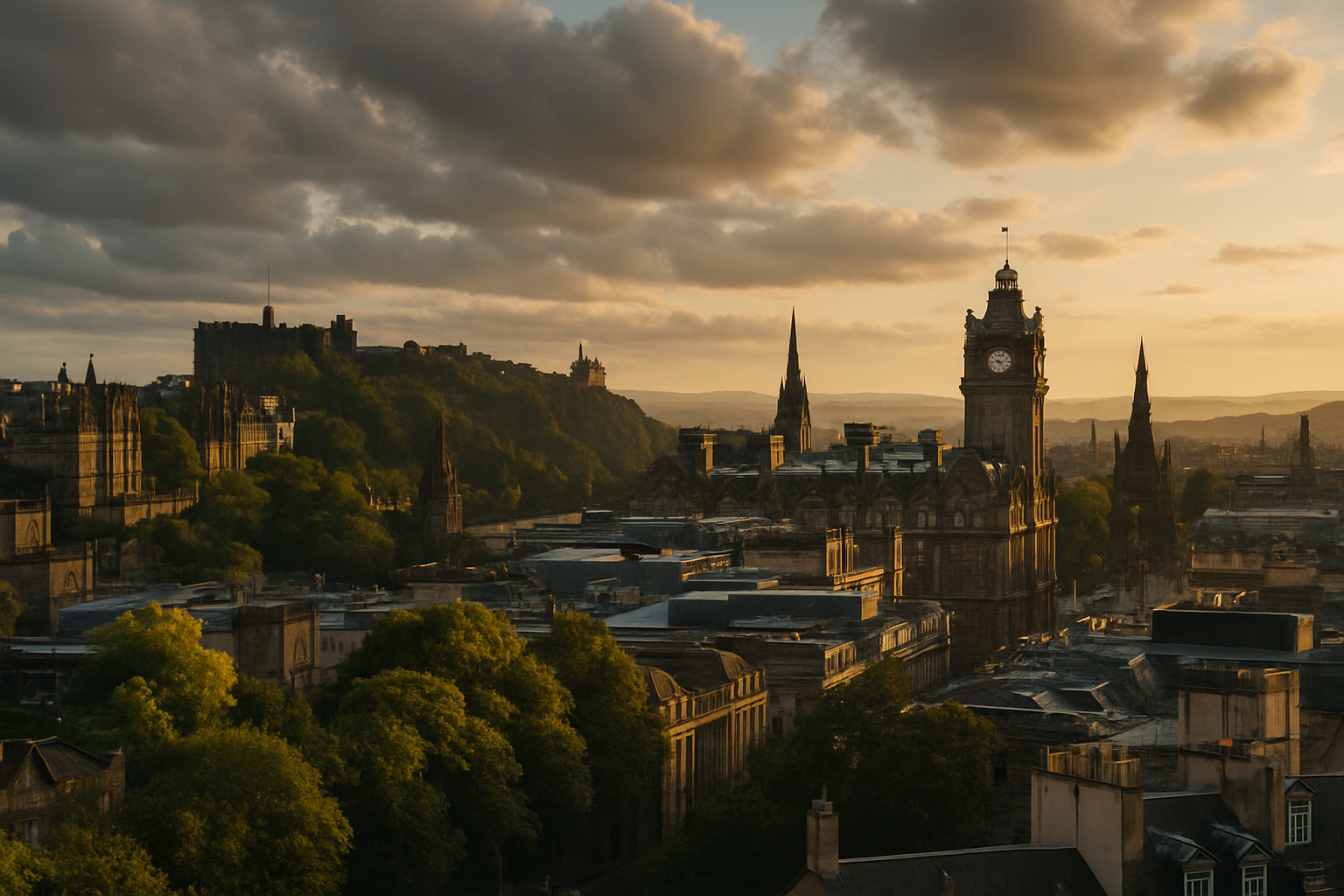
Edinburgh, Scotland's ancient capital, rises from volcanic foundations where Castle Rock has witnessed human habitation since the Bronze Age. From medieval fortress to Enlightenment crucible, the city nurtured philosophers, craftsmen, and the remarkable Stewart sisters whose eighteenth-century migration established New Edinburgh in Clivilius. Its cobbled closes and Georgian terraces have shaped generations of thinkers, healers, and Guardians, whilst modern Edinburgh continues producing individuals whose destinies intertwine with dimensional forces.
Ancient Foundations and Medieval Development
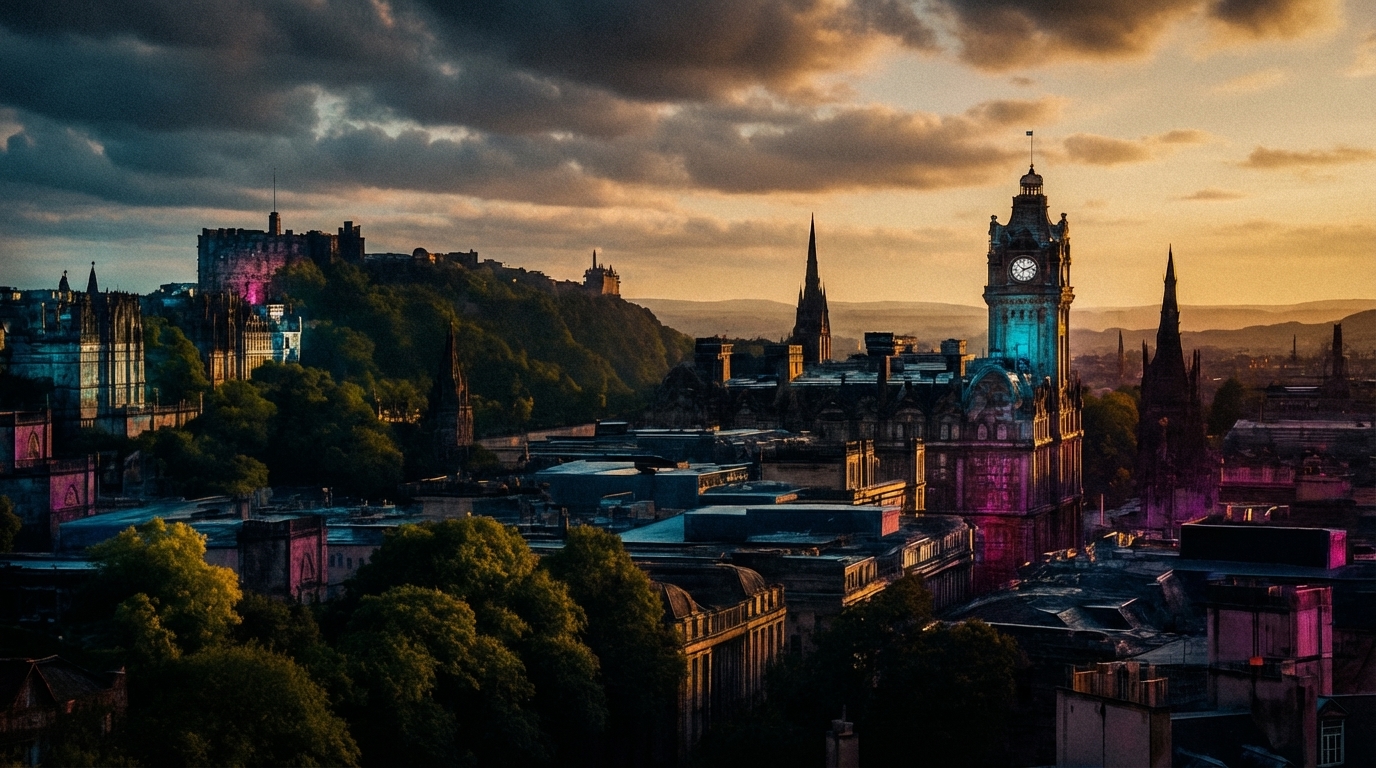
Edinburgh owes its existence to geology and strategic necessity. Castle Rock, the volcanic plug that dominates the city's skyline, has sheltered human settlement since approximately 900 BCE, when Bronze Age peoples first recognised the defensive advantages of its precipitous cliffs. The rock rises some eighty metres above the surrounding landscape, its western, southern, and northern faces presenting near-vertical approaches that rendered early fortifications virtually impregnable.
The city's name likely derives from the Old English "Eidyn" combined with "burh," meaning fortress, though Scottish tradition associates the name with King Edwin of Northumbria who supposedly captured the stronghold in the seventh century. Whatever the etymology, Edinburgh had established itself as a significant settlement by the time David I granted it royal burgh status in the twelfth century, conferring trading privileges that would shape its commercial character for centuries to come.
The medieval city developed along a single spine—the ridge descending from Castle Rock to the Abbey of Holyrood, a route that would become known as the Royal Mile. This kilometre-long thoroughfare accumulated the characteristic closes, wynds, and courtyards that still define Edinburgh's Old Town, where buildings rose to extraordinary heights as the population grew within the confining walls. By the sixteenth century, tenements of ten or twelve storeys crowded the ridge, their inhabitants representing every stratum of Scottish society from nobles to labourers, all sharing the same narrow staircases and communal wells.
The Grassmarket, lying in the valley beneath the castle's southern ramparts, emerged as Edinburgh's commercial heart—a sprawling marketplace where livestock changed hands, merchants hawked their wares, and public executions drew crowds to the gallows that stood at its eastern end. This confluence of commerce and mortality, of ordinary transaction and extraordinary spectacle, exemplified Edinburgh's essential character: a city where the mundane and the remarkable existed in constant proximity.
The Scottish Enlightenment
The eighteenth century transformed Edinburgh from a medieval stronghold into what contemporaries called the "Athens of the North"—a centre of intellectual ferment that reshaped Western thought. The Scottish Enlightenment, flourishing roughly between 1730 and 1790, produced a concentration of genius that defied the city's modest population. David Hume revolutionised philosophy; Adam Smith founded modern economics; James Hutton established geology as a science; Joseph Black discovered carbon dioxide and latent heat. These luminaries and dozens of others gathered in Edinburgh's taverns, clubs, and drawing rooms, engaging in discourse that would echo through subsequent centuries.
The physical city transformed alongside its intellectual life. The North Bridge, completed in 1772, connected the cramped Old Town to the open ground beyond the Nor Loch, enabling the construction of James Craig's New Town—a planned development of geometric precision and neoclassical elegance that contrasted sharply with the organic chaos of the medieval streets. Georgian terraces of honey-coloured stone lined broad avenues and gracious squares, offering Edinburgh's prosperous classes escape from the Old Town's congestion whilst maintaining proximity to its commercial vitality.
Yet the Enlightenment's rational discourse coexisted with older traditions. Herbalists like Agnes Fiona MacPherson, born in the Grassmarket on 12 May 1723, continued practising healing arts that predated scientific medicine. Artisans maintained craft traditions stretching back centuries. And beneath the surface of polite society, networks of less respectable enterprise flourished—most notoriously in the person of William Brodie, born on 28 September 1741, whose respectable daytime identity as Deacon of the Incorporation of Wrights concealed nocturnal activities as a burglar and gang leader.
The Stewart Family and the Clivilius Connection
Among the countless families inhabiting eighteenth-century Edinburgh, the Stewarts of the Old Town occupy a position of singular importance in the broader tapestry of dimensional history. Angus Stewart, a blacksmith whose forge served the city's practical needs, and his wife Morag MacKenzie, a skilled seamstress, produced four daughters whose collective destiny would extend Edinburgh's influence across realms that contemporary philosophy could not have imagined.
Elspeth Morag Stewart arrived first, born on 17 May 1738 beneath Castle Rock's shadow at the precise moment of 11:11—a detail that would acquire significance only in retrospect. The city that witnessed her birth was already stirring with Enlightenment energies, though the full flowering of that intellectual movement lay years ahead. Elspeth grew up absorbing Edinburgh's peculiar mixture of ancient tradition and emerging modernity, her father's practical craftsmanship complementing her mother's artistic sensibilities.
Euphemia, known as Effie, followed on 3 November 1742, her childhood shaped by accompanying Angus to the Grassmarket where she observed the intricate negotiations of merchant culture. Katrina arrived on 12 February 1744, developing under Morag's guidance a passion for cultivation that Edinburgh's market gardens and surrounding farmland nurtured. Finally, Violet completed the quartet on 8 August 1746—just months after the catastrophic Jacobite defeat at Culloden had reshaped Scotland's political landscape forever.
The sisters' Edinburgh childhood ended with Angus Stewart's death in 1754, forcing the family into circumstances that would ultimately redirect their lives toward extraordinary purpose. Elspeth found employment at Moira MacKenzie's Emporium of Fashion, a prestigious establishment on the High Street where she worked alongside Agnes Fraser, born in the Old Town on 17 April 1720. The Emporium served Edinburgh's fashionable classes whilst harbouring connections to networks that operated beyond conventional commerce.
In 1762, the Stewart sisters received appointments as Guardians—Elspeth on 28 April, Katrina on 19 May, and Violet on 21 May, with Effie's appointment following on the same date as Elspeth's. Their recruitment, facilitated by Guardian Lizbeth Wilson, initiated a migration that would carry Edinburgh's essence across dimensional boundaries. When Elspeth established New Edinburgh in Clivilius, she transplanted not merely Scottish settlers but the accumulated wisdom of her birthplace—its architectural sensibilities, its communal traditions, its blend of practical craft and intellectual ambition.
Moira MacKenzie's Emporium of Fashion
The establishment at which Elspeth Stewart apprenticed following her father's death represented more than a commercial enterprise. Moira MacKenzie, a Highland seamstress who had arrived in Edinburgh during the 1730s, transformed Madame Élisabeth Rochefort's existing dressmaking workshop into a centre of fashion and, less visibly, of activities that extended beyond needle and thread.
The Emporium occupied premises on Edinburgh's High Street, serving clientele that ranged from merchants' wives to aristocratic ladies requiring gowns for the social occasions that punctuated the city's calendar. Agnes Fraser, who had joined the establishment in 1734 under Madame Rochefort's proprietorship, provided the practical discipline that balanced Moira's more ambitious visions. Together, they created an environment where young women like Elspeth Stewart could develop skills whilst absorbing understanding of Edinburgh's complex social networks.
The Emporium weathered the upheavals of the 1745 Jacobite Rising, when Edinburgh briefly fell under Prince Charles Edward Stuart's control before the campaign's ultimate failure at Culloden. Political tensions that swirled through the city's streets found muted expression in the workroom, where Moira MacKenzie's own Highland origins required careful navigation of loyalties that could prove dangerous if too openly declared.
Following Moira's death in 1780, Agnes Fraser ensured the establishment's continuation until her own passing on 12 September 1790, by which time the Stewart sisters had long since departed for Clivilius. The Emporium's legacy persisted not in Edinburgh's fabric trade but in the training it had provided to women who would carry its lessons across dimensions.
William Brodie and Edinburgh's Duality
No figure better embodied Edinburgh's characteristic tension between respectability and shadow than William Brodie, whose double life inspired Robert Louis Stevenson's later exploration of human duality in Strange Case of Dr Jekyll and Mr Hyde. Born into a prosperous cabinet-making family, Brodie inherited both his father Francis's trade and his position as Deacon of the Incorporation of Wrights—one of the fourteen trade guilds that governed Edinburgh's commercial life.
By day, Brodie maintained premises on the Lawnmarket, crafting furniture of sufficient quality to serve Edinburgh's finest households. His position granted him access to residences throughout the city, access he exploited during nocturnal expeditions that saw him leading a gang of burglars in raids on the very establishments whose locks he had helped to install. The duality was exquisite: the respected tradesman whose fingers could craft exquisite joinery or pick any lock with equal facility.
Brodie's path intersected with Elspeth Stewart's at a soirée held at Balcarres House on 12 March 1758, hosted by John Leslie, the 8th Earl of Rothes. The grand residence, commissioned by Leslie as an expression of Edinburgh's architectural ambitions, provided the setting for an encounter that would eventually draw Brodie into Guardian activities. He received his own appointment on 9 July 1762, his particular skills proving invaluable for establishing Chewbathia's defences in Clivilius.
The botched robbery of the Excise Office in March 1788 ended Brodie's Edinburgh career, though Guardian intervention ensured his survival beyond the gallows where he apparently hanged on 1 October of that year. He lived nineteen further years in Clivilius, dying at Chewbathia on 23 February 1807 at the age of sixty-five—a conclusion that Edinburgh's history books could never record.
The University and Medical Tradition
Edinburgh's intellectual distinction rested substantially upon its university, founded in 1583 and developed through subsequent centuries into one of Europe's premier centres of learning. The medical school, established in 1726, attracted students from across Britain and beyond, its clinical teaching methods and anatomical instruction setting standards that rival institutions struggled to match.
Thomas William Abernathy, born in Edinburgh on 17 March 1782 to physician Robert Abernathy and herbalist Margaret Campbell, exemplified the medical tradition that the city nurtured. His education combined his father's scientific rigour with his mother's knowledge of traditional remedies, producing a ship's doctor who would carry Edinburgh's healing arts across distant oceans aboard vessels like the Persephone.
The university's influence extended beyond medicine into every branch of learning. Chemistry, geology, philosophy, literature—Edinburgh's academic community pursued knowledge with an intensity that attracted ambitious minds from throughout Scotland and beyond. Charles Edmund Livingston, born on 22 October 1835, absorbed the city's commitment to meticulous inquiry before carrying his expertise in toxicology to San Francisco, where he would achieve distinction in forensic science.
This tradition of intellectual cultivation persisted into modern times. Hugo Alexander Macdonald, born on 12 July 1980, emerged from Edinburgh's academic environment as a theoretical physicist whose work on nanotechnology would eventually connect him to the CLIVE virus project at Killerton Enterprises—a trajectory that linked Edinburgh's Enlightenment heritage to twenty-first-century dimensional research.
Edinburgh Castle and Civic Identity
The castle that crowns Castle Rock has served continuous military purpose longer than any other fortification in Britain, its strategic importance ensuring that successive generations invested in its maintenance and enhancement. The Honours of Scotland—crown, sceptre, and sword of state—reside within its walls, tangible symbols of Scottish sovereignty that survived even the 1707 Act of Union that merged the Scottish and English parliaments.
The castle's esplanade, the broad parade ground created in the eighteenth century, hosts the annual Royal Edinburgh Military Tattoo and various civic gatherings that draw visitors from across the globe. The Edinburgh Castle Artisan Food Festival, held on 5 April 2025, brought the Campbell family—Daniel Alistair Campbell, born at Simpson Memorial Maternity Pavilion on 3 September 1976, and his extended family—to display their distinctive coffee creations beneath the castle's ancient stones.
The Campbells' presence at the festival represented more than commercial enterprise. Their carefully guarded legacy, connecting to traditions that extended beyond ordinary commerce, attracted attention from observers whose interest exceeded casual curiosity. Edinburgh's castle grounds, which had witnessed centuries of intrigue and display, provided an appropriately charged setting for encounters that tested the family's ability to balance public presentation with private protection.
Modern Edinburgh
Contemporary Edinburgh maintains the duality that has characterised the city throughout its history. The annual festivals—the International Festival, the Fringe, the Book Festival—transform the city each August into a global cultural hub, whilst the financial services sector that emerged following the 1980s deregulation has established Edinburgh as a significant centre of investment management and banking.
Michael David Pearson, born on 14 March 1974, exemplified Edinburgh's financial tradition before relocating to Sydney, where his advisory practice served clients including those facilitating property acquisitions with connections to broader dimensional activities. Alexander James Hawke, born beneath Castle Rock's shadow on 17 April 1990, absorbed the city's martial heritage before military service led him toward Guardian responsibilities at Lynwood Heights in Clivilius.
Calum Douglas McKenzie, born on 4 October 1975 at the Royal Infirmary when autumn mist rolled across Leith, established McKenzie's Artisan Roasters on Bonnington Road, his meticulous approach to coffee cultivation reflecting Edinburgh's enduring commitment to craft excellence. Finlay Thomas Brittain, born on 12 May 1995, developed the technical skills that would eventually serve Bixbus in Clivilius, his Edinburgh childhood providing foundations that translated across dimensional boundaries.
The city continues producing individuals whose paths lead toward the extraordinary. Its ancient stones, its academic institutions, its commercial networks—all contribute to shaping lives that extend beyond Edinburgh's geographic boundaries whilst remaining rooted in its particular character. The Scottish capital that nurtured the Stewart sisters in the eighteenth century still nurtures potential Guardians in the twenty-first, its role as a crossing point between ordinary existence and dimensional significance persisting across the centuries.
Character and Continuity
Edinburgh's essential nature resists simple characterisation. The city embodies contradictions that coexist rather than resolve: medieval and modern, rational and mystical, respectable and shadowy, Scottish and cosmopolitan. Its volcanic foundations produced defensive advantages that accumulated centuries of human habitation; its intellectual traditions attracted minds that reshaped Western thought; its artisan culture preserved practical skills that proved valuable across dimensions.
The Stewart sisters carried Edinburgh's essence to Clivilius not as abstract concept but as lived experience—the social dynamics of the Grassmarket, the craft traditions of the Old Town workshops, the architectural sensibilities that would shape New Edinburgh's development. When Violet Stewart designed buildings for the new settlement, she drew upon memories of Edinburgh's own transformation from medieval congestion to Georgian elegance. When Effie established trade networks, she applied lessons learned watching merchants negotiate in her father's beloved Grassmarket.
Edinburgh's gift to Clivilius extended beyond its emigrant daughters. The city's capacity for producing individuals of extraordinary capability—healers, craftsmen, scholars, soldiers, entrepreneurs—has continued across centuries, each generation contributing new threads to the tapestry that connects Scotland's capital to dimensions beyond ordinary perception. The cobblestones that witnessed David Hume's philosophical perambulations and William Brodie's nocturnal expeditions continue witnessing lives that will prove significant in ways their contemporaries cannot imagine.
The city endures, its castle commanding the skyline as it has for millennia, its closes preserving medieval patterns beneath modern surfaces, its institutions cultivating minds that may yet reshape understanding of what existence encompasses. Edinburgh remains what it has always been: a place where the ordinary and the extraordinary exist in constant proximity, where ancient stone witnesses modern ambition, where the boundaries between worlds prove more permeable than casual observation might suggest.







