East Launceston Primary School, Tasmania
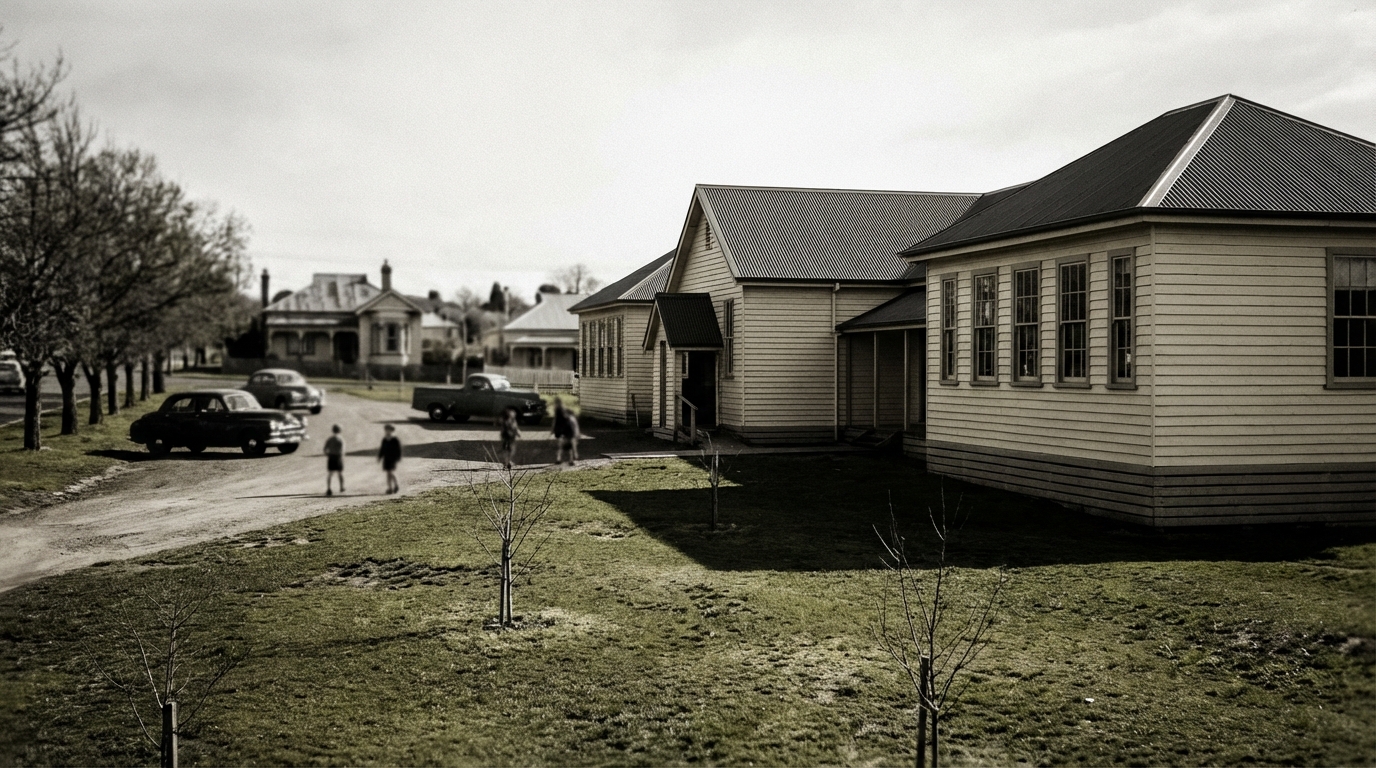
East Launceston Primary School has served the leafy eastern suburbs of Launceston since 1953, its weatherboard classrooms and shaded courtyards embodying Tasmania's post-war commitment to neighbourhood education. Established amid the suburban expansion that followed the Second World War, the school occupies a site where heritage homes and tree-lined streets create an environment of quiet stability. Within these cream-painted walls, generations of children have encountered their first structured learning—counting games and story hours, basic cartography and seasonal observation—carrying forward the methodical habits instilled by teachers whose patience shaped futures they would never witness.
Post-War Foundations
The establishment of East Launceston Primary School in 1953 reflected broader patterns of suburban development that transformed Australian cities in the decade following the Second World War. Launceston, like its mainland counterparts, experienced significant population growth as returning servicemen established families and European migrants arrived under assisted passage schemes. The eastern suburbs, with their established residential character dating from the Federation-era mineral boom, attracted young families seeking proximity to the city centre whilst enjoying the quieter rhythms of tree-lined streets and heritage architecture.
The site selected for the new school occupied land at the corner of Abbott and Mary Streets, positioned to serve the growing population of what would be formally gazetted as the locality of East Launceston in 1963. The original buildings followed standard Education Department designs of the period—weatherboard construction with cream-painted exteriors, high ceilings for ventilation, and large windows admitting northern light. These modest structures, whilst lacking architectural distinction, possessed the functional dignity characteristic of post-war public buildings: honest materials, practical layouts, and sufficient durability to serve successive generations.
The school's early years coincided with Launceston's continued industrial development. The city that had prospered through tin mining at Mount Bischoff and gold extraction at Beaconsfield maintained its position as Tasmania's commercial capital, whilst newer industries—textiles at Waverley Woollen Mills, engineering at various foundries—provided employment for families whose children filled the new suburban schools. East Launceston Primary drew students from households where fathers worked in trades and professions, where mothers maintained homes in the Federation cottages and inter-war bungalows that characterised the neighbourhood.
The Oval and Community Partnership
The relationship between school and community found physical expression in the oval and pavilion that distinguish East Launceston Primary from institutions relying solely on government provision. The land where children now play organised sports and conduct physical education was originally a market garden, its fertile soil supplying produce to Launceston households before suburban expansion rendered such agricultural use impractical.
When the market garden's owner signalled intention to subdivide in the early 1930s, the school faced a crisis familiar to urban institutions: adequate classroom space but insufficient grounds for outdoor activity. The response demonstrated community resourcefulness that would characterise the school's subsequent history. Parents organised themselves, raising funds to purchase three-quarters of the available land whilst the Education Department acquired the remainder. This partnership—community initiative supplementing government provision—established precedents that persist into the present day.
The Depression years that followed the purchase saw volunteer labour transform the acquired land. Parents who might have spent weekends seeking scarce employment instead gathered to clear vegetation, level ground, and create the oval that would serve their children and grandchildren. This collective effort, undertaken during Tasmania's most economically difficult period, embedded community ownership into the school's physical fabric. The land was not a gift from government but a purchase by parents who sacrificed limited resources for their children's benefit.
The original pavilion, erected on the opposite side of the oval from its current successor, provided shelter and storage for the developing sports programme. When this structure reached the end of its useful life, the Parents and Friends Association again mobilised resources, combining volunteer labour with fundraising and a state government loan to construct the current pavilion in the 1980s. This building, fronting Oxford Street, continues serving both school and community—a tangible reminder that East Launceston Primary exists through sustained partnership rather than government provision alone.
Educational Character
The pedagogical approach that distinguished East Launceston Primary emerged from its particular circumstances: a neighbourhood school serving established families, staffed by teachers who often remained for decades, operating within physical constraints that demanded creativity. The weatherboard classrooms, whilst well-maintained, lacked the flexibility of purpose-built modern facilities. Teachers learned to maximise limited space, to move furniture for different activities, to extend learning beyond classroom walls into the shaded courtyard and community oval.
The curriculum followed Education Department requirements whilst reflecting local emphases. Literacy and numeracy formed the foundation, as in all Tasmanian primary schools, but teachers developed particular strengths in areas suited to the school's character. Story hours became theatrical events under teachers who understood that narrative engagement preceded analytical comprehension. Counting games incorporated physical movement, taking advantage of outdoor spaces when weather permitted. Basic cartography—mapping the school grounds, the neighbourhood, the journey from home—introduced spatial reasoning through familiar territory.
Seasonal observation connected classroom learning to the natural environment. The established gardens surrounding East Launceston homes, the deciduous trees lining neighbourhood streets, the changing light as winter shortened days and summer extended them—all provided material for scientific inquiry grounded in direct experience. Teachers who walked the same streets as their students could reference shared observations, building understanding from common ground rather than abstract principle.
The school's size—large enough for adequate resources but small enough for individual recognition—created conditions where teachers knew students as individuals rather than anonymous members of cohorts. Children who struggled received attention; those who excelled found challenge. This personalised approach, possible in neighbourhood schools serving stable populations, produced educational outcomes that standardised metrics could not fully capture.
The Teaching Culture
The staff who shaped East Launceston Primary's character represented a generation of educators for whom teaching constituted vocation rather than mere employment. Many remained at the school for decades, their tenure spanning the educational journeys of siblings, sometimes of parents and children. This continuity created institutional memory that informed daily practice—knowledge of which approaches succeeded with particular types of learners, understanding of family circumstances that might affect student performance, awareness of community expectations and values.
Miss Carolyn Partridge exemplified this teaching culture during the 1990s. Her patient guidance of preparatory students introduced five-year-olds to the structured environment of formal education. She possessed the particular gift of recognising individual learning styles—understanding which children thrived on routine and which required variety, identifying those who processed information visually and those who learned through physical engagement. Her counting games and sequencing activities laid foundations for mathematical reasoning; her introduction to basic cartography developed spatial awareness that would serve students throughout their educational careers.
Mrs Dewsnap brought theatrical sensibility to story hours that transformed passive listening into imaginative engagement. Her animated readings gave voice to characters, her pacing built suspense, her questions following each story required students to synthesise narrative elements and predict consequences. Children who encountered literature through her performances developed relationships with books that persisted beyond her classroom, carrying into secondary education and adult life the understanding that reading offered access to worlds beyond immediate experience.
These teachers and their colleagues created an institutional culture characterised by high expectations delivered through supportive relationships. Discipline existed—the structured environment demanded attention, respect, and effort—but operated through earned authority rather than arbitrary imposition. Students learned that rules served purposes, that consequences followed choices, that adults who enforced standards did so from genuine concern rather than mere power assertion.
Shaping Young Minds
The students who passed through East Launceston Primary's weatherboard classrooms carried forward habits of mind established during their foundational years. The school's emphasis on sequencing and pattern recognition, on careful observation and systematic recording, on narrative comprehension and spatial awareness, equipped graduates with cognitive tools applicable across disciplines and careers.
Callum Edward Bray arrived at East Launceston Primary on 7 February 1996, joining dozens of other five-year-olds in the morning assembly that marked the beginning of the school year. The quiet boy from nearby streets brought with him tendencies already apparent to his parents—a preference for order, an interest in how things worked, a capacity for sustained attention that exceeded typical childhood restlessness. These characteristics, which might have been suppressed in less attentive educational environments, found encouragement within the school's structured yet nurturing culture.
Under Miss Partridge's guidance, Callum's natural gifts for sequencing and observation flourished through activities designed to develop precisely these capabilities. Counting games that other children completed mechanically became opportunities for pattern recognition; basic cartography exercises revealed spatial relationships that connected home, school, and neighbourhood into comprehensible systems. The boy who had spent early childhood noting the arrangements of objects in his bedroom, the routes his parents drove through Launceston streets, found in formal education a vocabulary for describing what he already instinctively observed.
Mrs Dewsnap's theatrical story hours offered different nourishment. The narratives she brought to life demonstrated how information could be organised for transmission, how sequences of events connected through cause and consequence, how voice and pacing shaped comprehension. For a child who would eventually coordinate emergency communications—conveying critical information clearly under pressure—these early lessons in narrative structure proved unexpectedly foundational.
The seven years Callum spent at East Launceston Primary (1996–2002) established patterns that would persist throughout his subsequent education and career. The methodical approach to problems, the attention to sequence and detail, the respect for established procedures—all found their origins in weatherboard classrooms where patient teachers recognised capability that might otherwise have been dismissed as mere quietness. The boy who learned cartography in preparatory school would later map communication networks; the child who mastered counting games would coordinate response protocols; the student who absorbed narrative structure would transmit critical information with the clarity such situations demand.
Physical Environment
The built environment of East Launceston Primary reflects accumulated decisions across seven decades of operation. The original weatherboard classrooms, cream-painted and high-ceilinged, remain in use despite the passage of years and changing educational philosophies. Their traditional design—teacher's position at front, student desks in rows, blackboards (later whiteboards) as focal points—suited pedagogical approaches emphasising direct instruction and individual work. Modifications over subsequent decades adapted these spaces for group activities and technology integration, though fundamental configurations persisted.
The shaded courtyard that connects classroom blocks provides transition space between indoor learning and outdoor activity. Established trees—planted in the school's early years and now mature—create microclimates that moderate Tasmania's variable weather. Students gathering before school, during breaks, and after final bells experience this space as threshold between the structured classroom environment and the wider world beyond school boundaries.
The community oval, accessed across Oxford Street, extends the school's physical footprint beyond its fenced grounds. Here, organised sports and physical education occur on grass maintained through continued Parents and Friends Association effort. The pavilion provides shelter during inclement weather, storage for equipment, and facilities for community groups using the space outside school hours. This arrangement—school activities conducted on community-owned land—reinforces the partnership model that characterises East Launceston Primary's relationship with its neighbourhood.
The administration facilities, library, and specialist teaching spaces occupy additions constructed as enrolments grew and educational requirements expanded. These later buildings, whilst serving necessary functions, lack the architectural coherence of the original weatherboard structures. The result is a campus that reflects institutional history through accumulated construction rather than unified design—honest in its revelation of changing priorities and constrained budgets, if aesthetically inconsistent.
Community Integration
East Launceston Primary's relationship with its surrounding neighbourhood extends beyond the formal partnership embodied in oval ownership. The school serves a defined catchment where families often maintain multi-generational connections. Parents who attended the school enrol their own children; grandparents volunteer for reading programmes; former students return as teachers or support staff. This continuity creates social fabric that binds institution and community into mutual dependence.
The established residential character of East Launceston—heritage homes on tree-lined streets, professional families valuing educational achievement, community organisations maintaining neighbourhood amenities—aligns with the school's educational culture. Parents who chose the suburb partly for its school support that institution through involvement beyond mere enrolment. Volunteer programmes, fundraising activities, and governance participation draw on community capacity that newer suburbs, lacking established networks, cannot easily replicate.
The school's position within walking distance of most catchment residences reinforces neighbourhood integration. Children traverse familiar streets between home and school, passing houses where classmates live, encountering neighbours who recognise them. This pedestrian scale—possible in established suburbs where residential density supports local institutions—creates educational experiences embedded in community rather than isolated from it.
Institutional Continuity
The decades since East Launceston Primary's 1953 establishment have brought substantial changes to Australian education—new curricula, different assessment approaches, evolving understandings of child development, technological transformation. The school has adapted to these changes whilst maintaining institutional character that connects present practice to historical foundations.
The weatherboard classrooms that housed 1950s students now accommodate their grandchildren, the same high ceilings and large windows serving contemporary pedagogy as they served earlier approaches. Teachers who began careers when chalk dust filled the air now employ digital technologies their predecessors could not have imagined, yet fundamental practices—patient instruction, individual attention, community engagement—persist across technological transitions.
The neighbourhood the school serves has evolved alongside the institution. The young families who populated East Launceston in the 1950s aged in place; their children departed for education and employment elsewhere; new generations discovered the suburb's heritage character and proximity to amenities. Through these demographic cycles, East Launceston Primary has maintained its position as neighbourhood institution, adapting to serve changing populations whilst preserving educational approaches that transcend generational difference.
The school's continued operation—unremarkable in itself, since most schools established in the 1950s remain functioning—represents nonetheless an achievement of sustained community investment. Buildings require maintenance, grounds demand attention, programmes need resources. The volunteer labour that cleared the oval during the Depression finds contemporary expression in working bees, fundraising events, and governance participation. Each generation inherits infrastructure created by predecessors and assumes responsibility for transmitting it to successors.







