Dallow Residence, Broken Hill
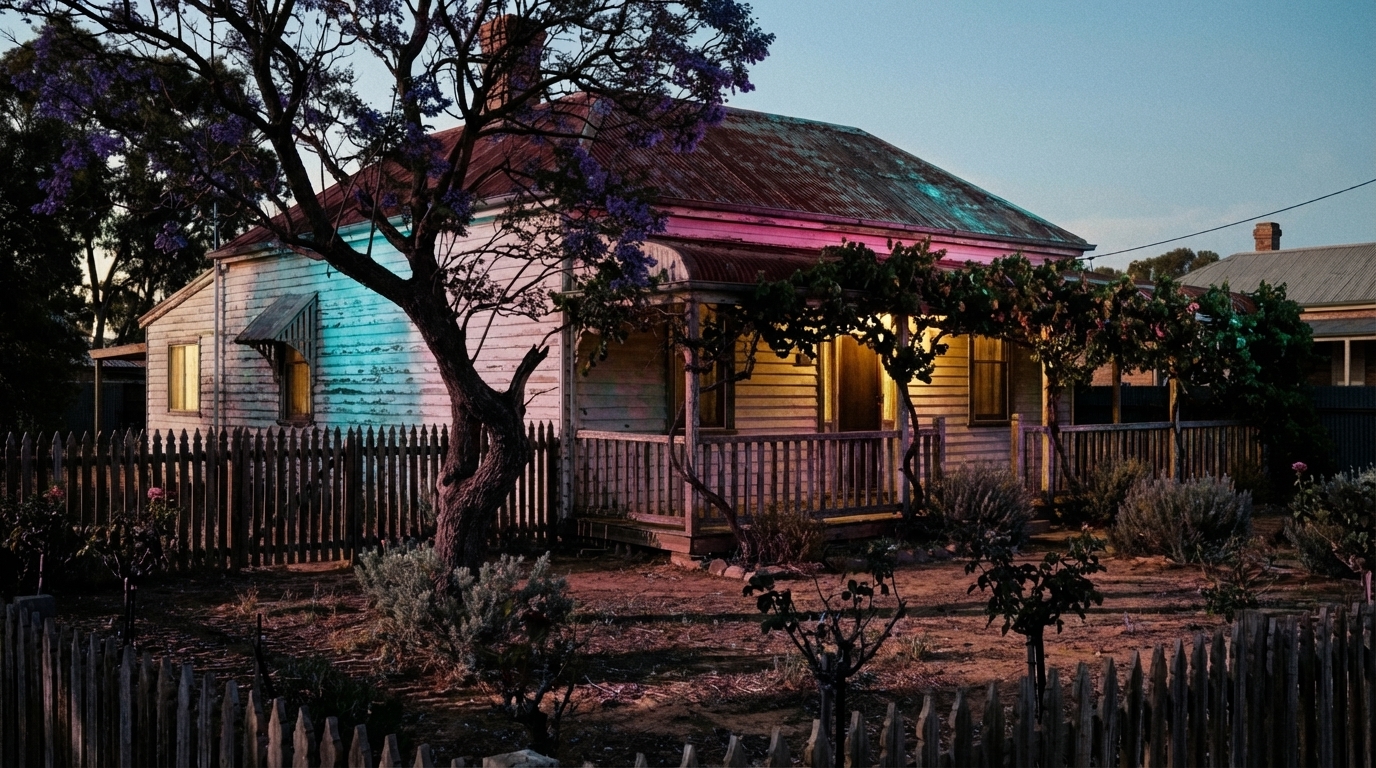
The Dallow Residence in far western New South Wales stands as a weatherboard witness to the twentieth-century mining town's most intimate human drama. Built in the early 1900s, this modest home sheltered Robert and Evelyn Dallow and their daughters Violet and Jasmine through sixteen years of ordinary family life before tragedy transformed it into a vessel of grief and resilience. The house absorbed Violet's final farewell in September 1988, her murder casting shadows that never fully lifted from its corrugated iron roof and grapevine-shaded verandah.
Architecture and Early History
The Dallow Residence emerged from Broken Hill's early twentieth-century building boom, constructed during the period when silver wealth transformed red dust into substantial settlement. Built around 1905 to 1910, the house exemplifies the vernacular architecture that working families could afford—sturdy weatherboard walls rising from concrete footings, a corrugated iron roof designed to shed the relentless summer heat and winter cold that defined outback existence, and a front verandah shaded by a thriving grapevine that provided respite from the unforgiving sun.
The structure reflects the practical considerations of mining families who understood that shelter needed to withstand extremes. The weatherboard cladding, painted and repainted over decades, protected timber framing from winds that carried red dust through every gap. The high ceilings allowed hot air to rise away from living spaces, whilst small windows with heavy curtains guarded against the worst of summer's assault. The floor plan followed convention: a central hallway dividing bedrooms from living areas, with the kitchen positioned at the rear where Evelyn's domain of cookstove and workbenches transformed ingredients into sustenance for her family.
The backyard, though small by rural standards, became Evelyn's canvas for self-sufficiency. A vegetable garden flourished under her attentive care, producing beans, tomatoes, potatoes, and other staples that supplemented Robert's mining wages. A chicken coop against the back fence provided eggs and occasional meat, whilst clotheslines stretched across the yard bore witness to Evelyn's endless cycle of washing and mending that kept her family presentable despite the dust that infiltrated everything in Broken Hill.
By the early 1970s, when Robert and Evelyn Dallow purchased the property, the house had weathered seven decades of occupants—miners and their families who had come and gone with the fortunes of the industry, leaving behind layers of paint, repairs made with whatever materials were available, and the subtle alterations that accumulated as each generation adapted the structure to their needs. The Dallows inherited not just walls and roof, but the accumulated character of a working-class home that had sheltered countless ordinary lives through boom and bust.
The Dallow Household: 1970s
Robert Thomas Dallow and Evelyn Margaret Ashcroft married in the early 1970s, their union representing the continuation of Broken Hill's mining community traditions—a man who worked underground marrying a woman whose skills with needle and thread would help stretch his wages into comfortable existence. They acquired the weatherboard residence shortly after their wedding, transforming the house from mere property into home through the incremental additions of furniture, decorations, and the intangible essence that comes only from daily living.
Robert's relationship with the house was fundamentally shaped by his work in the mines. He left before dawn most mornings, his footsteps heavy across the timber floors as he departed for shifts that took him deep beneath the surface where darkness, dust, and danger were constant companions. The residence represented everything his underground labour provided: shelter, stability, and a place where his daughters could grow up protected from the harsh realities of extraction work. His hands—calloused from handling tools, scarred from minor injuries that accumulated over years—performed the necessary repairs and maintenance that kept the house functional, each fix a demonstration of the practical competence that defined his approach to all problems.
Evelyn's presence saturated every corner of the residence. Her sewing machine—a Singer inherited from her mother—occupied pride of place in what had originally been intended as a second bedroom but which she'd claimed as her workspace. The rhythmic clack of the machine became the house's heartbeat, providing soundtrack to countless hours spent creating bespoke garments for Broken Hill families who couldn't afford ready-made clothing or who wanted something crafted with care rather than manufactured in distant factories. Bolts of fabric leaned against walls, patterns hung from hooks, and the scent of cotton, wool, and the particular must of stored textiles mingled with the cooking smells that drifted from the kitchen.
Her decorating reflected both practicality and her quiet aesthetic sensibility. Handcrafted quilts—some her own work, others inherited from female relatives extending back generations—covered beds and draped over furniture, their patterns telling stories of women who transformed scraps into beauty through patient labour. Family photographs occupied frames on walls and mantlepieces, creating a visual chronicle of Dallow history that connected the present household to broader kinship networks. Her collection of books—novels, histories, poetry anthologies purchased second-hand or borrowed from the library—lined shelves in the front room, evidence of an intellectual life sustained despite the demands of domestic labour and piece-work sewing.
The kitchen became Evelyn's command centre, where she orchestrated the complex logistics of feeding a family on a mining wage. The old Metters stove, temperamental but reliable if treated with understanding, produced the meat pies, roast dinners, and baked goods that defined Australian home cooking. The pantry held stores carefully managed—flour and sugar bought in bulk, preserves put up during seasons of abundance, the accumulated tins and packets that allowed for quick meals when sewing deadlines pressed. The kitchen table, scarred from decades of use, served multiple functions: dining surface, workspace for Violet's school projects, venue for family discussions that ranged from mundane logistics to more profound conversations about dreams, fears, and the future.
Violet's Childhood and the House as Witness
The birth of Violet Dallow on 12 May 1972 transformed the residence from married couple's home into family dwelling. Her arrival infused the weatherboard walls with new energy—the cries of an infant, the exhausted satisfaction of new parents navigating sleepless nights, the gradual accumulation of baby paraphernalia that colonised previously adult spaces. What had been the second bedroom became Violet's domain, painted in colours chosen by Evelyn with care, furnished with a cot that would later transform into a proper bed as the child grew.
From earliest consciousness, Violet demonstrated the restless curiosity that would define her personality. The house bore witness to her transformation from toddler to child to adolescent, its rooms absorbing the evidence of her developing interests and obsessions. Her bedroom evolved from generic child's space into a reflection of her particular fascinations: maps pinned to walls showing places she dreamed of visiting, journals where she recorded observations and invented stories, collections of interesting rocks and discarded mining equipment retrieved from explorations around Broken Hill, and books—always books—stacked on every available surface.
The residence became both sanctuary and launching pad for Violet's adventures. She would depart through the front door with Mandy Glasson or other friends, heading off on expeditions that ranged from the merely adventurous to the genuinely concerning, returning hours later with stories that mixed truth and embellishment in ways that left her parents uncertain whether to be proud of her spirit or frightened by her fearlessness. The weatherboard walls absorbed her energy like a sponge—the slam of doors, the pounding of feet as she raced through hallways, the animated conversations that carried from her bedroom where she and Jasmine would talk late into the night.
The front verandah, shaded by the grapevine that Evelyn tended with care, became one of Violet's favourite contemplation spaces. She would sit on the worn timber, back against a post, staring out at the red landscape that surrounded Broken Hill whilst her mind wandered to distant places and imagined adventures. The verandah represented a threshold between the known safety of home and the unknown dangers that lurked beyond—a liminal space where dreams of escape mingled with the deep comfort of belonging.
Jasmine's Arrival and Sisterhood
The birth of Jasmine Anne Dallow on 27 August 1974 added another dimension to the household's dynamics. Whilst Violet had been the sole focus of parental attention for her first two years, she now had to accommodate a sibling whose temperament differed dramatically from her own. The house witnessed the complex dance of sisterhood: moments of tender affection when Violet would read to Jasmine or include her younger sister in carefully supervised adventures, balanced against periods of rivalry and irritation when sharing space and parental attention felt like intolerable compromise.
Jasmine's bedroom, smaller than Violet's, reflected her more orderly nature. Where Violet's room represented controlled chaos, Jasmine maintained organisation—books alphabetised on shelves, toys stored in designated containers, a desk kept clear for homework rather than colonised by archaeological layers of creative projects. The contrast between the sisters' spaces revealed fundamental personality differences that would shape their relationship throughout childhood.
The kitchen table became the stage for their morning rituals—breakfast conversations where Violet would spin elaborate fantasies about the day's potential adventures whilst Jasmine listened with the practical scepticism of a younger sibling who'd learned to distinguish her sister's embellishments from likely reality. These breakfast scenes, with Evelyn moving between stove and table whilst the girls ate, created rhythms of domestic life that seemed eternal, as though they would continue indefinitely rather than being subject to the terrible fragility that defined all human arrangements.
The residence absorbed the sounds of their growing up: Jasmine practising piano (an instrument Evelyn had insisted on acquiring, determined that her daughters would have access to cultural refinement despite their working-class circumstances), Violet arguing with Robert about curfews or restrictions she deemed unreasonable, both girls completing homework whilst Evelyn's sewing machine hummed in the next room. The house became a vessel holding not just physical bodies but the invisible substance of family life—the jokes, tensions, affections, and frustrations that accumulated like layers of paint.
The Dark Summer of 1988
The events of September 1988 would transform the Dallow Residence from sanctuary into site of trauma, though the transformation occurred gradually rather than in a single catastrophic moment. The house witnessed Violet's increasing preoccupation with the Emily Sullivan disappearance—her room becoming an impromptu investigation headquarters filled with photocopied documents from the library, handwritten timelines, and speculative connections between historical vanishings that most would dismiss as coincidence.
The morning of 30 September unfolded within the residence with the ordinary rhythms that had characterised thousands of previous mornings—yet retrospective knowledge transforms every detail into unbearable poignancy. The house witnessed the routine preparations for what was supposed to be an ordinary Girl Guides camping trip: Violet packing her bag with camping gear and, tellingly, her Emily Sullivan notebooks; Evelyn moving through the kitchen with quiet efficiency, preparing coffee and overseeing the morning's logistics; Robert present in that solid, silent way that characterised his relationship with his daughters.
Violet's bedroom became the setting for the most profound moment in the residence's history: her gift of the family locket to Jasmine. The walls absorbed this sacred ritual of protection and love, witnessed the silver chain passing from elder to younger sister, contained the whispered promises and fierce devotion that transformed a piece of jewellery into talisman. Morning light filtering through curtains illuminated this farewell that neither girl consciously recognised as final, this transfer of ancestral strength that would prove both burden and comfort for Jasmine in all the years that followed.
The verandah held their final moments together in the house—Violet's backpack shouldered, her expression caught between excitement for the camping adventure and some unnameable apprehension, Jasmine watching her sister depart with the locket warm against her skin and foreboding she couldn't articulate churning in her stomach. The residence witnessed this goodbye, absorbed the weight of words unspoken and embraces that would have lasted longer had either girl understood they were final.
When Violet departed through the front door that morning, the house released her into a world that would not return her alive. The weatherboard walls, the corrugated iron roof, the grapevine-shaded verandah—all the physical structures that had sheltered her for sixteen years—could offer no protection against what awaited in Silverton. The residence that had witnessed her birth, her childhood adventures, her transformation into a fierce and curious young woman, became the last place where Violet Dallow walked as a living person rather than as the subject of memory and grief.
The Void and Aftermath
The days following Violet's disappearance transformed the residence into a house haunted not by supernatural presence but by terrible absence. The silence in her bedroom—no footsteps pounding through hallways, no animated conversations carrying through walls, no slam of doors as she departed for adventures—created a void more oppressive than any sound. Her room remained undisturbed, frozen in the arrangement she'd left it, becoming shrine to a living girl who might yet return and museum to a lost child who almost certainly would not.
Evelyn's sewing machine fell silent for the first time in years. The woman who had filled the house with creative productivity found herself unable to sustain the rhythms that had structured her days, the machine's absence creating another layer of unnatural quiet. The kitchen continued to function—meals still needed preparing, though appetites had vanished and eating became mechanical rather than pleasurable—but the life had drained from domestic activities that had once carried meaning beyond mere survival.
Robert maintained his presence in the house through sheer force of stoic determination, leaving for the mines each morning not because work provided distraction but because routine represented the only framework he possessed for navigating catastrophe. The residence witnessed his silent grief, the way his movements became more deliberate, his already-quiet nature deepening into something approaching withdrawal. He would sit on the verandah in evenings, staring at the landscape that might be hiding his daughter's body, his face weathered by decades of mining work and now further eroded by anguish no physical labour could address.
Jasmine, only fourteen years old, moved through the house like a ghost herself—the locket her sister had given her a weight that seemed to grow heavier with each passing day. The residence that had always contained her entire world now felt simultaneously too large (all those empty spaces where Violet should be) and suffocatingly small (no corner free from memories that had transformed from comfort into torment). Her room, once sanctuary, became cell from which escape seemed both necessary and impossible.
The discovery of Violet's body in early October brought not resolution but merely transformation of the horror from uncertainty to confirmed loss. The residence absorbed the impact of this news—the way it shattered whatever fragile hope had sustained the household, the way it transformed waiting into mourning, the way it made permanent what might have remained ambiguously temporary. The weatherboard walls witnessed grief that exceeded language, that found expression only in Evelyn's silent tears, Robert's hollow eyes, and Jasmine's thousand-yard stare that suggested permanent damage to something essential.
Fractured Family and Necessary Separation
The months following Violet's death revealed the residence's inability to support the weight of collective grief whilst simultaneously maintaining the structures necessary for Jasmine's survival. The house had become saturated with loss—every corner holding memories of Violet, every ordinary activity corrupted by her absence, the very air heavy with unexpressed anguish that had no outlet and no remedy.
The decision to send Jasmine to boarding school in Adelaide represented both mercy and additional fracture. The residence witnessed the preparations for this departure—the packing of belongings, the conversations that attempted to frame separation as opportunity rather than abandonment, the recognition that staying in a house haunted by her sister's ghost might prevent Jasmine from building any future at all. The departure, when it came, created another layer of absence within walls that had already contained too much empty space.
Robert and Evelyn remained in the house, two people attempting to continue existence in a structure designed for family life rather than grief management. The residence became witness to their separate sorrows—Evelyn's marathon sewing sessions that resumed as desperate therapy, the machine's clack creating sound to fill silence that threatened to consume her; Robert's increasing withdrawal into physical labour and the maintenance tasks that provided problems with solutions, unlike the unsolvable tragedy that defined their family's reality.
Violet's room remained largely untouched, a museum to a life interrupted. Her maps continued to mark dreams of distant places she would never visit, her journals documented investigations that led to her death rather than to the discoveries she'd sought, her collections of outback detritus gathered dust whilst testifying to curiosity that death had not diminished but merely ended. The residence held this shrine, maintaining space for a girl who would never return whilst her parents couldn't bring themselves to dismantle the evidence of her existence.
The House Through Decades of Aftermath
The Dallow Residence continued its function as shelter for Robert and Evelyn through the decades that followed Violet's death, though "home" seemed too vital a word for a structure so thoroughly marked by tragedy. The house witnessed their ageing—the way grief accelerated the wear that would have come eventually anyway, how their bodies accumulated the visible evidence of loss that internal sorrow generated.
Evelyn's sudden passing in 2008, two decades after Violet's murder, transformed the residence yet again. Robert, already withdrawn, became even more isolated within walls that now contained the absence of both daughter and wife. The house that had once thrummed with female energy—Evelyn's sewing, Violet's restless movement, Jasmine's quieter presence—became the domain of a solitary elderly man whose life had been defined by loss and whose remaining years stretched ahead with little apparent purpose beyond endurance.
The structure itself showed the inevitable wear of decades: paint that needed refreshing, timber that required repair, the accumulated evidence of insufficient maintenance performed by a man whose energy and motivation had been eroded by grief. Yet Robert maintained the essentials, particularly Violet's room, which remained his private shrine to a daughter whose sixteen years of life continued to eclipse all the subsequent decades of his survival.
Jasmine's Legacy and the Residence's Continuing Significance
The establishment of the Violet Fund by Jasmine Collins (née Dallow) created a different kind of relationship between the now-adult younger daughter and the residence of her traumatic adolescence. The house became symbol rather than dwelling—representative of the family destroyed by Violet's murder, evidence of the ordinary life that preceded catastrophe, reminder of the breakfast conversations and sisterly bonds that had seemed eternal until proven devastatingly temporary.
Jasmine's entrepreneurial success, her marriage to Bradley Collins, her creation of a new life in Adelaide—all represented escape from the weatherboard residence and everything it contained. Yet the Violet Fund's existence meant that the house remained tethered to her identity, its story inseparable from the narrative of loss and resilience that had come to define Jasmine's public persona. The residence that had witnessed her final morning with Violet became part of the origin story for her advocacy work, evidence of the before that made the after both necessary and meaningful.
The house stands as testament to the various ways that trauma marks not just individuals but the physical spaces that contain human dramas. Its weatherboard walls absorbed sixteen years of ordinary family life, then absorbed the catastrophe that destroyed that ordinariness, then absorbed decades of grief and absence. The structure that was built to shelter mining families through the practical challenges of outback existence found itself containing sorrows that no architectural design could have anticipated or mitigated.
Contemporary Status and Unresolved Echoes
The Dallow Residence continues its existence in the dusty streets of Broken Hill, now occupied by the elderly Robert Dallow, who maintains the property with the diminished energy of a man whose reason for living departed long ago. The house has become something of a local landmark in the way that sites of tragedy often do—not officially commemorated, but known to those who remember the story, whispered about when the subject of Broken Hill's darker history arises.
The unsolved nature of Violet's murder means that the residence remains connected to ongoing mysteries rather than relegated to closed history. The Silverton Strangler's continued presence—the 2001 murder in Menindee, the 2009 killing in White Cliffs, the 2015 death in Tibooburra—creates a thread of continuing threat that prevents the house from becoming mere monument to historical tragedy. Somewhere in Australia, quite possibly still operating in the vast spaces of western New South Wales, the person who abducted Violet from the Silverton campsite and strangled her body lives and breathes, their continued existence making the Dallow Residence's story unfinished rather than concluded.







