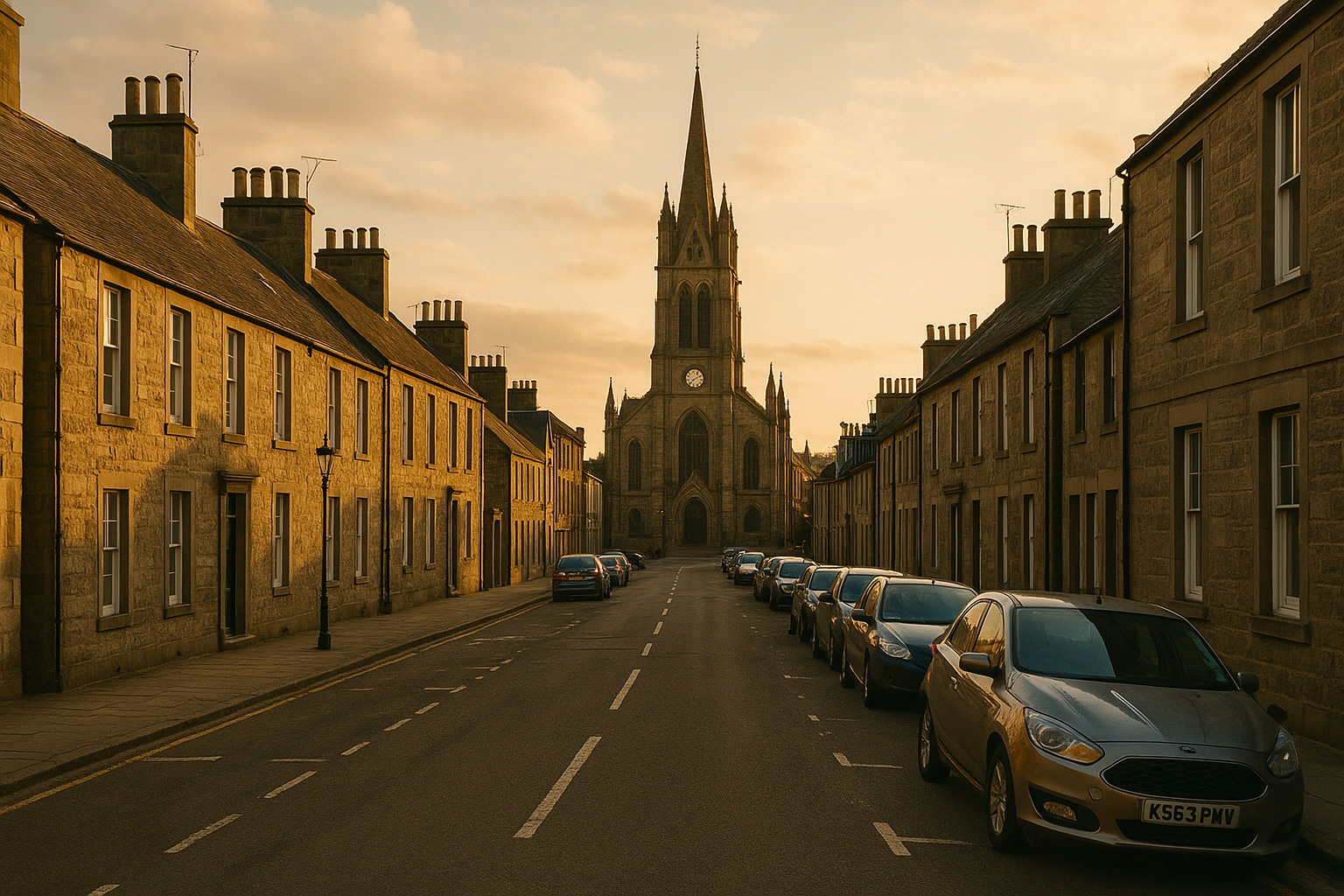
Dalkeith, Midlothian, Scotland
Dalkeith, a historic market town where the North and South Esk rivers converge, has served as Midlothian's administrative heart since medieval times. Once seat of the Buccleuch family at Dalkeith Palace, the town witnessed centuries of Scottish history whilst nurturing quieter legacies among its merchant families. On 22 February 1948, Alasdair William Campbell was born here—an archivist whose dedication to preserving hidden histories would prove essential to understanding dimensional forces.
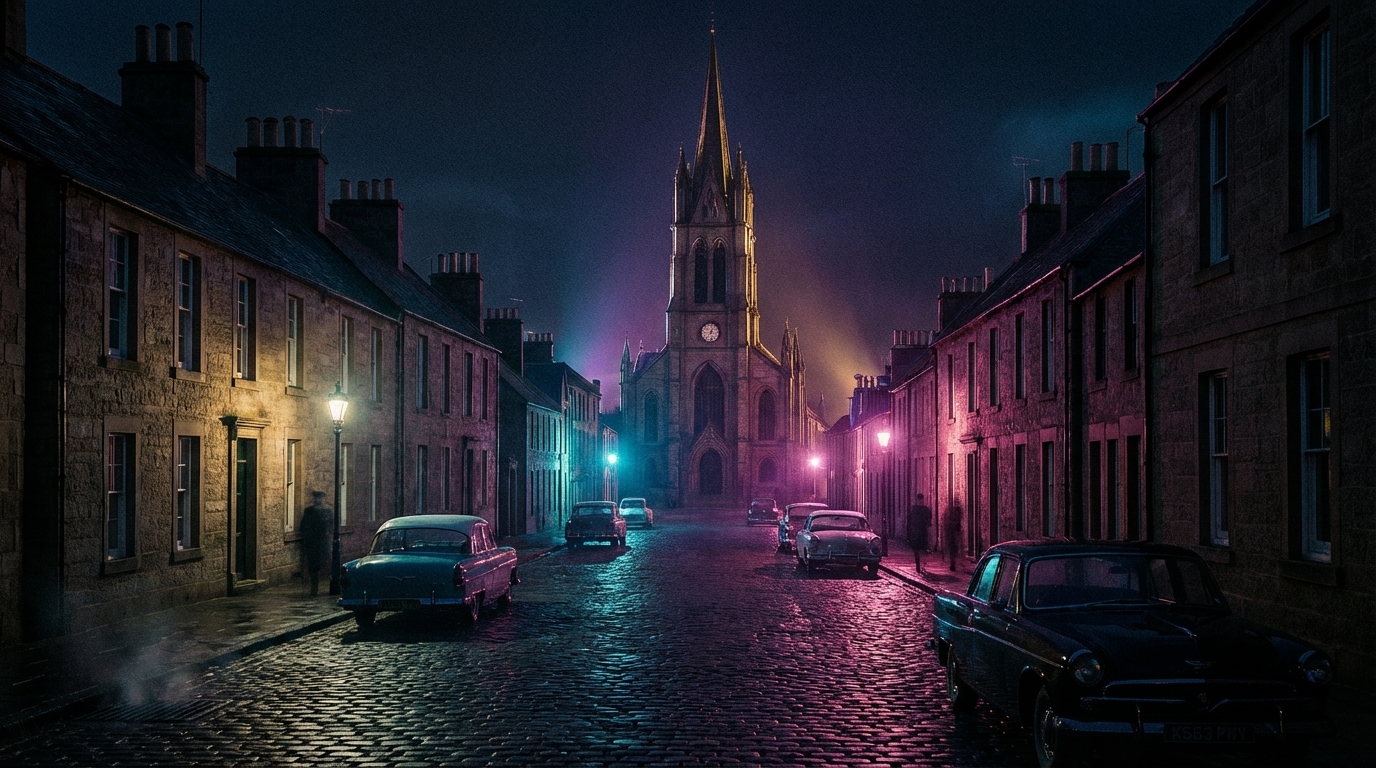
Geographic Setting and Early History
Dalkeith occupies a strategic position approximately ten kilometres southeast of Edinburgh, where the waters of the North Esk and South Esk rivers converge before flowing northward to the Firth of Forth. This confluence determined the town's character from earliest settlement, providing both natural defence and the water power that would sustain mills and industry through subsequent centuries. The name itself derives from the Brittonic "dol coed," meaning meadow in the woods—a description that captured the landscape's essential character before urban development transformed its appearance.
Human habitation in the Dalkeith area extends to prehistoric times, with archaeological evidence suggesting Bronze Age activity along the river valleys. The Romans, during their occupation of southern Scotland in the first and second centuries, established presence in the broader Lothian region, though Dalkeith itself lay beyond their primary fortifications. The town's documented history begins in earnest during the medieval period, when it emerged as a significant settlement serving the surrounding agricultural lands.
By the twelfth century, Dalkeith had developed sufficient importance to warrant a castle, the original structure occupying the promontory between the two rivers where Dalkeith Palace now stands. This fortification changed hands repeatedly during Scotland's turbulent medieval centuries, witnessing sieges, political machinations, and the broader conflicts between Scottish independence and English ambition. The town that grew beneath the castle walls provided services to the garrison and the surrounding estates, establishing the market function that would define Dalkeith's economic identity.
The Buccleuch Inheritance
The transformation that shaped Dalkeith's subsequent history began in 1642, when Francis Scott, 2nd Earl of Buccleuch, acquired the barony and its associated properties. The Scott family, whose power base lay in the Scottish Borders, recognised Dalkeith's strategic value—close enough to Edinburgh for political influence, sufficiently removed for independent operation. Under Buccleuch stewardship, the medieval castle underwent systematic reconstruction, eventually emerging as Dalkeith Palace, one of Scotland's grandest aristocratic residences.
The palace's development reflected the family's rising fortunes. Anne Scott, Duchess of Buccleuch in her own right, married James Scott, Duke of Monmouth—the illegitimate son of Charles II whose ill-fated rebellion would end on the executioner's block in 1685. Despite this catastrophe, the Buccleuch title and estates survived, passing through subsequent generations who continued enhancing both palace and parklands. The extensive grounds, eventually encompassing over four hundred hectares, incorporated formal gardens, woodland walks, and agricultural improvements that demonstrated Enlightenment principles of landscape management.
Dalkeith Palace hosted royalty on multiple occasions, most notably George IV during his celebrated 1822 visit to Scotland—the first by a reigning monarch since Charles II. The town prepared extensively for the royal passage, its High Street decorated, its citizens assembled in their finest attire. Such occasions reinforced Dalkeith's position as Midlothian's premier settlement outside Edinburgh itself, a status reflected in its designation as the county town for administrative purposes.
Market Town Character
Beyond aristocratic grandeur, Dalkeith developed as a thriving market centre serving the agricultural communities of Midlothian and beyond. The weekly markets, held in the broad High Street since medieval times, drew farmers, merchants, and tradespeople from throughout the region. Grain from the fertile Lothian plains, livestock from surrounding pastures, manufactured goods from Edinburgh's workshops—all found buyers and sellers in Dalkeith's commercial spaces.
The corn exchange, established in the nineteenth century, formalised the grain trade that had long sustained local prosperity. Maltings and breweries exploited the combination of quality grain and abundant water, whilst flour mills processed wheat for the growing Edinburgh market. The town's position on routes connecting the capital to the Borders ensured steady traffic through its streets, with coaching inns and hostelries catering to travellers and their horses.
By the Victorian era, Dalkeith had acquired the institutional infrastructure befitting its administrative importance. Banks established branches along the High Street; solicitors and accountants served the legal and financial needs of landowners and merchants; physicians and apothecaries tended the health of a population that had grown to several thousand. Churches of various denominations—the established Kirk, Free Church congregations following the 1843 Disruption, Episcopal and Catholic communities—provided for spiritual needs whilst contributing to the architectural character of the townscape.
Educational Traditions
Dalkeith's commitment to education distinguished it among Scottish market towns. The burgh school, tracing origins to medieval ecclesiastical instruction, evolved through successive reforms into an institution providing sound grounding in classical and practical subjects. Grammar, mathematics, Latin for those aspiring to university or the professions—the curriculum prepared generations of Dalkeith youth for advancement beyond their origins.
The nineteenth century brought expansion of educational provision. The parish school system, supplemented by subscription schools and dame schools for younger children, ensured basic literacy reached most of the population. The Free Church established its own educational facilities following the Disruption, whilst later decades saw board schools erected under national legislation. Teachers occupied respected positions in local society, their influence extending beyond classroom instruction to broader cultural and moral formation.
Among those who would carry forward Dalkeith's educational traditions was Angus Robert Campbell, born in 1913 to a family with deep roots in the town's merchant community. His path led to teaching, and by the 1940s he had established himself as a schoolmaster known for exacting standards tempered by fundamental fairness. The discipline he instilled in pupils reflected values absorbed from Dalkeith itself—respect for knowledge, commitment to rigorous inquiry, understanding that education served purposes larger than individual advancement.
The Campbell Family of Dalkeith
The Campbell presence in Dalkeith extended back several generations before Angus Robert's birth, though the family occupied no prominent position in local hierarchies. They were solid merchant stock—shopkeepers, clerks, minor tradespeople who contributed to the town's commercial life without leaving significant marks in historical records. Their respectability was unremarkable, their ambitions modest, their faith conventionally Presbyterian.
Angus Robert Campbell distinguished himself through intellectual capacity that his education nurtured and his profession expressed. His marriage to Margaret Ellen MacKenzie in 1946 united two complementary temperaments. Margaret, born in 1918 to a family from the western Highlands who had migrated to Midlothian seeking economic opportunity, brought passion for historical research that bordered on obsession. Where Angus approached knowledge through systematic instruction, Margaret pursued it through archival investigation—tracing genealogies, collecting oral histories, preserving documents that others dismissed as insignificant.
The couple established their household in Dalkeith, occupying a modest but respectable dwelling that would fill with books, old maps, and the accumulated papers of Margaret's researches. The Campbell home became a repository of local and family history, its rooms organised around the materials that Margaret gathered with tireless dedication. Angus tolerated and eventually appreciated his wife's passion, recognising in her methodology a rigour that matched his own pedagogical standards.
Birth of Alasdair William Campbell
On 22 February 1948, in the austere aftermath of the Second World War, Alasdair William Campbell entered the world in Dalkeith. The town he was born into still bore marks of wartime privation—rationing continued, bomb damage from scattered raids remained visible in Edinburgh, and the general atmosphere retained the grey exhaustion of a nation slowly recovering from six years of conflict. Yet within the Campbell household, the arrival of a firstborn son represented hope and continuity.
The name Alasdair connected the infant to Scottish tradition, whilst William honoured generations of Campbell men who had served various forms of stewardship. Margaret, already pregnant with the passion for lineage that defined her researches, understood that names carried weight—that they linked individuals to ancestors and implied obligations to descendants. The child would grow into awareness of this heritage gradually, absorbing from earliest years the understanding that history lived in documents, in family memories, in the careful preservation of what might otherwise be forgotten.
Dalkeith provided the setting for Alasdair's earliest formation. The town's streets, its market square, its riverside walks—all became familiar territory as the boy grew. He accompanied his father to school functions, absorbing the atmosphere of educational discipline that Angus embodied. He watched his mother sort through papers, learning to handle fragile documents with reverence before fully grasping their significance. The Campbell household's particular blend of systematic instruction and passionate inquiry shaped capacities that would define his adult life.
Post-War Dalkeith
The Dalkeith of Alasdair's childhood was transitioning from its Victorian and Edwardian character toward something more recognisably modern. The immediate post-war years brought continued austerity, but the 1950s saw gradual improvement in material conditions. New housing developments extended the town's boundaries, accommodating families who commuted to Edinburgh for employment whilst maintaining residence in Dalkeith's more affordable and spacious environment.
The traditional industries that had sustained the town faced challenges. The grain trade declined as agricultural patterns shifted; the maltings and mills that had processed local harvests reduced operations or closed entirely. Retail patterns changed as Edinburgh's shopping districts drew customers who might previously have conducted business in Dalkeith's High Street. The town adapted, finding new functions as a residential community for Edinburgh's expanding professional classes whilst maintaining sufficient commercial activity to preserve its character as more than mere dormitory suburb.
Dalkeith Palace and its grounds underwent their own transformation. The Buccleuch family, facing the economic pressures that affected aristocratic estates throughout post-war Britain, opened the parklands to public access—creating what would become Dalkeith Country Park, a recreational resource serving the broader region. The palace itself housed various educational and institutional functions, its grand rooms no longer serving aristocratic entertaining but contributing to community purposes that earlier generations could not have imagined.
The Campbell Siblings
Alasdair's position as eldest of six children shaped his character permanently. His siblings arrived in steady succession: Robert Angus in 1952, destined to become a lawyer specialising in heritage and property matters; Eleanor Margaret in 1956, who would pursue museum curation and artefact conservation; Andrew Fraser in 1958, whose death in infancy from complications at birth left a quiet grief that never fully departed the household; John Douglas in 1961, who would serve in the military before emigrating to Canada; and Catriona Elizabeth in 1964, who chose religious life and dedicated herself to theological studies and manuscript preservation.
The loss of Andrew marked Alasdair's first encounter with the precariousness of existence, the way history could be interrupted by tragedy that left no documents, only absence. He was ten years old when his infant brother died—old enough to understand loss without fully processing its implications. The experience deepened his sense that preservation mattered, that what was not recorded, not maintained, could vanish utterly. Dalkeith's churchyard, where Andrew was buried, became a place of contemplation where the boy first grasped that history consisted not merely of great events but of countless individual lives, most of which left minimal trace.
His relationship with Eleanor proved particularly formative. She shared his passion for historical objects, for the tangible remnants of the past that required careful handling and dedicated protection. Their correspondence would continue throughout their adult lives, comparing notes on archival discoveries, sharing techniques for document restoration, consulting each other on matters of provenance and authenticity.
Education and Departure
Alasdair's intellectual gifts found early recognition in Dalkeith's schools, where teachers identified capacities that exceeded what local instruction could fully develop. His parents, recognising the opportunity, arranged for his attendance at George Heriot's School in Edinburgh—a significant commitment for a schoolmaster's family, but one that both Angus and Margaret considered essential. The daily journey to Edinburgh expanded young Alasdair's horizons whilst maintaining his connection to Dalkeith roots.
At George Heriot's, he excelled in history, Latin, and literature, demonstrating the capacity for sustained attention and meticulous analysis that would define his scholarly career. Teachers recognised in him something beyond mere intelligence—a reverence for knowledge itself, a sense that learning served purposes larger than personal advancement. The school's traditions, its emphasis on both classical education and practical preparation, complemented what the Campbell household had already instilled.
By 1966, when Alasdair enrolled at the University of Edinburgh to pursue Scottish History and Archival Studies, his departure from daily life in Dalkeith was effectively complete. Yet the town remained foundational to his identity—the place where his particular combination of systematic rigour and passionate inquiry had first taken shape, where his mother's genealogical obsessions had planted seeds that would flower into professional expertise. He would return for family occasions, for his parents' eventual funerals, for moments when Dalkeith's streets reminded him of origins that his subsequent career could never entirely transcend.
Dalkeith in the Late Twentieth Century
The decades following Alasdair's departure saw Dalkeith continue its evolution from market town to Edinburgh satellite. Population grew as housing developments multiplied; the A68 road brought increased traffic through streets designed for horse-drawn vehicles; shopping patterns shifted further toward Edinburgh and eventually toward out-of-town retail centres. The traditional High Street retained sufficient activity to preserve recognisable character, but the town's economic function had fundamentally changed.
Dalkeith Country Park emerged as a significant regional attraction, its woodland walks, adventure playground, and restored farm buildings drawing visitors from throughout the Lothians. The palace itself, no longer serving aristocratic residence, found various institutional uses—at different times housing educational programmes, conference facilities, and heritage interpretation. The relationship between town and estate, which had defined Dalkeith's character since the seventeenth century, persisted in altered form.
The Campbell family's presence in Dalkeith diminished as the twentieth century progressed. Angus Robert Campbell died in 1987, his funeral drawing former pupils who remembered the schoolmaster's exacting standards and fundamental decency. Margaret Ellen Campbell survived until 1993, her final years spent organising the accumulated papers of a lifetime's research—materials that would eventually pass to Alasdair, who understood their value better than any other inheritor could have. The family home was sold; the physical connection to Dalkeith that had sustained several generations came to its end.
Contemporary Character
Modern Dalkeith presents a blend of historical fabric and contemporary development that characterises many Scottish towns of similar size and situation. The High Street retains buildings from the eighteenth and nineteenth centuries, their ground floors adapted for current retail purposes whilst upper storeys preserve original proportions. Churches, schools, and civic buildings contribute architectural variety, their styles reflecting the periods of their construction and the aspirations of their builders.
The town serves primarily residential functions for a population that largely works elsewhere—in Edinburgh's offices and institutions, in the commercial and industrial facilities scattered throughout Midlothian. Local employment exists in retail, services, and the various enterprises that any community of Dalkeith's size requires, but the economic self-sufficiency of earlier centuries has long since disappeared. Transportation links—buses to Edinburgh, road connections to the broader region—make commuting practical for those who choose Dalkeith's relative affordability and community scale over urban residence.
Dalkeith Country Park continues attracting visitors, its combination of natural beauty, historical interest, and recreational facilities serving families and individuals seeking escape from urban pressures. The park's restoration and development demonstrate how aristocratic estates can find new purposes in democratic ages, their grounds becoming public resources rather than private preserves. The palace itself, though not regularly open to casual visitors, contributes to the sense of historical depth that distinguishes Dalkeith from purely modern developments.







