Colonia Hesperidum, Clivilius
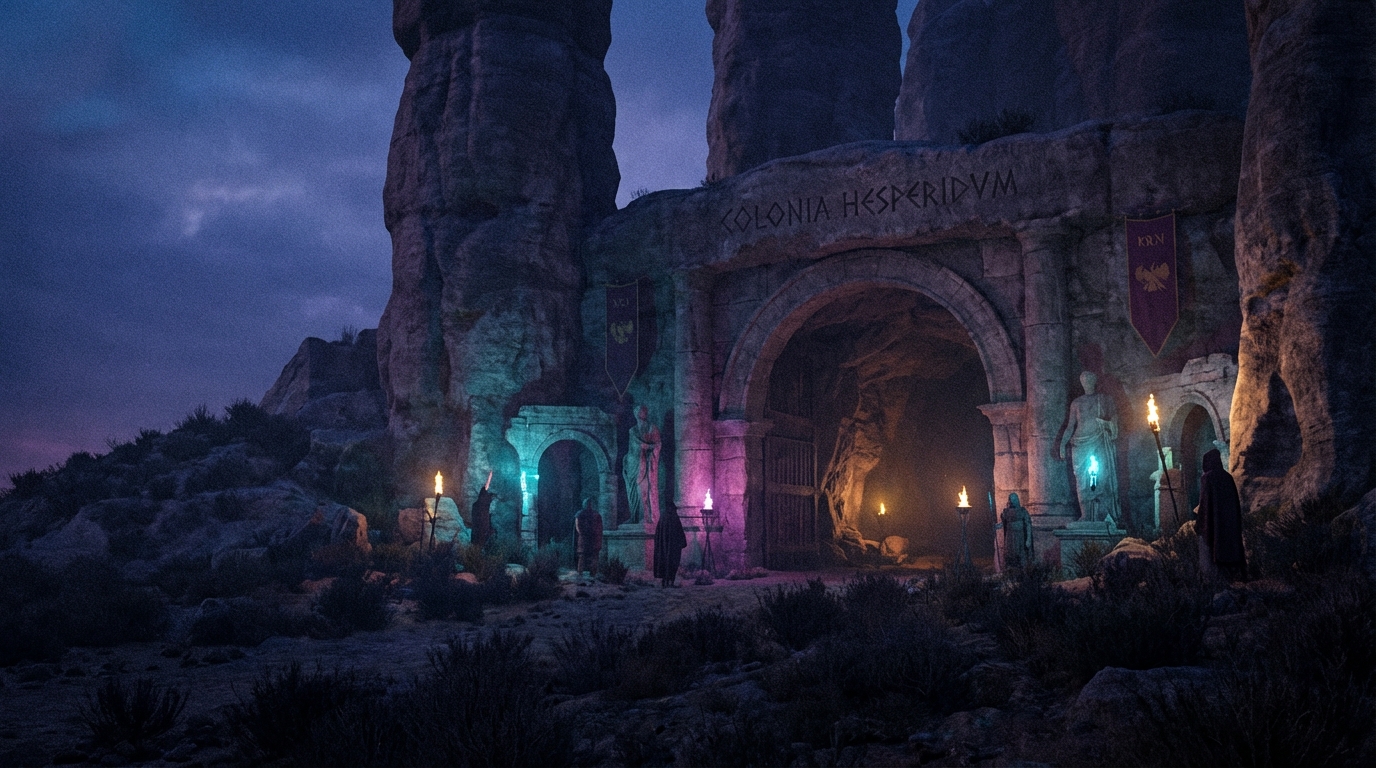
A settlement founded in a cave system by five Guardians from Hispania Ulterior in 89 BCE. Named Colonia Hesperidum—"Colony of the West"—the community discovered and absorbed the Oryim, a remnant population who possessed invaluable knowledge of Lumineux cultivation. The settlement flourished during its Guardian era, establishing L'Establum and expanding cave infrastructure significantly. However, when the last of the five founding Guardians died in 14 CE, the community lost all direct access to Earth. Isolated for over a century and a half, the settlement ultimately succumbed to plague and internal conflict in 187 CE.
Origins
Colonia Hesperidum began with a conversation in a Corduba tavern during the winter of 91 BCE.
Adherbal bar-Hamilcar was a Punic merchant whose family had fled Carthage after its destruction in 146 BCE. For three decades he had built trade networks across the western Mediterranean, his commercial success masking a secret that would have seemed like madness to his business partners: he was a Guardian, one of five who maintained a small community called Maqqom-Tanit in a place far removed from Earth. His Portal Key allowed him to step between worlds as easily as crossing a threshold, though he kept this ability hidden from all but a trusted few.
Recently, Adherbal had received something extraordinary through means he could not fully explain—five new Portal Keys, bestowed upon him through Clivilius itself. The Keys required recipients. He needed five people capable of building a settlement in unknown wilderness, resourceful enough to survive without guarantees, and trustworthy enough to be given power that could reshape their understanding of reality.
He spent that winter travelling through Hispania Ulterior, using his trade contacts to identify candidates.
Lucius Valerius Cordubensis was the first he approached—a fellow merchant whose trading house had worked with Adherbal's network for years. Lucius was forty-two years old, wealthy, respected, and quietly desperate. His wife had died in childbirth three years earlier, taking their only son with her. His business, though profitable, had lost its meaning. When Adherbal described doorways to another world, Lucius did not ask for proof. He asked when they could leave.
Gaius Sertorius Hispalensis came recommended by Lucius. A former centurion who had served in the Iberian campaigns before retiring to his native Hispalis, Gaius was fifty-one and struggling with civilian life. The discipline and purpose of the legions had defined him for twenty-five years; running a small wine shop had nearly broken him. He accepted a Portal Key with the relief of a man who had finally found a reason to live.
Publius Cornelius Gaditanus owned three trading vessels operating out of Gades, the ancient Phoenician port the Romans had inherited. At thirty-eight, he was the youngest of the group, ambitious and restless, chafing against the limitations of a maritime trade increasingly dominated by larger operators. The prospect of building something entirely new appealed to his temperament.
Aemilia Fabia Astigitana was the surprise. A widow of forty-five who had managed her late husband's estates near Astigi for fifteen years, she had developed a reputation for agricultural innovation and efficient administration. Women did not typically receive Guardian Keys, but Adherbal had watched her negotiate a grain contract that left three experienced merchants speechless, and he understood that capability mattered more than convention. Aemilia accepted without hesitation; she had been waiting, she said, for something worthy of her abilities.
Hasdrubal bar-Bodmelqart completed the group. A Punic craftsman from Malaca, descended from the same Phoenician diaspora as Adherbal himself, Hasdrubal was a metalworker and engineer whose skills had made him valuable to Roman clients across the province. He was also an outsider—neither fully Roman nor fully accepted by the Punic communities that clung to their fading identity. At thirty-five, he saw this opportunity as a chance to be judged by what he could build rather than by who his ancestors had been.
On September 21, 89 BCE, the five gathered in a warehouse outside Corduba that Lucius had quietly purchased for the purpose. Adherbal distributed the Portal Keys with brief ceremony, explaining what little he understood: the Keys would bind to their blood and could never be transferred to another. They would open doorways to a location somewhere in Clivilius that none of them—including Adherbal—could predict or control. Each Key would function only for its bearer, and when that bearer died, the Key would die with them.
He would not be able to follow them. His own Key connected to Maqqom-Tanit, and he had no means of knowing where their Portals would lead. They would need to find their own way.
Lucius activated his Key first. The Portal tore open against the warehouse wall—a vertical sheet of swirling colour that cast strange light across the dusty floor. Reds bled into violets, blues sparked against golds, the surface rippling like something alive. Nothing could be seen through it; the colours themselves formed an impenetrable barrier between one world and the next.
He stepped through. The others followed. Forty settlers who had been recruited over the preceding months—people willing to leave everything behind for the promise of a new beginning—walked into the swirling light after them.
Adherbal watched the last of them vanish, the colours flaring bright for an instant before the Portal collapsed behind them. He would never know where they had gone, never learn whether they had survived, never see any of them again.
The Early Settlement
The five Portals had manifested in a large chamber deep within a cave system—hours of travel from any entrance to the surface, surrounded by passages that branched in every direction. The settlers had no way of knowing that anyone had preceded them into these caves. As far as they understood, they were the first humans to set foot in this particular corner of Clivilius.
Gaius Sertorius took command of the initial exploration, applying military discipline to a situation that could easily have descended into chaos. He organised the forty settlers who had accompanied the five Guardians into work parties, established watch rotations, and began systematic mapping of the surrounding passages. Within two weeks, they had located a route to the surface. Within a month, they had identified water sources, defensible positions, and chambers suitable for permanent habitation.
The settlement was formally named on October 15, 89 BCE. Lucius proposed "Colonia Hesperidum"—a reference to the mythological gardens at the western edge of the world, where the daughters of the evening tended golden apples. It was an appropriate name for settlers from the westernmost reaches of the Roman world, founding a community in a darkness that knew neither dawn nor dusk.
The first year was brutal. Supplies brought through the Portals ran short faster than expected. Cave agriculture proved more difficult than Aemilia's surface experience had prepared her for. Three settlers died—one from a fall in an unmapped passage, two from a fever that Gaius privately suspected had been carried from Earth. By the summer of 88 BCE, morale had begun to fray.
Then the exploration parties found the light.
Discovery of the Oryim
On June 3, 88 BCE, a team led by Lucius Valerius Cordubensis was mapping passages several hours east of the main settlement when they saw something impossible.
Light. Soft, blue-green, emanating from somewhere ahead. Not torchlight, not fire—something steady and strange that drew them forward through passages they would otherwise have avoided.
They found the Oryim tending their pools.
Twenty-three people, descendants of refugees who had fled a burning city seven centuries earlier, living in chambers illuminated by glowing water. They spoke a language that bore traces of something ancient—Lucius, educated in the classics, thought he caught fragments that might once have been Phoenician. They wore clothing woven from cave fibres. They cultivated gardens in soil they had enriched over generations. They had never seen the sun.
The encounter changed everything.
Communication took months to establish. The Oryim's language had drifted so far from its roots that Hasdrubal—whose family had preserved some knowledge of the old Punic tongue—could barely identify one word in twenty. But gestures, patience, and the universal language of trade eventually bridged the gap.
The Oryim knew things that Colonia Hesperidum desperately needed. They understood which cave pools were safe to drink and which held minerals that accumulated in the body over time. They knew which fungi were edible and which caused hallucinations or death. They knew how to cultivate the glowing organisms in the pools—what they called the "sea fire" their ancestors had carried from a homeland none of them remembered, now tended with devotion by people who had forgotten the sea entirely.
In exchange, Colonia Hesperidum offered what the Oryim needed equally desperately: new blood. Seven centuries of isolation had reduced them to a population so inbred that survival itself was uncertain. The diseases the settlers carried proved devastating—eleven of the twenty-three Oryim died within the first two years of contact—but those who survived gained access to a genetic diversity that their community had lacked for generations.
By 50 BCE, the Oryim had ceased to exist as a distinct people. Their bloodlines had merged with the Colonia Hesperidum population. Their cultivation knowledge had been absorbed, documented, and systematised. Their oral histories—fragmentary accounts of a city that had fallen to enemies long ago—had been transcribed by Roman-trained scribes, preserved in Latin even as the language in which they had been transmitted faded from memory.
But the Lumineux pools still glowed. The techniques for tending them, refined over seven hundred years, now belonged to a new community that had the numbers and resources to expand them.
The Guardian Era
The integration of the Oryim marked the beginning of Colonia Hesperidum's most prosperous period.
With access to Lumineux cultivation and a growing understanding of the cave environment, the settlement expanded rapidly. The five Guardians made regular crossings to Earth, recruiting new settlers from across Hispania Ulterior and the broader Mediterranean world. Each journey brought people seeking new opportunities—farmers displaced by war, craftsmen looking for patrons, families fleeing debt or persecution. By 50 BCE, the population had reached approximately 150. By the turn of the era, it had doubled.
The Guardians themselves became the settlement's vital connection to everything beyond the caves. They brought seeds and livestock, tools and textiles, medicines and books. They carried messages to and from family members left behind on Earth. They recruited specialists when the settlement needed particular skills—a physician here, an engineer there, a teacher of Greek when the community decided its children should be properly educated.
The establishment of L'Establum in 71 BCE marked a crucial milestone. A sheltered canyon accessible from both the caves and the surface, it provided a location where the settlement could interact with the outside world without revealing the caves' existence. Marcus Equitius Cursor, a horse breeder recruited specifically for the purpose, established the breeding programme that would produce the Cinerei Antri—pale mules uniquely suited to navigating the brutal terrain between the caves and the surface settlements. Over the following decades, L'Establum became the settlement's primary interface with the world above.
Infrastructure expanded throughout this period. Gaius Sertorius designed defensive positions at key passages, drawing on his military experience. Hasdrubal bar-Bodmelqart developed metalworking facilities using ore deposits discovered in the deeper caves. Aemilia Fabia transformed cave agriculture from desperate improvisation into systematic cultivation. Publius Cornelius maintained trade relationships with surface communities, carefully managed through L'Establum to preserve the settlement's secrecy.
But the Guardians were mortal, and their Keys would die with them.
Gaius Sertorius Hispalensis died first, on March 7, 41 BCE. His Portal went dark that same day—the swirling colours simply ceased, leaving only blank stone where a doorway between worlds had once opened. The settlement held a funeral that was also a farewell to something irreplaceable.
Publius Cornelius Gaditanus followed on November 22, 28 BCE, his heart giving out during a heated argument about shipping routes that had become purely theoretical decades earlier. Another Portal went cold.
Aemilia Fabia Astigitana passed on August 3, 19 BCE, still issuing instructions about crop rotation from her deathbed. A third connection to Earth was severed.
Hasdrubal bar-Bodmelqart survived until January 15, 8 CE, his final years devoted to training the metalworkers who would maintain the settlement's forges after he was gone. Four Portals dark. One remaining.
Lucius Valerius Cordubensis was the last. He died on September 21, 14 CE—exactly 103 years after he had activated his Portal Key in a warehouse outside Corduba. He was 145 years old, a lifespan that defied everything the settlers knew about human mortality. Whether the cave environment had preserved him, or the Lumineux water he drank daily, or simply the stubbornness that had driven him to build a new world rather than mourn the old one, no one could say.
He was buried in a chamber he had selected decades earlier, overlooking the first pool the settlement had learned to cultivate. His Portal Key, bound to his blood alone, went dark with his final breath.
The last direct connection between Colonia Hesperidum and Earth was gone.
Isolation
The settlement had known this day would come.
For decades, the Guardians had prepared the community for a future without Portal access. They had stockpiled supplies that could not be produced locally. They had documented everything they knew about Earth—its geography, its languages, its customs—so that future generations would not forget where their ancestors had come from. They had established L'Establum as an alternative connection to the surface world, a slower and more limited pathway but a pathway nonetheless.
The transition was still difficult.
Trade through L'Establum continued, but the Cinerei Antri could only carry so much, and the journey to the nearest surface settlements took days rather than the instant of a Portal crossing. Recruitment effectively ceased; few people were willing to descend into caves they could never leave once they understood the commitment required. The settlement's population stabilised and then began a slow decline as deaths outpaced births and emigration through L'Establum drew away the restless and ambitious.
By 100 CE, approximately 350 people remained in Colonia Hesperidum. By 150 CE, the number had fallen to around 300. The decline was gradual enough that it did not feel like crisis—more like a slow settling, a community finding its natural size.
The culture shifted as well. During the Guardian era, Latin had remained vital through constant contact with Earth. Now, isolated for generations, the settlement's language began to drift. New words emerged for concepts unique to cave life. Old words fell out of use as the things they described became irrelevant. Children learned their grandparents' stories about Rome and Hispania as legends rather than living memory.
The Lumineux cultivation continued, the techniques passed down carefully from one generation to the next. The forges that Hasdrubal had established still operated, maintained by craftsmen trained by craftsmen trained by the founder himself. The agricultural systems Aemilia had designed still fed the community. Life went on.
But the settlement had lost something it could not replace: the ability to call for help.
The Plague
The disease arrived in the autumn of 180 CE, carried by a trader who had come up from the southern surface settlements through L'Establum.
No one knew its name. The trader himself seemed healthy when he arrived, showing only a mild cough that he attributed to dust on the mountain trails. He spent three days in the settlement, conducting business, sharing meals, sleeping in the guest quarters near the central market. By the time he departed, he had left something behind far more consequential than the textiles he had come to sell.
Symptoms appeared within five days of exposure: fever, coughing, a rash that spread from the torso to the extremities. The settlement's physicians recognised immediately that they were dealing with something serious, but their medicines—developed over generations for the ailments common to cave life—proved largely ineffective against this new threat.
The enclosed cave environment accelerated the disease's spread with terrifying efficiency. Families who lived in the same chamber infected each other within days. Workers who shared tools passed the illness through contact. The central market, once the heart of community life, became a vector for contagion as people gathered without understanding the danger.
Most who contracted the plague recovered after two weeks of suffering. But approximately one in four did not. They developed difficulty breathing, then fluid in the lungs, then death.
By December 180 CE, forty-three people had died. By March 181 CE, the number had reached seventy-one. The community that had numbered around 300 before the outbreak found itself reduced to barely 230, with more falling ill every week.
In the Guardian era, the settlement could have responded to such a crisis. The Guardians could have crossed to Earth, sought physicians with experience treating similar diseases, brought back medicines and supplies. They could have evacuated the sick to quarantine areas on the surface. They could have called for help.
Now, there was no one to call. L'Establum could provide only limited assistance—the founding families there were terrified of the disease spreading to their own community and restricted contact to essential supply runs. The surface settlements had their own problems and no particular investment in the survival of a cave community most of them barely knew existed.
Colonia Hesperidum faced its greatest crisis entirely alone.
The plague burned itself out by summer of 181 CE, leaving approximately 220 survivors. The community had lost more than a quarter of its population in less than a year. Entire families had been wiped out. The carefully maintained systems of cultivation and craft had lost key practitioners whose knowledge died with them. Workshops stood empty. Cultivation pools went untended.
The settlement endured. But something had broken that could not easily be mended.
Collapse
The years following the plague were marked by a slow unravelling.
The immediate crisis was practical. The population had fallen below the level needed to maintain the settlement's infrastructure efficiently. Cultivation pools that had once been tended by dedicated teams were now managed by whoever could spare the time. The forges operated intermittently as the remaining metalworkers struggled to keep up with demand. Trade through L'Establum declined as the settlement had less to offer and fewer people to manage the logistics.
Resentments that had simmered for generations began to surface. The settlement had always contained fault lines—between those who traced their ancestry to the original Roman settlers and those descended from the Punic craftsman Hasdrubal bar-Bodmelqart, between families who had prospered and those who had not, between those content with cave life and those who dreamed of the surface. In times of prosperity, these tensions had been manageable. In times of scarcity, they became poisonous.
Disputes over resource allocation grew increasingly bitter. Which chambers should receive priority for Lumineux cultivation? Which families should have first claim on trade goods from L'Establum? Who should bear the burden of maintaining infrastructure that benefited everyone? Every decision became a battle, every compromise a betrayal.
By 184 CE, the settlement had fractured into hostile factions. Families retreated to different sections of the cave system, hoarding supplies and viewing their neighbours with suspicion. The central market, once the place where the whole community gathered, stood largely empty. The systems of cooperation that had sustained Colonia Hesperidum for nearly three centuries collapsed into mutual hostility.
Violence erupted on April 7, 184 CE. A dispute over water rights escalated from argument to shoving to drawn blades. Three people died in the central chambers that day, and a dozen more were injured. The factions retreated to their respective territories, and for the next three years, Colonia Hesperidum existed as two armed camps sharing the same cave system.
The final years were characterised by gradual abandonment rather than dramatic catastrophe. Families slipped away—some to L'Establum, which maintained careful neutrality and accepted refugees from both factions; some to surface settlements accessible through the upper passages; some deeper into the caves, establishing isolated homesteads far from the conflict. Each departure weakened the factions further, making the remaining infrastructure even harder to maintain, driving more people to leave.
By October 187 CE, the central chambers of Colonia Hesperidum stood empty. The last holdouts had departed for L'Establum or scattered into the surrounding caves. The Lumineux pools still glowed, tended by no one, their light illuminating passages where no one walked. The forges stood cold. The market was silent.
The settlement that Lucius Valerius Cordubensis and his companions had founded 276 years earlier had ceased to exist.
Aftermath
Approximately 180 people had lived in Colonia Hesperidum at the time of its final collapse. Perhaps sixty found refuge at L'Establum, where the founding families accepted them as the settlement they had served for two centuries disintegrated. Perhaps forty made successful transitions to surface communities. The rest—eighty or more souls—scattered into the caves or perished in the chaos of those final years.
L'Establum endured. The breeding programme continued. The Cinerei Antri multiplied. The founding families maintained their traditions, their isolation, their patient routines. They remembered stories of a great settlement that had once purchased their animals and protected their canyon, and they waited to see what would come next.
The Lumineux pools, left untended for the first time in centuries, began to contract. Without cultivators to manage their spread, to introduce nutrients, to maintain the delicate balance that the Oryim and their successors had sustained, the organisms retreated to their strongest pools and held on. The light did not die—the sea fire had survived worse—but it diminished, waiting for hands that would not come for seven centuries.
The records that Lucius Valerius Cordubensis and his successors had carefully maintained were scattered in the collapse—some carried away by refugees, some left to decay in chambers that would not be entered again for generations. The language the settlement had spoken, evolved over nearly three centuries of isolation, faded as survivors assimilated into other communities or died without passing it on.
The caves themselves remained, vast and dark and patient. The chambers that human hands had shaped, the passages that human feet had worn smooth, the infrastructure that human ingenuity had carved from stone—all of it waited in silence for whatever would come next.
The Colony of the West had fallen. The light endured.







