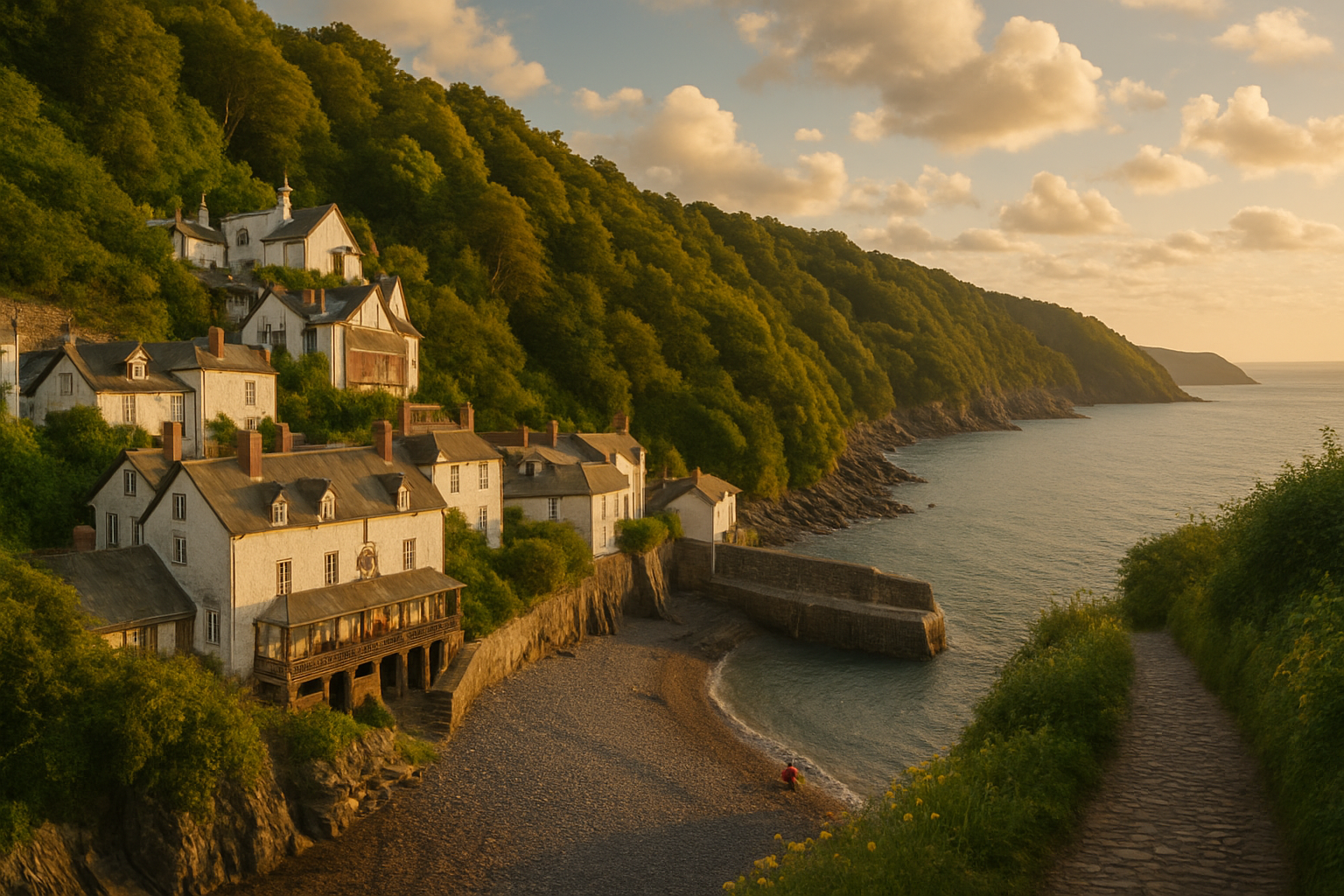
Clovelly, Devon, England
Clovelly is a privately owned fishing village clinging to the steep wooded cliffs of North Devon, where a cobbled main street descends four hundred feet from the plateau above to a stone harbour on Bideford Bay. Recorded in the Domesday Book as a royal manor and held by only three families across nearly eight centuries, the village was transformed into a working fishing port in the late sixteenth century by George Cary. It is the birthplace of Elizabeth Mary Harrington, whose emigration to Van Diemen's Land entwined Clovelly's story with colonial Tasmania.
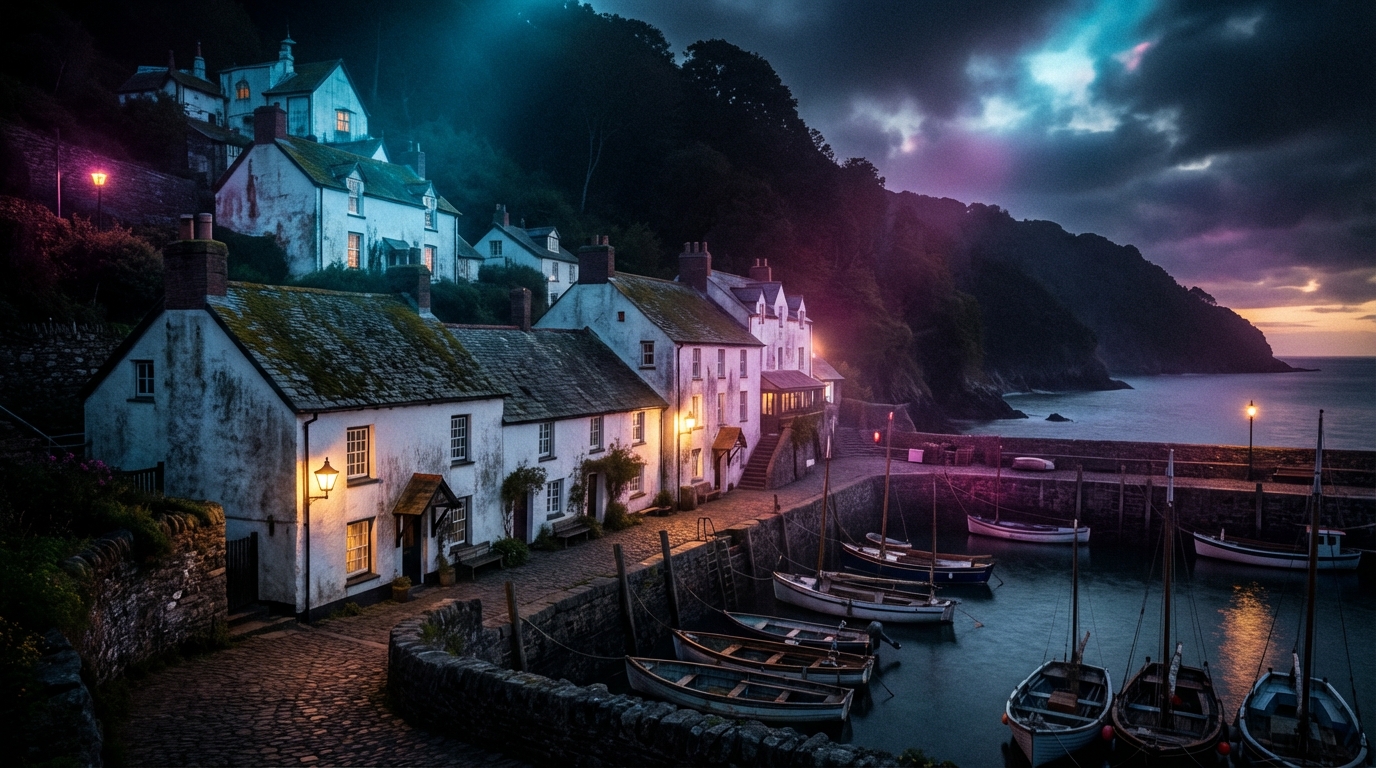
Geography and Setting
Clovelly occupies a steep, wooded cleft in the cliffs of the North Devon coast, facing north-west across Bideford Bay toward the Bristol Channel and the distant Welsh coast beyond. The village lies approximately twenty-one miles west of Barnstaple and eleven miles west-south-west of Bideford, within the Torridge district. Its main street — known locally as Down-a-long and Up-a-long depending on the direction of travel — descends some four hundred feet from the plateau above to a small stone harbour at the water's edge, following the course of a stream that once provided the only natural route between the clifftop and the shore. The gradient is too severe for wheeled traffic of any kind; goods have historically been transported by sledge, and until the 1960s donkeys were employed for everyday haulage of fish, supplies, and even passengers. The village comprises roughly eighty whitewashed cottages — some over six hundred years old, many of wattle and daub construction — built into the slope in close succession, their tight, functional architecture dictated entirely by the terrain. Thick woodland shelters the settlement from the worst of the Atlantic weather, allowing tender plants to flourish in an otherwise exposed position. The estate encompasses some two thousand acres of surrounding farmland and woodland, and the South West Coast Path passes through the village on one of its most spectacular stretches, between Clovelly and Hartland Quay.
Domesday and the Manor
Evidence of human settlement in the area predates recorded history. The substantial Iron Age hillfort at Clovelly Dykes, situated on the cliffs north-west of the village, spans over eight hectares and features multiple concentric ramparts and ditches, probably constructed around 500 BCE. Roman and Saxon occupation in the immediate vicinity remains poorly attested, though the wider North Devon coast shows scattered evidence of both periods.
The manor of Clovelly enters the written record in the Domesday Book of 1086, listed as Clovelie in the Hundred of Hartland. The entry describes a community of sixteen villagers, eleven smallholders, and ten slaves — thirty-seven households in total — supported by twelve ploughlands and fisheries valued at thirty shillings, with a mill recorded on the estate. At the time of the survey, the manor was held by the king, having been gifted by William the Conqueror to his wife, Matilda of Flanders. Following Matilda's death in 1083, the lands passed through various royal grants, eventually reaching the Giffard family, who acquired the estate in 1242. Clovelly has been privately owned ever since, and its extraordinary continuity of ownership is central to its character: in nearly eight hundred years, the manor has been held by only three families.
The Carys and the Making of a Fishing Village
In the late fourteenth century, during the reign of Richard II, the manor was purchased by the judge Sir John Cary, and the Cary family would remain lords of Clovelly for over four hundred years. The village's transformation from a modest agricultural parish into a working fishing port was the achievement of George Cary in the late sixteenth century. At a cost of some two thousand pounds — an enormous sum for the period — Cary had a stone breakwater erected to create a harbour, providing the only safe haven for shipping along the entire stretch of the Devon coast between Appledore and Boscastle. He also built fish cellars and warehouses at the cliff base and erected the cottages along the stream's path that still form the village's main street. The harbour made Clovelly's fortune. Herring appeared in vast shoals in the shallow waters of the Bristol Channel at certain seasons, and the village became celebrated for its herring fishery; besides which, large quantities of conger, whiting, hake, pollack, and cod were caught in winter, with turbot, sole, plaice, and mackerel taken in summer.
The Church of All Saints, standing in the grounds of Clovelly Court, is the parish's only Grade I listed building, its origins Norman but its surviving fabric largely fifteenth and early sixteenth century. The church is unusually rich in monuments to the lords of the manor. Monumental brasses on the chancel floor commemorate Sir William Cary, beheaded after the Lancastrian defeat at the Battle of Tewkesbury in 1471, and his son Robert. A large Elizabethan six-poster memorial on the south side of the chancel marks Sir Robert Cary, who died in 1586 after attending the Exeter Assizes when an outbreak of gaol fever struck down prisoners, judges, lawyers, and jury alike. The Jacobean pulpit, carved in 1634, carries an hourglass given the following year by William Cary, mounted on a pedestal of driftwood found on the beach. George Cary's son William — sometimes identified as the model for Will Cary in Charles Kingsley's novel Westward Ho! — sat as Member of Parliament for Mitchell in Cornwall. The Carys supported the Royalist cause during the Civil War, and local tradition holds that they had the lead stripped from the church roof to make musket balls. But the male line eventually failed: the last of the Carys of Clovelly was Elizabeth Cary, who married Robert Barber of Ashmore in Dorset and died in 1738.
The Hamlyns and the Preservation of Clovelly
In 1738, the year of Elizabeth Cary's death, the Clovelly estate was purchased for £9,438 by Zachary Hamlyn, a lawyer of Lincoln's Inn who had been born at Kennerland Farm in Higher Clovelly and made a considerable fortune in London. Zachary died unmarried in 1759, leaving the estate to his great-nephew James Hammett, who adopted the Hamlyn surname by Act of Parliament and was created a baronet in 1795. The Hamlyn family's most enduring contribution to the village was the construction of the Hobby Drive, a scenic carriage road cut through the woods above the coast connecting the village to the Bideford road. Work began during the Napoleonic Wars, reportedly assisted by French prisoners of war, and continued through the period of high unemployment after 1815.
The woman who more than any other individual gave Clovelly its present appearance was Christine Hamlyn, who inherited the estate in 1884 and married Frederick Gosselin in 1889. For over half a century until her death in 1936, Christine devoted herself to restoring and beautifying the village, renovating the ancient cottages and expanding them while preserving their character. Her initials can still be seen worked into the stonework and plasterwork of cottages throughout the village, a quiet signature of stewardship that endures to this day. A memorial to Christine Hamlyn stands in All Saints Church. The estate remains in the hands of her descendants: the present owner, the Hon. John Rous, is her great-grand-nephew, the son of Keith Rous, fifth Earl of Stradbroke, by his second marriage to Mary Asquith, granddaughter of the former prime minister H. H. Asquith.
Life and Loss at Sea
Fishing defined not only Clovelly's income but also its rhythms and its sorrows. Boys were apprenticed early to the boats, and girls learned the work of net mending, fish gutting, and preserving. The sea gave, and the sea took away. On the night of 4 October 1821, a sudden gale struck some sixty herring boats working off the coast; more than forty were driven onto the rocks, and thirty-one fishermen drowned, leaving scores of widows and orphans in a village that depended entirely upon the fishery for its survival. A relief fund was established, and a silver salver presented to the local benefactor who led the charitable response. Barely seventeen years later, on Sunday 28 October 1838, twelve fishing vessels carrying twenty-six men put out from Clovelly harbour for the herring grounds. A ferocious storm rose in the Bristol Channel; only one vessel and its crew ever returned. The disaster inspired Charles Kingsley — who had lived in Clovelly as a boy while his father served as curate and then rector between 1826 and 1836 — to write the poem The Three Fishers, and contributed to the founding of the Shipwrecked Mariners' Society in 1839.
During the eighteenth and nineteenth centuries, smuggling provided a significant supplement to legitimate trade, the village's steep cliffs and isolated harbour offering ideal cover for the illicit movement of brandy, tea, and other dutiable goods. Many local fishermen were involved, and the remoteness of the North Devon coast made detection difficult. Life was harsh in other respects as well: water had to be carried in pails from communal wells, coal was brought in by boat or carted laboriously from inland, and families lived in two- or three-room cottages, often shared with elderly parents or widowed relatives. A typical household diet consisted of salted fish, bread, root vegetables, and in harder winters barley broth with dried peas. The cliff's relentless incline demanded physical resilience from childhood onward.
Elizabeth Mary Harrington (1783–1852)
Among those shaped by this hard, isolated existence was Elizabeth Mary Harrington, born on 8 March 1783, the eldest of six children of Thomas Harrington, a fisherman, and his wife Mary. Elizabeth's early life was defined by domestic responsibility and the rhythm of her father's tide-bound work, and from a young age she demonstrated a steadiness and capability that set her apart. In 1801, at the age of eighteen, she left Clovelly for employment in service near Barnstaple, where she earned a reputation for precision, discretion, and incorruptible diligence. Yet she did not remain content with provincial life. In 1815, driven by a mixture of pragmatism and a yearning for something beyond the narrow world of the Devon coast, Elizabeth emigrated to Van Diemen's Land.
There, she became housekeeper at Jeffries Manor, a colonial estate beset by both grandeur and mystery, and her exacting standards and unflinching temperament were widely noted. Her detailed household ledgers became the manor's living memory — a meticulous record that would prove central to the investigation following the disappearance of William Jeffries Sr. in 1821, not because of any dramatic revelation, but because of the precision of her recollections and the completeness of her accounts. Elizabeth died on 7 June 1852, aged sixty-nine, unmarried, having given thirty-five years of unwavering dedication to the estate. Back in Clovelly, few likely knew the full extent of her influence abroad, but her departure was not unusual. Many from the village, particularly younger women, sought domestic employment or passage to the colonies — sometimes driven by economic hardship, other times by the desire to escape the constraints of an insular life from which the sea offered the only horizon.
Kingsley, Dickens, and the Discovery of Clovelly
Until the middle of the nineteenth century, Clovelly was virtually unknown to the outside world. Its transformation into a place of national renown owed much to Charles Kingsley, whose childhood years in the village between 1831 and 1836 left an indelible impression. His 1855 novel Westward Ho!, set in and around the village during the age of the Spanish Armada, romanticised the North Devon coast and drew the first wave of curious visitors. Charles Dickens visited and described the village in A Message from the Sea in 1860, and J. M. W. Turner painted its harbour around 1822 — the painting now hangs in the National Gallery of Ireland in Dublin. Rex Whistler later captured the village in cameos that were used on a china service by Wedgwood. The surgeon Campbell De Morgan, who first speculated that cancer arose locally before spreading more widely through the body, was born in Clovelly in 1811.
By the late nineteenth century, as fish stocks declined and younger generations increasingly left for better prospects inland or abroad, tourism gradually replaced fishing as the village's primary economic activity. Christine Hamlyn's painstaking restoration work ensured that visitors found a settlement of remarkable architectural coherence, and the estate has charged an admission fee since 1924 — among the earliest such arrangements in England. The village today operates under the Clovelly Estate Company, with every building owned by the estate and maintained using traditional materials and skilled labour. More than fifty of the seventy-one buildings along the main street are architecturally listed. The parish population stood at 443 at the 2011 census, a far cry from the 950 recorded in 1841, when forty seamen were additionally absent at sea. The fishing boats still work from the harbour, the cobbles still descend to the quay, and the steep street that so astonished Susan Coolidge in 1890 — built, as she marvelled, into the sides of a crack in a tremendous cliff — remains as it was when George Cary first laid its stones four centuries ago.







