4085.162 · June 11, 1765 AD
Chewbathia, Stewartshire, Caledonia, Clivilius
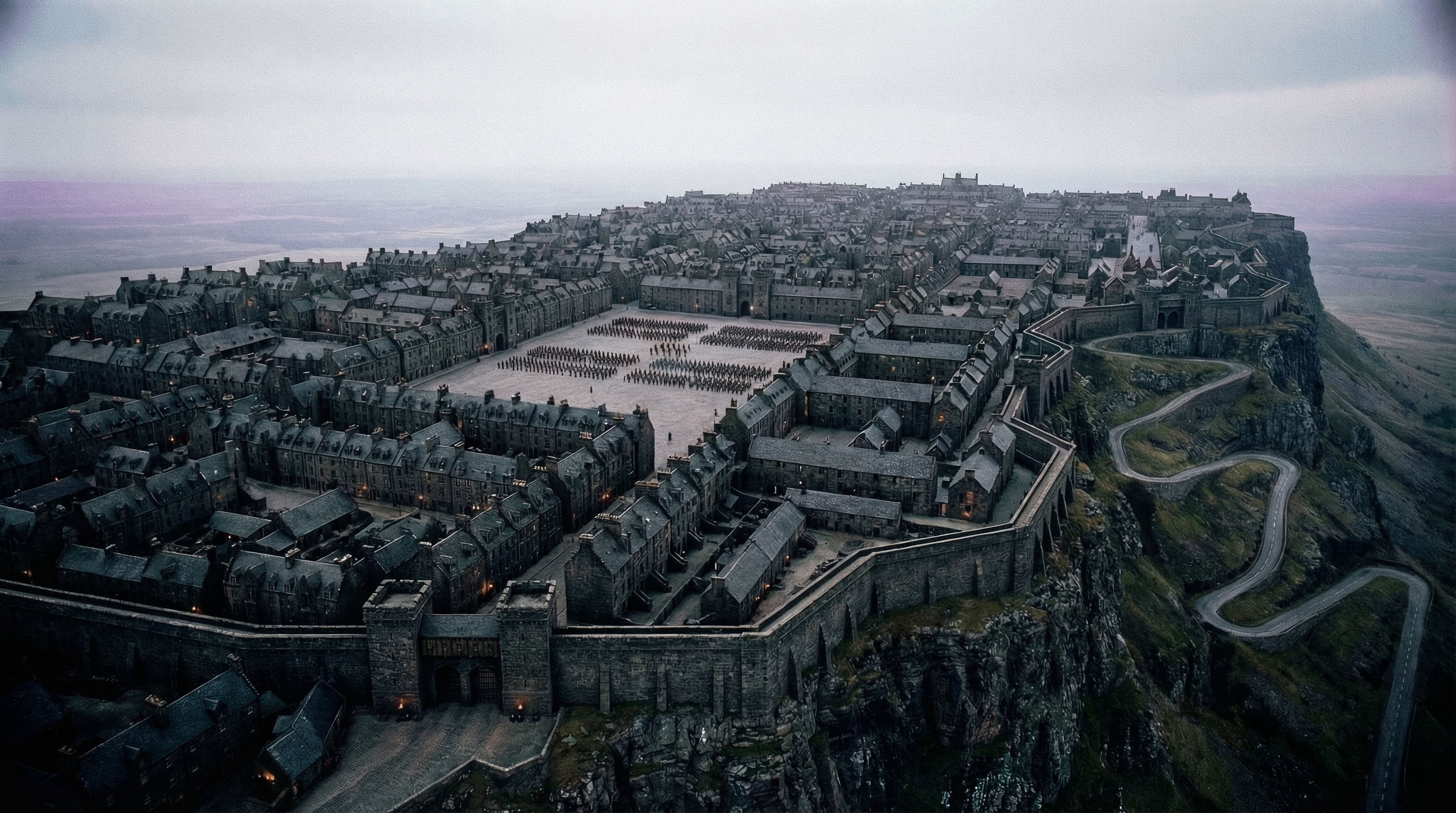
Chewbathia is the military burgh of Stewartshire, established on a commanding rocky plateau overlooking New Edinburgh. Founded by William Brodie in 1762 and formally completed on 11 June 1765, the settlement was named to honour the fallen of Culloden and serves as Caledonia's primary military installation. Home to the legendary Chewbathian Hunters and the elite Shadow Division, Chewbathia maintains its own governance structure whilst remaining integral to Stewartshire's defence and regional security.
Origins and Naming
Chewbathia owes its existence to the partnership between Elspeth Stewart and William Brodie, two figures whose unlikely alliance shaped the early security of New Edinburgh. When Brodie arrived in Clivilius on 9 July 1762, fleeing prosecution for his criminal activities in Edinburgh, he brought with him not merely his skills as a cabinet-maker but also the street cunning and organisational abilities that had made him a successful leader of thieves. Elspeth, recognising that the fledgling settlement would require defenders as much as farmers and builders, saw in Brodie a man whose talents could be redirected toward more honourable purposes.
The name "Chewbathia" represents a deliberate corruption of "Culloden," the site of the devastating 1746 battle where Jacobite hopes had been crushed on Scottish soil. For Brodie and the Scottish settlers who would form the garrison's first defenders, the name carried profound significance. Many had lost relatives at Culloden or in the brutal clearances that followed; others had grown up hearing stories of that terrible day when the Highland way of life had been shattered. By naming their military outpost after this site of sacrifice and loss, the founders transformed grief into purpose—the warriors trained at Chewbathia would ensure that no such catastrophe would befall their new home.
The corruption of the name from Culloden to Chewbathia occurred naturally over time, shaped by the accents of settlers from various parts of Scotland and the gradual evolution of local pronunciation. Some scholars suggest the transformation was deliberate, creating a name that honoured the past whilst asserting Chewbathia's distinct identity in Clivilius. Whatever the truth, the name has become inseparable from the settlement's martial character, spoken with pride by generations of warriors who have passed through its gates.
Location and Physical Character
Chewbathia occupies a rocky plateau that rises some sixty metres above the surrounding plain, positioned to command views across the approaches to New Edinburgh from the north and east. The plateau's natural defensive advantages were immediately apparent to Elspeth and Brodie when they scouted potential locations on 8 April 1763—steep cliffs on three sides, a single manageable approach from the southwest, and sight lines extending for kilometres across the terrain below. The rock itself, a grey-brown stone shot through with veins of darker mineral, has proven excellent building material, lending Chewbathian structures their distinctive appearance.
The settlement spreads across approximately two square kilometres of the plateau's surface, its buildings constructed primarily from local stone quarried from the cliffs themselves. The architecture reflects both practical military requirements and the Scottish heritage of its founders—thick walls capable of withstanding assault, narrow windows positioned for defensive fire, but also the stepped gables and crow-stepped rooflines familiar from Edinburgh's Old Town. The central parade ground, where generations of recruits have drilled beneath Caledonia's sky, is paved with flagstones worn smooth by countless boots.
The approach road winds up the plateau's southwestern face in a series of switchbacks, each turn overlooked by defensive positions carved into the rock. Brodie's craftsman's eye is evident in the road's construction—the gradient carefully calculated to exhaust attackers whilst remaining manageable for supply wagons, the turning points positioned to prevent siege engines from gaining clear lines of fire. At the road's summit stands the main gate, a massive timber and iron construction that has been replaced and reinforced several times over the centuries but maintains the essential design Brodie specified in 1763.
Founding and Construction
Construction of Chewbathia began on 23 May 1763, less than a year after New Edinburgh's founding. Brodie assembled a team of workers from among the settlers—stonemasons, carpenters, and labourers willing to undertake the demanding work of building on the exposed plateau. Many were men from his Edinburgh network, former criminals whose skills in breaking into buildings proved surprisingly applicable to constructing them. Others were settlers seeking wages to support their families during the uncertain early years.
The work proceeded in phases, with defensive walls and basic barracks taking priority. Brodie proved an exacting supervisor, his cabinet-maker's precision extending to every aspect of construction. Joints were to be tight, walls plumb, foundations deep enough to anchor in solid rock. Workers who produced shoddy work found themselves dismissed; those who met Brodie's standards earned his respect and, often, positions of responsibility as the settlement grew. The construction site became an informal training ground, teaching settlers skills they would apply throughout New Edinburgh's development.
The arrival of Captain Angus MacTavish on 17 March 1764 marked a turning point in Chewbathia's evolution. MacTavish, a seasoned military officer and close associate of Brodie from Edinburgh, brought professional military expertise to complement Brodie's practical cunning. Under his guidance, the settlement's layout was refined to incorporate proper training facilities, armouries, and the administrative structures necessary for a functioning military installation. MacTavish also began the work of transforming raw settlers into disciplined soldiers, establishing training regimens that would evolve into the legendary programmes of the Chewbathian Hunters.
The formal completion and inauguration of Chewbathia occurred on 11 June 1765, in a ceremony led by Elspeth Stewart and attended by all four Stewart sisters, William Brodie, and representatives from the growing community of New Edinburgh. The ceremony combined Scottish military traditions with acknowledgement of the settlement's new context—bagpipes played as the garrison flag was raised, whilst Elspeth spoke of the challenges ahead and the defenders' sacred duty to protect their new homeland. The date is still commemorated annually in Chewbathia, marked by parades, ceremonies, and the traditional playing of "The Flowers of the Forest" in memory of Culloden's fallen.
The Chewbathian Hunters
The establishment of the Chewbathian Hunters on 7 October 1767 transformed Chewbathia from a military garrison into something more distinctive—a centre for the training and deployment of elite warriors whose skills would become legendary throughout Clivilius. Elspeth Stewart and Captain MacTavish conceived the Hunters as a specialised force combining the tracking and fieldcraft skills of Highland hunters with military discipline and tactical sophistication. The name itself reflected this dual heritage, evoking both the hunting traditions of the Scottish Highlands and the lethal purpose these skills would serve.
Recruitment for the Hunters was selective from the beginning. Candidates required not merely physical fitness and courage but also the patience, observation skills, and independent judgement necessary for extended operations in hostile territory. Many early Hunters came from Highland backgrounds, bringing traditional knowledge of stalking, tracking, and survival that formed the foundation of Hunter training. Others demonstrated aptitude through service in Chewbathia's regular garrison, earning selection through exceptional performance.
The Hunters proved their worth decisively on 6 July 1770, when Chewbathia successfully defended New Edinburgh from a major assault. The details of this engagement—the identity of the attackers, the course of the battle, the casualties on both sides—have become somewhat obscured by time and the tendency of military history to acquire legendary embellishments. What remains clear is that the defence succeeded, that the Hunters played a crucial role, and that the battle established Chewbathia's reputation as the shield of New Edinburgh. Elspeth and William Brodie both participated in the defence, their leadership during the crisis cementing the partnership that had built Chewbathia.
Governance and Administration
Chewbathia operates as a military burgh within Stewartshire, a status that grants it considerable autonomy in internal affairs whilst maintaining its integration with the broader regional framework. This arrangement, formalised when Stewartshire was established on 15 August 1775, recognises the settlement's distinctive character and the practical impossibility of subjecting military operations to civilian administrative processes. Chewbathia participates in Stewartshire governance through appointed representatives rather than elected officials, reflecting the military chain of command that structures life within the settlement.
The Commander of Chewbathia serves as the settlement's chief executive, responsible for military operations, training programmes, and the administration of the garrison. This position has evolved considerably since Brodie's informal leadership in the early years; modern Commanders operate within an elaborate institutional framework that includes advisory councils, specialist departments, and formal procedures for decision-making. The Commander reports to both the Stewartshire Council on administrative matters and to Caledonia's defence establishment on military affairs, a dual accountability that occasionally generates tension but generally functions effectively.
Beneath the Commander, the High Council advises on strategic matters and oversees the various divisions and units that comprise Chewbathia's military structure. The Council includes senior officers from the regular garrison, representatives of the Hunter corps, and specialists in logistics, intelligence, and training. Decisions of significant consequence—major deployments, changes to training doctrine, allocation of resources—require Council deliberation, ensuring that no single individual's judgement determines Chewbathia's course.
Civilian administration within Chewbathia is minimal but not absent. The settlement includes support personnel—cooks, clerks, medical staff, craftspeople—whose work enables military operations but who are not themselves soldiers. These civilians fall under military jurisdiction whilst within Chewbathia but retain their rights as Stewartshire citizens. Families of serving personnel may reside in designated areas of the settlement, creating a small but stable civilian population that softens somewhat the garrison's martial atmosphere.
Military Structure and Divisions
Chewbathia's military organisation has grown considerably more complex since the early days when Brodie commanded a handful of settlers with more enthusiasm than training. The modern establishment comprises several distinct components, each with its own traditions, specialisations, and place within the overall defensive framework.
The Regular Garrison forms the foundation of Chewbathia's strength, providing guards, patrols, and the bulk of forces available for major operations. These soldiers receive thorough training in conventional military skills—formation fighting, fortification, the use of various weapons—and serve as the first line of defence for both Chewbathia itself and New Edinburgh. Service in the Regular Garrison often precedes selection for more specialised units, allowing commanders to identify individuals with aptitude for advanced training.
The Chewbathian Hunters remain the settlement's most prestigious unit, their selection process, training programme, and operational capabilities representing centuries of accumulated expertise. Hunters operate in small teams, typically four to eight individuals, undertaking reconnaissance, long-range patrol, and special missions that require skills beyond those of regular soldiers. Their training emphasises self-sufficiency, adaptability, and the judgement to make sound decisions far from support or supervision.
The Shadow Division represents a more recent evolution in Chewbathian military capability, established to address threats requiring covert rather than conventional responses. Shadow Division personnel receive additional training in infiltration, intelligence gathering, and operations where discretion matters more than force. The Division operates in squads, each led by an experienced officer and comprising specialists whose skills complement one another. Squad 11, currently led by Alistair MacKenzie, exemplifies the Division's approach—a small team of exceptional individuals including spotter Eilidh Robertson, whose combined capabilities exceed what their numbers might suggest.
Training and Traditions
Training at Chewbathia begins with fundamentals—physical conditioning, weapons proficiency, drill and discipline—and progresses through increasingly demanding programmes that test candidates' limits and develop their capabilities. The training philosophy, established by Captain MacTavish and refined over generations, emphasises realistic preparation for actual combat conditions. Exercises are conducted in varied terrain and weather, often with minimal warning, teaching soldiers to function effectively despite fatigue, discomfort, and uncertainty.
Scottish traditions permeate Chewbathian military culture, connecting modern warriors to the heritage that inspired the settlement's founding. Soldiers wear kilts and tartans for ceremonial occasions, their patterns reflecting unit affiliations and individual family connections. Bagpipes accompany significant events—graduations, deployments, memorials—their sound carrying across the plateau as it once carried across Highland battlefields. The songs, stories, and customs of Scotland have been adapted to Chewbathian circumstances, creating traditions that honour the past whilst serving present purposes.
The annual commemoration of Chewbathia's founding on 11 June represents the settlement's most significant ceremonial occasion. Current and former personnel gather on the parade ground for ceremonies that include the playing of traditional music, recitation of the names of those who have fallen in service, and renewal of oaths to defend New Edinburgh and Caledonia. The day concludes with celebrations that blend military formality with the warmth of shared community—feasting, music, and the telling of stories that connect generations of Chewbathian warriors.
Relationship with New Edinburgh
Chewbathia's relationship with New Edinburgh has always been characterised by interdependence rather than subordination. The military settlement exists to defend the civilian city, drawing its purpose and much of its population from New Edinburgh whilst providing the security that enables civilian life to flourish. This symbiosis has deepened over the centuries, creating bonds of family, commerce, and shared identity that transcend the formal administrative distinction between the two settlements.
Many Chewbathian families maintain connections in New Edinburgh—relatives who chose civilian occupations, children sent to the city for education, retired personnel who settled in less martial surroundings. The road between the settlements sees constant traffic as personnel move between duty stations and homes, as supplies flow up to the plateau and products of Chewbathian industry flow down to city markets. Marriages between Chewbathian military families and New Edinburgh civilians are common, weaving the communities together through ties of blood and affection.
The New Scottish Guard, established on 23 April 1790 to provide internal security and ceremonial functions within New Edinburgh, represents one institutional expression of this relationship. Though administratively distinct from the Chewbathian military, the Guard draws heavily on Chewbathian training methods and often recruits personnel who have served in the garrison. Elspeth Stewart's address to the newly formed Guard, delivered at Chewbathia on 24 April 1790, emphasised the complementary roles of the two forces—the Guard protecting New Edinburgh's internal peace whilst Chewbathia defended against external threats.
Economic Character
Chewbathia's economy centres on its military function but extends beyond purely martial activities. The settlement requires substantial resources—food, equipment, materials for construction and maintenance—much of which is supplied from New Edinburgh and the broader Stewartshire economy. In return, Chewbathia provides security services, trained personnel who often transition to civilian occupations after military service, and the products of its own specialised industries.
Weapons and armour production has been a Chewbathian speciality since the settlement's earliest years, drawing on the metalworking skills that Ironhold refugees brought to New Edinburgh in 1767. Chewbathian smiths produce equipment renowned throughout Caledonia for quality and durability, their work combining traditional techniques with innovations developed through close attention to military requirements. The armouries supply not only Chewbathian forces but also the New Scottish Guard and, through carefully controlled trade, allied settlements beyond Caledonia's borders.
The settlement also produces leather goods, textiles, and other military equipment, maintaining workshops where skilled craftspeople create everything from boots to tents to the elaborate formal uniforms worn on ceremonial occasions. These industries employ both military personnel developing practical skills and civilians who have made Chewbathia their home. The quality of Chewbathian craftsmanship reflects the settlement's culture of excellence—the same standards that govern military training apply to the production of goods that soldiers' lives may depend upon.
Notable Figures
William Brodie's legacy pervades Chewbathia, though the man himself lived only nineteen years after his apparent execution in Edinburgh. Having escaped the gallows through Guardian intervention in 1788, Brodie spent his remaining years at the settlement he had founded, dying peacefully on 23 February 1807 at the age of sixty-five. His grave, located in a quiet corner of the plateau with views across the land he had helped to defend, has become a site of pilgrimage for Chewbathian personnel. The inscription, composed by Elspeth Stewart before her own death, acknowledges both his flaws and his contributions: "William Brodie—Craftsman, Scoundrel, Guardian, Defender."
Captain Angus MacTavish, the military professional who transformed Brodie's ambitious project into a functioning military establishment, is remembered as the architect of Chewbathian training traditions. His methods, documented in manuals that remain required reading for officers, established principles that have guided the development of Chewbathian warriors for over 260 years. MacTavish served as Commander until his death in 1791, having witnessed the establishment of the Hunters, the successful defence of New Edinburgh, and the emergence of Chewbathia as Caledonia's premier military institution.
Among contemporary figures, Alistair James MacKenzie represents the continuation of Chewbathian excellence. Born on 12 March 1975 to a Hunter father and healer mother, MacKenzie rose through the ranks to command Squad 11 of the Shadow Division, demonstrating the tactical brilliance and connection to Highland heritage that characterise Chewbathia's finest warriors. His leadership of the squad—which includes spotter Eilidh Robertson, born 8 March 1992—exemplifies the combination of tradition and adaptation that has sustained Chewbathia through changing circumstances.
Marcus Alexander Lane, born 5 January 1990 in New Edinburgh and trained at Chewbathia, represents how the settlement's influence extends beyond its walls. His progression from Chewbathian Hunter to Chief Operative of the Clivilius Secret Service demonstrates the broader impact of Chewbathian training, producing leaders whose capabilities serve not merely the settlement or Stewartshire but all of Caledonia. Operation Desert Sentinel in 2015, which Lane planned and executed to dismantle a network of Portal Pirate spies, illustrated how Chewbathian methods translate into modern intelligence operations.
Modern Era
Contemporary Chewbathia faces challenges and opportunities that its founders could not have anticipated. The settlement's population, though still modest compared to New Edinburgh, has grown to include several thousand military personnel and their dependents, straining infrastructure designed for a smaller garrison. Training programmes must prepare soldiers for threats that evolve as Clivilius changes—not merely conventional military challenges but also the complexities of intelligence warfare, dimensional security, and cooperation with allied forces from settlements with very different military traditions.
The Shadow Division has assumed increasing importance as threats to Caledonia have grown more sophisticated. Operations like Desert Sentinel demonstrated capabilities that extend well beyond traditional military skills, requiring Chewbathia to develop expertise in areas its founders would have found incomprehensible. This evolution has generated some tension between traditionalists who emphasise the Hunter heritage and modernisers who argue that effectiveness requires adaptation. The resolution, typically, has been to maintain traditional training as a foundation whilst adding specialised programmes for those selected for advanced roles.
Chewbathia's relationship with New Edinburgh has grown more complex as the city's population has swelled to over 250,000. The military settlement that once defended a small frontier community now protects a major urban centre whose security requirements extend far beyond simple perimeter defence. Coordinating with the New Scottish Guard, the Clivilius Secret Service, and civilian authorities demands diplomatic skills alongside martial ones, requiring Chewbathian commanders to navigate political sensitivities that would have baffled William Brodie.
Yet for all these changes, Chewbathia's essential character endures. The plateau still commands its views across Stewartshire; the parade ground still echoes with the tramp of boots and the skirl of pipes; the training programmes still push candidates to their limits and beyond. Warriors who complete Chewbathian training carry with them not merely skills but an identity—membership in a community that stretches back to the settlement's founding and forward to generations yet to come. In their discipline, their excellence, and their dedication to defending their homeland, they honour the memory of Culloden's fallen whilst building something those fallen warriors could only have dreamed of: a Scottish civilisation flourishing in a new world, protected by sons and daughters worthy of their heritage.







