Carrington Flats
The Carrington Flats are a low-lying marshland south-east of Brierly, where the Whitmore River slows and spreads into shallow wetlands at the end of its course. Once a barren, lifeless expanse of mud, the Flats were transformed by the botanist Guardian Elizabeth Carrington, who seeded them with reeds, marsh grasses and nitrogen-fixing plants until the dead marsh came alive. Renewed each season by the river's nutrient-rich flooding, they became Brierly's principal supplementary farmland and a natural regulator of the region's water and soil. They bear Carrington's name in tribute.
Where the River Ends
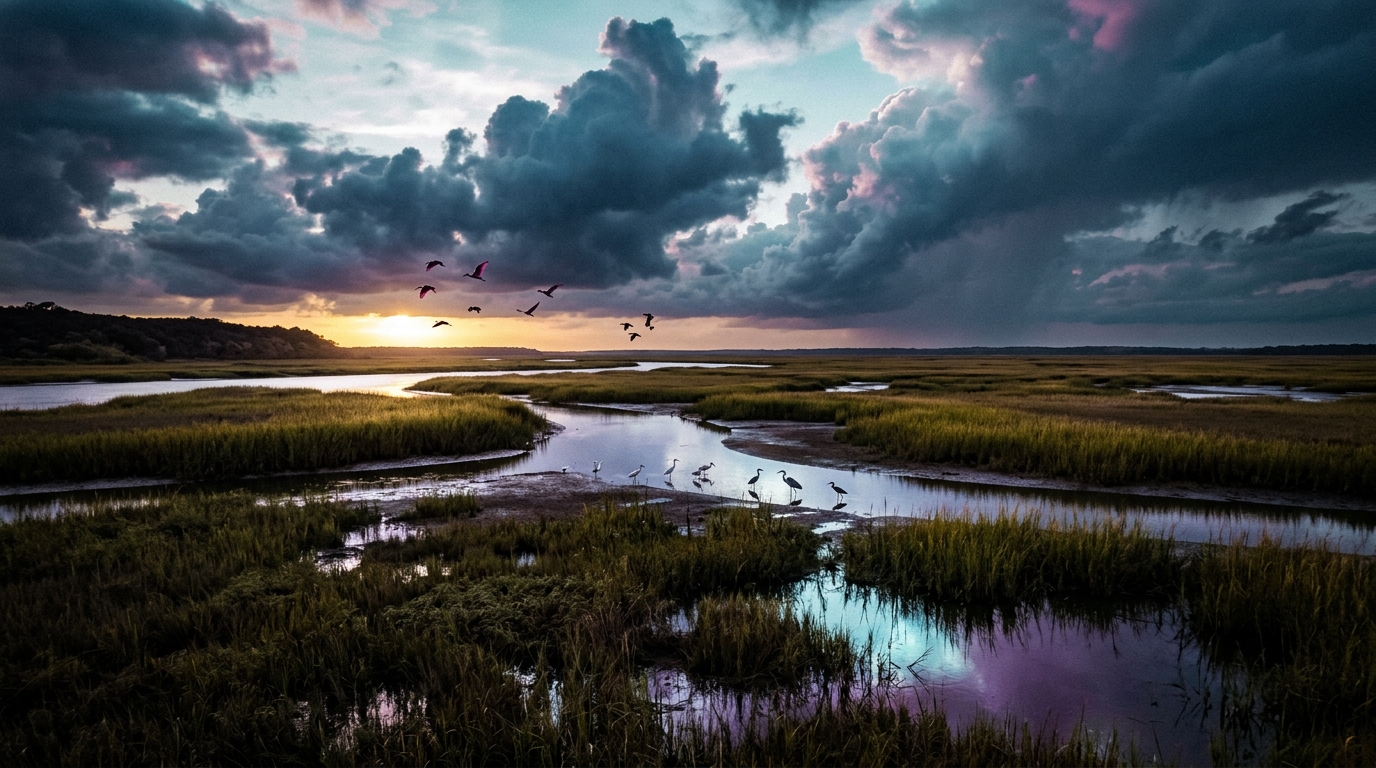
The Carrington Flats lie to the south-east of Brierly, in the low country where the Whitmore River comes to the end of its journey. Here the river loses the single thread it has held since the highlands, slowing and spreading across the flat ground until it is no longer quite a river at all but a broad, shallow marshland — a network of seasonally flooded grasslands, sediment-rich silt banks, and slow, reed-choked channels through which the last of the highland water finds its unhurried way.
It is a gentle, low-lying country, the opposite in every way of the rugged highlands at the river's source. Where the high country is stone and steepness, the Flats are silt and standing water, a soft horizontal expanse that floods and dries with the turning of the seasons. The settlers learned to read those rhythms early, for the marsh that looked at first like waste ground would prove, in time, to be one of the most quietly valuable features of the whole region.
A Barren Marsh
It did not begin that way. In the first years of the settlement the Flats were a desolate place — a muddy, lifeless expanse where the river's water simply pooled and stagnated, incapable of supporting any growing thing. Like the barren ground on which Brierly itself was raised, and like the dead river that ran through it, the marsh was so much empty potential, offering nothing to the struggling settlers but mud and standing water.
For a community fighting to feed itself, a great tract of sodden, useless ground at the river's end was a problem rather than a promise. Yet it was precisely the kind of problem that the founding company had been assembled to solve, and the marsh would not stay barren for long.
Carrington's Work
The transformation of the Flats was the work of Elizabeth Carrington, the botanist among Brierly's five founding Guardians, and it stands as one of the clearest demonstrations of her craft anywhere in the settlement. Where others saw only mud, she saw a wetland waiting to be made, and she set about making it with the same patient, methodical skill she brought to all her work with growing things.
Under her guidance the settlers introduced Earth-native wetland plants to the marsh — reeds and marsh grasses to bind the loose ground, and nitrogen-fixing plants to feed the impoverished soil and ready it for cultivation. It was a deliberate ecological design rather than a hopeful scattering of seed: each plant was chosen for the part it would play in turning dead silt into living, productive land. Slowly the roots took hold, the soil firmed and enriched, and the lifeless marsh began, season by season, to come alive.
The Gift of the Flood
What Carrington's plants began, the river itself completed. Each season the Whitmore's controlled flooding spread across the Flats and withdrew again, and every time it did so it left behind a fresh layer of nutrient-rich sediment carried down from the highlands and the settled country upstream. Where on Earth a farmer must labour to feed his fields, the Flats were renewed for free, fertilised anew with each cycle of flood and retreat.
The settlers learned to work with that rhythm rather than against it. They timed their planting to the drying of the ground, sowing as the floodwaters fell back and the enriched silt lay ready, and in this way the Carrington Flats became Brierly's principal source of supplementary farmland. It was here, above all, that the settlement grew its grain, and here that it practised the rotational agriculture that kept its soils healthy — the marsh that had once been useless now feeding the community as reliably as the plains themselves.
The Settlement's Balance
The value of the Flats was never only in what could be grown on them. The marsh serves the whole region as a natural regulator of water, and in doing so it protects Brierly from the extremes that might otherwise threaten it. In times of heavy flow, the Flats absorb the river's excess, soaking up water that might otherwise have flooded the settled ground upstream; in drier spells, the slow release of that stored water helps guard against the worst of any drought.
Their seasonal cycle of flooding and drying also keeps the land itself in good heart, preventing the soil depletion that relentless cultivation would bring and allowing the planned rotations on which Brierly's farming depends. As the wetlands filter sediment and draw off excess nutrients from the water passing through them, they keep the whole river system clear and healthy. The Flats are, in this sense, the settlement's ecological keystone — a single feature quietly holding the region's water, soil, and harvests in balance.
Reeds, Birds and Fish
With the plants came the rest of a living wetland. The reed beds and marsh grasses that Carrington established gave shelter to the creatures that followed, and the Flats grew into a haven of wetland life — a place loud with birds at the turning of the seasons, its channels and shallows home to the fish that spread down the river system from the settlers' early stocking. From a dead expanse of mud, the marsh became one of the richest habitats in the region.
That abundance has not gone unnoticed by a settlement always alert to what its land might yield. Among the experimental projects that have been tried on the Flats are tentative ventures into controlled aquaculture, raising fish in the managed shallows, alongside proposals for more permanent irrigation works to draw on the marsh's water with greater regularity. For the most part, though, the Flats remain undeveloped, their value lying as much in being left to do their patient natural work as in any scheme to improve upon it.
The Botanist's Memorial
The Flats carry Elizabeth Carrington's name in fitting tribute, for they are her work made permanent — the place where the botanist Guardian took a barren marsh and, through her command of growing things, turned it into ground that helped ensure the whole settlement's survival. To name them for her was to acknowledge a simple truth: without what she did here, and across Brierly's other fields, the settlement might not have outlasted its first hard years.
There is a quiet symmetry, too, in the watercourse that binds the region's geography. The Whitmore River runs its whole length from the highlands that bear the vintner's name to the flats that bear the botanist's — from George Whitmore's high country to Elizabeth Carrington's wetland, the two founders joined by the water that flows between them. Along the marsh's northern edge runs the Old Brierly Road, carrying travellers past the reed beds on their way to and from the settlement, and the Flats endure much as Carrington made them: a living memorial to the founders' ingenuity, and to the patient art of making a dead land yield.







