Cambridge, Cambridgeshire, England
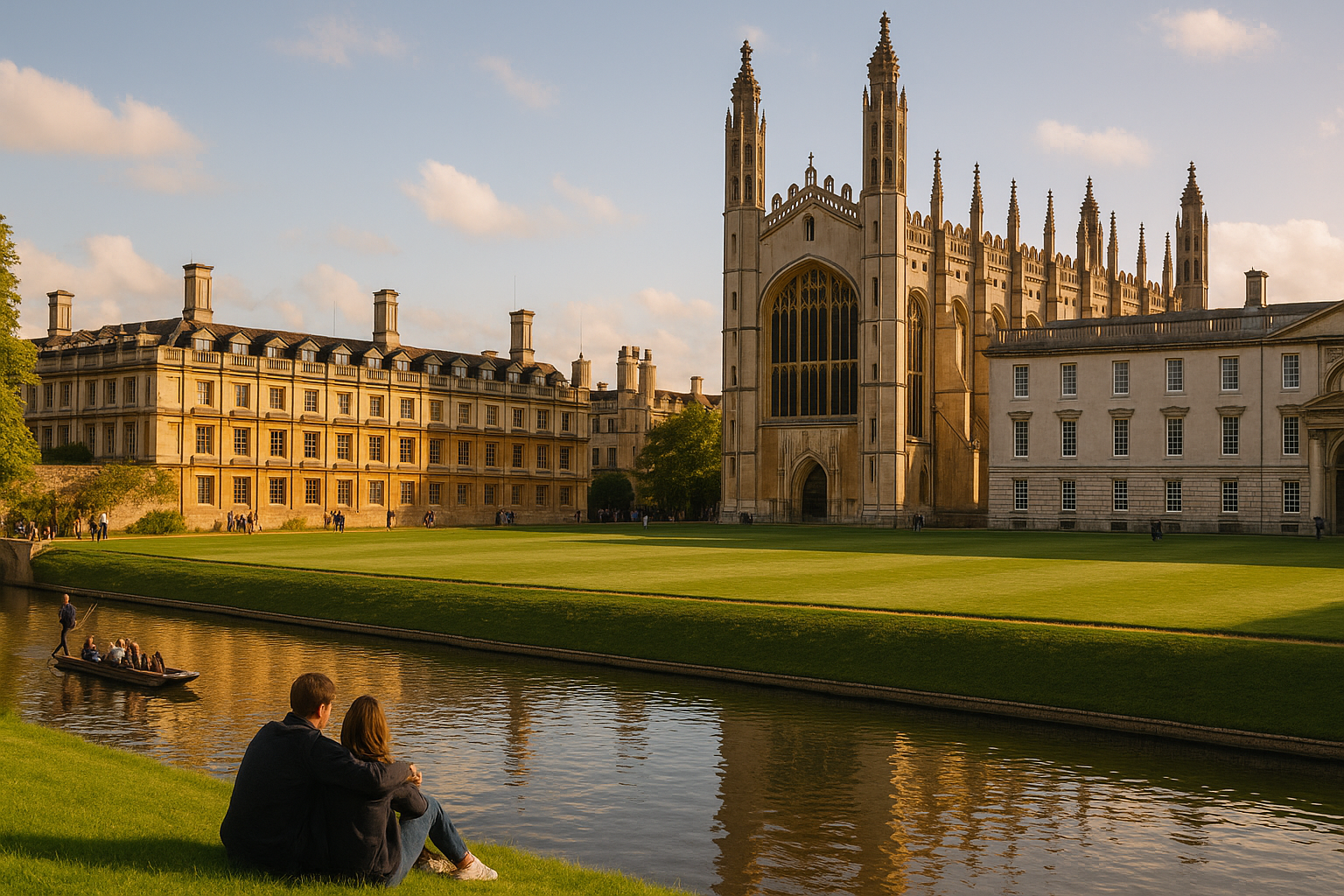
Cambridge, the county town of Cambridgeshire, stands on the River Cam fifty-five miles north of London. The site has been continuously occupied since the Romans built the fort of Duroliponte on Castle Hill around AD 70, and the Anglo-Saxon settlement of Grantebrycge grew into a prosperous trading centre under Danish rule in the ninth century. Since 1209, when scholars fleeing violence at Oxford established a new centre of learning on its banks, the town's identity has been inseparable from the university it hosts — now home to thirty-one colleges and 126 Nobel laureates.
Duroliponte: The Roman Fort on Castle Hill
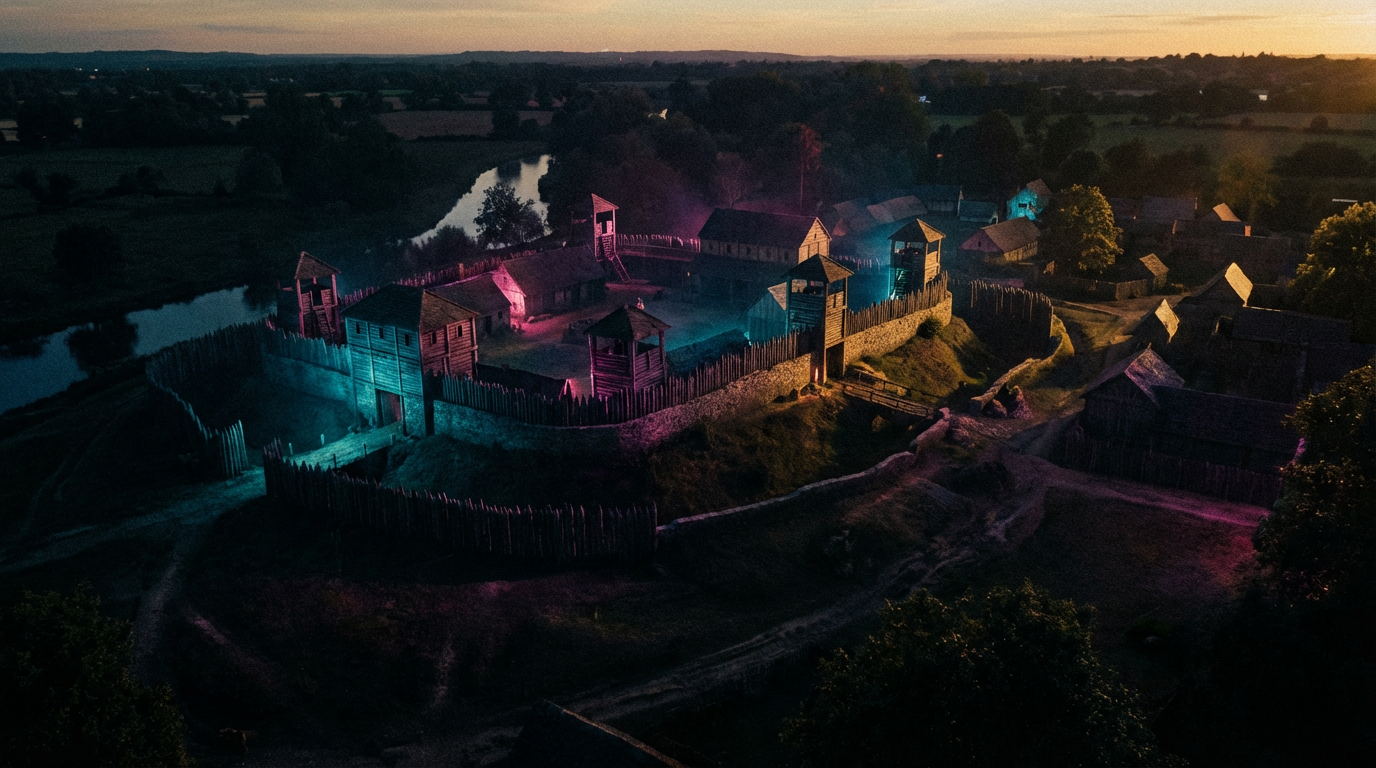
The earliest clear evidence of habitation in the Cambridge area is a farmstead dating to around 1500 BC, discovered at the site of Fitzwilliam College. By the first century before Christ, an Iron Age settlement had been established on Castle Hill, overlooking the river crossing that would determine the town's fortunes for two millennia. Following the Boudican rebellion of AD 60, the Roman army built a fort on Castle Hill to secure the river crossing and its connection to Ermine Street via Akeman Street. The fort, known as Duroliponte, was constructed around AD 70 and converted to civilian use roughly fifty years later, growing into a prosperous small town with road access, river trade, and, by the fourth century, a defensive stone wall erected against seaborne raiders who used the navigable river to penetrate inland. Evidence of wider Roman settlement has been found across the area, including farmsteads and a village in what is now the suburb of Newnham.
Grantebrycge: Saxons, Danes, and the Bridge
Following the Roman withdrawal around 410, the site appears not to have been entirely abandoned — it is usually identified with Cair Grauth, one of the twenty-eight cities of Britain listed in the History of the Britons attributed to Nennius. Anglo-Saxon settlers had occupied the area by the end of the fifth century, establishing a settlement on and around Castle Hill that became known as Grantebrycge — the bridge over the Granta. The Venerable Bede, writing in the eighth century, described it as a little ruined city, noting it as the burial place of the saintly queen Æthelthryth. The town sat on the border between the East Anglian and Mercian kingdoms, and the Great Bridge — probably built during the reign of King Offa between 756 and 793 — secured the river crossing that remains the heart of the town today, at the site of the present Magdalene Bridge.
The Anglo-Saxon Chronicle records that a Danish army arrived at Grantebrycge in 875, and by 878 the town had been absorbed into the Danelaw. Danish rule lasted some forty years and proved transformative: the vigorous trading habits of the Scandinavian settlers caused rapid growth, and the town's centre shifted from Castle Hill on the left bank to the area now known as the Quayside on the right bank. The Danes established government by lawmen and a commercial culture that left a lasting mark. In 921, the town submitted to King Edward the Elder, and it subsequently minted its own coins, with the town's name abbreviated to Grant. The name itself evolved: in the Domesday Book of 1086 it appears as Grentebrige, and the change from Gr- to C- first appears in the Inquisitio Eliensis of the same year, where it is rendered Cantebrigie. The river's name followed: Granta became Cam, a back-formation from the town's evolving name.
The Castle and the Charter
In 1068, two years after the Conquest, William of Normandy built a motte-and-bailey castle on Castle Hill to anchor Norman control of the fenland approaches and the strategically vital river crossing. The Domesday survey recorded that twenty-seven houses were demolished to make room for it. The castle served as a centre of administration and, during the Anarchy of Stephen's reign, as a garrisoned strongpoint. By the twelfth century, Cambridge had developed into a significant trading centre, its prosperity underpinned by the river trade that connected it via the navigable Cam to the port of King's Lynn and thence to the sea. The first town charter was granted by Henry I between 1120 and 1131, giving Cambridge a monopoly on waterborne traffic and control of hithe tolls, and recognising the borough court.
Stourbridge Fair, held annually in the parish of Barnwell, became one of the greatest commercial fairs in England, lasting three weeks and drawing traders from across the country and the Continent for the sale of cattle, timber, wool, cheese, and hops. Daniel Defoe, visiting in the eighteenth century, called it the largest fair in the world. The town also had a Midsummer Fair, and its weekly markets on Wednesday and Saturday were well attended. But it was Defoe who captured the essential economic truth of Cambridge: that the trade of the town depended upon the colleges, and the tradesmen got their bread by them.
Town and Gown
The arrival of scholars from Oxford in 1209 transformed Cambridge from a prosperous market town into a university city, but the transformation was not without friction. The relationship between town and gown was marked by periodic violence: in 1381, during the Peasants' Revolt, townspeople attacked university property throughout Cambridge, burning books and charters. The result was that even more civil authority was awarded to the University Chancellor, including the right to prosecute lawsuits arising from trade and market disputes — powers the university retained until the nineteenth century. Henry III had granted the scholars a royal charter in 1231, and his decree that only students under the supervision of a recognised Master could remain in the town effectively established the university as a governing presence within the borough.
The collegiate buildings that rose along the river from the thirteenth century onward — Peterhouse in 1284, Clare in 1326, Corpus Christi in 1352 — transformed the town's physical character. But it was the ambitious patronage of Henry VI that gave Cambridge its most famous landmark. In 1441, the young king founded King's College and exercised compulsory purchase across the centre of medieval Cambridge, demolishing houses, shops, lanes, wharves, and a parish church to clear the site. The foundation stone of King's College Chapel was laid in 1446; the building was not completed until 1515, but its fan vault — the largest in the world — and its great Flemish windows made it one of the finest late medieval buildings in Europe. St Bene't's Church, with its Anglo-Saxon tower dating from around 1000 to 1050, remains the oldest building in the city.
Reformation, Science, and Fresh Water
Cambridge played a central role in the English Reformation. Erasmus of Rotterdam resided at Queens' College from around 1510 to 1515, teaching Greek and influencing a generation of humanist scholars. Thomas Cranmer, who would become Archbishop of Canterbury and architect of the Book of Common Prayer, was educated at Jesus College. The White Horse Inn, where reformist scholars met to discuss the new Protestant theology in the 1520s, stood close to the site of the present King's College. In 1534, Henry VIII granted the university a patent for printing, leading to the establishment of Cambridge University Press — the oldest university press in the world, in continuous operation since 1584.
The seventeenth century brought both civil war and scientific revolution. During the English Civil War, Cambridge served as the headquarters for the Eastern Counties Association of the Parliamentarian army, and Oliver Cromwell — a graduate of Sidney Sussex College — was the town's Member of Parliament. The university's greatest scientific figure, Isaac Newton, arrived at Trinity College as an undergraduate in 1661 and produced the work that would transform mathematics and physics. Between 1610 and 1614, the town had gained one of its most practical improvements: Hobson's Conduit, an open watercourse constructed to carry fresh water from Nine Wells on the southern edge of the town to a fountain in the Market Square, funded in part by the carrier Thomas Hobson — the same Hobson whose insistence that customers take the horse nearest the stable door gave rise to the phrase Hobson's choice.
The Georgian and Victorian Town
In 1766, Addenbrooke's Hospital opened on Trumpington Street, founded under the will of Dr John Addenbrooke, a Fellow of St Catharine's College who had died in 1719, leaving £4,500 to establish a hospital for the poor. The original building served for over two centuries before the hospital relocated to its present site south of the city in the 1970s, where it has become the centre of one of the largest biomedical research campuses in Europe. The Fitzwilliam Museum, founded in 1816 through the bequest of Richard FitzWilliam, seventh Viscount FitzWilliam, together with £100,000 for a purpose-built repository, opened in its present neoclassical building on Trumpington Street in 1848. It houses over half a million objects and is among the finest university museums in Europe.
The population of Cambridge in 1801 was 10,087. The railway arrived in 1845 with the opening of the Great Eastern Railway's London to Norwich line, though the station was placed outside the town centre — reportedly under pressure from the university, which wished to restrict the ease with which undergraduates might travel to London. The railway stimulated heavier industry, including brick, cement, and malt production, and brought the expansion of new neighbourhoods around the station, such as Romsey Town. Cambridge gained gas lighting in 1823 and its first modern police force in 1836. A corn exchange was built in 1842. Despite this growth, the town did not receive formal city status until 1951.
Silicon Fen
The twentieth century brought profound changes. During the First World War, many students and scholars served and died; afterward, the university received regular state funding for the first time. During the Second World War, Cambridge became an important military planning centre and an evacuation destination for children from London. The post-war decades saw the founding of new colleges — Churchill in 1960, Darwin in 1964, Robinson in 1979 — and a significant expansion of the city's boundaries to absorb surrounding villages, including Chesterton, Cherry Hinton, and Trumpington.
In 1970, Trinity College established the Cambridge Science Park on its land to the north of the city, catalysing the development of a high-technology industrial cluster that would earn Cambridge the name Silicon Fen. Companies specialising in software, biotechnology, artificial intelligence, and pharmaceuticals have concentrated in and around the city, many of them spin-offs from university research. The Cambridge Biomedical Campus, anchored by Addenbrooke's Hospital, has grown into one of the largest centres of medical research and health science in Europe. The population of the city at the 2021 census was 145,700, with the wider built-up area reaching 181,137.
The University of Cambridge, whose thirty-one colleges occupy much of the historic centre and whose Backs — the gardens stretching down to the river behind the colleges — form one of the most celebrated urban landscapes in England, remains the institution around which the city revolves. Among its graduates are men and women who went on to shape law and commerce in the furthest corners of the British Empire, including the colonial lawyer Thomas Hawkins and the Tasmanian landowner William Edward Jeffries Jr., who studied law here in the late 1830s before returning to Van Diemen's Land. The River Cam, with its punts and its bridges, its willows and its college walls, continues to define the character of a city that has been shaped by learning for more than eight centuries.







