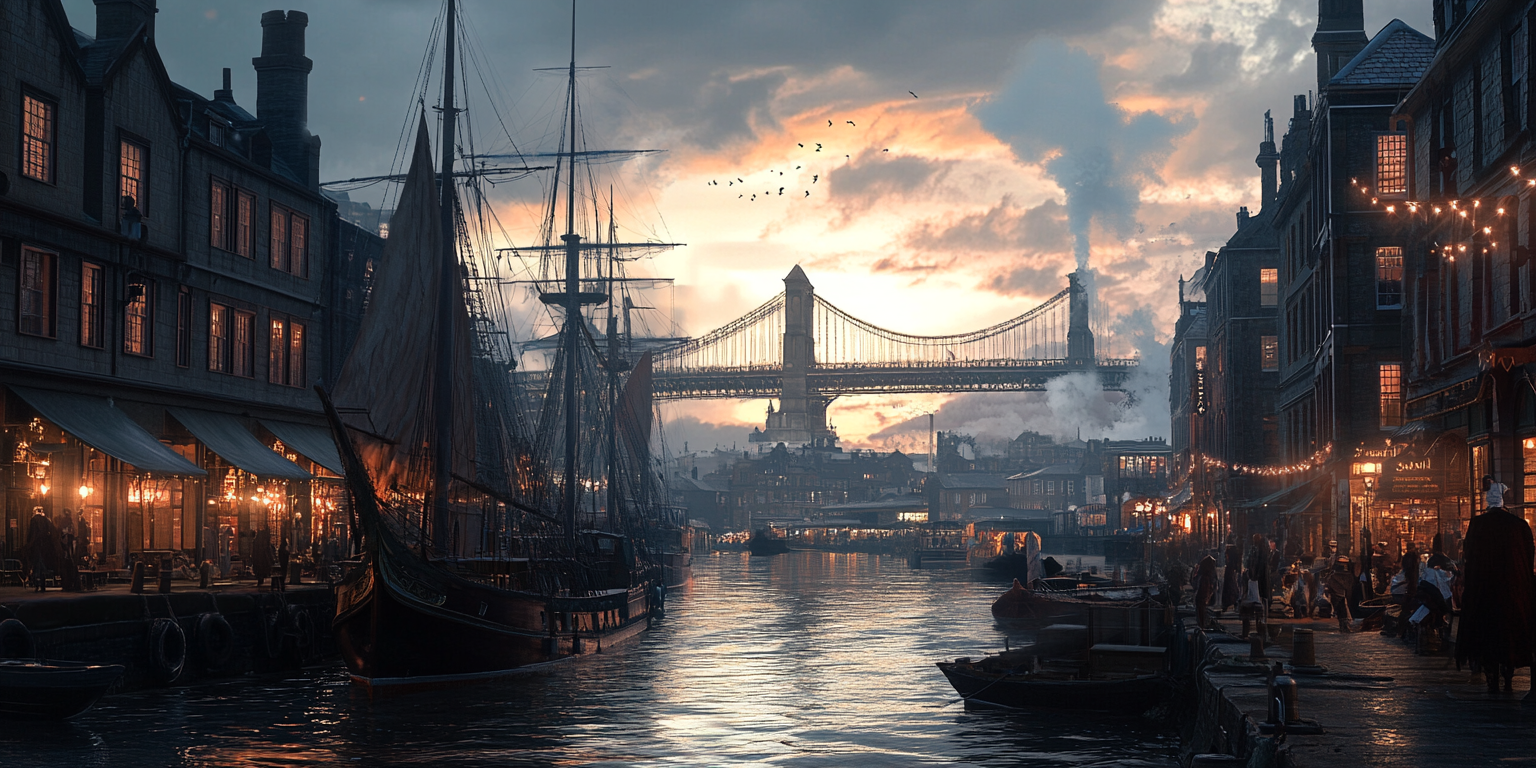
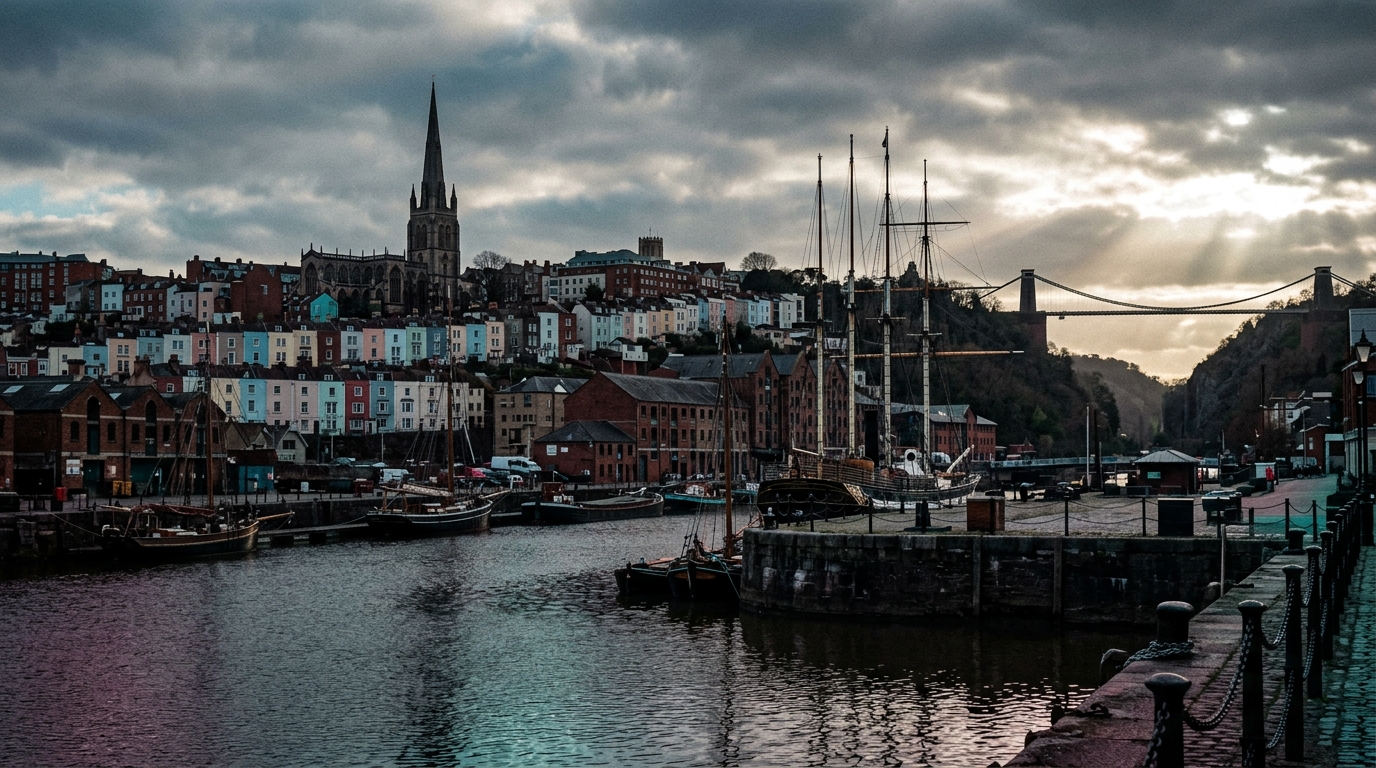
Bristol, Gloucestershire, England
Bristol began as the Roman river-port of Abonae and the Saxon bridge-town of Brycgstow, grew into a medieval power made a county in its own right in 1373, and launched Cabot west in 1497. It grew rich and culpable on the slave trade, was remade by Brunel, scarred by the Blitz and reborn through Filton's aircraft, then reinvented itself as a creative modern city. Across every age it was a place of departure — the birthplace of soldiers, convicts, physicians, spies and engineers.
Abonae and the Bridge
When the Romans held Britain, the nearest thing to a town on this stretch of the Avon was Abonae, a small port and crossing at Sea Mills where a road ran inland toward the hot springs at Bath and ships could be beached on the mud. It was a minor place, and when Rome withdrew it dwindled to nothing. The settlement that became Bristol was a later, Saxon making.
By the turn of the first millennium there stood a fortified town at the meeting of the Avon and the Frome called Brycgstow — the place at the bridge — important enough to hold a royal mint and strike its own coin while England was still a patchwork of Saxon and Danish lordships. From the very beginning the town was defined by two things that never afterwards left it: a bridge over tidal water, and trade carried on that water to places downstream and across the sea.
The Norman Town and the Medieval Port
After the Conquest the Normans raised a great castle on the neck of land between the two rivers, and under its protection the town grew rich. Medieval Bristol traded wool out and wine in — vast quantities of it, shipped from English-held Gascony — and became, by the fourteenth century, the second or third city of the realm, behind only London and sometimes York.
Its merchants built churches to the glory of God and of their own account books, none finer than St Mary Redcliffe, the soaring parish church a later queen was said to have called the fairest in England; on the hill above the city the abbey of St Augustine kept its own state, and would in time become the cathedral.
The city's confidence was such that in 1373 the Crown granted it a charter unique among English provincial towns: it was made a county in its own right, lifted clear of the surrounding shires of Gloucester and Somerset and answerable, in effect, to no one but itself. By the sixteenth century its overseas merchants had bound themselves into the Society of Merchant Venturers, a guild that would direct the city's trade, and much of its politics, for centuries to come. Bristol had become a power, and it knew it.
The Matthew
It was this outward-facing, ocean-minded city that, at the close of the fifteenth century, sent a ship to look for a new world. In May 1497 the Genoese navigator John Cabot, sailing under letters from the English king and funded by Bristol money, took a single small vessel, the Matthew, west out of the Avon in search of a passage to Asia, and made landfall instead on the coast of Newfoundland — among the first European footfalls on the North American mainland in that age, and the opening of the rich Newfoundland fishery that Bristol ships would work for generations.
The voyage fixed something in the city's sense of itself: that the proper direction of Bristol's ambition was outward and westward, across the Atlantic, toward whatever the ocean concealed.
Storm and Reformation
The convulsions that remade Tudor and Stuart England did not pass the city by. When Henry VIII broke with Rome and dissolved the monasteries, the great abbey of St Augustine was suppressed and then, in 1542, reborn as the cathedral of a new diocese, the city's religious houses parcelled out and pulled down.
A century later, in the Civil War, Bristol's wealth and its harbour made it a prize both sides had to have: in 1643 the Royalist forces of Prince Rupert stormed and took the city, and in 1645 the army of Parliament under Fairfax stormed and took it back, each assault bloody, each leaving the citizens to make their peace with a new master. A port that lived by trade learned, as such places do, to bend with whichever wind was blowing and to get back to business the moment the soldiers had gone.
The Wealth and the Wound
The business that defined the next age would shadow the city forever after. When the monopoly of the Royal African Company was broken at the end of the seventeenth century, Bristol's merchants threw themselves into the transatlantic slave trade, and threw themselves in so hard that for a span of the early eighteenth century the city was the leading slaving port in the kingdom. Bristol ships carried manufactured goods south to the coast of West Africa, enslaved Africans west across the Atlantic to the plantations of the Caribbean and the Americas, and the sugar and tobacco those plantations produced back home — a triangular trade of monstrous profit, on which a great part of the city's Georgian splendour was raised.
The terraces of Clifton and the fine squares below them, the charities and churches and almshouses, were paid for in no small measure by the buying and selling of human beings. The trade's great local benefactor, the merchant Edward Colston, endowed the city so liberally that it set his statue up in bronze and carved his name across its streets and halls, and for the better part of two centuries declined to ask too loudly where the money had come from.
There had always been Bristol voices raised against it, and the British trade was abolished in 1807; but the full reckoning waited until 2020, when, amid protests that circled the globe, a crowd wrenched Colston from his plinth and rolled him into the harbour his ships had sailed from. The statue was fished out and laid, battered and paint-streaked, in a museum — which was, perhaps, the first wholly honest place the city had ever kept it.
The Georgian City and Its Scattered Sons
Beneath the grand squares, the working city went about its noise and its labour, and it was a city that produced people in their thousands and then, as often as not, sent them away. The Georgian docks were a dense human warren of shipwrights and coopers, sailors and dock-labourers, ship's solicitors and chandlers, and the children born among them inherited the port's restlessness as much as its trades.
From a Bristol shipwright's household came William Hollinghurst, who had no patience for the shaping of hulls and ran instead to the soldiers passing through the city; he enlisted, marched under Wellington through the Peninsular War, and carried his wounds and his melancholy at last to a land grant and a grave in Van Diemen's Land. From a cramped cottage by the docks, the son of a sailor and a washerwoman, came Jeremiah Hawkins, a rebellious boy who failed his apprenticeship, drifted through the quaysides as labourer and seaman, fell into crime, and was transported to that same far colony for armed robbery.
The respectable streets sent out their sons no less surely: John Ezekiel Broadmoor, son of a solicitor whose practice served the shipping interest, went into the Royal Navy as a midshipman, fought through the Napoleonic Wars, and ended his days a colonial constable in Hobart Town, worrying for thirty years at a disappearance he never solved — a Bristol lawman set down at the edge of the world, in the very colony to which the city's convicts were shipped.
The professions and the parlours bred their own. Charles Edward Harrington, the son of a Bristol cooper and churchwarden, passed through Bristol Grammar School and an apprenticeship to a Clifton surgeon-apothecary before training in the dissecting rooms of London and Edinburgh and settling to a physician's life in the spa city of Bath. Edward Hutchins, a Bristol clergyman's son raised among his father's books, went up to Oxford, took holy orders, and turned minister and social reformer, emigrating to Tasmania to found schools in a colony hungry for them.
Even the daughters of the port carried its salt: Eleanor Sinclair, child of a sea-captain and of a mother who kept a quayside boarding house, grew up among the travellers and the seafaring talk that passed through her mother's rooms, gifted in painting and letters, before she too left England for a life across the water. Soldier and convict, constable and physician, parson and captain's daughter — the city poured them out by every road it had, and a startling number of them washed up in the same place, the penal colony of Van Diemen's Land, as though Bristol and that far island were two ends of one long rope.
It was not always a placid city to leave. In 1831, when the House of Lords threw out the bill to reform Parliament, Bristol rose in some of the worst rioting England saw that century: for three days the mob held Queen Square, the Mansion House and the bishop's palace and the gaols went up in flames, and order was restored only by cavalry sabres and a heavy toll of dead. The elegant Georgian city and the furious working one were always the same city, and the smoke over Queen Square belonged to its character as surely as the terraces of Clifton.
The Engineer's Century
The nineteenth century gave the restless city a new kind of hero: the engineer. To keep its harbour usable against the enormous tides of the Avon, Bristol had already, in 1809, dammed and impounded the river to create the Floating Harbour, a basin of permanently navigable water where before the ships had sat twice daily in the mud.
Then came Isambard Kingdom Brunel, who made the city the proving-ground of his genius — driving the Great Western Railway up from London to his terminus at Temple Meads, building in the city's yards the SS Great Britain, the iron-hulled screw steamship that changed the very idea of an ocean ship when she took the water in 1843, and throwing across the Avon Gorge at Clifton the suspension bridge that was finished after his death and remains the city's emblem.
Industry of a homelier kind made fortunes too: the tobacco of the Wills family and the chocolate of the Frys grew into firms of national weight, and out of their wealth, in 1909, the University of Bristol received its charter, its tower climbing over the rooftops where Colston's statue still stood in the streets below.
This was the Bristol that, in 1850, gave the world Jane Elizabeth Smith — the daughter of a city watchmaker and a schoolteacher, raised in a modest household to her father's precision and her mother's books, and gifted far beyond the station a tradesman's daughter was allotted. She left it behind altogether, carrying her ear for languages and her gift for going unnoticed across the Atlantic, where she made a career as an industrial spy in the boom-and-bust boardrooms of San Francisco, moving unseen among men who never thought to look twice at a quiet secretary.
The watchmaker's parlour had, without intending to, taught a Bristol girl to take a city's secrets apart like a movement of gears — and the port that had sent out soldiers and convicts and parsons now sent out its spies as well.
Blitz and Flight
The twentieth century brought the city both ruin and reinvention out of the air. In 1910 an aeroplane company was founded at Filton, on the city's northern edge, and Bristol became one of the cradles of British aviation, its works turning out aircraft through two world wars.
That eminence carried a terrible price. Through the winter of 1940 and the spring of 1941 the German bombers came for the docks and the aircraft factories and the city itself, and the Bristol Blitz gutted the medieval heart of the old town — whole streets of it burned away, the ancient shopping quarter left as the roofless ruin it partly remains. The Bristol that rose from the rubble was greyer and more modern, its old centre never wholly recovered.
But Filton kept building, and it was from the Filton runway, in 1969, that the first British Concorde climbed into the sky — the delta-winged machine that would carry passengers over the Atlantic faster than the turning of the world, the old westward ambition of Cabot's city refined at last into something supersonic. The working docks, meanwhile, drew down toward their end; the great ships had long outgrown the city wharves and moved downriver to Avonmouth, and the Floating Harbour that Brunel's century had been so proud of fell quiet.
The City Remade
What filled the quiet was something new. After the war Bristol drew in newcomers from across the world — among them a Caribbean community that settled in St Pauls and Easton, whose presence enriched the city and whose frustrations, in 1980, boiled over into a riot that ran ahead of a decade of them across Britain, and whose carnival became one of the brightest fixtures of the city's year.
As the old industries faded the city reinvented itself, as it had always known how to do: the silent harbourside filled with galleries and bars and museums, a brooding, bass-heavy strain of music carried the Bristol sound out into the world, the walls of Stokes Croft bloomed with the street art of a local boy turned anonymous celebrity, and an animation studio in the suburbs gave the world a man and his dog modelled in clay. The university spread across the heart of the city, and its hospitals — Southmead out on the northern edge, St Michael's on the hill — became the places where the modern city was born and mended and died.
And the city went on, as it always had, making Bristolians. Nathan Porter, born in a city maternity ward in 1993 into a household obsessed with rivers and rainfall, grew up on the moods of the Severn and the tides of the Avon and passed through the same Bristol Grammar School that had schooled the physician Harrington two centuries before him, becoming, almost inevitably for a child of that watery city, an engineer of water.
Five years later, across town at Southmead, the early-born son of a young electrician from the Knowle West estate drew his first breath: Adolfo Forte, as much a child of Bristol as any merchant's son or shipwright's boy in all the centuries before him, born to the ordinary, unremarked life of the modern city. The same handful of streets that had bred Georgian soldiers and a Victorian spy were breeding engineers and electricians' sons still.
The Tide
Through all of it, from the Saxon bridge to the supersonic runway, the constant was the water. Twice a day the Avon climbed and fell through one of the greatest tidal ranges on Earth, and the whole of Bristol's history was a long negotiation with that restless, muddy river — bridging it, damming it, riding it out to the ocean for wool and wine and slaves and sugar and emigrants, and hauling back wealth and guilt in equal measure.
The city had been, by turns, a Saxon burh, a medieval power, a slaving port, a workshop of engineers, a target for bombers, and a capital of reinvention; and through every incarnation it had above all been a place of departure — the quay from which ships and fortunes and people set out and seldom wholly returned. The soldier and the convict, the constable, the physician and the parson, the spy and the engineer and the electrician's son: four centuries of Bristolians had begun in the same wet streets at the meeting of two rivers and gone out, every one of them, carrying with them the salt and the stubbornness of the place at the bridge.







