Brierly Vineyards
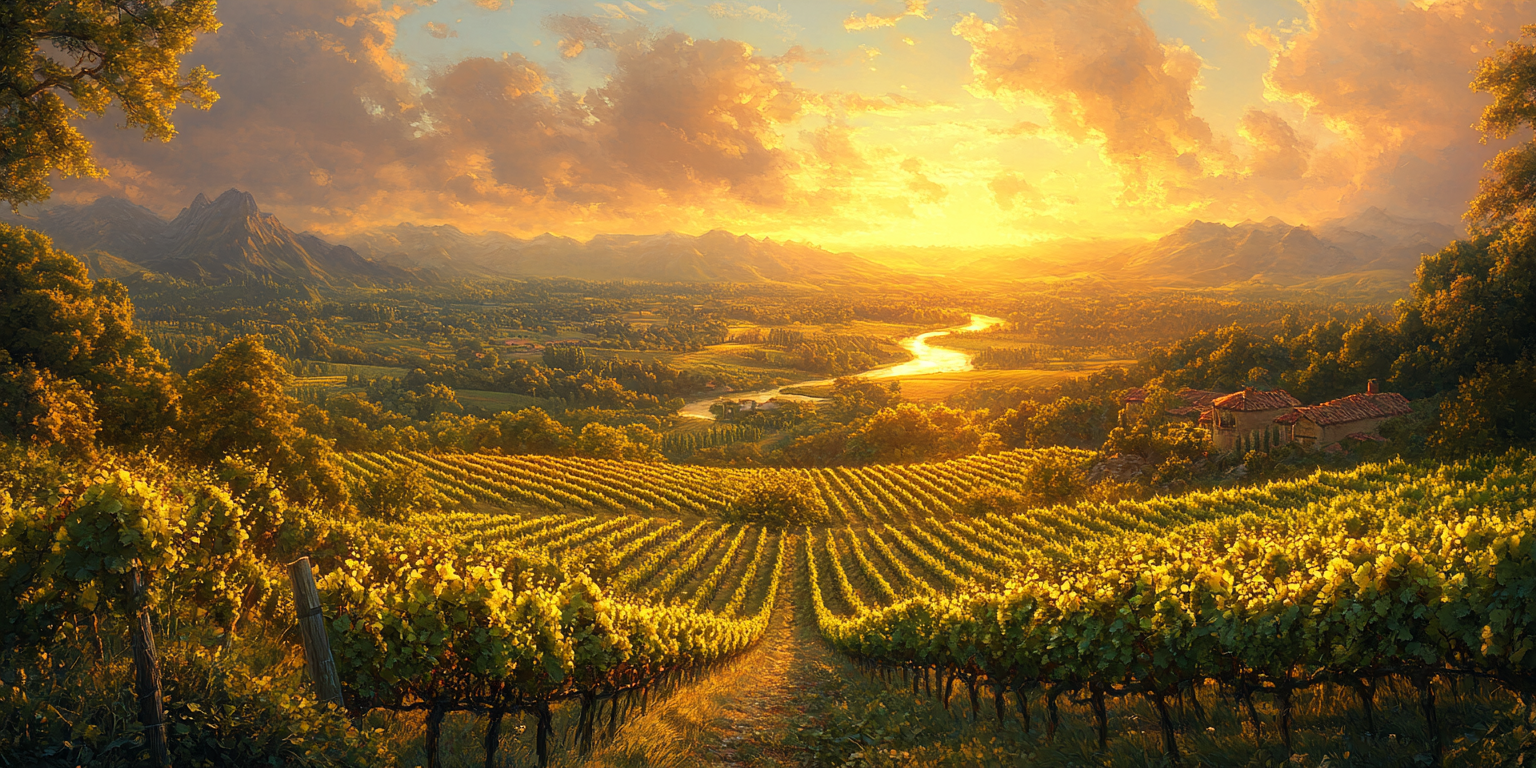
The Brierly Vineyards climb the southern slopes of the Brierly Plains above the Whitmore River, and have been the economic and cultural heart of the settlement since the founding Guardian George Henry Whitmore planted the first Earth grapes there in 1815. Their first true vintage in 1820 gave rise to the Harvest Festival and its ceremonial First Pour, and through more than a century and a half of isolation the rows sustained Brierly's two hundred and fifty souls. After 2018 their wine at last reached markets beyond the valley.
The Southern Slopes
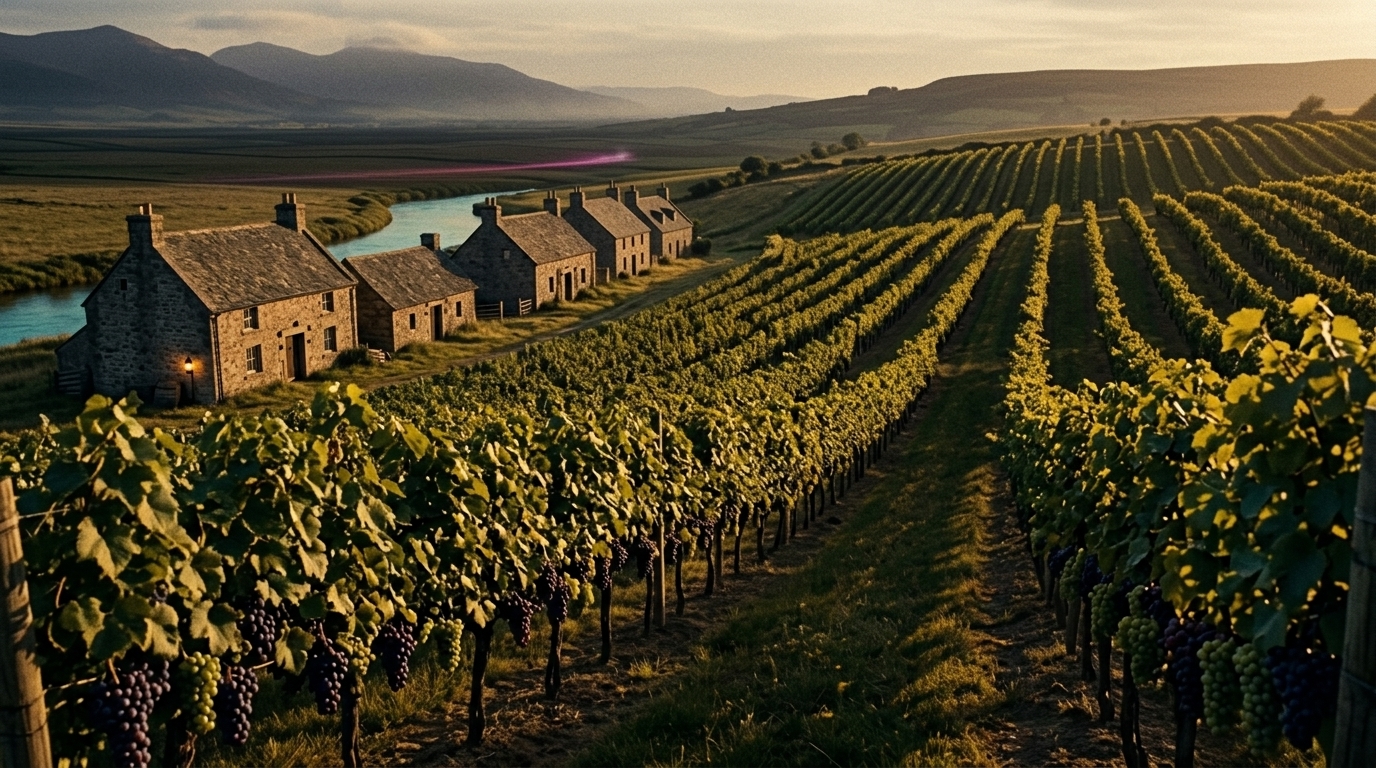
The Brierly Vineyards occupied the southern slopes of the Brierly Plains, where the rolling grassland tilted up toward the bare ridge and caught the long afternoon light. They were never a single estate but a patchwork of family holdings, ordered rows upon rows of vines that had been tended by the same handful of names since the settlement's first decade. Below them the Whitmore River ran slow and green, carrying down from the Whitmore Highlands the mineral character that gave the wine its particular signature; above them the ridge sheltered the slopes from the worst of the highland wind.
The terroir was the vineyards' inheritance and their explanation. The soil of the Plains, broken open in the founding years from beneath a thick and barren crust, proved unexpectedly generous once it was reached, and the runoff from the highlands laced it with minerals no Earth vineyard had ever drawn upon. Warm days pulled the sugar up through the fruit; cool nights, falling off the high country to the north-west, held the acid firm. The result was wine of unusual structure — reds with a dark, almost smoky depth, whites with a flinty edge that the vintners learned to prize rather than correct.
To walk the slopes in late summer was to move through ranks of vines heavy with fruit, the grassland falling away below and the ridge rising above. In winter the same rows stood black and skeletal against the frost, and the work moved indoors to the cellars, where the previous year's vintage matured in oak. The vineyards were never idle; they only changed the nature of their labour with the turning of the year.
At the foot of the slopes ran Vineyard Row, its low stone cottages stacked with pruning tools and fermentation gear, their cellars breathing oak and tannin into the dusty air. Over the generations the families gave their best blocks names — the home rows, the river rows, the high rows near the aqueduct — so that a vintage was known as much by the ground it came from as by the year. The whole life of the place turned on the vines: the pruning, the watching, the long wait for the fruit, and the press.
A Vintner's Hands
The vineyards owed their existence to one man's hands. George Henry Whitmore, born in Somerset in 1778 into a family of small vintners, was one of the five Guardians whom Jonathan Blackwood had drawn together to raise a settlement out of nothing, and he had stepped into Clivilius in March 1810 carrying the only knowledge the venture possessed about the making of wine. While the leader Thomas Ainsworth worked the open country and Elizabeth Carrington coaxed the dead soil into life, Whitmore walked the southern slopes and recognised, with a vintner's certainty, a country made for vines.
He did not rush it. Through the settlement's first uncertain years he experimented with the grape varieties he had brought from Earth — planting, failing, grafting, and watching how each cultivar answered the strange new soil. Some withered; some took and changed. By 1815, satisfied at last, he set out the settlement's first true vineyard on the southern slopes, ordered rows that would decide everything that came after. The gamble was considerable, for every vine given to grapes was a vine not given to grain, but Whitmore had read the land correctly.
Water made the difference. The Whitmore River ran reliably past the slopes, and in 1819 the settlers completed the Brierly Aqueduct to carry its flow to the higher rows, freeing the vineyards from their dependence on the season's rain. With irrigation secured, the vines climbed steadily up the slopes year on year, and what had begun as one man's experiment became the settlement's defining industry.
Whitmore was a patient man in a venture that rewarded patience. Where Ainsworth led and Aldridge built and Fairchild healed against the clock, the vintner's work could not be hurried; a vine planted in one year gave nothing worth drinking for several more, and a reputation took a generation to earn. He gave his life to a craft whose final verdict he would not live to hear, and trusted his sons to carry it.
The First Pour
In 1820, after five years of toil and doubt, George Whitmore tapped the first barrel of wine made entirely from Brierly-grown grapes. The settlers gathered beneath lanterns in the town square, drank and danced and feasted late into the night, and founded — without quite intending to — the tradition that would come to define them. From that year the Brierly Harvest Festival was held every September to mark the close of the grape harvest, its centrepiece the ceremonial First Pour, when the season's first cask was broached before the assembled town.
The vineyards became the settlement's living calendar. The agrarian year turned around them — the pruning in the cold months, the long green swell of summer, the frantic gather of the harvest, and the festival that closed it. They became, too, the centre of Brierly's economy, the one craft the settlement did better than any other and the one commodity it had to trade. A family's standing was measured in its rows, its cellar, and the quality of the cask it carried to the square each September.
Around the First Pour grew the rest of the festival — music carried down from the founders' England, feasting, grape-stomping and barrel-rolling contests, and the communal tasting of the new vintage that let the whole town judge the year's wine together. Courtships began on the slopes during the gather and were sealed at the festival; quarrels were settled there; reputations were made and unmade over a single cask. For a settlement of two hundred and fifty people, the vineyards were not merely an industry but the ground on which most of life was lived.
No one in 1820 thought of it as a tradition. The settlers simply came back the next September, and the one after, until coming back was what Brierly did.
The 1834 Reserve
The most celebrated wine in Brierly's history was born of near disaster. In 1834, a summer of dry winds ended in a lightning strike that set the Whitmore estate ablaze just before the harvest. Samuel Whitmore, the founder's grandson, fought the fire through the night with water hauled by hand from the river, and salvaged from the ruin only a small batch of scorched grapes.
What he made from them should have been worthless. Instead the fire had done something the vintners could never have engineered: the smoke and the heat concentrated the fruit into a bold, dark red of extraordinary depth, and the wine that came to be known as the 1834 Harvest Reserve became the most prized vintage the settlement ever produced. The smallest First Pour ever broached — a single modest cask before the whole town — became its most remembered, and the Reserve passed into local legend as proof that Brierly's luck, even at its worst, had a way of turning.
By 1870 the vineyards had grown from one man's rows into a winemaking region in miniature. That year the fiftieth festival was kept across three days, with a cask from every vineyard on the slopes blended into a single golden pour — a measure of how many families now kept rows of their own, and how completely the craft had spread beyond the Whitmores who began it. Brierly was confident in its wine and certain of its continuity, and had no reason yet to doubt either.
Wine Without the World
That certainty was tested by a loss the founders had not fully reckoned with. The Portal Keys that had brought the first vines and the first vintner from Earth belonged to the Guardians alone, and died with them. George Whitmore was gone by 1850; the last of the five followed in 1857, and with that death the gate to Earth closed for good. No new vine stock would come through, no new vintner, no fresh knowledge from the world the founders had left — only what the slopes already held and what the families could keep alive among themselves.
For a hundred and sixty years the vineyards fed and defined a community that had no one to lean on but itself. The rows were the settlement's wealth, its work, and its identity, tended by perhaps two hundred and fifty people who married within a handful of families and passed land, craft, and cuttings down the generations or lost them altogether. Nothing of the wider universe — its industries, its wars, its inventions — reached the slopes. The vines were pruned and gathered as they always had been, by hand, by families who knew every row by name.
Winemaking under isolation became an act of preservation as much as production. With no new stock coming through the closed gate, the vintners propagated their vines from cuttings, keeping the founder's Earth varieties alive across the generations until the vines themselves were as closed a lineage as the families who tended them. Nothing could be replaced from outside; a row lost to blight or frost had to be coaxed back from whatever survived. The cellars held vintages decades deep, and the oldest casks became a kind of memory the settlement could taste.
It made the vintners conservative by necessity. A method that worked was a method kept, and a vine that thrived was a vine multiplied. Innovation, when it came at all, was tested for a generation before anyone trusted it.
The Whitmore name stayed bound to the craft across the whole long silence. The founder's sons John and Henry carried it on; Edward James Whitmore modernised the settlement's viticulture before his death in 1920; Charles Robert Whitmore brought his own innovations to the rows; and John Henry Whitmore expanded the estate before he died in 1990. Each generation inherited the same southern slopes and the same stubborn discipline, and added what it could without breaking faith with what it had received.
Beside the Whitmores worked the Bennetts, the soil-and-water family whose labour underpinned the vines without ever quite being vintners themselves. The founding Bennett, Charles Joseph, had been a brewer and a friend of George Whitmore, and his beer stood on Brierly's tables beside the wine; his descendants tended the grain fields, the irrigation, and the health of the soil down the centuries — Edward's crop rotations, John's water channels, Henry's careful husbandry through the hardest years of isolation. The two families were bound by a friendship as old as the settlement, and would in time be bound by more.
The vineyards' darkest season came in 1938, when the Great Drought dropped the Whitmore River to its lowest recorded level and left barely grapes enough to eat, let alone to press. For the first time the town faced a harvest with no First Pour to give. It was Eleanor Fairchild who refused to let the festival lapse, proposing that each household pour a single cup from its own dwindling reserves into one communal cask. That night Brierly drank not to abundance but to perseverance, and the Shared Pour entered the settlement's traditions ever after as a rite kept only in times of scarcity.
The Rails and the New Vintage
The long isolation ended at the vineyards' own gate. On the thirteenth of August 2018, an exploration party from the young settlement of Bixbus — its mission named, fittingly, the Vineyard Venture Exploration and led by Elias Bradbury — followed the river to Brierly and found a wine town that had not seen an outsider in over a century and a half. The two worlds met properly that September, when Bradbury and Sophie McMonagle came to the Harvest Festival at the invitation of the settlement's leader, watched the First Pour, failed cheerfully at the grape stomp, and discovered that Brierly's vines and songs had outlasted the world that planted them.
For all its quiet pride, Brierly's renown had never gone further than Brierly. The wine the settlement believed to be the finest anywhere was tasted only by the few hundred people who made it, and the slopes produced for a market of one town. The vintners kept their standards high for their own sake and their neighbours', with no outside palate to impress and no outside trade to chase. That the wine was good, they knew; that anyone beyond the valley might one day agree had long since stopped being imaginable.
What followed reshaped the slopes more than anything since the closing of the portals. Brierly held two centuries of hard-won knowledge about coaxing crops from the unforgiving soil of Clivilius, which the struggling capital lacked; Bixbus held tools, resources, and techniques the vineyards had done without since 1857. New equipment began to reach the rows, slowly and not always welcome. The traditionalists feared, with reason, that machinery and outside method might thin out the very character that made Brierly's wine its own, and the settlement spent years negotiating, vintage by vintage, how much of the modern world to let onto the slopes.
The change that mattered most ran on iron. The CGRN Bixbus–Brierly Line, begun in 2019 and opened to its first train on the first of December 2020, carried Brierly's vintages — for the first time in the settlement's history — to markets beyond the valley. The governing council had approved the railway only reluctantly, and only because the promise of wider markets for the wine proved more persuasive than the fear of change. For the first time the rows on the southern slopes were producing not merely for two hundred and fifty people, but for a world that had only just learned they existed.
The new era fell to a younger generation to manage. Sophie Bennett brought modern method to the irrigation that had watered the vines since the aqueduct of 1819, upgrading the channels her ancestors had dug by hand. James Carrington, a direct descendant of the founding botanist, returned to Brierly in 2025 after years in Bixbus to help marry modern technique to inherited practice — the very bridge the slopes now needed. The vineyards that had survived by refusing to change were learning, cautiously, how to.
And the two oldest families closed their long friendship into kinship. Amelia Rose Whitmore, of the vintner line that had begun the vineyards, and Thomas William Bennett, of the soil-and-water family that had sustained them, had worked the rows together as children and married as adults, joining wine and earth in a single household two centuries after Charles Joseph Bennett first set his beer beside George Whitmore's wine. Their children would inherit both inheritances at once.
Through all of it the essentials held. The vines still climbed the southern slopes toward the ridge; the Whitmore still ran past them from highland to marsh; and every September, whatever else had changed, the town still gathered for the First Pour. The Brierly Vineyards had outlasted their founder, their isolation, and very nearly their luck, and had become — slowly, and against the odds — not just the heart of one small settlement, but the first wine of a wider world.







