Brierly Plains
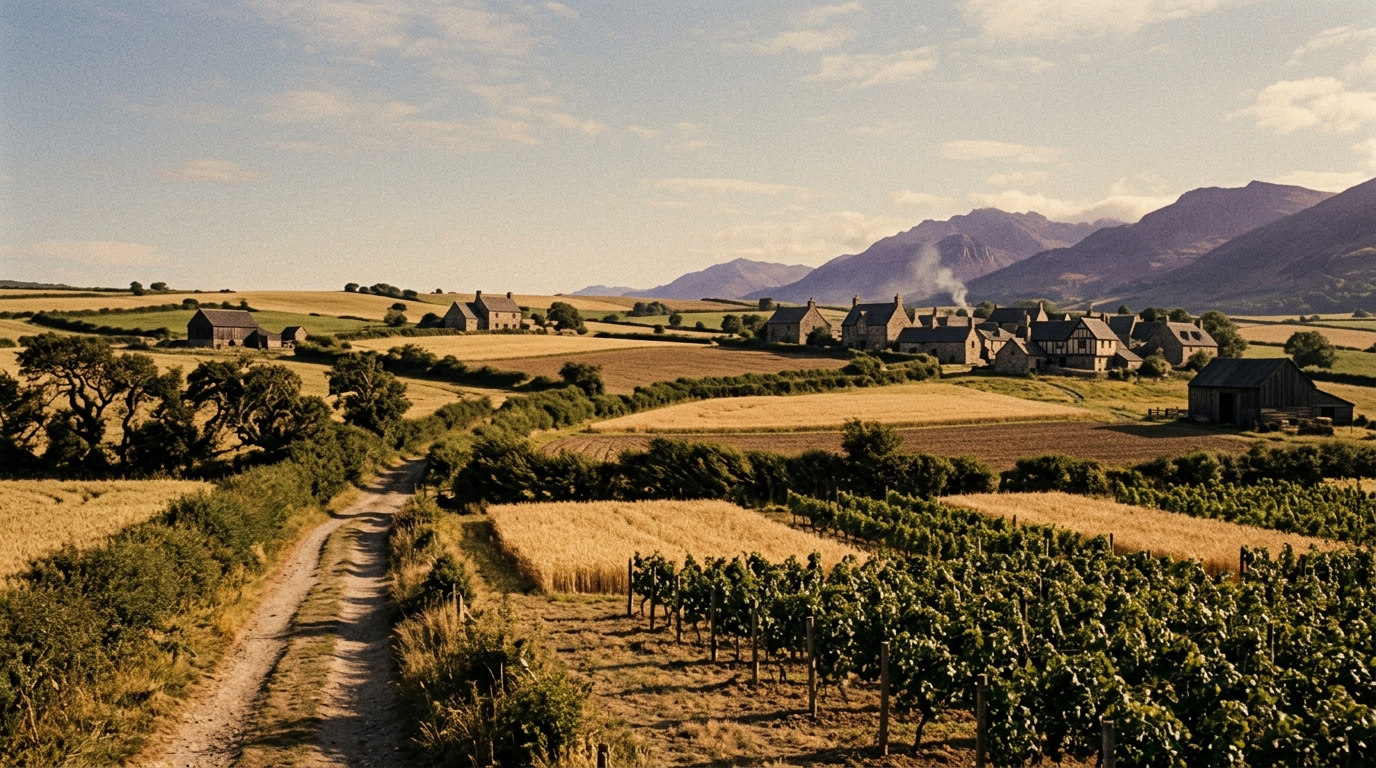
The Brierly Plains are an expansive stretch of gently rolling grassland and farmland surrounding the settlement, forming the open heartland of its country. When the founders arrived, the land lay sealed beneath a thick, barren crust, until the botanist Guardian Elizabeth Carrington recognised the rich soil hidden beneath and the settlers broke through to reach it. Over the generations the plains became a patchwork of vineyards, grain fields and pasture, fed by the rains, the highland runoff and the river. They are both Brierly's agricultural heart and its sheltering buffer.
The Heartland
The Brierly Plains are the great open heart of the settlement's country — an expansive stretch of gently rolling grassland and cultivated farmland that spreads out on every side of Brierly itself. Where the Whitmore Highlands to the north-west are all stone and steepness, and the Carrington Flats to the south-east all silt and standing water, the plains are the broad, temperate middle ground between them: a soft, open landscape of low rises and shallow vales, neither rugged nor sodden, made for the plough and the vine.
It is here, more than anywhere, that the daily life of Brierly is lived. The settlement sits at the centre of the plains like a hub at the heart of a wheel, and the farms, vineyards, and grazing lands that feed it radiate outward across the open country in every direction. To speak of Brierly's land at all is, for the most part, to speak of the plains, for they are the natural heartland on which the whole settlement's survival and prosperity have always rested.
The Sealed Land
For all their present fertility, the plains did not welcome the first settlers. When the founders crossed into Clivilius and looked out over the ground that would become Brierly, they saw not promise but desolation — a dry, inhospitable expanse sealed beneath one of the protective soil layers that lie over so much of the unworked Clivilian land. A thick, barren crust covered everything, hard and lifeless, shedding dust and giving no sign of what lay beneath it.
It was the kind of sight that might have turned a less determined company back. The land appeared not merely poor but dead, a great sterile plain stretching to the horizon, and nothing on its surface suggested that anything could ever be made to grow there. The barrenness of the plains was, in this, of a piece with the barrenness of the river that ran through them and the marsh at their edge — the blank, unpromising face that Clivilius first turned to those who would settle it.
Breaking the Crust
What changed everything was a single act of perception. Elizabeth Carrington, the botanist among the five founding Guardians, looked at the same dead crust the others did and understood it differently. The sterility, she recognised, was only a surface — a sealing layer of crust and dust, beneath which lay soil of real richness, waiting to be reached. The plains were not barren at all; they were merely closed.
On that understanding the settlement's whole agricultural future was built. Under Carrington's guidance the settlers set themselves to the hard, unglamorous labour of breaking the crust — cracking and turning the hard upper layer to expose the fertile ground beneath, and working it until seed would take. It was slow, back-breaking work, and the first broken ground was won by hand, acre by stubborn acre. But where the crust was broken and the soil beneath turned to the light, things grew, and the dead plain began at last to live.
A Patchwork of Plenty
What the first settlers began, the generations after them carried outward across the open country. Slowly, over the long span of Brierly's history, farms and vineyards and grazing lands spread across the plains, until the once-barren expanse became a patchwork of productive land — green and gold and ordered, stitched together from the holdings of a whole community.
The vineyards that are Brierly's pride lie here, spread across the plains and drawing on their rich soil, and around them stretch the grain fields and the pastures that feed the settlement and its livestock. The landscape between is dotted with the plain furniture of a farming country: scattered homesteads set among their fields, storage barns standing against the harvest, and the small trade outposts where the produce of the outlying land changes hands. It is a worked, lived-in country, quiet and productive, bearing everywhere the marks of the long human effort that made it.
The Water of the Plains
The fertility of the plains, once unlocked, has been sustained ever since by water drawn from every quarter of the region. The seasonal rains feed the land directly; the runoff from the Whitmore Highlands carries highland water down across it; and the controlled irrigation of the Whitmore River, channelled out from its banks, reaches the fields that the rain and runoff cannot. Together they keep the plains green through the turning year.
The Carrington Flats, away to the south-east, play their own quieter part in the same work. As the wetlands regulate the river's flow and filter its waters, they help maintain the soil's nutrient levels across the wider region and guard the plains against the long, slow exhaustion that relentless farming would otherwise bring. The whole watercourse of the region, from highland spring to wetland marsh, bends in the end towards the keeping of this central ground.
A Sheltering Country
The plains give the settlement more than food. By their very openness and extent they form a natural buffer around Brierly, an apron of cultivated country that holds the wider environment at a distance. The strong winds that come down off the high ground to the north-west spend much of their force crossing the open land before they reach the settlement, so that the plains shelter Brierly even as they feed it.
This double role — provider and protector — has shaped the way the settlement sits within its land. Brierly does not stand at the edge of its territory but at the heart of it, ringed about by the productive, sheltering plains, drawing its security as much as its sustenance from the broad open country that surrounds it on every side.
Room to Grow
For all that has been made of them, the plains remain, beyond the farmland, a largely undeveloped country, and in that lies much of their promise for what is to come. As Brierly slowly opens once more to the wider world, the open ground of the plains offers room for new agricultural ventures, for the sustainable development of land still held in reserve, and perhaps in time for the trade routes that might link the settlement to others across Clivilius.
Through that open country runs the Old Brierly Road, cutting across the plains to gather the distant farms and homesteads back towards the settlement at their centre. Along it the produce of the outlying land has always travelled in to Brierly, and along it, one day, the settlement's reach may travel out. Whatever comes, the plains will remain what they have been since the first crust was broken: the fertile heartland on which the whole of Brierly stands.







