Brierly, Clivilius
Brierly is a historic, self-sustaining settlement on the Whitmore River, northwest of Bixbus, founded in 1810 when five Guardians recruited by Jonathan Blackwood opened their Portal Keys over barren ground. Known for its vineyards and its annual Harvest Festival, it lost the last of its Guardians in 1857 and lived for over a century and a half in near-total isolation, a community of some two hundred and fifty bound by craft, kinship, and a tradition of inquiry, until contact with Bixbus in 2018 reopened it to the wider world.
A Settlement on the Whitmore
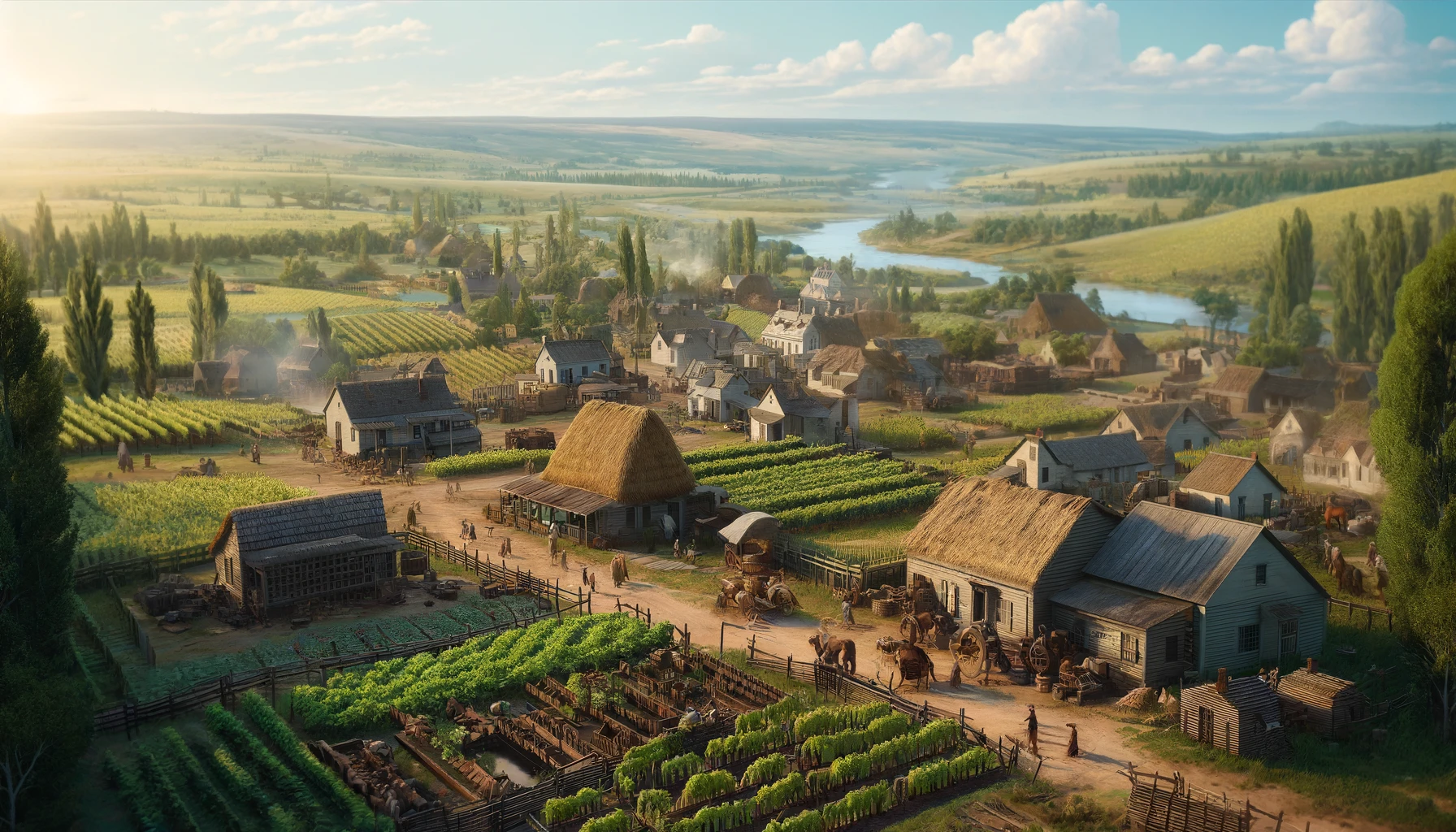
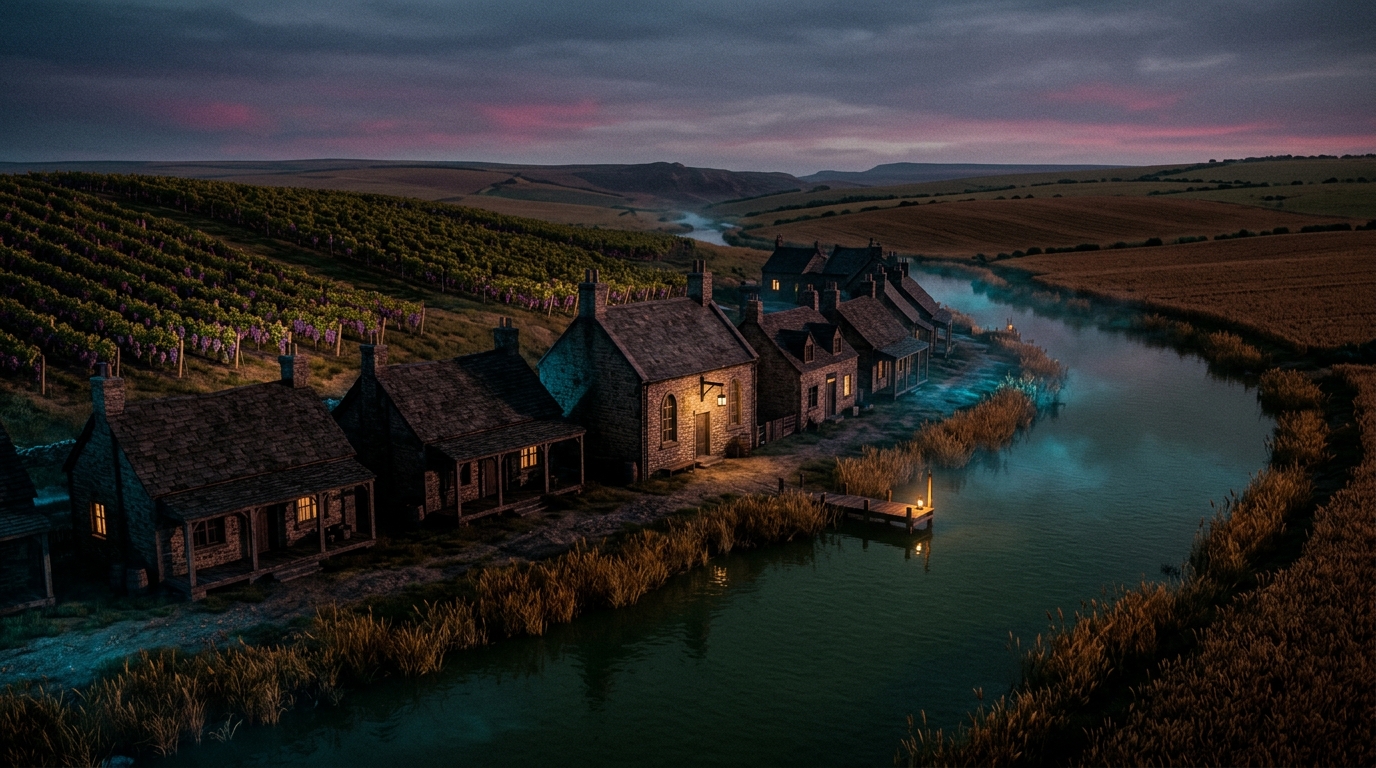
Brierly stood on the banks of the Whitmore River, a slow green town of stone and timber set into the rolling grassland of the Brierly Plains, some sixty kilometres northwest of the place that would one day become Bixbus. The river rose in the rugged Whitmore Highlands to the northwest, ran southeast past the settlement's vineyards and grain fields, and dispersed at last into the shallow wetlands of the Carrington Flats. Between highland and marsh lay everything Brierly was: a self-contained world of perhaps two hundred and fifty souls who had, for the better part of two centuries, asked nothing of the wider universe and received nothing from it.
To walk into Brierly in any decade of its long isolation was to step backwards in time and sideways out of it. Low stone cottages lined Vineyard Row, their walls thick against the heat, their porches stacked with pruning tools and fermentation gear. The air carried oak and tannin from the cellars, dust from the Plains, and the green smell of the river. A schoolhouse, a library, a town hall, and a modest academy formed the civic heart of the place, and beyond them the vines climbed the southern slopes in ordered ranks that had been tended, row by row, by the same handful of families since 1810.
It was a beautiful place and an unlikely one. The ground beneath it had begun as dead crust, the river beneath it had begun without a single fish, and the people who had made it had arrived with no certainty that any of it would hold. That it endured at all was the achievement of five remarkable individuals and the generations who inherited their stubbornness.
Five Keys, One Settlement
The founding of Brierly was the work of a man who never set foot in it. Jonathan Marcus Blackwood, a Guardian already established elsewhere in Clivilius, spent years searching Earth for the people he believed could raise a settlement from nothing. Through agricultural symposia, viticulture lectures, botanical gardens, and engineering conferences, he assembled across 1809 a group of five, each chosen for a single indispensable skill, and pressed into each one's hand a Portal Key.
Thomas Edward Ainsworth, a Yorkshire landowner's son born in 1774, was the leader — a farmer of strong moral fibre and easy command, equally at home with a plough and a volume of classical literature. Elizabeth Carrington, a Sussex botanist's daughter born in 1779, carried her father's passion for plants and a quiet, exacting mind, and in time married Charles Sinclair and raised a family alongside her life's work on the land. George Henry Whitmore of Somerset, born in 1778 into a family of small vintners, knew the art of wine in his hands. Mary Ellen Fairchild of Gloucestershire, born in 1777, was a healer and midwife from a family of healers. Robert Samuel Aldridge of Kent, born in 1776, was a builder whose trade would give the settlement its bones.
On the tenth of March, 1810, Ainsworth activated his Portal Key, and the five Guardians stepped from Earth into a barren, anonymous stretch of Clivilius that had no name. Over the days that followed, each in turn opened their own key, drawing through perhaps twenty further settlers and the tools, seed, and livestock the venture would need — men and women predominantly from rural England, lured by the promise of arable land and a clean beginning. On the twentieth of March the settlement was formally named Brierly. Blackwood, who could not himself enter, mentored the Guardians from a distance until his death in 1811, after which the colony was left wholly to its own devices.
Roots in Barren Ground
Survival came first. The land the settlers had inherited was fertile in potential but lifeless in fact, a thick and barren crust that gave nothing without labour. Elizabeth Carrington proved the settlement's quiet salvation. She catalogued what little grew wild, devised methods to coax Earth's crops into alien soil, and turned the dead river into a living one, introducing fish and water plants that took, multiplied, and slowly made the Whitmore the artery of the colony's agriculture. Her experimental plots became the settlement's botanical gardens, and her habit of careful observation — watch, test, record, and remain open to what the land itself might teach — became the founding discipline that her descendants would carry for two hundred years.
Robert Aldridge raised the first durable buildings, laying out the roads and cottages whose stone walls still defined the town generations later. Mary Fairchild established the settlement's medicine, tending the sick through the inevitable hardships of a new colony and training those who would follow her. And it was George Whitmore who gave Brierly its destiny. Recognising in the Plains a country made for vines, he experimented through the early years with grape varieties brought from Earth, and by 1815 he had planted the settlement's first vineyard on the southern slopes. The success of those early rows decided everything that came after. Brierly would not merely survive on its land; it would become known, across the narrow world it could reach, for its wine.
By the time the colony marked its first decade, the Brierly Plains had begun their long transformation from barren crust to working farmland — grain in the open country, pasture on the margins, and the steadily widening vineyards climbing toward the ridge.
The First Pour
In 1820, after five years of toil and uncertainty, George Whitmore tapped the first barrel of wine made entirely from Brierly-grown grapes. The settlers gathered in the town square beneath lanterns, drank and danced and feasted late into the night, and in doing so founded — without quite intending to — the tradition that would come to define them. The Brierly Harvest Festival was thereafter held every September to mark the end of the grape harvest, its centrepiece the ceremonial First Pour, when the season's first cask was broached before the assembled town.
The festival became the settlement's living calendar, the fixed point around which the agrarian year turned. Music, feasting, grape-stomping and barrel-rolling contests, and the communal tasting of the new vintage drew the whole community together, and over the decades particular years entered local legend.
In 1834, a summer of dry winds and a lightning strike set the Whitmore estate ablaze just before harvest, and Samuel Whitmore, George's grandson, fought the fire with water hauled from the river and salvaged only a small batch of scorched grapes. The wine he made from them — a bold, smoky red that came to be known as the 1834 Harvest Reserve — became the most celebrated vintage in Brierly's history, and the smallest First Pour ever poured became its most remembered.
By 1870, when the fiftieth festival was kept across three days with a cask from every vineyard blended into a single golden pour, Brierly had grown from a struggling outpost into a winemaking region in miniature, confident in its craft and certain of its continuity.
The Closing of the Portals
That continuity came at a price the founders had not fully reckoned with. The Portal Keys belonged to the Guardians alone, and the ability to bring new people and new resources from Earth died with them. George Whitmore was the first to go, dying among his vines in 1850, and Elizabeth Carrington followed in the same year. Robert Aldridge died in 1852, and Thomas Ainsworth — the settlement's founding leader, who had guided it through forty-five years — in 1855. Finally Mary Fairchild, the last Guardian, died in 1857.
With Fairchild's death the gate to Earth closed for good. No new settlers would arrive, no fresh blood, no replenishment of tools or knowledge from the world the founders had left. Brierly was, from that point, entirely alone — a population of roughly two hundred and fifty people who would now have to make everything they needed, marry within a handful of families, and pass land, craft, and memory down the generations or lose them altogether.
The settlers turned inward. Isolation became both the defining condition of their existence and, in a way they came to take quiet pride in, the guarantor of their character. What the wider universe was doing through the long nineteenth and twentieth centuries — its industries, its wars, its inventions — passed Brierly by entirely. The town kept its own counsel, its own rhythms, and its own slowly diverging way of life.
A World Turned Inward
For a hundred and sixty years, Brierly lived by the seasons and by itself. The vineyards remained the centre of its economy, and the Whitmore name remained bound up with the craft: the founder's sons John and Henry carried it forward, and the line ran on through Edward James Whitmore, who modernised the settlement's viticulture before his death in 1920, through Charles Robert Whitmore and his innovations, and through John Henry Whitmore, who expanded the estate before his own death in 1990.
Beside the Whitmores worked the other founding families — the Bennetts above all, who tended the grain fields and the soil, and whose later generations kept faith with the old methods even as the world beyond eventually came knocking.
Brierly governed itself loosely, through a council of its leaders and landowners and, more truly, through the moral authority that a community of two hundred and fifty extends to those it trusts. Its institutions were modest and human in scale. The Brierly Schoolhouse taught every child reading, writing, mathematics, natural history, and the agricultural science a self-supporting town required. The Brierly Library, a stone building beside the Town Hall, held the settlement's accumulated records, including the journals the founders had kept during their bewildered first years — documents that the Carrington family guarded across the generations as their particular charge. From 1840, a small academy offered what passed for higher learning, never more than a dozen instructors and thirty students at a time, teaching natural history, agriculture, mathematics, and literature.
It also taught something Brierly called, simply, the inquiry. There was no curriculum for it. It was a habit of sustained questioning that had run through the settlement since the founding, when Elizabeth Carrington first wrote of the unshakeable sense that the land was watching her as she watched it.
The questions never changed and were never answered — what kind of world was this, what had been here before them, what did it mean to be born in Clivilius rather than to have come through a Portal to it. They were pursued through reading circles in the library, debates in the town hall, and long contemplative walks along the river. Two centuries of living with genuine uncertainty about the nature of their own world had given the people of Brierly a depth of reflection altogether out of proportion to their numbers.
The town's other inheritance was its music. The folk traditions the founders had carried from England and the British Isles survived in Brierly almost unchanged, passed from grandmother to grandchild, fiddle tunes and ballads that surfaced at every harvest and every gathering.
Hardship surfaced too, and was met in kind. When the Great Drought of 1938 dropped the Whitmore River to its lowest recorded level and left barely grapes enough to eat, let alone to press, the town faced its first harvest without a First Pour. It was Eleanor Fairchild who refused to let the festival lapse, proposing instead that each household contribute a single cup from its own reserves, blended together into one communal cask. That night the people of Brierly drank not to abundance but to perseverance, and the Shared Pour entered their traditions ever after as a rite to be performed only in times of scarcity.
A Meeting of Two Worlds
On the thirteenth of September, 2018, the long silence ended. An exploration party from Bixbus — a settlement only weeks old, founded by people who still held the power to cross to and from Earth — found Brierly along the river to its northwest. The mission that made contact, the Vineyard Venture Exploration, was led by Elias Bradbury, and its arrival shattered assumptions the settlers had held for over a century and a half. For the people of Brierly, the discovery that they were not alone, that an entire wider Clivilius existed and had been changing without them, was at once exhilarating and deeply unsettling.
The two worlds met properly that September, when Bradbury and his companion Sophie McMonagle attended Brierly's Harvest Festival at the invitation of the settlement's leader, Samuel Fletcher. The visitors were received with curiosity and caution in equal measure — they watched the First Pour, failed cheerfully at the grape stomp, and, when McMonagle took out a guitar and played an Earth folk ballad, fell into an unexpected communion with a town that had kept its own version of the same melodies for two hundred years. The festival that had marked the close of every Brierly year now marked the opening of its borders.
Negotiation followed celebration. The two settlements found their needs neatly complementary: Brierly held generations of accumulated wisdom about cultivating the unforgiving land of Clivilius, which the struggling young capital desperately lacked, while Bixbus could offer technology, resources, and a connection to the wider world that Brierly had done without since 1857. The agreement they reached sent some of Brierly's younger settlers — agriculturalists and craftspeople — to assist with the building of Bixbus, in exchange for tools and modern knowledge to flow the other way. In October 2018 the first group left, among them the botanist James Carrington, a direct descendant of Elizabeth herself, carrying two centuries of horticultural learning into a settlement that needed every scrap of it.
Rails and the Years After
The most ambitious expression of the new partnership ran on iron. A feasibility study in March 2019 traced a route between the two settlements; resources were gathered by June, the final sixty-kilometre line through the valleys was fixed by August, and construction began that September under the relentless rail foreman Aaron Semple. The crews fought rugged hills, dust storms, freezing nights, and several landslides before the first train ran on the first of December, 2020. The CGRN Bixbus–Brierly Line — the first artery of what would become the Clivilius Global Rail Network — bound the historic wine town to the modernising capital and carried Brierly's vintages, for the first time, to markets far beyond the valley.
Not everyone welcomed it. Brierly's governing council had approved the railway only reluctantly, late in 2019, and only because the promise of wider wine markets proved more persuasive than the fear of change. The traditionalists' anxieties were not misplaced: with the rails came new faces, new money, and new ideas, and the settlement that had prized stability above all things now found itself negotiating, year by year, how much of the modern world to let in. Some embraced the influx; others resented it; most simply tried to fold the new into the old without losing what had made Brierly worth preserving.
The traffic ran in both directions. Some of Brierly's children left for good — Lucia Lamb, born in the settlement, became a landscape architect in Bixbus, and James Willems, raised within the inquiry tradition in a cottage at the edge of the vineyards, departed in 2019 to help build a faculty of philosophy at the new Clivilius National University, carrying his town's two-century habit of questioning into a lecture hall. Others left and came home. James Carrington, after six years in Bixbus and a family built there, returned to Brierly in early 2025 to help his community marry modern technique to its inherited practice — the very bridge the settlement now needed.
Through all of it the essentials held. The vines still climbed the southern slopes, the Whitmore still ran past them from highland to marsh, and every September the town still gathered for the First Pour. Brierly had spent the better part of two centuries proving that a community could outlast its founders, its isolation, and very nearly its luck, sustained by little more than good soil, stubborn families, and a refusal to stop asking what kind of world it lived in. The arrival of Bixbus had not ended that story; it had only, at long last, given it somewhere else to go.







