Bixbus Wildlife Sanctuary
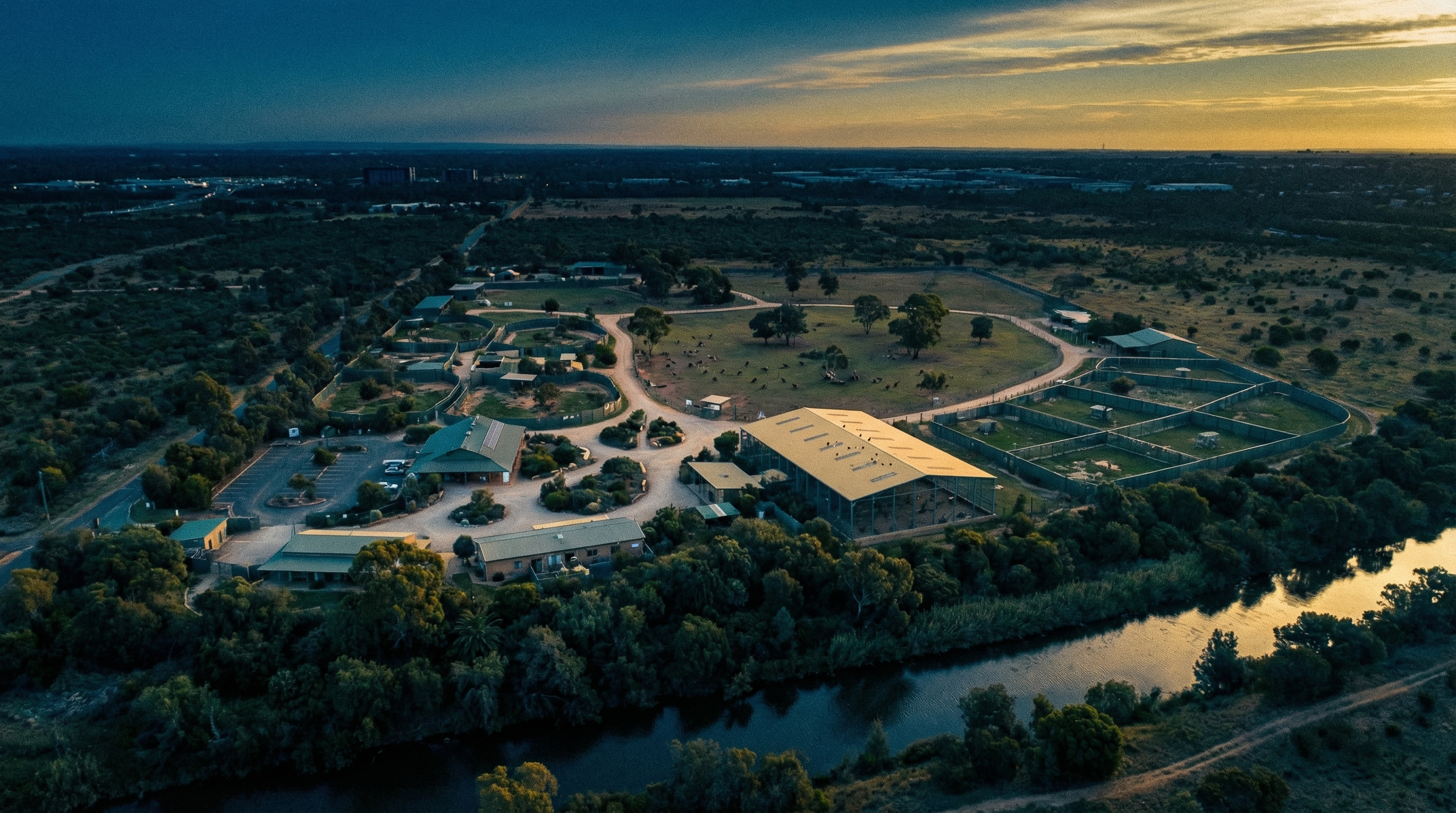
The Bixbus Wildlife Sanctuary, established in late 2018 by displaced Tasmanian conservationists Grant and Sarah Ironbach, grew from a collection of chain-link enclosures on the southern edge of a frontier settlement into one of Clivilius's most significant conservation institutions. Housing over 400 species by 2026, the sanctuary serves as the public-facing partner of the Clivilian Ecological Seeding Programme, bridging the deep scientific heritage of the Black Hallows Breeding Facility with Bixbus's millions of residents through exhibition, education, and ecological research.
Origins
The Bixbus Wildlife Sanctuary owes its existence to a case of mistaken identity, a pair of displaced conservationists, and a settlement desperate enough to build anything that might make an alien world feel like home.
Grant and Sarah Ironbach arrived in Bixbus on 29 July 2018, one day after the settlement's founding week had barely concluded. The siblings — Director and Assistant Director of the Bonorong Wildlife Sanctuary in Tasmania — had spent weeks preparing for what they believed was a two-week site assessment for a legitimate conservation project coordinated through the TerraNova Conservation Foundation. Instead, a stranger who was not the man they were expecting led them through a portal, and the life they knew ended without farewell.
Luke Smith recognised immediately what the Ironbachs represented. Grant's career had spanned roles with Tasmania Parks and Wildlife Service, the Australian Wildlife Conservancy, and Zoos Victoria before he returned to lead Bonorong. Sarah had followed a parallel path through the same institutions. Their combined expertise in wildlife rescue, rehabilitation, habitat management, and captive breeding was precisely the kind of knowledge Bixbus needed but had no means of developing on its own. Within days of their arrival, Luke had proposed turning their grief into purpose: build something here. Use what you know.
Grant, methodical and deliberate by nature, began surveying the settlement's southern periphery within the first week. Sarah, more instinctive and driven, was already sketching enclosure designs on the back of supply manifests. By 5 August, Grant had produced the first draft of a master project plan. By 25 August, it had been revised three times, reviewed by Luke and the settlement leadership, and formally approved. On 29 August 2018, a modest groundbreaking ceremony marked the commencement of construction on what would become one of Bixbus's most significant institutions.
They were not entirely alone in those earliest days. Karen Owen, an entomologist and former Associate Professor of Environmental Science at the University of Tasmania, had arrived in Bixbus with her husband Chris just days before the Ironbachs, transported through the portal on 27 July under circumstances no less disorienting. Karen's expertise in insect ecology and soil systems made her an invaluable adviser during the sanctuary's planning phase — she participated in the initial site surveys, conducted soil assessments, and designed the sanctuary's founding planting strategy. However, Karen and Chris had already identified a larger purpose.
By late 2018, the Owens departed Bixbus to establish Tree Acres, a specialised biological propagation facility 67 kilometres to the northeast, dedicating themselves to industrial-scale plant production for the region's terraforming programme. Karen's ecological insights remained embedded in the sanctuary's approach long after her departure, but her direct involvement ended before the facility opened. Jerome Smith, a twenty-one-year-old zoology syudent who had arrived in Bixbus with his family in August 2018, brought youthful energy and a genuine passion for wildlife that quickly made him indispensable to the early operation.
The Land
The sanctuary site occupies the western periphery of the Bixbus settlement, near the Norong River and the series of natural lakes that punctuate its course. The location offered freshwater access, varied terrain around the lake margins, and adequate distance from the main residential and commercial zones developing along the Bixbus River to the northeast. Grant named the western river during his first survey of the site in early August 2018 — a quiet, private reference that Sarah understood without explanation and no one else thought to question.
What lay beneath changed everything. The Clivilius soil system — three distinct layers known colloquially as The Veil, The Shield, and The Cradle — proved to be an extraordinary asset for habitat establishment. The Veil, a fine dust layer up to sixty centimetres deep, acts as a protective insulator that captures atmospheric moisture. Beneath it, The Shield is a dense, compacted mineral layer containing dormant terraforming enzymes encased in protective capsules. And below that lies The Cradle — a rich, living soil matrix up to 180 centimetres deep, teeming with AI-guided terraforming enzymes that actively optimise soil structure, nutrient content, and the microbiome in real time.
The practical implication was transformative. Once the dust was cleared and the crust broken through to expose The Cradle, plant germination occurred within days rather than weeks. Grasses established ground cover in under a fortnight. Saplings planted in September were providing meaningful shade by December. As vegetation coverage increased, localised microclimates developed through transpiration and albedo changes, bringing subtle shifts in humidity and temperature that further supported the emerging ecosystems. By the time the sanctuary formally opened, its oldest plantings had transformed from bare earth into a young but thriving landscape that bore no resemblance to the dust Grant had first surveyed.
Before her departure for Tree Acres, Karen Owen's entomological background proved particularly valuable during site preparation. She identified the soil's potential for supporting pollinator populations and designed the sanctuary's initial planting strategy to prioritise flowering species that would attract and sustain introduced insect communities — a foundational step that accelerated the ecological complexity of every enclosure that followed. The relationship between the sanctuary and Tree Acres, established through the Owens' early involvement with both institutions, would later become one of the region's most productive partnerships, with Tree Acres supplying vegetation, habitat plantings, and animal fodder crops to the sanctuary at increasing scale as both facilities grew.
Construction
The sanctuary was built in four phases over six months, from late August 2018 to early March 2019. Grant's construction philosophy, set out in the master project plan, was unambiguous: practical functionality first, refinement later. In a settlement that was itself barely weeks old, there was no place for exhibition-standard architecture. What mattered was getting safe, functional habitats built as quickly as possible using materials delivered through the Guardian supply network and assembled by whatever hands were available.
Construction materials, tools, and specialist equipment arrived on demand through portal logistics — fencing, timber, cement, mesh, corrugated iron, prefabricated panels, plumbing, and electrical components. Personnel with specific trade skills were sourced as needed. The settlement's rapid growth meant that new arrivals with relevant experience were frequently directed to the sanctuary site within days of reaching Bixbus.
The first structures to rise were the Sanctuary Supply Depot and the Sanctuary Operations Hub — prefabricated steel-framed buildings that provided secure storage and a coordination base for everything that followed. From this foundation, construction fanned outward. The four small enclosures — the Meadow, Canopy, Wetland, and Thicket — went up in early September, each built in under a week using treated timber posts, wire mesh, gravel bases, and simple wooden shelters. The Open Range and Mixed Scrub Paddocks followed, providing fenced grassland for the first grazing animals. The Flutter Dome — a timber-framed mesh enclosure designed for butterflies and pollinators, with dense flowering plantings and a basic misting system — and the Shallows Aquarium, fitted with concrete block walls, lined tanks, and basic filtration, completed the first phase by the end of September.
October and November brought the aviary network. The Woodland, Canopy, and Grassland Aviaries were constructed concurrently by the same crew — each a galvanised steel-framed, mesh-enclosed space designed for a specific bird community. The Webbed Gallery and Scaled Sanctuary provided terrariums and enclosures for arachnids and reptiles respectively. The River's Edge Aquarium expanded the sanctuary's aquatic capability with larger display and breeding tanks. The LifeCare Centre — the sanctuary's veterinary facility — was the most complex build of this period, requiring specialist trades for its examination rooms, surgical suite, quarantine ward, and laboratory. Dr. Linnea Hargrove, a veterinarian recruited through the supply network in October 2018, provided layout guidance during construction and assumed the role of Head Veterinarian upon the centre's completion on 20 November.
The final construction phase delivered the sanctuary's largest facilities. The Plains and Savannah Enclosures, each spanning 2,500 square metres, provided space for larger herbivores across varied terrain. The Sky Haven Aviary — a 1,600-square-metre structure rising eight metres at its centre with a central pond, stream feature, and tiered planting — became the sanctuary's flagship attraction, housing mixed flocks of peafowl, macaws, night herons, emerald doves, and mynas across multiple vertical habitat layers. The Genesis Centre, completed on 29 December 2018 under the coordination of breeding specialist Dr. Rowan Kessler, gave the sanctuary its captive breeding programme capability, with modular enclosures, incubation facilities, and observation stations.
Landscaping, gravel pathways, timber viewing platforms, signage, and final integration work occupied January and February 2019, overseen by head groundskeeper Tomás Arrieta.
First Year of Operations
The Grand Opening on 1 March 2019 was a modest affair by the standards Bixbus would later set for its civic occasions, but it carried a weight that the settlement's population — then numbering in the low thousands — understood instinctively. The sanctuary was not just a collection of animals behind fences. It was proof that Bixbus could sustain deliberate, purposeful life beyond the bare requirements of human survival.
In its opening month, the sanctuary housed forty-seven animal species across its twenty-two facilities. The collection was eclectic rather than curated — a reflection of what the supply network had been able to source and deliver during the six months of construction. The Meadow Enclosure held European rabbits, Patagonian maras, and a small group of quokkas. The Open Range Paddock contained red-necked wallabies and eastern grey kangaroos. The Sky Haven Aviary hosted its intended mix of peafowl, scarlet macaws, black-crowned night herons, emerald doves, and common mynas, alongside a pair of sulphur-crested cockatoos that had arrived unscheduled in a consignment intended for the Canopy Aviary and had refused, with characteristic stubbornness, to be relocated.
The first months of operation were defined by the particular chaos of running a wildlife facility that was simultaneously still being finished. Tomás Arrieta's landscaping work continued through March and April, with pathways being gravelled and viewing platforms completed whilst visitors walked around construction debris. Dr. Linnea Hargrove established the LifeCare Centre's quarantine protocols during this period, processing new animal arrivals at a rate that frequently exceeded the centre's designed capacity. Every shipment through the portal brought uncertainty — animals arrived stressed, disoriented, and occasionally injured from transit, and the veterinary team's ability to assess, stabilise, and house them rapidly became the sanctuary's operational bottleneck.
Jerome Smith, then twenty-one and still finding his professional footing, emerged during this period as an unexpectedly effective liaison between the animal care team and the broader Bixbus settlement. His quiet manner and genuine affection for the animals made him a natural ambassador, and Sarah Ironbach increasingly relied on him to coordinate volunteer labour from the settlement's growing population. By mid-2019, Jerome was managing a rotating roster of over thirty volunteers who supplemented the sanctuary's small permanent staff with everything from enclosure cleaning to feed preparation.
Grant, meanwhile, spent much of the first operational year navigating the politics of resource allocation within a settlement that had competing demands for every delivery through the portal. The sanctuary required a continuous supply of animal feed, veterinary medications, specialist equipment, and — most contentiously — live animals, all of which consumed portal capacity that other Bixbus projects also needed. Grant's meticulous documentation habits served him well here. His quarterly reports to Luke Smith and the settlement leadership presented the sanctuary's requirements in precise, justified terms that were difficult to argue against, and he developed a reputation for never requesting more than he could demonstrate was necessary.
Staffing and Early Culture
The sanctuary's permanent staff grew steadily through 2019 as Bixbus's population expanded and new arrivals with relevant skills were identified. Dr. Hargrove recruited Nadine Calloway, an experienced veterinary nurse with a background in emergency wildlife care, to join the LifeCare Centre team. Calloway proved invaluable during the chaotic early months when the quarantine ward was rarely empty.
The aquarium facilities, initially managed on a part-time basis by whoever could be spared, gained their first dedicated aquarist in June 2019 when Marcus Tan, a marine biologist with experience in tropical aquatic systems, was assigned to the sanctuary. Tan brought a rigour to the Shallows and River's Edge Aquariums that transformed them from functional holding tanks into properly managed aquatic environments, introducing water quality monitoring protocols that became the template for every aquatic facility the sanctuary subsequently developed.
The sanctuary's relationship with Tree Acres deepened during the first year of operations. Karen and Chris Owen's propagation facility, now developing rapidly 67 kilometres to the northeast, began supplying habitat vegetation to the sanctuary from mid-2019 once its first propagation houses became operational. The arrangement reduced the sanctuary's dependence on portal-delivered plant stock and established a supply chain that would scale dramatically in subsequent years. Tree Acres provided not only habitat plantings — grasses, shrubs, and saplings selected for rapid establishment in Clivilius soil — but also began cultivating fodder crops and specialist feed plants that eased the sanctuary's reliance on imported animal feed. By late 2019, the partnership had become a practical necessity for both institutions: Tree Acres gained a consistent, demanding client that pushed its propagation capacity, whilst the sanctuary gained a reliable source of vegetation adapted to the specific conditions of the Bixbus region.
Meanwhile, the sanctuary's habitats were producing results that no one had fully anticipated. Plants grew according to The Cradle's optimisation algorithms, not always in the patterns the horticulturists had planned. Insect populations introduced for pollination diversified faster than expected, with some species exhibiting behavioural changes within their first year. Grant noted in his quarterly reports that several animal species were also displaying subtle shifts in activity patterns and feeding preferences that did not align with Earth-based literature. These observations were informal and unsystematic in 2019, but they planted a question that would later become central to the sanctuary's scientific identity: what was Clivilius doing to the organisms living within it?
The culture that emerged within the sanctuary during this period was shaped by the particular circumstances of its staff. Nearly everyone had been displaced from Earth involuntarily. Grant and Sarah channelled their loss into institutional purpose with a discipline that set the tone for the entire operation. Dr. Hargrove, who rarely spoke about her life before Bixbus, brought a clinical focus to the veterinary team that left no room for sentimentality but plenty for compassion. Jerome Smith, the youngest of the core team, embodied a quieter kind of resilience — he had followed his family through the portal out of loyalty rather than choice, and he found in the animals a form of connection that asked nothing of him except care. The sanctuary became, for many of its early staff, the closest thing to a sense of normative purpose that Bixbus could offer.
Growth and Upgrades: 2020
The sanctuary's second full year of operation was marked by the transition from survival-mode functionality to deliberate institutional development. The chain-link fences and timber structures of the original build remained, but targeted upgrades began to transform the facility's character.
The most significant infrastructure project of 2020 was the connection of the sanctuary to Bixbus's expanding electrical grid, replacing the standalone solar panels and diesel generators that had powered the facility since construction. The grid connection, completed in April under the supervision of BUDA engineer Priya Venkatesh, enabled the installation of proper climate management systems in the Scaled Sanctuary and Webbed Gallery — facilities that had previously relied on portable heat lamps and manually managed humidity trays. The LifeCare Centre received an upgraded surgical suite with reliable lighting and refrigeration, and the Genesis Centre's incubation facilities were fitted with thermostatically controlled units that dramatically improved hatching success rates.
Dr. Rowan Kessler, who had coordinated the Genesis Centre's construction, led the sanctuary's first formal breeding programme through 2020 — a captive breeding effort focused on Tasmanian devils, a species whose vulnerability on Earth gave the programme particular emotional resonance for Grant and Sarah. The first litter of four joeys, born in the Genesis Centre in August 2020, became an unofficial symbol of the sanctuary's maturation. Kessler's breeding protocols, developed in consultation with Grant's knowledge of Bonorong's devil programmes, established a framework that the Genesis Centre would apply to subsequent species.
The animal collection expanded considerably during 2020, growing from forty-seven species at opening to over ninety by year's end. New arrivals included a pair of red pandas for the Canopy Enclosure, a breeding group of meerkats that necessitated the construction of a small additional enclosure adjacent to the Meadow, and a consignment of freshwater crocodiles for the River's Edge Aquarium that tested Marcus Tan's equanimity and the structural integrity of his tanks in roughly equal measure. Each new species arrived through the supply network with minimal advance notice, and the sanctuary's ability to absorb and house them rapidly became one of its defining operational characteristics.
The Flutter Dome received its first major upgrade in late 2020, when the original timber-and-mesh structure was reinforced with glass panelling along its southern face, creating a partial conservatory effect that improved temperature stability and allowed the introduction of more delicate tropical butterfly species. The upgrade was designed by Tomás Arrieta, whose landscape architecture skills had expanded during his time in Bixbus to encompass a practical facility design capability born of necessity rather than formal training.
Clivilius National University Partnership: 2021
The formal partnership between the Bixbus Wildlife Sanctuary and Clivilius National University, signed in March 2021, represented a turning point in the sanctuary's institutional identity. What had begun as an informal arrangement — university students volunteering at the sanctuary, academics consulting on specific problems — became a structured relationship that embedded the sanctuary within Bixbus's educational and research infrastructure.
The partnership was brokered by Professor Elaine Matsuda, Dean of the Faculty of Natural Sciences at CNU, who had recognised the sanctuary's potential as a living laboratory from her first visit in mid-2020. Under the agreement, the university provided dedicated research funding, laboratory access, and graduate student placements in exchange for the sanctuary hosting field research programmes and contributing data to the university's ecological databases. The first cohort of four CNU postgraduate students commenced placements at the sanctuary in April 2021, supervised jointly by Dr. Neville Ashworth and Professor Matsuda's department.
Ashworth, a wildlife ecologist who had joined the sanctuary in early 2019 specifically to investigate the behavioural and physiological anomalies Grant had been noting in his quarterly reports, had spent two patient years establishing baseline datasets for every vertebrate species in the collection. By 2021, his ecological adaptation research programme — methodical, unglamorous, and built on thousands of individual observations — was generating data that no institution on Earth could replicate. Introduced species were exhibiting measurable physiological variations within timeframes that Earth-based biology could not explain. Insects introduced for pollination in 2018 showed morphological changes in wing structure and colouration. Vertebrate populations displayed shifts in activity patterns, feeding behaviour, and social organisation. Ashworth's working hypothesis, informed by the broader scientific understanding of Clivilius's terraforming enzymes, was that the soil system's AI-guided optimisation extended its influence beyond plant life to affect any organism living in sustained contact with the environment. The hypothesis was controversial, not least because its implications for the sanctuary's entire collection were profoundly unsettling to anyone who thought carefully about them.
Isabella Taylor, then thirteen years old and already displaying the ecological intuition that would define her later career, began volunteering at the sanctuary in 2021 through a CNU youth engagement programme that Sarah Ironbach had helped establish. Isabella had arrived in Bixbus in August 2018 at the age of ten, a survivor of the Brisbane School Bus Tragedy, and had spent her first years in Clivilius navigating the particular challenges of growing up in a settlement that was itself still growing up. The sanctuary provided her with something the settlement's classrooms could not — direct, tactile engagement with living systems. Sarah recognised Isabella's aptitude immediately and ensured she was given meaningful responsibilities rather than token tasks, a decision that would have long-term consequences for both the sanctuary and Isabella's trajectory.
The sanctuary's public profile within Bixbus grew substantially during 2021. With the settlement's population now in the hundreds of thousands and expanding rapidly, the sanctuary became one of the city's most visited destinations — a place where families could spend an afternoon in green, living spaces that contrasted sharply with the construction sites and urban development that dominated much of Bixbus. Sarah, who had assumed primary responsibility for community engagement, introduced a programme of educational talks, guided tours, and school visits that established the sanctuary as an educational institution in its own right, not merely a place to look at animals. Attendance records from 2021 show over 40,000 individual visits across the year — a figure that astonished Grant, who had built the sanctuary expecting it to serve a settlement of thousands, not a city of hundreds of thousands.
The physical expansion of 2021 reflected this growth. A dedicated visitor centre — the Ironbach Centre, named at Luke Smith's insistence over Grant's protests — was completed in July 2021 adjacent to the main entrance. The building, designed by BUDA architect Sanjay Mehta in consultation with Sarah, housed an exhibition space, a small auditorium for educational presentations, administrative offices, and a modest café. Its construction marked the moment the sanctuary ceased to be a collection of enclosures connected by gravel paths and became something closer to a civic institution with a public face.
Two new enclosures were added during 2021: the Nocturnal House, a purpose-built low-light facility designed to house species with crepuscular and nocturnal activity patterns, and the Waterbird Lagoon, an open-air enclosure built around a constructed wetland that extended the sanctuary's footprint southward toward the river. Both projects were substantially more sophisticated than the original Phase 1 builds, reflecting the increased availability of materials, specialist trades, and design expertise that Bixbus's rapid growth had made possible.
Maturation and Growing Pains: 2022
By the start of 2022, the Bixbus Wildlife Sanctuary had operated for nearly four years and had outgrown the assumptions on which it was built. The collection had expanded to over 150 species. The original Phase 1 fencing had been replaced with sturdier materials. The Ironbach Centre drew steady visitor traffic from a city whose population was now measured in millions. The university partnership was generating published research. The Genesis Centre's breeding programmes, managed by Dr. Rowan Kessler, had produced successful litters and clutches across a dozen species, including the Tasmanian devil programme that remained the Ironbachs' most emotionally resonant project.
And yet, the facility was straining. Enclosures designed for a frontier settlement were serving a metropolis. The veterinary team — still led by Dr. Linnea Hargrove, now supported by veterinary nurse Nadine Calloway and a growing roster of CNU placement students — managed a caseload that had tripled since the LifeCare Centre opened. Animals arrived through the supply network faster than habitats could be developed, and Grant's quarterly reports had taken on an increasingly pointed tone regarding the gap between what the sanctuary was being asked to accommodate and the resources it was given to do so.
The most consequential staff change of 2022 was Jerome Smith's departure. Jerome had been with the sanctuary since before its groundbreaking — a twenty-one-year-old zoology graduate who had grown into a skilled and trusted member of the team, managing volunteer coordination, then animal care, with a quiet competence that belied his age. The completion of the Black Hallows Express Rail Line earlier that year had opened a channel between Bixbus and the Black Hallows Breeding Facility, and Jerome — whose practical experience and zoological training made him exactly the kind of person Black Hallows needed — saw an opportunity to work at a scale the Bixbus sanctuary could not yet offer. Grant supported the move publicly. Privately, he told Sarah that losing Jerome felt like losing a piece of the sanctuary's founding identity.
To replace Jerome's operational role, Grant promoted Callum Hatch, a young man who had been part of Jerome's original volunteer cohort in 2019 and had since completed a CNU zoology degree. He understood the sanctuary's culture from the inside — having been part of Jerome's volunteer cohort since 2019 — and brought an energy to the senior animal keeper role that helped offset the loss of Jerome's steadier presence.
The Black Hallows Connection
The completion of the CGRN rail link did not immediately transform the sanctuary's operations, but it fundamentally altered its horizon.
Black Hallows was something the Bixbus team had heard of in passing but never engaged with directly — a breeding facility 950 kilometres east of Cranbourne, founded in 1865, with over 160 years of continuous operation in conservation, captive breeding, and ecological research. Where the Bixbus sanctuary was young, practical, and built for public engagement, Black Hallows was ancient, insular, and built for science. Its cliff-carved laboratories housed generations of research into what its staff called "adaptive compression" — the phenomenon by which Clivilius accelerated evolutionary change in introduced organisms at speeds that defied Earth-based biological understanding. Its breeding lineages included species that had been in Clivilius for over a century and had diverged measurably from their Earth counterparts.
Grant and Sarah travelled to Black Hallows by rail in August 2022 for a week-long assessment visit. Grant later described the experience as "humbling and slightly terrifying in equal measure." The facility's scale dwarfed anything Bixbus had built — hundreds of square kilometres of purpose-built biome habitats, thousands of species, a multi-generational staff whose families had worked with the same breeding lineages for decades. But what struck Grant most was not the scale. It was the science. Black Hallows' researchers were not merely housing animals. They were studying how Clivilius changed them, documenting evolutionary trajectories in real time, and grappling with questions about what conservation meant when the organisms you were conserving refused to stay the same.
Dr. Ashworth's adaptation research at the Bixbus sanctuary suddenly had context. The changes he was documenting in Bixbus's captive populations — the subtle physiological shifts, the behavioural divergences — were not anomalies. They were the early stages of processes that Black Hallows had been tracking for over a century. The two institutions were asking the same questions from opposite ends of the timeline.
Jerome Smith, now several months into his role at Black Hallows, served as an informal bridge between the two cultures during the visit. He understood both institutions — the Bixbus sanctuary's practical, community-oriented ethos and Black Hallows' deep, sometimes insular scientific traditions — and his ability to translate between them would become increasingly valuable as the relationship deepened.
The Clivilian Ecological Seeding Programme: 2023
In mid-2023, Bixbus formally proposed the Clivilian Ecological Seeding Programme — a systematic effort to deploy Black Hallows' breeding stock and ecological expertise across Bixbus's expanding territories. The programme was ambitious, well-funded, and controversial within Black Hallows, where staff debated whether their facility's century-and-a-half of careful, methodical work was about to be instrumentalised by a settlement barely five years old.
The compromise reached in September 2023 preserved Black Hallows' scientific authority over breeding protocols, release schedules, and species selection whilst accepting the programme's broader framework. For the Bixbus Wildlife Sanctuary, the implications were immediate and transformative.
The sanctuary was designated as the Seeding Programme's primary public-facing partner in Bixbus — the institution through which the programme's work would be communicated, exhibited, and made accessible to the city's millions. This was partly pragmatic — the sanctuary had the visitor infrastructure, the educational programmes, and the community relationships that Black Hallows lacked — and partly strategic. Bixbus's leadership understood that public support for the Seeding Programme depended on people seeing and understanding what it produced, and the sanctuary was the natural venue.
The first consignment of Black Hallows-bred specimens arrived in November 2023 — thirty-seven species, many never previously housed in Bixbus. The shipment included species whose Clivilian lineages stretched back decades, organisms that resembled their Earth counterparts but behaved differently, responded differently to their environments, and carried genetic profiles that Dr. Ashworth's team found fascinating and faintly unsettling. Housing them required new enclosures and new approaches to management that drew on Black Hallows' institutional knowledge rather than the Ironbachs' Earth-based training.
Grant recruited heavily during this period. Douglas Wren and Callum Hatch took on expanded supervisory roles across the existing enclosures, freeing Grant to focus on the Seeding Programme integration. Dr. Patrick Ngata, a veterinary surgeon with extensive experience in large-mammal care, joined the veterinary team to manage health protocols for the Black Hallows species. Reuben Tsang, a structural engineer who had joined BUDA in 2022, was seconded to the sanctuary to oversee the construction of a new enclosure complex — collectively designated the Seeding Programme Exhibits — on previously undeveloped land south of the existing site. Tsang developed a modular enclosure system that allowed rapid reconfiguration as new species arrived, a design philosophy that owed more to logistics than to zoology but proved remarkably effective.
Tree Acres, now a 500-hectare industrial propagation facility under Karen and Chris Owen's direction, supplied the vegetation for the new enclosures at a scale that dwarfed the sanctuary's earlier planting efforts — tens of thousands of habitat plants, ground cover species, and mature shrubs delivered by rail and planted by specialist crews who could vegetate an enclosure in days rather than weeks. Tree Acres also expanded its fodder crop programme to meet the increased demand from the Seeding Programme species, many of which required diets that could not be replicated from Earth imports alone. The partnership between the sanctuary and Tree Acres, which had begun with Karen Owen's involvement in the sanctuary's founding planting strategy in 2018, had matured into one of the region's most productive institutional relationships — the sanctuary providing the demand that drove Tree Acres' diversification, and Tree Acres providing the biological foundation on which every new enclosure depended.
Institutional Transformation: 2024
By 2024, the sanctuary had become something qualitatively different from the facility that opened in March 2019. It was no longer simply a local wildlife park. It was the public face of one of the most ambitious ecological programmes in Clivilius — a bridge between Black Hallows' deep scientific heritage and a city of millions.
The collection had grown to over 300 species. The Seeding Programme Exhibits alone housed nearly a hundred, with species rotated between Bixbus display and Black Hallows' breeding programmes as population management required. The research partnership between Dr. Ashworth's team and Black Hallows had produced the sanctuary's first jointly authored publications through CNU — comparative adaptation data across species housed in both facilities, early-stage Clivilian adaptation at Bixbus measured against long-term evolutionary trajectories at Black Hallows.
The university partnership had deepened correspondingly. Professor Elaine Matsuda's department maintained a permanent field station within the sanctuary grounds, housing two full-time CNU researchers and rotating up to eight postgraduate students per semester. Isabella Taylor, now sixteen and increasingly serious about her ecological ambitions, had progressed from weekend volunteer to formal research assistant within the field station, working under Dr. Ashworth on vertebrate adaptation monitoring. Her intuitive understanding of the sanctuary's ecosystems — built from years of hands-on engagement rather than formal training — complemented Ashworth's methodical approach in ways that both found productive.
Marco Pellegrini, a gifted science educator who had joined the sanctuary's education team in 2022, now led a dedicated education team that operated semi-independently from the animal care division. The Ironbach Centre hosted weekly public lectures, school programmes serving thousands of students annually, and a community science initiative that trained Bixbus residents to contribute to species monitoring across the city's green spaces. Pellegrini's gift for making complex ecological concepts accessible to children and adults alike had made him one of the sanctuary's most publicly visible staff members, a role that suited his gregarious temperament.
Grant found himself spending as much time on institutional politics as on sanctuary management. The Seeding Programme had brought resources and prestige, but it had also brought complexity. Managing the relationship between the sanctuary's original community-focused mission and its new role as a Seeding Programme partner required constant negotiation — with Black Hallows' scientific leadership, with Bixbus's settlement administration, with CNU's academic priorities, and with his own staff, some of whom felt the sanctuary's identity was being subsumed by an initiative it had not chosen.
The tension was productive more often than it was destructive, but it was real. Grant addressed it in his 2024 annual report with characteristic directness: "This sanctuary was built to give a displaced community something to care about. That purpose has not changed. What has changed is the scale of what we are being asked to care about, and the number of institutions that have opinions about how we should do it."
Clivilian-Evolved Species: 2025
The year 2025 brought a shift that challenged the sanctuary's understanding of its own purpose. In late 2025, the Black Hallows Breeding Facility formally expanded its mandate to include the collection, study, and breeding of Clivilian-evolved species — organisms descended from Earth stock but so dramatically diverged over thousands of years of adaptation that they constituted distinct species found nowhere else. The shadow panther, evolved from melanistic leopards introduced in 1287 BCE, was the most widely known example, but Black Hallows' field teams had begun cataloguing dozens of previously undocumented species that had evolved without human observation across millennia.
The implications for the Bixbus Wildlife Sanctuary were immediate. As the Seeding Programme's public-facing partner, the sanctuary was expected to exhibit and interpret these species for the city's population. The first Clivilian-evolved specimens — a breeding pair of ridge-backed hares, descendants of European stock that had been in Clivilius for approximately 400 years — arrived at the sanctuary in September 2025. They were larger than their Earth ancestors, with thickened hind-leg musculature and a pronounced dorsal ridge of coarse fur that gave them their common name. They looked like hares. They did not quite behave like hares.
Douglas Wren, who managed their initial housing in a modified section of the Meadow Enclosure, described the experience to Grant as "like working with an animal you think you know and then realising you don't." The ridge-backed hares were more alert, more socially structured, and more aggressively territorial than any lagomorph species the team had encountered. Their dietary preferences diverged from Earth hares in ways that required Dr. Ngata and the veterinary team to develop entirely new nutritional protocols. The experience served as a concentrated lesson in what Black Hallows' researchers had been saying for decades: Clivilius did not merely house organisms. It changed them.
Dr. Ashworth's adaptation research programme gained a new dimension with the arrival of Clivilian-evolved species. For the first time, his team could compare early-stage adaptation (the sanctuary's Earth-sourced populations, now seven years into their Clivilian residency) against the endpoint of centuries-long evolutionary divergence. The data was preliminary but striking — the physiological trends Ashworth had been documenting in the sanctuary's collections appeared to be the opening chapters of the same story that the Clivilian-evolved species represented in their later chapters. The research, conducted in partnership with Black Hallows and published through CNU, positioned the sanctuary at the centre of what was becoming one of Clivilius's most significant scientific questions: what happened to Earth life when it was given thousands of years in a world that actively accelerated change?
Jerome Smith, now firmly established at Black Hallows and serving as a liaison between the two facilities, visited the sanctuary twice during 2025 to assist with the Clivilian-evolved species integration. His knowledge of both institutions — the practical, community-facing culture of the Bixbus sanctuary and the deep, research-driven traditions of Black Hallows — made him uniquely effective at bridging the gap between what Black Hallows' scientists recommended and what the sanctuary's keepers could practically implement. Grant noted in his 2025 annual report that Jerome's role had evolved into something the sanctuary could not have anticipated when a twenty-one-year-old volunteer walked through the gates in 2018: he had become the human thread connecting two institutions that were, between them, redefining what conservation meant in Clivilius.
Expansion and the Seeding Programme Exhibits
The sanctuary's physical footprint expanded substantially through 2025. The Seeding Programme Exhibits complex, which Reuben Tsang had designed with modular flexibility in mind, received two additional enclosure clusters to house the growing number of species transferred from Black Hallows. The new builds reflected the sanctuary's evolving construction standards — still practical and functional, but incorporating design elements that Tsang had adapted from Black Hallows' habitat engineering principles. Enclosures were larger, terrain was more varied, and planting schemes were more complex, drawing on species assemblages provided by Tree Acres that replicated the kinds of ecosystems the Seeding Programme was deploying across the region.
The collection by mid-2025 exceeded 400 species, including both Earth-sourced populations and the first Clivilian-evolved specimens. Managing this scale required organisational restructuring. Grant divided the sanctuary's animal care operations into three zones, each overseen by a senior keeper: Douglas Wren managed the original enclosures and aviaries (Zone A), Callum Hatch managed the Seeding Programme Exhibits (Zone B), and a newly recruited senior keeper, Vincent Okafor — a wildlife management specialist who joined the sanctuary in late 2024 — took responsibility for the aquatic facilities, the Genesis Centre, and the LifeCare Centre's quarantine operations (Zone C). The zonal structure gave each manager clear accountability whilst allowing Grant to focus on strategic planning and the increasingly complex institutional relationships that the sanctuary's expanded role demanded.
The veterinary team expanded in parallel. Dr. Hargrove, who had been with the sanctuary since October 2018, continued to lead the LifeCare Centre but increasingly delegated routine caseload to Dr. Ngata and a growing team of veterinary nurses. The arrival of Clivilian-evolved species introduced veterinary challenges that Earth-based training had not prepared anyone for — organisms whose physiology had diverged enough from their ancestral species that standard treatment protocols could not be assumed to apply. Dr. Hargrove and Dr. Ngata developed a system of "adaptive veterinary protocols" — treatment approaches that began from Earth-based best practice but incorporated continuous monitoring for species-specific variations. The system was documented and shared with Black Hallows, where it was adopted as a model for their own expanding veterinary operations.
Education and Public Engagement
The sanctuary's educational role underwent its most significant transformation in 2025 with the introduction of what Marco Pellegrini called the "Two Worlds" programme — an educational framework that presented the sanctuary's collection not as a zoo but as a living demonstration of how life changed across dimensions and timescales. The programme, developed in collaboration with Professor Matsuda's CNU department, used the sanctuary's unique position — housing Earth species at various stages of Clivilian adaptation alongside genuinely Clivilian-evolved organisms — to teach visitors about evolution, ecology, and the relationship between organisms and their environments.
The "Two Worlds" programme proved unexpectedly popular. School bookings tripled within its first six months. Public lectures at the Ironbach Centre drew standing-room audiences. The programme's centrepiece — a guided walk that took visitors from the original Phase 1 enclosures through to the Seeding Programme Exhibits, narrating the journey from Earth-standard species to Clivilian-evolved variants — became one of the most requested experiences in Bixbus's growing tourism sector. Pellegrini recruited two additional educators to his team: Anton Breytenbach, an experienced conservation outreach coordinator, and Yusuf Hamdi, a young CNU graduate whose background in science communication brought a fresh perspective to the programme's messaging.
Sarah Ironbach, who had built the sanctuary's educational identity from scratch, found herself in the unusual position of stepping back from a function she had created. Pellegrini's team had grown into a semi-autonomous operation with its own culture and momentum, and Sarah's attention was increasingly consumed by the sanctuary's expanding community partnerships — including a new initiative with the Bixbus Housing Authority to integrate wildlife-friendly design principles into residential developments along the city's green corridors. She remained the sanctuary's public face for civic occasions and media engagement, but the day-to-day educational operation was Pellegrini's domain.
Isabella Taylor
Isabella Taylor turned seventeen in February 2025 and eighteen in February 2026, transitions that marked her evolution from promising young volunteer to one of the sanctuary's most distinctive contributors. Her formal role — research assistant within the CNU field station, working under Dr. Ashworth — understated the breadth of her involvement. Isabella had been present at the sanctuary in some capacity since 2021, longer than most of the current staff, and she carried an institutional knowledge that was experiential rather than documented.
Her particular gift was pattern recognition. Where Ashworth's methodology relied on systematic data collection and statistical analysis, Isabella noticed things — behavioural shifts, dietary changes, social dynamics — before they showed up in the data. She had been the first to observe that the sanctuary's eastern grey kangaroos, housed in the Open Range Paddock since 2019, had developed a nocturnal foraging pattern that diverged significantly from the species' Earth-based behaviour. Ashworth's subsequent analysis confirmed the shift and traced it to environmental factors unique to the Clivilius light cycle, but it was Isabella who had flagged it months before the data made it statistically visible.
By 2026, Isabella was preparing to commence formal undergraduate study at CNU whilst maintaining her role at the sanctuary. Grant and Sarah had discussed her future with Ashworth and Professor Matsuda, and there was quiet consensus that Isabella represented something the sanctuary had never produced before: a conservationist whose entire professional formation had occurred in Clivilius rather than on Earth. Every other senior figure at the sanctuary — Grant, Sarah, Ashworth, Hargrove, Ngata, Wren — had been trained on Earth and had adapted their knowledge to Clivilius. Isabella had no Earth-based assumptions to unlearn. Her understanding of ecological systems was native to the world she had grown up in, and the implications of that for the sanctuary's future approach to conservation were, as Ashworth put it in a note to Grant, "worth paying very close attention to."
The Sanctuary in 2026
Eight years after Grant Ironbach surveyed a patch of dust on the southern edge of a settlement that barely existed, the Bixbus Wildlife Sanctuary is one of the city's defining institutions. The collection exceeds 400 species housed across more than thirty enclosures, aviaries, paddocks, aquariums, and specialised facilities. The staff numbers over fifty permanent employees across animal care, veterinary, research, education, grounds, and administration functions. Annual visitor numbers exceed 300,000. The CNU field station produces a steady stream of published research. The Seeding Programme partnership has positioned the sanctuary at the intersection of conservation, ecological engineering, and public education in ways that no comparable institution in Clivilius has achieved.
The original Phase 1 enclosures — the Meadow, the Canopy, the Wetland, the Thicket — still stand, though they bear little resemblance to the chain-link and timber structures that went up in September 2018. They have been upgraded incrementally over the years, their fencing replaced, their vegetation matured into dense, self-sustaining habitats, their species populations managed through breeding programmes that the Genesis Centre coordinates. The Sky Haven Aviary remains the sanctuary's most visually striking feature, its central pond and tiered planting now eight years established and supporting an ecosystem complex enough that Dr. Ashworth uses it as a reference site for his adaptation research.
The LifeCare Centre, the Genesis Centre, the Ironbach Centre, and the Seeding Programme Exhibits represent successive layers of institutional development — each one reflecting the sanctuary's capacity and ambition at the time it was built. Taken together, they tell the story of a facility that began as an act of defiance against despair and grew into something its founders could not have imagined.







