4338.207 · July 26, 2018 AD
Bin Night
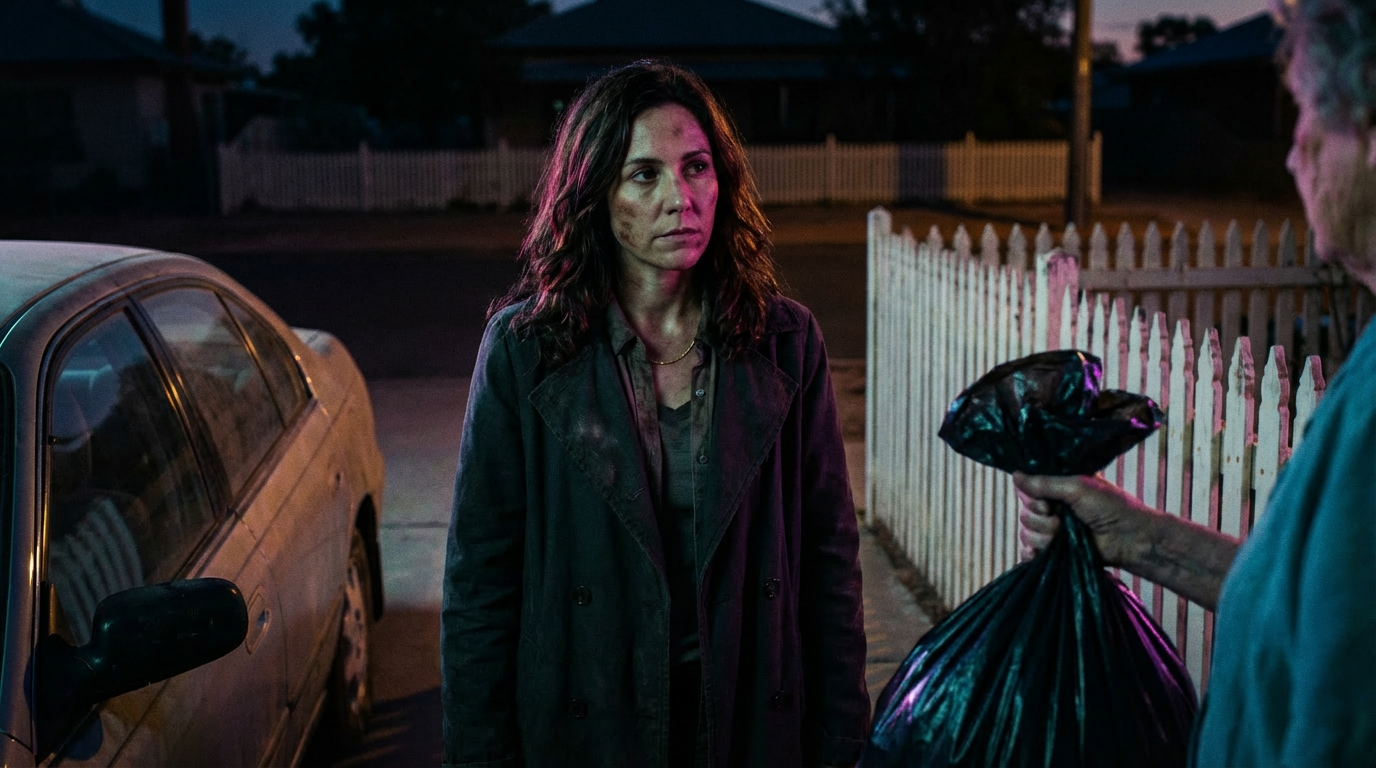
Claire makes it home, but the six metres between her car and the front door become the longest distance she's ever crossed — because Gertrude is at the fence with a bin bag and a full evening's worth of questions. What follows is the performance of Claire's life, delivered to an audience of one who notices everything, and the cold arithmetic of what happens when the curtain finally falls.
"Every performer knows the trick isn’t what you show the audience. It’s what you make them forget to look for."
Town.
I drove through it like a ghost through walls—present but not participating, occupying the same space as the houses and the streetlights and the people behind their curtains without being part of any of it. A woman at a bus stop, huddled in a coat. A man walking a dog. A teenager on a bicycle, no lights, swerving across the road with the casual immortality of youth. Ordinary lives in an ordinary town on an ordinary Thursday evening, and none of them knowing, none of them seeing, none of them aware that the woman in the car with the packed back seat and the blood on her hands had left her children in the dark.
I turned off the engine. Sat in the driveway for a moment, listening. Nothing. The street was quiet. No movement at Gertrude’s windows, no shape at the fence line. Just the tick of the cooling engine and the distant sound of a dog barking three streets over.
I got out. Closed the door softly. Kept my head down and walked towards the front door, my hands in my jacket pockets, my keys already between my fingers—six metres of gravel between me and safety, between me and the door I could close and lock and lean against while the darkness hid everything I was carrying.
Four metres. Three.
"Claire?"
The voice came from my left. From the fence line, from the darkness between our two properties where a shape was moving—resolving, as my eyes adjusted, into the thin upright figure of Gertrude Thompson stepping out from her side gate with a bin bag in one hand and her cardigan held closed at the throat with the other.
I stopped. Six metres from my front door. Six metres from safety, from the door I could close and lock, from the darkness inside that would hide everything I was carrying. My hands were in my pockets but the rest of me was exposed—my face, my hair, my torn trousers, whatever was visible in the thin wash of light from the streetlamp on the corner. I couldn’t turn back to the car. Couldn’t turn away without it looking wrong. Could only stand there, caught in the open, while Gertrude set down her bin bag and came to the fence.
"I thought I heard your car. I’ve been listening out for you."
Listening out. Of course she had. Of course Gertrude, who’d seen the car leave this afternoon, who’d noted the time and the direction and probably the expression on my face as I’d reversed out of the driveway, had been waiting for the sound of the engine returning, cataloguing the duration of my absence the way she catalogued everything.
She was at the fence now. Three metres from me. Close enough to talk, close enough to see the general shape of me in the dim light—but not close enough, I hoped, to see detail. Not the dirt on my face. Not the torn knee. Not the particular darkness under my fingernails that wasn’t dirt at all.
"Gertrude." I forced my voice into its social register. "What a surprise to see you out this time of evening."
The words came out steadier than I had any right to expect. My voice, or a version of it—the social version, the one that made small talk at school gates and thanked checkout operators and said lovely to see you to people it wasn’t lovely to see. The version that had been built, over years, for exactly this kind of moment. Not this exact kind—I hadn’t anticipated needing to make conversation with my neighbour while my parents’ blood dried on my skin—but the architecture was the same. Smile. Deflect. Perform.
"Oh, I’m sorry, dear. I didn’t mean to startle you." Her face was a pale oval in the darkness, her expression impossible to read. "I was just putting out the bins and I heard your car."
Putting out the bins. It was Thursday. The bins went out on Thursday night. A perfectly reasonable explanation that was also, I was certain, a perfectly constructed alibi for standing in her yard at dusk watching my house.
"Long day," I said, and started walking towards the front door, keeping the car between us for as long as possible, keeping my body turned slightly away. The distance between the car and the door was maybe six metres. Six metres of gravel and darkness and Gertrude’s eyes.
"You’ve been out since this afternoon. I noticed you’d packed the car—are you heading off tonight?"
Five metres.
"Not tonight, no. Just getting things sorted."
"The boot looked quite full. Are you still planning that trip to Queensland?"
Four metres.
"That’s the plan. Taking the kids up to see Amelia."
"How lovely. And they’re still at your mother’s, are they? The children?"
Three metres. The front door was close now. My keys were in my pocket—the same pocket as my left hand, which meant I’d have to take the hand out to get them, which meant the hand would be visible, which meant—
I stopped walking. Turned to face Gertrude. Kept my hands in my pockets.
"They’re having a wonderful time," I said. "You know how Mum spoils them. She’ll have them stuffed full of biscuits and pavlova by the time I pick them up."
The lie tasted like nothing. Like water. Like air. It came out of me with such ease that I wondered, briefly, whether I’d crossed some threshold—whether there was a point in the progression of catastrophe where lying stopped requiring effort and simply became the medium through which you moved, the way water is the medium through which a fish moves, invisible and essential and no longer worthy of notice.
"Dawn does love having them," Gertrude said. Her voice carried that particular warmth she deployed when she was settling in for a longer conversation—the warmth of a woman who had all evening and nowhere else to be and every intention of extracting the maximum amount of information from this encounter.
I needed to end this. Needed to get inside, get the blood off, get the door between me and those watching eyes. But leaving too abruptly would be worse than staying. Abruptness was suspicious. Abruptness was noted, recorded, filed away for later retrieval. She seemed in an awful hurry, Officer. Wouldn’t stop to chat. Not like her at all.
"She does," I said. "Dad’s been teaching Mack to play chess. Badly, mind you—Dad’s never been much good at chess—but Mack loves it."
Where was this coming from? The detail, the colour, the casual warmth of a daughter describing her parents’ relationship with their grandchildren? I was standing in my driveway inventing anecdotes about a man who was sitting dead in his armchair three kilometres away, and the words were coming out of me like music, like choreography, like a routine so well rehearsed that the body could execute it while the mind was somewhere else entirely.
"And Rose?"
"Rose is Rose. Bossing everyone around. She’s got Mum wrapped around her little finger."
Gertrude laughed. A soft, indulgent sound. "She’s a character, that one. Reminds me of you at that age."
"God help her, then."
Another laugh. I was winning. The performance was landing. Gertrude was relaxing into the familiar rhythm of neighbourly gossip, the tension in her posture easing, her grip on the cardigan loosening. This was the Gertrude I could manage—the one who wanted to chat, who wanted to feel included, who wanted the warm glow of being confided in. Not the Gertrude who watched from windows and noted headlights and filed discrepancies for later examination.
"You do look tired, Claire." The observation came casually, almost as an afterthought, but I felt its edges. "Are you sure you’re all right?"
"Just busy. You know how it is—packing, organising, trying to get the studio sorted before we leave. A thousand things to do and not enough hours."
"You’ve got dirt on your face, dear."
My stomach dropped.
"Have I?" I raised a hand halfway—the gesture of someone about to touch their own face—and then stopped, remembering. The hand went back into the pocket. "I was cleaning out the studio. Shifting boxes. You wouldn’t believe the dust in there."
"Hmm." Gertrude’s head tilted slightly. A bird-like movement. The movement of a woman whose bullshit detector was more finely calibrated than most people’s entire sensory apparatus. "The studio’s in quite a state, isn’t it? I noticed through the window."
That damn window, from the night I’d—the mirror, the glass, the dancing. Had that been two days ago? Three? Time had become unreliable, the days folding into each other like shuffled cards.
"I’m getting it fixed," I said. "After the trip."
A pause. Gertrude standing at the fence. Me standing at my front door. The space between us filled with everything she suspected and everything I couldn’t say and the particular quality of silence that exists between two women who both know the other isn’t being entirely honest.
Charlie broke it. A bark from the backyard—not alarmed, just a recognition bark, the sound she made when she heard familiar voices and wanted to be included. Then another bark. Then a whine, high and sustained, the sound of a dog who’d been alone all day and was reminding everyone within earshot of this fact.
"Oh, poor Charlie," Gertrude said. "She’s been crying on and off all afternoon. I gave her some water earlier—I hope you don’t mind."
"That’s kind of you. I should get her fed."
The pivot. The excuse I needed. Not a retreat from the conversation but a reason to end it naturally—a domestic task, a responsibility, the kind of mundane obligation that even Gertrude couldn’t argue with. I turned to the door, got the key out of my pocket in the shadow of my own body, unlocked it. The hallway opened in front of me, dark and safe.
"I’ll let you go, then," Gertrude said, but she didn’t move from the fence. Still watching. Still cataloguing.
"Night, Gertrude."
I stepped inside. Closed the front door. Leaned against it for three seconds—just three, just enough for one full breath—and then I was moving. Down the hallway, through the kitchen, into the laundry where Charlie’s food was kept in a plastic bin beside the washing machine. I scooped kibble into the bowl in the dark, working by feel, and opened the back door.
Charlie was there instantly, her body wriggling against my legs, her tail beating, her whole being vibrating with the uncomplicated joy of a creature whose needs were simple and whose capacity for forgiveness was total. She pushed her nose into my hands as I set the bowl down and I pulled them away—too fast, too sharp, the instinct to hide what was on them overriding even the comfort of a dog’s greeting.
"Good girl," I said. Loud enough. Loud enough for the woman I could hear shifting on the other side of the fence, her slippers on concrete, still there, still listening. "There you go."
I filled the water bowl from the outdoor tap. Ran the water hard, let it splash, let the sound carry. Performance. All of it. Every gesture calculated, every action staged for the audience of one who stood on the other side of the fence in her cardigan and her slippers.
"She sounds happy," Gertrude called over. "Poor thing’s been lonely."
"She’ll be right now."
"Well. Get some rest, dear. You’ve got a big drive ahead of you."
"I will. And thanks again for keeping an eye on her."
"Any time. That’s what neighbours are for."
I heard her slippers on concrete. The sound of her back door opening, closing. The click of a lock being turned. Then silence—real silence, not the performed silence of two people pretending the conversation was over while one of them was still watching.
I waited. Counted to thirty. Charlie sat at my feet, crunching kibble, oblivious. Then I stepped back inside, closed the laundry door, and stood in the darkness with my hands finally out of my pockets and pressed against my face and my whole body shaking—not gently, not the manageable tremor of controlled fear, but violently, convulsively, the full-body shudder of an animal that has just narrowly escaped a predator and is processing the fact of its own survival.
She didn’t see. She didn’t know. She saw a tired woman with a dirty face, not a woman with her mother’s blood under her fingernails. She heard a daughter talking about her parents, not a daughter who’d left them both dead in a lounge room. She noticed the packed car and the dirt and the fatigue and she filed it all under Claire’s going to Brisbane and that was the story, that was the narrative, and it would hold. It had to hold.
I found the light switch. The laundry appeared—the washing machine, the basin, the shelf of detergent and fabric softener. Normal things. Clean things. Things that belonged to the life I’d lived this morning, before.
I turned on the tap. The water ran cold—the pipes in this house took forever to warm, and I put my hands under it and watched the water run red.
Not bright red. Not the vivid arterial red of the floor at Dawn’s house. Darker, muddier—the blood mixed with dirt and soot, diluting as the water carried it away, the colour fading from red to brown to pink to something almost clear but not quite, a faint tint that might have been iron in the water or might have been the last traces of my mother leaving my skin.
I scrubbed. With soap, with the nail brush I kept by the basin, with the rough side of a kitchen sponge when the nail brush wasn’t enough. Under my nails. Between my fingers. The creases of my knuckles, where the blood had settled deepest, where the whorls and ridges of my skin had trapped it like sediment in a riverbed.
My hands turned raw. Red—a different red now, the red of abraded skin, of scrubbing too hard, of trying to remove something that had gone deeper than the surface. I kept going. The nail brush catching on the cuts from the corrugated iron, reopening them, fresh blood mixing with water and soap and running down the drain. I watched it go and thought of Dawn’s blood on the lounge room floor, spreading, soaking into the fibres of the carpet. Of Greg’s blood on the wall behind his chair, that terrible dark pattern. Of the blood that was probably still there now, in that house, in those rooms, while I stood in my laundry and scrubbed and scrubbed and the water ran and ran.
I stripped off my clothes. The jacket first—dark enough to have hidden the worst, but when I held it under the light I could see the marks. The trousers, torn and smeared. The shirt, which had seemed clean until I looked and saw the dark line at the cuff where my mother’s blood had seeped up from my hands. Everything went into the machine. Hot wash. Extra detergent. The machine humming to life, doing what machines do—processing evidence into laundry, turning catastrophe into a domestic chore.
I stood in the laundry in my underwear, under the fluorescent light, and looked down at myself. Bruises I didn’t remember getting—a dark one on my shin from Greg’s footrest, another on my forearm from the struggle, from the gun, from the moment our four hands had been locked around the same weapon. Scratches on my legs from the scrub. The cut on my palm from the corrugated iron, reopened and raw. And everywhere, on every surface of exposed skin, the fine red-brown dust of the outback mixed with something darker, something that wasn’t dust at all.
I needed to shower.
The thought arrived with the flat authority of common sense. Of course I needed to shower. The blood was evidence. On my hands, my arms, my knees where I’d knelt on the lounge room floor—every trace connecting me to that house, that room, that gun. Every minute it stayed on my skin was a minute closer to discovery.
I walked to the bathroom. Turned on the water. Stood beside the shower screen with my hand under the stream, feeling the temperature climb from cold to warm to hot, watching the steam begin to rise.
Then I looked at my hands.
The water had caught them—the outstretched fingers that had been testing the temperature. Droplets running between my knuckles, loosening the dried blood, carrying it away in thin rivulets that traced the lines of my palms. My mother’s blood. Leaving my skin. Dissolving, diluting, flowing towards the drain where it would mix with soap and shampoo and every other mundane fluid of a mundane life and be gone.
I pulled my hands out of the water.
I turned it off.
I don’t know what to call the thing that made me do it. The impulse that came from somewhere deeper than thought, deeper than reason, and closed my fingers into fists and drew them against my chest. It wasn’t rational. I knew it wasn’t rational. The practical part of my brain—the part that had performed for Dr Price, for Gertrude, for every person I’d needed to deceive—was screaming at me. Wash it off. Get rid of it. You cannot carry this into tomorrow.
But I couldn’t.
Her blood was still on me. Under my nails, in the creases of my knuckles, in the fine lines that mapped my palms. Not a memory. Not words, not directions to a property where my children weren’t waiting. Those were already fading, already becoming unreliable, already losing their edges the way everything does once it passes from the present into the past. But this was physical. Actual. The substance of her body pressed into the substance of mine. The most intimate thing she had ever given me—more intimate than birth, than breastfeeding, than any of the careful, rationed gestures of affection Dawn Clift had permitted herself across all her years of motherhood. In death she had given me more of herself than she ever had in life, and it was on my hands, and I was not ready for it to go down the drain.
I got dressed over the top of it. Track pants pulled over legs still streaked with outback dirt. Jumper pulled over arms still marked with whatever the evening had left on them. Clean clothes on dirty skin. The costume of a woman at home on a winter evening, layered over the body of a woman who had held her mother while she died and was not yet willing to wash that away.
I caught myself in the bathroom mirror as I pulled my hair back. The face was presentable—Gertrude had already seen it dirty, so the remaining smudges were consistent, expected. But below the neckline, hidden by the jumper’s collar, by the sleeves pulled down over my wrists, was everything I was carrying. My mother. My father’s house. The lounge room floor. The gun.
I wore them like a secret garment. Like a hair shirt. Like the thing underneath the thing that no one sees.
The house settled around me. The familiar sounds—the fridge humming, the hot water system clicking, the particular creak the floorboards made near the kitchen doorway. Paul’s coffee mug was still broken on the floor. The blanket was still twisted on the couch. Nothing had moved. Nothing had changed. The house had been waiting for me, preserving itself in amber, a perfect diorama of the life I’d walked out of this afternoon.
I tried to eat. Made toast. Stood at the kitchen bench with the plate in my hand and looked at it and put it down and picked it up and took one bite and put it down again. The bread was dry in my mouth, impossible to swallow, my throat closing against it as though my body had decided that food was a luxury it could no longer afford to process.
Tea, then. I filled the kettle. Waited for it to boil. Poured the water over a tea bag and watched the colour bloom and thought about the mug of cold tea on Dawn’s kitchen table, the skin of milk on its surface, the toast crusts beside it. Small crusts. Children’s crusts.
I poured the tea down the sink.
The lounge room. I sat on the couch—Paul’s end, not mine, because mine felt wrong tonight, because everything about my usual place in this house felt wrong, as though the coordinates of my life had shifted by a few degrees and nothing lined up anymore. The television stared at me, blank and dark. I didn’t turn it on. Couldn’t bear the thought of sound—of voices, of music, of the manufactured drama of whatever was on at this hour, people pretending to have problems that could be resolved in forty-five minutes plus advertisements.
My phone was on the coffee table. I picked it up. The screen lit—no missed calls, no messages. Paul’s silence, which had been the crisis a few hours ago, was now so far down the hierarchy of catastrophes that it barely registered. Paul hadn’t called. Paul wasn’t coming.
I put the phone down. Picked it up again. Stared at the screen.
I could call someone. Amelia. Tell her—what? I’m in trouble. I’ve done something. The children are lost. Amelia would ask questions. Would tell me to call the police. Would be on the phone to the police herself within minutes if I told her even half of what had happened, because Amelia was sensible and responsible and not the kind of person who understood that sometimes calling the police was the one thing you absolutely could not do.
I could call the police myself. Report the children missing. But the moment they found Dawn and Greg—
The bodies.
The thought I’d been holding at arm’s length all evening, the thought I’d kept in my peripheral vision without looking directly at it, finally pushed its way to the centre.
Two bodies in a house on the other side of town. My father with a bullet in his head. My mother with a bullet in her stomach. The gun on the floor between them, covered in my fingerprints. My shoe prints on the carpet, the dirt, the lino. I’d touched everything. Moved through every room. Left evidence of my presence on every surface like a signature I couldn’t erase.
How long before someone found them?
I had a day. Maybe two. Before the house became a crime scene and the questions started and the police began looking for the daughter who’d been in hospital earlier that week, the daughter whose marriage was falling apart, the daughter who’d been heard screaming at her husband on Monday night by the neighbours.
The daughter who was the last person to see either of them alive.
I pulled my knees up to my chest. Wrapped my arms around them. The couch was cold—the heating hadn’t been on all day, the house holding the winter chill in its walls and its floors and its furniture like a cellar holds temperature. I should turn the heating on. Should get a blanket. Should do any of the small, practical things that would make this night survivable.
Instead I sat in the cold and I thought.
Tomorrow. First light. Back to the property. But not the same approach—different roads, different tracks. Dawn said she’d driven the children there this morning, which meant there was a route she’d taken, a road she’d followed, and if I could find that road I might find what she’d found, or what she’d missed, or the point where her memory had failed and she’d left the children somewhere other than where she’d intended.
And if they weren’t at the property—if they’d walked, if they’d gone looking for help, if Mack had decided to try to find the road—then I needed to search wider.
And while I searched, the clock would be ticking. On the bodies. On the discovery. On the moment when Claire Smith stopped being a woman going through a difficult time and became a suspect.
I needed to find them tomorrow. Not the day after. Not eventually. Tomorrow. Before anyone walked through that unlocked front door and found what I’d left behind.
The washing machine beeped from the laundry. Cycle finished. My clothes, cleaned. The blood removed. Evidence processed.
I didn’t get up.
I sat on the couch in the dark house with the cold pressing in and the washing machine beeping and Charlie scratching at the back door and my children somewhere out there in the night and I stared at nothing and I planned.
Tomorrow. Everything depended on tomorrow.







